

You can do the necessary thing, receive sincere gratitude, and still be blamed when the consequences become painful. At that point, two temptations appear: chase the lost approval, or dismiss everyone who has turned against you.
Krishna’s experience in Mathura offers a harder and more useful discipline. Public opinion can reveal where people are hurting, but it cannot decide what dharma requires. You have to separate the justice of an action, the consequences that follow it, and the reputation of the person who acted.
Mathura’s praise was sincere, but it was not a moral compass

Kamsa had terrorised Mathura, imprisoned Devaki, and killed her children. When Krishna killed Kamsa and ended his rule, the people had good reason to celebrate. Their relief was real. Krishna had removed the oppressor whom they had been unable to remove themselves.
But gratitude rooted in immediate relief is vulnerable to immediate fear. When Jarasandha’s attacks placed Mathura under recurring danger, the public question changed. People were no longer asking only, “Who freed us from Kamsa?” They were also asking, “Why are we suffering now?” Yesterday’s deliverer could therefore be recast as today’s liability.
This is the first thing to notice whenever public sentiment turns: the crowd may be answering a different question without admitting that the question has changed. The end of Kamsa’s tyranny and the danger created by Jarasandha were both part of Mathura’s experience. The later danger did not make the earlier liberation unjust. Nor did the justice of Krishna’s action make the people’s danger imaginary.
Keep those truths separate in your own disputes. Ask, “Was the original action right?” Then ask, “What burden followed, and who now has a duty to address it?” If you combine the questions, suffering becomes proof that the action was wrong. If you ignore the second question, good intentions become an excuse for careless leadership.
Jarasandha exposes the difference between causing and preceding harm
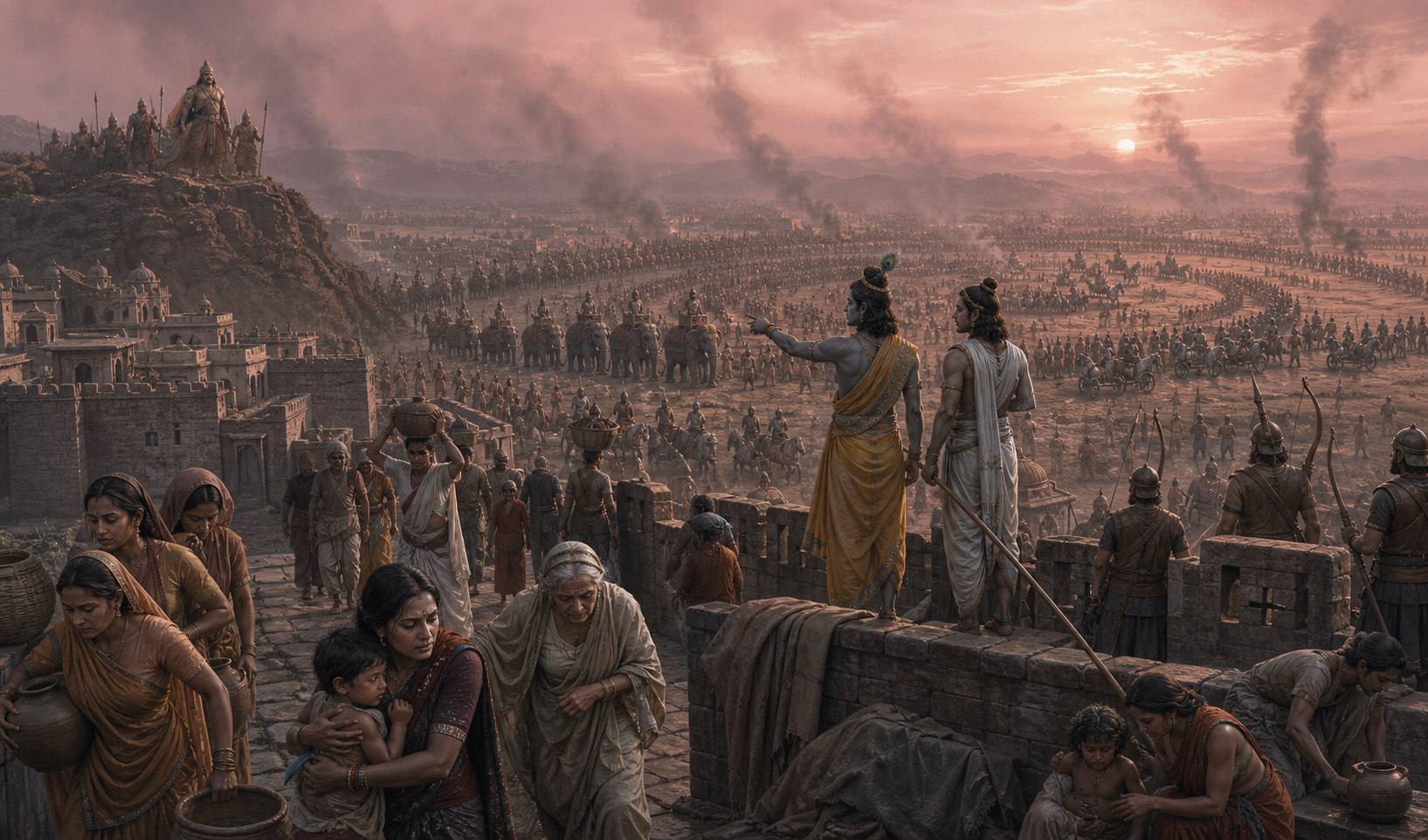
An aggressor’s retaliation often produces a convenient accusation: if you had not resisted, the aggressor would not have struck. The statement may describe a sequence, but it does not settle moral responsibility. Krishna’s action against Kamsa preceded Jarasandha’s aggression. Jarasandha, however, remained the agent who chose aggression.
This distinction matters far beyond Mathura. A person who exposes wrongdoing may be blamed for the conflict that follows. A community that refuses intimidation may be blamed for provoking its intimidator. A leader who confronts an entrenched threat may be blamed for the threat’s response. In each case, the visible reformer is easier to accuse than the hostile actor who made retaliation a weapon.
Yet “the aggressor chose this” cannot be the end of responsible leadership. If resistance predictably places others in danger, dharma also demands preparation, protection, and an honest accounting of costs. Moral innocence and practical responsibility are not opposites.
Use four tests before assigning blame:
- Agency: Who deliberately chose the harmful act? Do not transfer that agency merely because another person’s action came first.
- Foreseeability: Could the retaliation or disruption reasonably have been anticipated? If so, ask what preparation was made.
- Duty: Who had responsibility for protecting the people bearing the cost, even if that person did not create the threat?
- Alternatives: Was there another course that could have upheld the same principle with less danger, or would avoidance merely have preserved the original injustice?
These tests prevent two equally serious errors. You do not absolve Jarasandha by blaming Krishna for being opposed to him. You also do not turn Krishna into an excuse for every leader who claims righteousness while leaving others to absorb an avoidable cost.
Protect people without making reputation the mission

The traditional arc from Mathura to Dvaraka sharpens the lesson. Krishna did not need to keep a vulnerable population in danger merely to preserve the appearance of standing his ground. Moving the Yadava community away from Jarasandha’s pressure could look less heroic than a dramatic confrontation, but leadership is measured by what it safeguards, not by how impressive it appears.
Retreat and cowardice are not synonyms. A withdrawal can abandon duty, but it can also deny an aggressor access to the people being used as leverage. The moral question is not whether an action looks bold. It is whether the action protects what should be protected while preserving the capacity to confront adharma effectively.
This is where public fickleness becomes dangerous. A leader addicted to applause may choose the most theatrical response because a quieter strategy looks weak. The public then pays the price of the leader’s reputation management. Krishna’s example points in the other direction: accept the possibility of insult when the safer, more strategic course serves the community.
If approval has turned into accusation around a decision you must make, work through this sequence:
- Name the dharmic obligation. State what must not be sacrificed: truth, protection of the innocent, fidelity to a promise, or resistance to injustice.
- Name the people carrying the risk. Do not hide them inside words such as “community” or “stakeholders.” Identify whose safety, livelihood, trust, or stability is actually exposed.
- Separate strategic cost from reputational cost. A plan that harms your image may still protect the people. A plan that restores your image may place them in greater danger.
- Respond to the concrete grievance. If people lack safety or clear information, address that deficiency. You can correct a failure without accepting a false account of who caused the threat.
- Review the decision after the immediate pressure passes. Ask what you failed to anticipate, what remains outside your control, and what must change before the next test.
This approach neither worships the crowd nor treats it with contempt. Fear can distort public judgment, but fear also tells a leader where protection has failed or where an explanation has not reached the people who need it.
Use the story to examine your own side as rigorously as the other
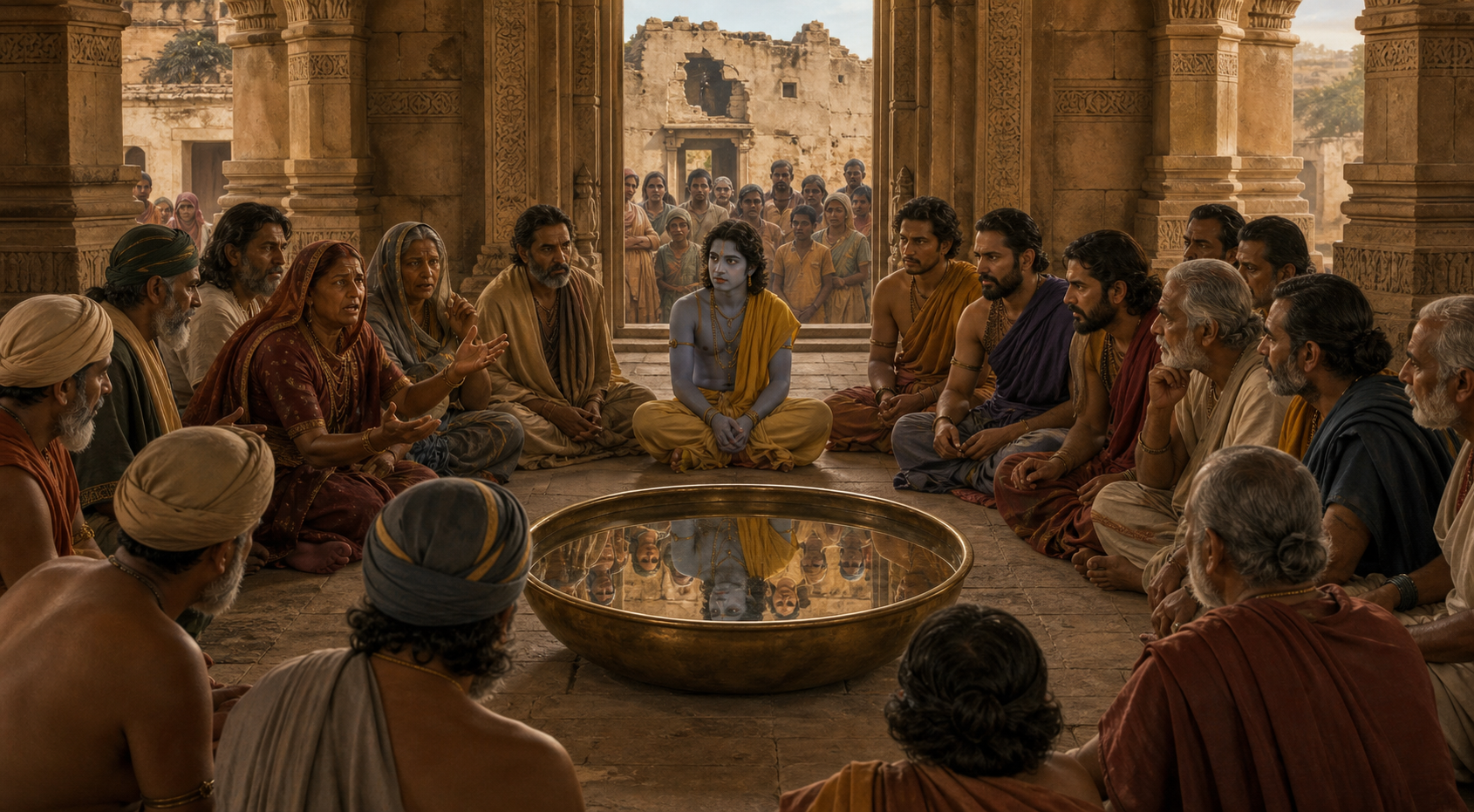
It is easy to identify with Krishna and assign the role of Jarasandha to anyone opposing us. That is precisely where a dharmic teaching can be reduced to political decoration. A sacred analogy should discipline your judgment, not exempt your preferred person or group from scrutiny.
When you are part of the public, pause before joining either the praise or the denunciation. Ask what changed between the two reactions. Did new evidence appear, or did discomfort merely replace relief? Is criticism directed at a genuine failure of protection, or is it transferring responsibility from the aggressor to the person who resisted? Would you apply the same standard if the leader belonged to another camp?
Also resist the opposite mistake: calling every criticism “fickleness.” People are allowed to revise a judgment when conduct changes or hidden facts become clear. Constancy is not blind loyalty. The relevant distinction is between principled reassessment and a mood governed only by the latest benefit or pain.
A mature community therefore does three things at once. It remembers the original injustice, acknowledges the present cost, and assigns responsibility according to agency and duty. This prevents gratitude from becoming hero worship and hardship from becoming scapegoating.
The same standard belongs in family conflicts, community organisations, public advocacy, and politics. Do not ask only whether a person is popular or whether a decision produced pain. Ask whether the person acted justly, anticipated consequences, protected those placed at risk, and changed strategy when protection required it.
Key takeaways
- Public praise often reflects immediate relief, while public blame often reflects immediate pain. Neither reaction alone determines what is right.
- An aggressor remains responsible for choosing aggression, even when another person’s just action preceded the retaliation.
- A right action can still create a serious duty to anticipate danger and protect those who will bear its consequences.
- Listening to fear does not require accepting a false accusation, and rejecting scapegoating does not justify ignoring real suffering.
- A strategic withdrawal may serve dharma better than a dramatic stand taken mainly to preserve appearances.
- Use Krishna’s example to test leaders you support, not merely to condemn people you already oppose.
The next time applause turns into blame, write down four headings before you react: agency, foreseeability, duty, and alternatives. Place each fact under the right heading. That small act will help you hear legitimate criticism without surrendering your judgment to the crowd’s latest mood.
References
