
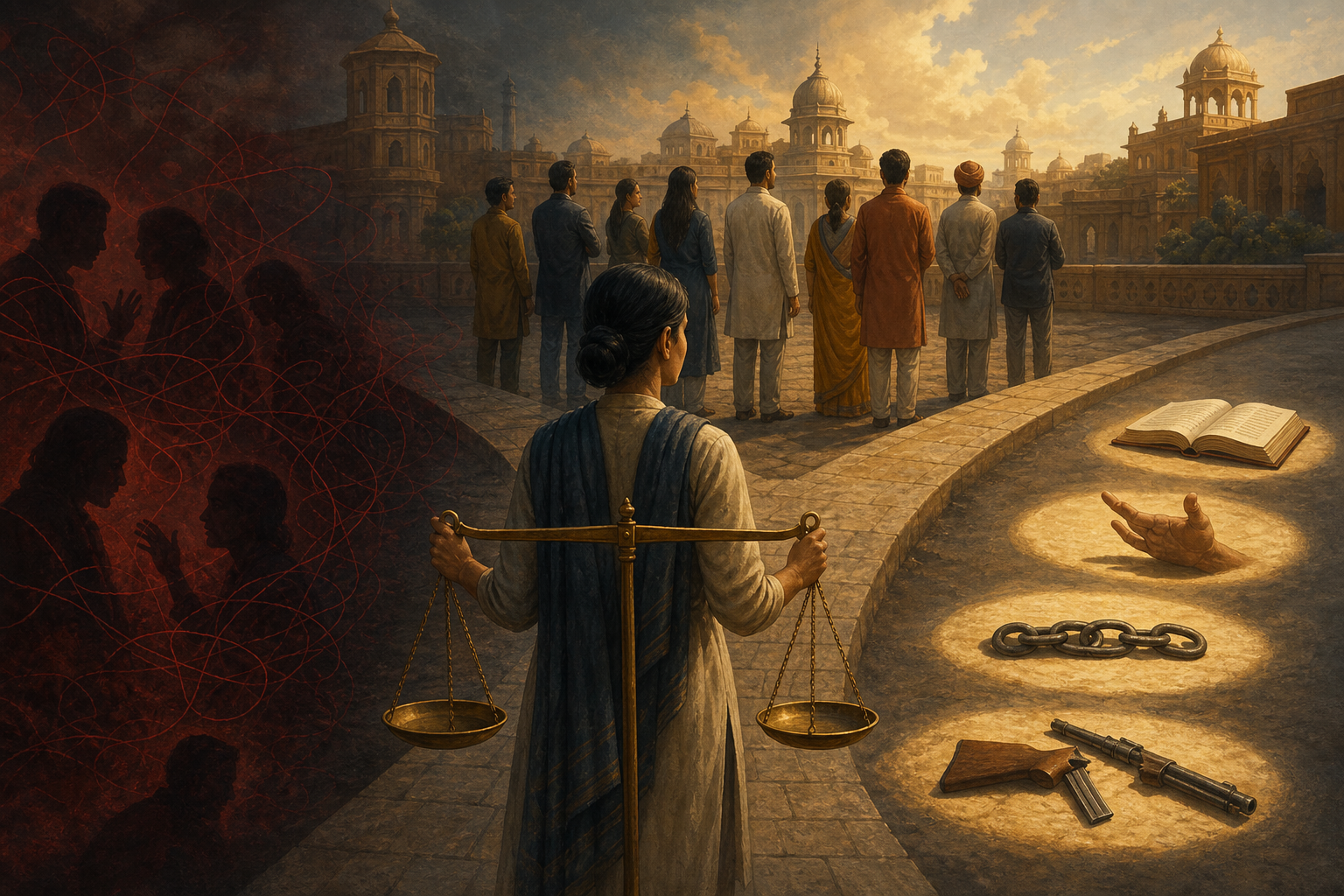
If you hear “dimagi Naxal” applied to a professor, journalist, activist or political opponent, you face a choice before you repeat it. Does the label identify a real relationship to Maoist violence, or does it merely turn disagreement into suspicion?
You do not have to dismiss the danger of ideological support networks in order to demand evidence. Nor do you have to defend every critic of the state in order to reject guilt by association. The useful position is harder and more Dharmic: oppose coercive ideology firmly, distinguish thought from action, and name each person’s conduct accurately.
What the phrase is designed to make you notice
Narendra Modi brought the phrase into his 2026 Independence Day address from Red Fort. In this usage, “dimagi Naxal” means a Maoist in the mind: not necessarily an armed cadre, but a person alleged to carry Maoist ideas into academia, media, policymaking or public debate.
The phrase belongs to the same rhetorical method as “Shehzada,” “andolanjeevi” and “Khan Market gang”. Each name compresses an argument into a memorable identity. Instead of making listeners reconstruct a network of interests, assumptions and institutional influence, the label gives them a character they can recognise immediately.
That compression is why political nicknames travel. It is also where the danger begins. A slogan can alert you to a pattern, but it cannot prove that a named person belongs to that pattern.
Supporters of the expression present it as the next stage of a conflict in which militant Naxalism has suffered major security reverses, including in Chhattisgarh. Their central contention is that defeating armed formations does not automatically defeat the ideas, narratives and institutional sympathies that can legitimise them.
That contention should not be waved away. Violent political movements can seek intellectual respectability, sympathetic language and institutional protection. But an allegation about an ideological ecosystem still has to resolve into an evidence chain: a named actor, a specific statement or action, a demonstrated connection to Maoist doctrine, a relationship to coercion, and an identifiable consequence. If those links are missing, the phrase is doing the work that evidence should do.
As used in this debate, “dimagi Naxal” is a political label, not a self-executing legal finding. A weapon, threat, recruitment effort or concrete act of assistance can be investigated. A presumed mental allegiance is inferred. The less observable the accusation becomes, the more disciplined your standard of proof must be.
Keep four different kinds of conduct separate

Most misuse begins when several distinct categories are collapsed into one. Before deciding whether the rhetoric fits, place the conduct in the narrowest category the available facts support.
- Participation in or concrete assistance to violence. This concerns observable involvement in coercive activity: directing, enabling or materially assisting violent operations. Evidence of such conduct deserves investigation through due process.
- Explicit advocacy or moral justification of Maoist violence. A person may not participate directly yet openly praise killing, excuse coercion or portray insurgent violence as an acceptable political instrument. Critique the exact words and show their context.
- Revolutionary ideology pursued through peaceful activity. A person can hold ideas you consider destructive, anti-national or profoundly mistaken while using debate, scholarship, elections or lawful protest rather than violence. That person can be challenged vigorously without being treated as an armed participant.
- Ordinary democratic dissent. Criticism of the government, development policy, nationalism or a constitutional interpretation is not by itself evidence of Maoist allegiance. The substance may be unfair, selective or false, but those are separate claims that need their own proof.
The second category is often the most important in public argument. Open apologetics for political violence should not receive a free pass merely because they appear in polished academic or journalistic language. Yet even here, precision matters. Saying that a speaker justified a particular violent act is stronger and more verifiable than claiming access to the speaker’s mind.
The third and fourth categories are where overreach commonly occurs. Reading Maoist texts, interviewing insurgents, teaching revolutionary theory or sharing a platform with a radical does not establish endorsement. Association may justify a question; it does not supply the answer.
Dharma asks for viveka, the discrimination that separates things which look alike but are not the same. It also asks for satya. Neither principle requires softness toward violent politics. They require correct naming. A false negative can give coercive ideology cover; a false positive can impose reputational punishment on an innocent dissenter. Serious citizens guard against both errors.
Use this five-question test before repeating the label

When the term appears in a speech, television debate or social-media post, do not begin by asking whether you like the accused person. Work through these questions instead.
- What exactly did the person say or do? Find the full sentence, speech, essay, decision or transaction. Record its date and setting. A clipped video, paraphrased accusation or screenshot without context is not enough.
- What is the demonstrated connection to coercion? Look for explicit praise of violence, advocacy of violent methods, recruitment, operational assistance or another concrete nexus. Anger at the state, sympathy for a community or opposition to a policy does not establish that connection.
- Is the conclusion direct, or does it depend on association? Separate the person’s own position from that of an author they cited, a guest they interviewed, a colleague they defended or an organisation that later endorsed them. Show each link instead of assuming it.
- Does the person accept peaceful and democratic correction? Someone who treats elections, courts, public reasoning and non-violent protest as legitimate operates differently from someone who presents armed coercion as the decisive political path. The distinction does not make every democratic argument sound; it identifies the method being used.
- Can you describe the problem more precisely? If the conduct is factual distortion, selective outrage, revolutionary romanticism or explicit justification of violence, say exactly that. A narrower description gives your reader something testable; a sweeping identity label gives them a conclusion to inherit.
Then apply a role-reversal check. Would you accept the same standard if it were used to connect a Hindu scholar, temple organisation, Sikh institution, Buddhist association or Jain activist to an extremist who cited similar language? If not, your standard is political loyalty rather than evidence.
A simple decision rule follows. If the case contains nothing beyond unpopular or hostile speech, do not present the label as a factual classification. If someone explicitly defends Maoist coercion, quote the relevant words and explain why they amount to a defence. If there is evidence of material involvement, preserve the underlying facts and let competent authorities determine legal responsibility.
The same discipline should govern claims about institutional capture. Ask which institution, which appointment or decision, which actor, which ideological proposition and which measurable effect are at issue. “The ecosystem controls academia” is too broad to test. “This decision adopted this proposition after these actors promoted it” is a claim that can be examined.
Key takeaways
- “Dimagi Naxal” shifts attention from armed cadres to alleged ideological influence in institutions and public discourse.
- The possibility of ideological support for violence is real enough to investigate, but the label itself proves nothing about a named person.
- Separate participation in violence, justification of violence, peaceful revolutionary ideology and ordinary democratic dissent.
- Demand an evidence chain that connects the actor, conduct, ideology, relationship to coercion and claimed consequence.
- Use the narrowest accurate description. Precision makes criticism harder to dismiss and protects innocent people from guilt by association.
The next time you encounter the phrase, rewrite the allegation in one sentence without using it. Describe only the observable conduct. If the sentence still establishes advocacy or assistance for coercion, you have a serious case to examine. If it shrinks to “this person criticised the government” or “this academic discussed a radical text,” do not inflate disagreement into insurgency.
Bharat needs the capacity to defeat political violence and the confidence to hear criticism. A Dharmic public culture can defend both national cohesion and truthful judgment. Use slogans as alerts, if you find them useful, but let evidence decide whom they actually describe.
References
