
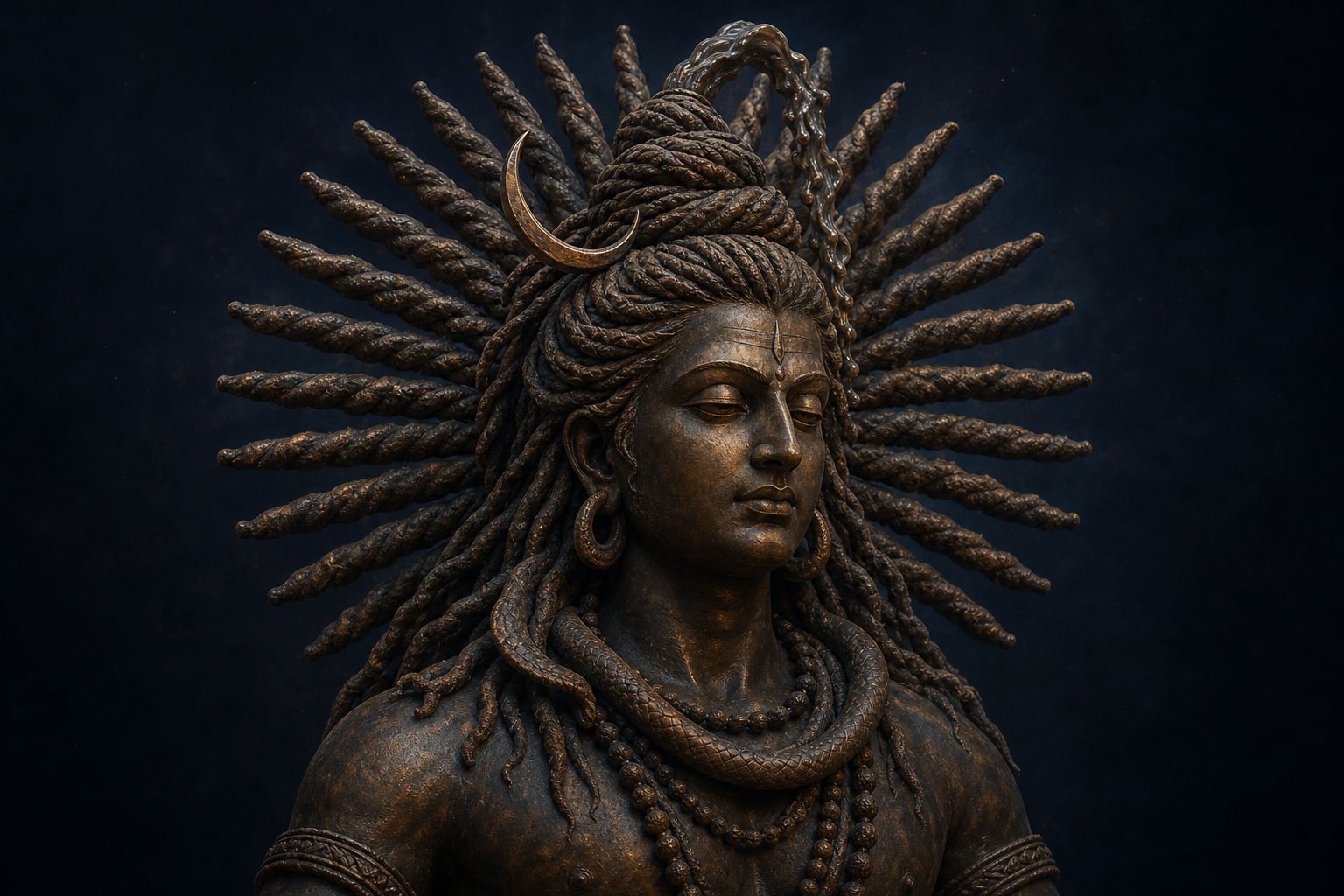
You are looking at an image of Shiva, and the hair seems to fan out around the head. Is it a halo, a crown, a sign of violent motion, or simply an artistic flourish? That small uncertainty matters because the hair changes how you read the entire form.
Once you know what to look for, the jata mandala becomes one of the clearest meetings of ascetic discipline, divine energy and cosmic order in Hindu iconography. You do not need to memorise a catalogue of symbols. You need to distinguish hair from the forms around it, notice how it has been arranged, and relate that arrangement to the deity’s face and posture.
First establish that you are looking at radiating hair
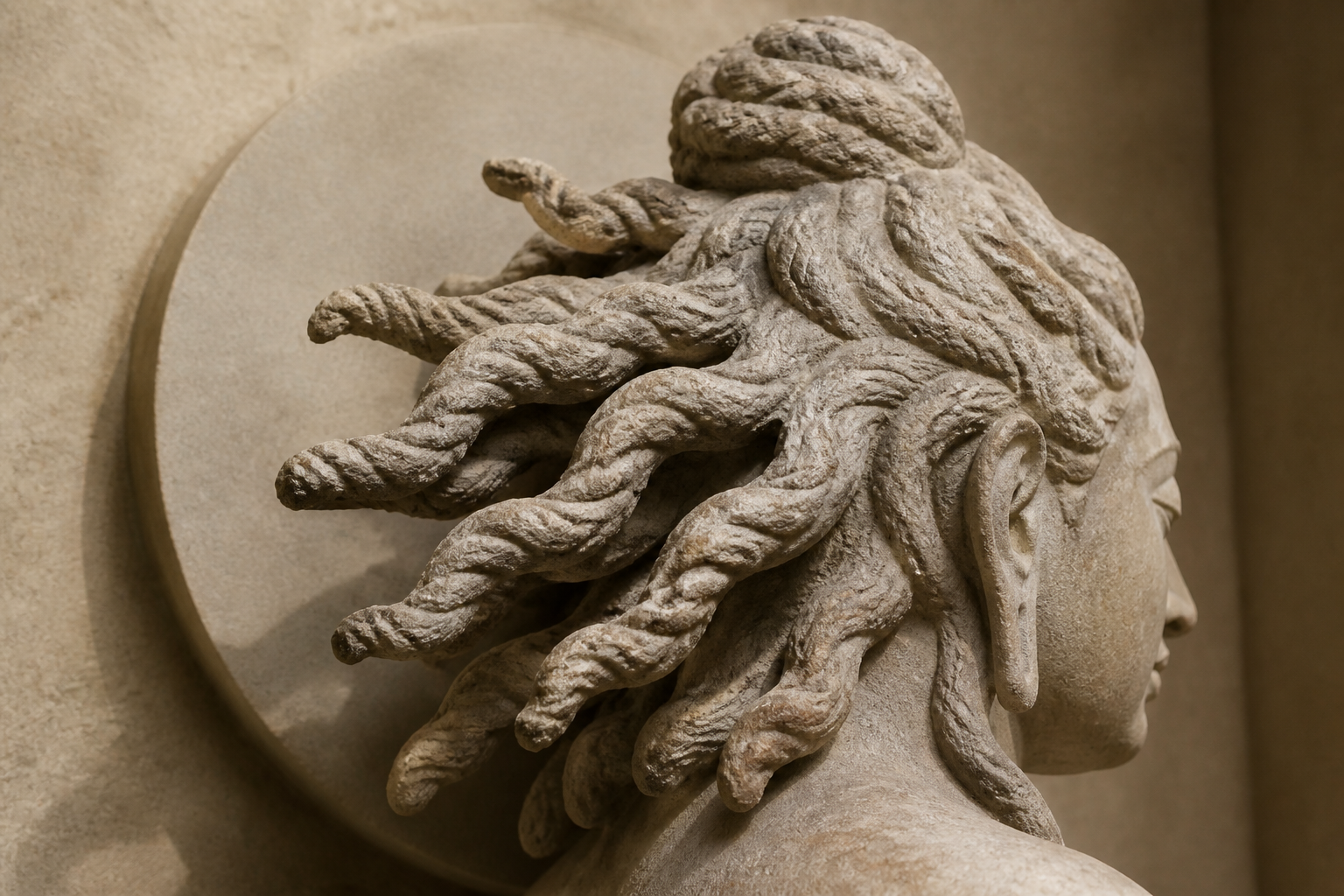
The compound gives you a practical recognition rule. Jata means matted locks, while mandala indicates an ordered circular or radiating formation. A jata mandala is therefore not a separate object worn behind the head. It is the deity’s matted hair arranged as a radiating, halo-like crown.
Begin with the material represented by the sculptor or painter. Do you see individual locks, parallel ridges, curling strands or bands that visibly emerge from the head? If so, you are probably looking at hair. A smooth disk, an unbroken ring or a clearly separate plate behind the head belongs to another part of the composition, even when its outline resembles the hair.
- Jata mandala: matted locks spread outward, around or behind the head, creating a radiating field.
- Jata-mukuta: matted locks are gathered predominantly upward into a high, crown-like mass.
- Royal crown: the headgear reads as a constructed ornament rather than hair growing from the body.
- Prabhamandala: a luminous disk or halo appears behind the head as a distinct element.
These forms can appear close together, and an image may combine more than one of them. Do not decide from the outer silhouette alone. Trace the lines back toward the scalp. If they remain recognisable as locks, the hair itself is doing iconographic work.
The word mandala also does not require a mechanically perfect circle. In sculpture, the locks may curve, rise, fall or spread unevenly because the figure occupies a particular pose. What matters is the organising idea: the hair expands from the head into a surrounding field.
Why an ascetic’s hair becomes a cosmic crown
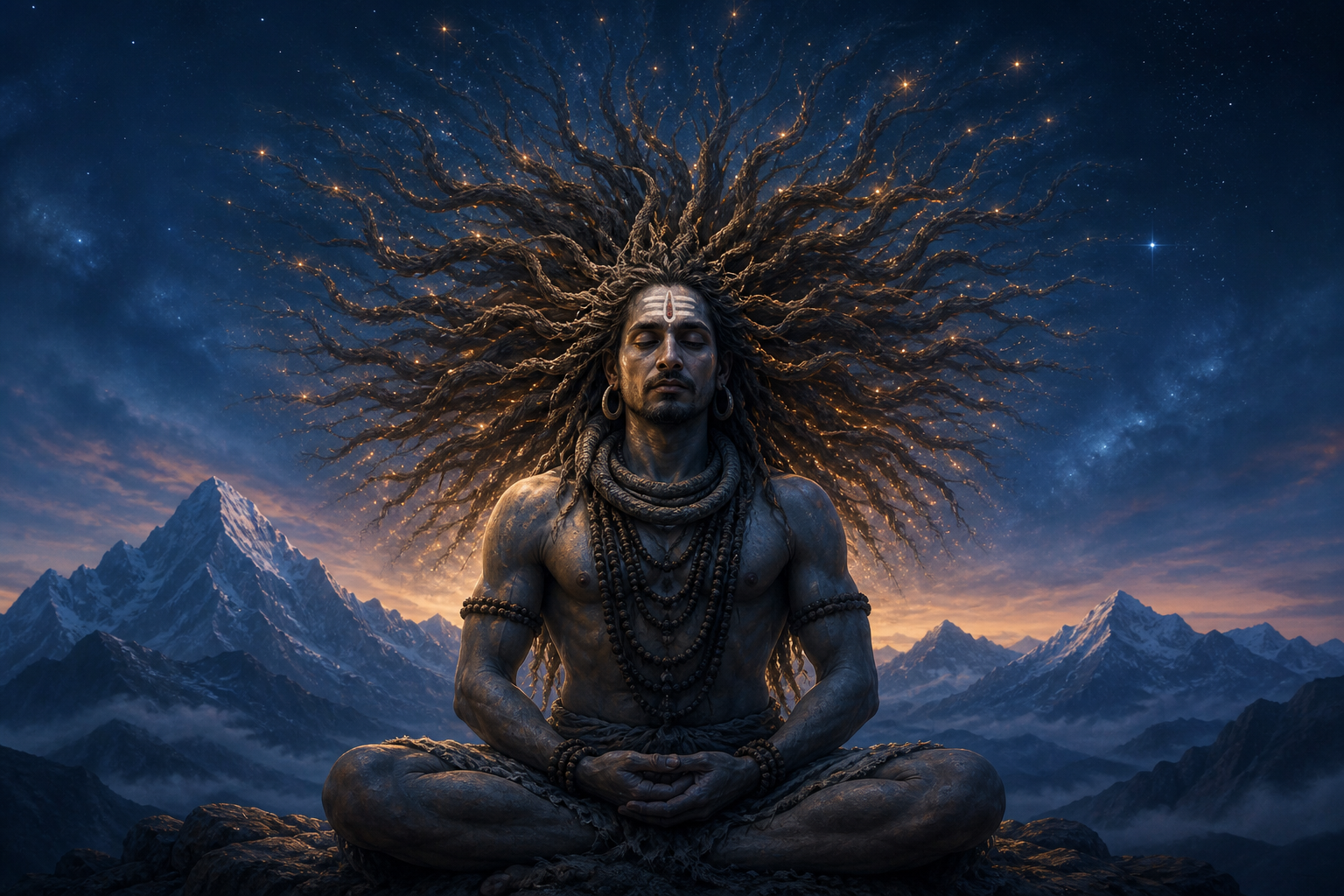
Matted hair first identifies an ascetic mode of being. It directs your attention away from courtly grooming and social display toward restraint, inwardness and spiritual discipline. This is why it should not be dismissed as untidiness. In the icon, the locks are deliberate. Their visible order is part of their meaning.
The mandala arrangement then enlarges that ascetic sign. What could have remained a compact bundle of hair occupies the space around the deity’s head. The body of the yogi and the wider cosmic field are no longer visually separate. Ascetic power does not remain hidden or inert; it radiates.
This produces a characteristic tension in Shaiva imagery. The face may communicate composure while the locks communicate immense movement. The deity is not being overwhelmed by that movement. The still centre governs the expanding form. You can therefore read the jata mandala as controlled potency rather than uncontrolled agitation.
The comparison with a royal crown sharpens the point. A conventional crown signifies rank through an object placed upon the head. The jata mandala grows from the deity’s own form. Its authority comes from realised discipline and intrinsic power, not from an external badge of office. Its halo-like shape can suggest radiance, yet that radiance remains embodied in the ascetic locks.
Read the locks in relation to the whole image
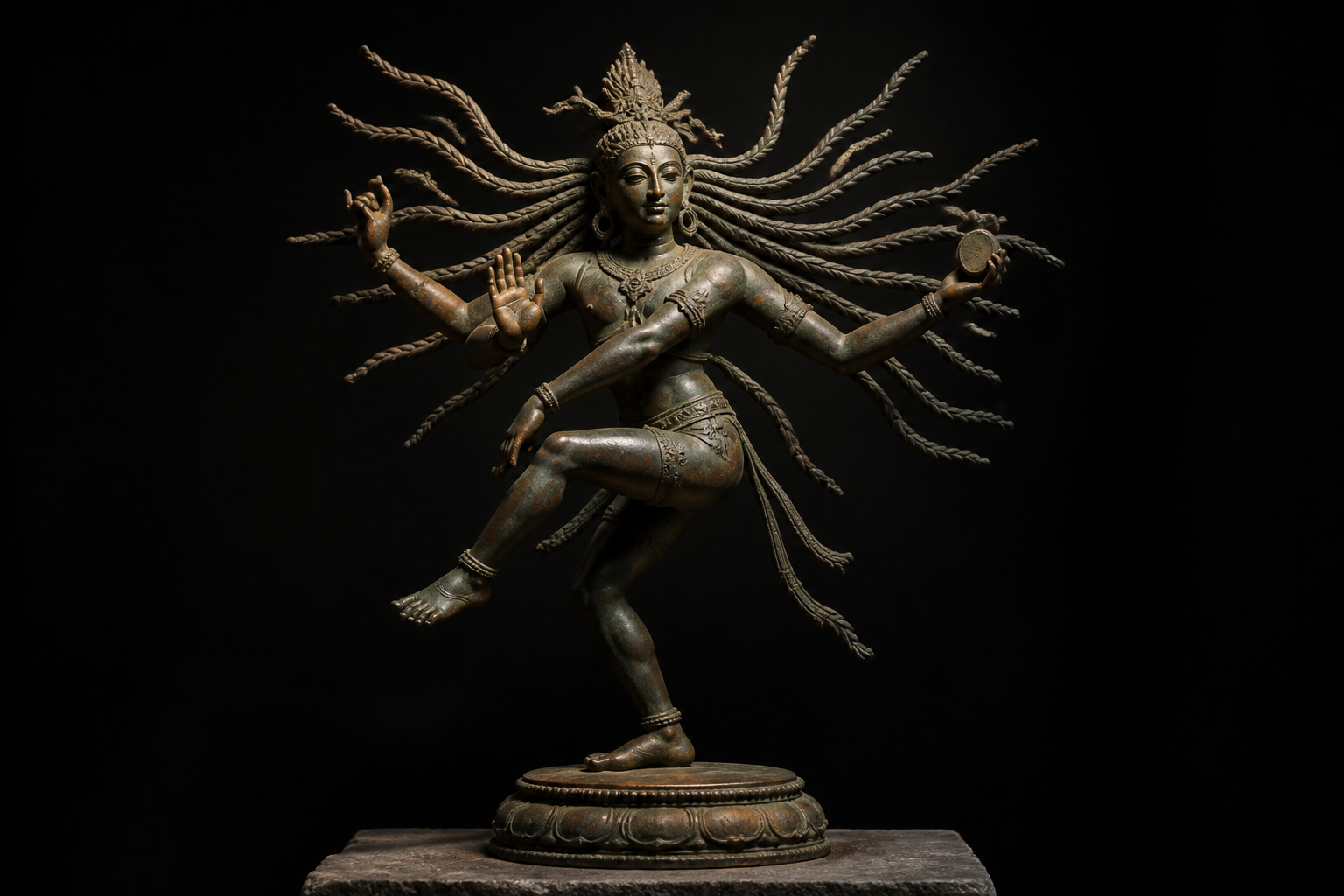
A jata mandala does not carry one fixed message independently of its setting. Its immediate visual relationships tell you whether the composition stresses repose, motion, balance or expansive power. Check four features before settling on an interpretation.
- The face: a composed expression set within vigorous locks joins inner stillness to outward energy. Do not read the hair as emotional turmoil when the face points elsewhere.
- The posture: beside a seated or firmly poised body, spreading locks can make power appear contained but present. In a visibly moving figure, they can extend the movement beyond the limbs.
- The arrangement: balanced locks emphasise order and centredness. Strongly directional locks may intensify motion, but asymmetry alone does not imply disorder.
- The surrounding frame: identify any separate disk, arch or ring before assigning everything around the head to the hair. Several symbolic layers may occupy the same visual space.
Also look for details placed within or upon the locks, but identify them separately. The jata mandala is the arrangement of the hair; an emblem associated with that hair remains an additional feature. Collapsing the two into one symbol makes the image harder, not easier, to understand.
Regional styles, materials and the limits of scale can change how clearly each lock is shown. A small carving may reduce the hair to repeated ridges, while a larger work can articulate strands individually. Use the temple setting, museum description or known identity of the figure as supporting context. Hair alone is not a safe basis for assigning a precise date, school or sectarian identity.
Key takeaways
- A jata mandala is an ordered, outward arrangement of matted locks, not a generic halo behind the deity.
- Confirm it by tracing carved or painted strands back toward the head.
- Distinguish it from the upward-piled jata-mukuta, an ornamented royal crown and a separate prabhamandala.
- Read the matted hair as disciplined ascetic identity, and the radiating arrangement as that power made expansive and cosmic.
- Use the face, posture, symmetry and surrounding frame to decide how the feature functions in a particular image.
- Treat the identification as one part of the image’s meaning, not as a shortcut to its date, region or complete theological interpretation.
Use a three-pass method in a temple or museum

You can turn these distinctions into a reliable viewing practice. Slow down and make three passes rather than naming the feature immediately.
- Read the silhouette from a distance. Does the head appear compact, vertically crowned or surrounded by an expanding form? This tells you what the arrangement contributes to the composition before small details distract you.
- Inspect the material at close range. Look for locks, ridges or strands. Separate hair from disks, arches, jewellery and other elements occupying the same area.
- Return to the whole figure. Compare the direction of the hair with the face and body. Ask whether the image holds movement around a still centre, extends bodily motion, or presents radiating power within a balanced design.
Keep observation and interpretation in that order. First write, mentally or on paper, what you can actually see: matted locks spread laterally from the head. Then state the relationship: the locks are dynamic, while the face remains composed. Only then formulate the meaning: the composition presents expansive energy governed by yogic stillness. This sequence protects you from turning a familiar symbol into a guess.
A short label may name the deity without naming every iconographic feature. You can still use precise but proportionate language: the radiating matted locks form a jata mandala. If strand detail is absent or damaged, say that the arrangement appears consistent with one rather than forcing certainty.
The next time you stand before a Shaiva image, pause at the head before moving to the hands and attributes. Trace the locks, separate them from the surrounding frame, and then look back at the face. That movement of your own attention—from radiating form to centred presence—is the most direct way to understand what the jata mandala contributes.
References
