
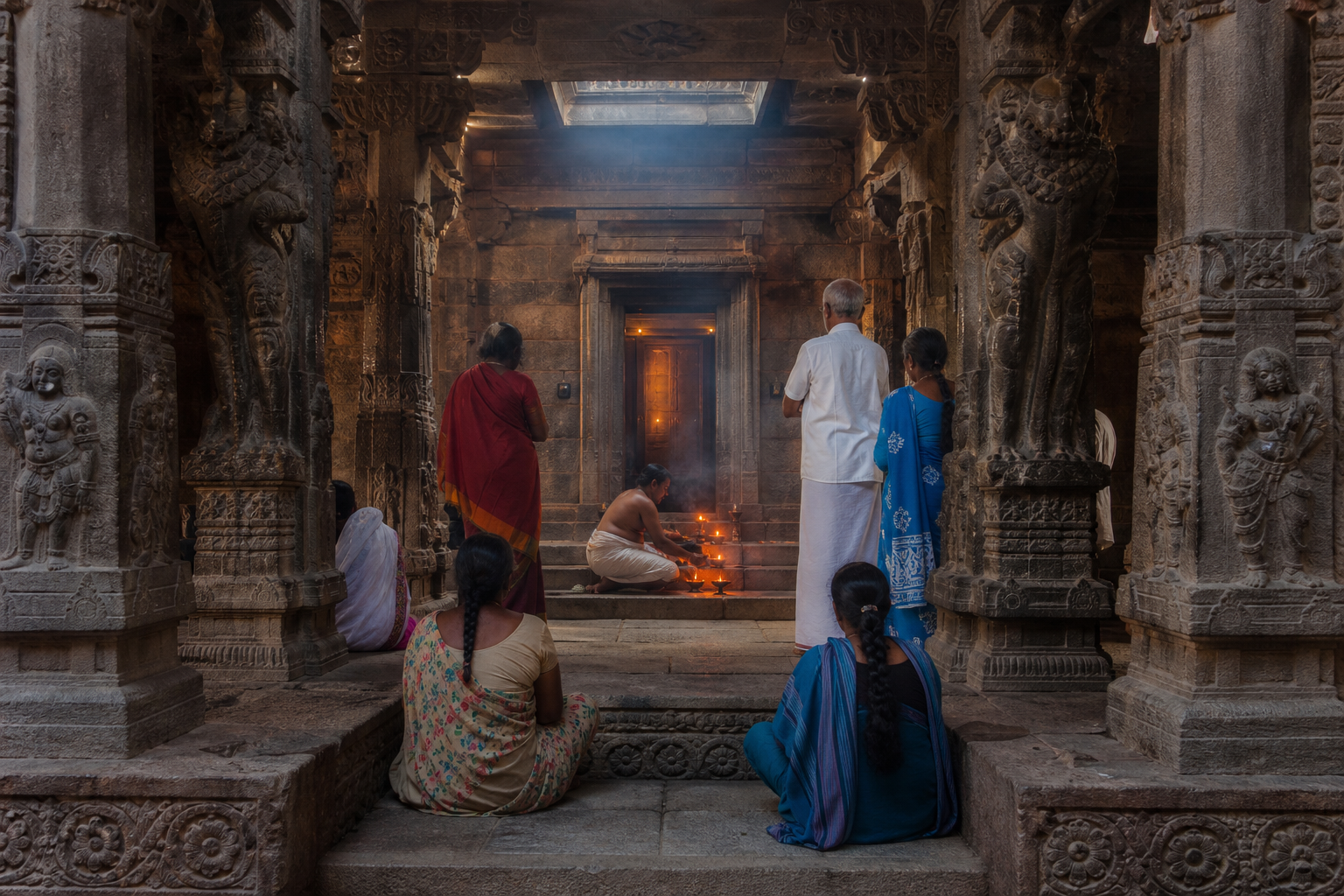
You may enter a Hindu temple wanting to understand its carvings, only to find that the usual labels – sculpture, architecture, ornament – explain very little. They describe what an object looks like, but not what it is doing in a place of worship.
A better approach is to read temple art through composition, ritual and continuity. That lets you notice meaning without inventing it, respect practices you may not fully understand, and support preservation without turning a sacred place into a museum.
Read the temple as a sacred composition
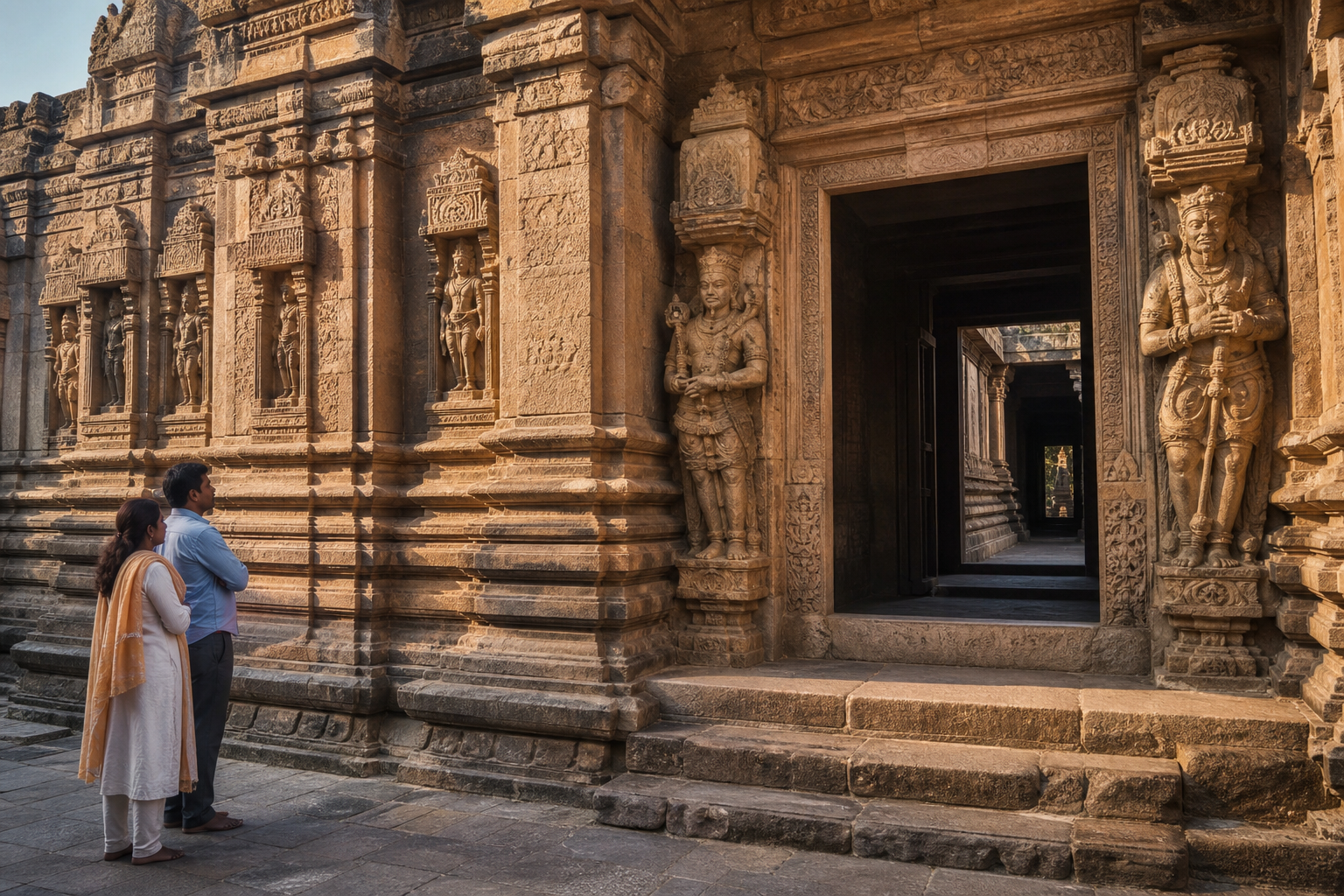
Begin by refusing the assumption that ornament is merely material added to make a building attractive. In Hindu sacred architecture, temple sculpture is not decoration for its own sake. Borders, curves and repeated forms belong to a composition shaped by the principles of Shilpa Shastra, the traditional discipline of sacred art.
Floral carving is a useful place to practise this way of seeing. A curling floral motif may be called Karukku in Tamil. If you photograph it as an isolated design, however, you lose much of the information that could help you understand it. Its location, direction, scale and relationship to nearby figures matter.
Before assigning a symbolic meaning to any motif, ask four concrete questions:
- Where is it placed: at an entrance, around an image, between architectural zones or along a base?
- What does it frame, connect or separate?
- Does the form repeat, and does that repetition lead your eye in a particular direction?
- How does it relate to the deity, attendant figures, animals, narrative scenes or other vegetation around it?
This method guards against opposite mistakes. One is dismissing a carved border as visual filler. The other is attaching a confident, free-floating explanation to every petal and tendril. Sacred art carries meaning, but meaning is not a licence for guesswork.
If photography is permitted, record the whole architectural area before taking a close view. The wider image preserves the motif’s position; the detail preserves its workmanship. Keep both together. A close-up without context may be beautiful, but it is poor documentation.
Ask what the art is doing in worship
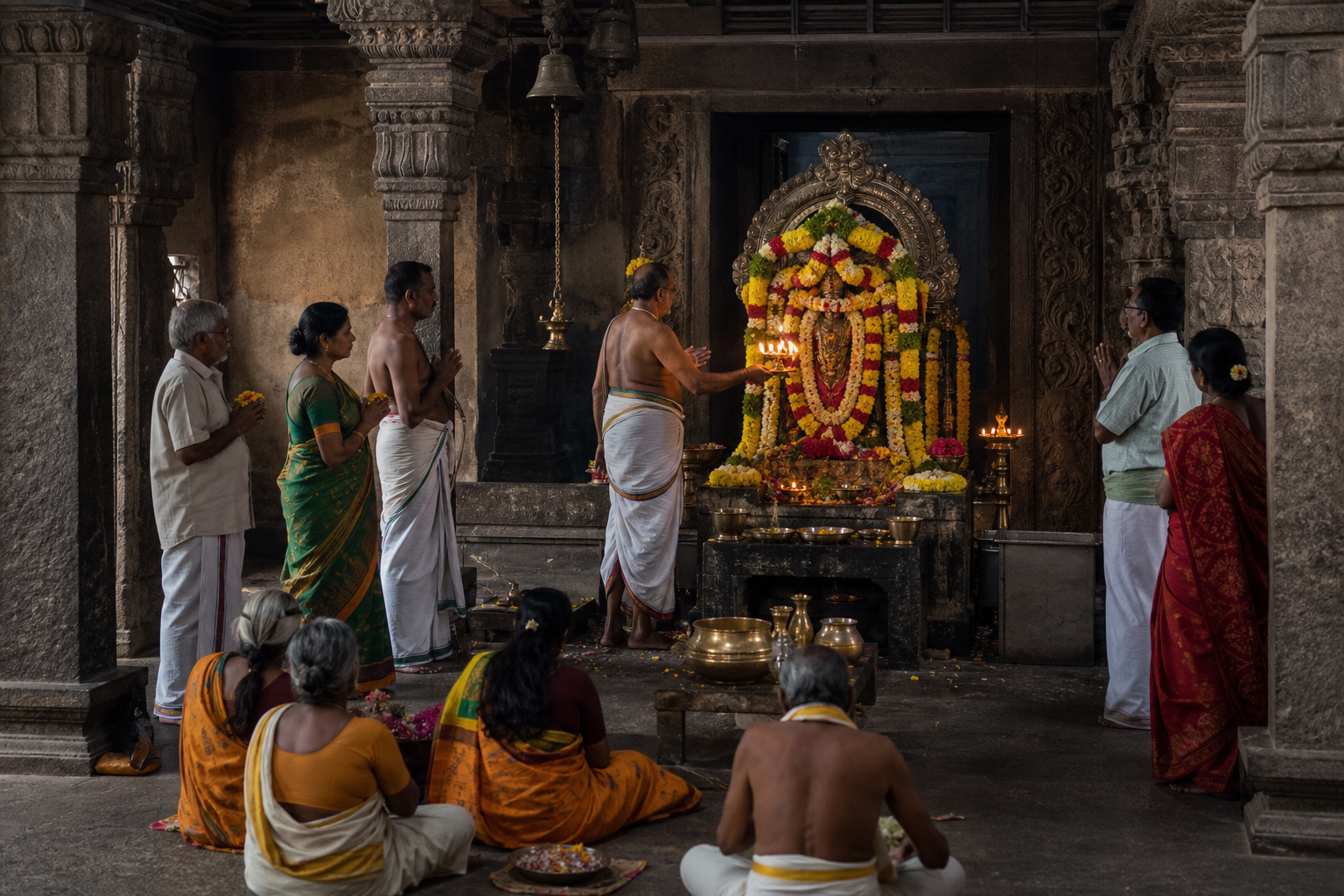
A living temple gives sacred art verbs. An image is approached, dressed, adorned, offered to, carried, sheltered and renewed. Architecture directs movement and marks degrees of access. Festival objects bring the deity into a different relationship with devotees and the surrounding city. If you look only for age, material and style, you miss this active life.
Jagannath Temple in Puri makes the distinction especially clear. The principal deities – Jagannath, Balabhadra and Subhadra – are not static exhibits. They are wooden sacred images seated on the Ratna Bedi, together with other revered representations in the sanctum. Their clothing and ornaments change with the seasons.
The annual Rath Yatra carries the three principal deities in immense decorated chariots before assembled devotees. Here, sacred art moves. Chariots, textiles, adornment, procession and public darshan form one event rather than separate categories of art, craft and religion.
The Puri tradition goes further. Its neem-wood images are periodically replaced through Nabakalebara. Material replacement does not mean that the deity or tradition has been discarded. Within this specific tradition, renewal is itself governed by sacred continuity.
That should change the questions you bring to any temple:
- What ritual action does this image, vessel, gateway, pavilion or ornament support?
- When does its appearance or use change?
- Who holds the knowledge required to prepare, handle or renew it?
- Which parts may be seen by everyone, and which are governed by religious restrictions?
- Would freezing the object in its present condition preserve the tradition, or interrupt it?
You will not always be entitled to an answer. Restrictions can be part of the sacred order of the place. Respecting them is not an obstacle to understanding living heritage; it is part of understanding it.
Let Puri teach you to recognise several kinds of time
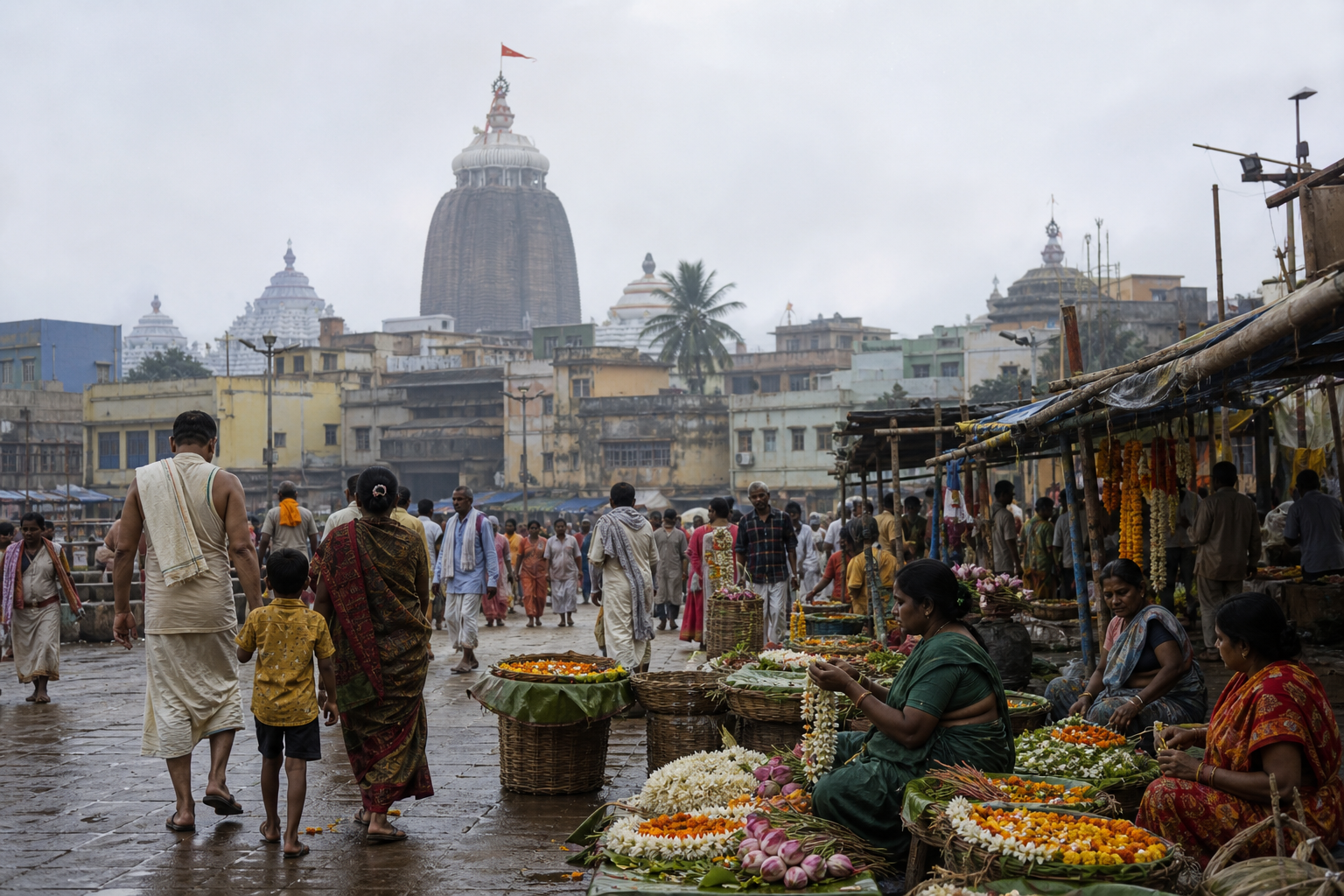
People often ask when a temple was built as though a single year will explain it. A living sacred site usually operates in several kinds of time at once: architectural chronology, continuing worship, institutional memory and sacred narrative. Puri shows why you should keep these layers distinct without pulling them apart.
- Architectural time: The major construction of the present Jagannath Temple belongs to the 12th century and is associated with Anantavarman Chodaganga Deva of the Eastern Ganga dynasty. Accounts differ over the roles of later rulers and the timing of completion or major renovation. The complex continued to develop under subsequent Ganga and Suryavamsi Gajapati patronage.
- Ritual and institutional time: Puri remains one of Hinduism’s four Char Dham destinations, alongside Badrinath, Dwarka and Rameswaram. Its religious memory also includes Ramanuja’s establishment of the Emar Math, Adi Shankara’s Govardhan Math and Chaitanya Mahaprabhu’s long association with the city.
- Sacred time: Traditional narratives remember Jagannath as Nilamadhava, secretly worshipped by the Savara king Vishvavasu. Vidyapati discovers the place of worship, King Indradyumna seeks the deity, and divine guidance eventually leads to the making of sacred wooden images.
The building history should be handled with the uncertainty its chronology requires. Sacred narrative should be identified as sacred narrative rather than forced into the role of an inscription. Yet neither layer makes the other disposable. One helps you follow construction, patronage and renovation; the other helps you understand how a community locates divine presence, human devotion and inherited responsibility.
This distinction is practical. When a guide offers a dynastic date, ask which part of the complex or building phase it describes. When a devotee recounts the search for Nilamadhava, listen for the religious relationships carried by the story: forest worship, the Savara custodian, the searching king, concealment, revelation and the making of the images. Do not demand that one account answer the questions properly addressed by the other.
Puri’s location within a sacred geography extending across Bharat also matters. A temple is connected not only to its walls but to pilgrimage routes, monastic institutions, festivals, teachers, local custodians and generations of devotees. Preserving the structure while allowing those relationships to weaken would preserve only part of the heritage.
Use a disciplined method when you visit
You do not need to be an art historian to look carefully. You do need enough discipline to let the temple set the terms of the encounter.
- Learn the rules before reaching for a camera. Entry and photography rules vary by temple and by area within a complex. Follow current instructions from the temple’s authorised representatives. Visibility is not permission to photograph, touch or circulate an image.
- Notice worship before isolating objects. Observe how devotees approach, where movement slows, what remains inaccessible and how ritual activity changes the use of space. Do not obstruct a queue, offering, procession or line of sight for the sake of a picture.
- Read from whole to part. Begin with the gateway, axis, major masses and route through the complex. Then examine wall zones, frames and repeated motifs. Only after that should you isolate a figure, flower or ornamental detail.
- Trace relationships. Ask what a carving faces, supports, surrounds or leads toward. A motif’s role in the composition is usually a safer starting point than a symbolic definition detached from its setting.
- Watch for change. Clothing, ornaments, vehicles, temporary structures and festival arrangements can reveal that sacred art has seasonal or ceremonial lives. Do not treat a temporary form as less authentic merely because it is not permanent.
- Record context and uncertainty. A useful note identifies the temple area, architectural element, motif, visible function and occasion, where these are known. If a name or interpretation is uncertain, mark it as uncertain instead of converting a guess into a caption.
Local vocabulary deserves particular care. If a knowledgeable custodian gives you a term such as Karukku, retain the language and context in which it was given. Do not automatically turn a regional term into a universal label for every visually similar form in Bharat. Shared sacred principles and regional artistic vocabularies can coexist.
The same standard applies when you share images online. Name the temple and architectural location when permitted, credit the craft or regional tradition when you can do so accurately, and avoid captions that present speculation as settled meaning. A decontextualised photograph may travel farther, but an accurate record serves the heritage better.
Protect the tradition, not only the surviving material
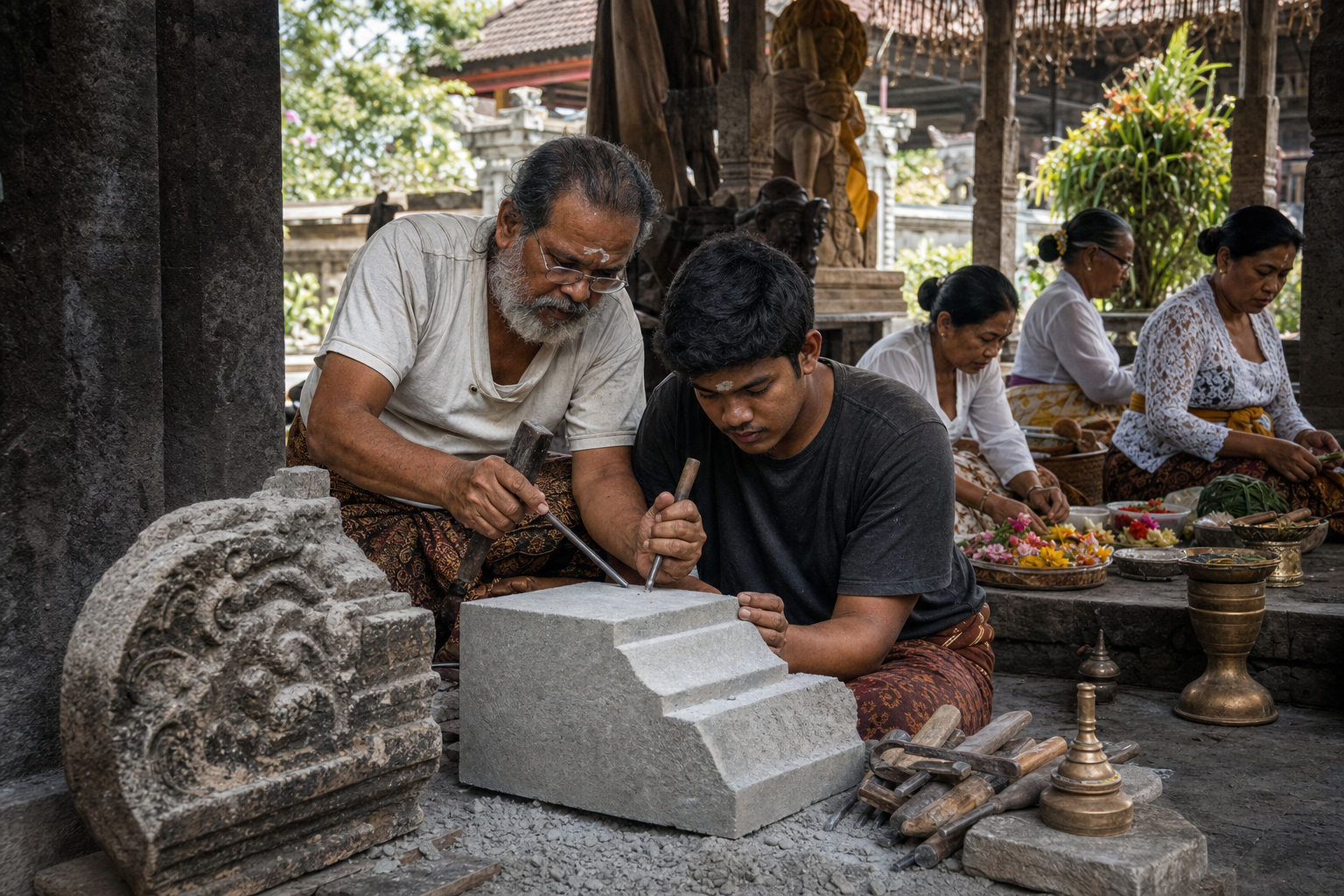
Preservation decisions become distorted when age is treated as the only measure of authenticity. Old fabric matters, and careless alteration can destroy evidence that cannot be recovered. But a living temple also depends on worship, ritual authority, transmitted knowledge, skilled work, festivals and the participation of its community.
Before supporting a conservation, documentation or interpretation project, ask whether it does the following:
- Includes the temple’s authorised custodians and practising community in decisions that affect sacred use.
- Documents an element in context rather than treating it as an independent art object.
- Distinguishes conservation repair, ritual renewal and modern reconstruction instead of calling every intervention restoration.
- Preserves knowledge of correct preparation, use and renewal alongside the physical object.
- Respects restrictions on access, photography and the circulation of sacred imagery.
- Explains uncertainty honestly when dates, meanings or building phases remain disputed.
Nabakalebara supplies a demanding corrective here. It does not prove that every replacement is authentic or that material conservation is unimportant. It shows that a tradition-governed act of renewal can carry continuity through material change. The governing authority, purpose, sequence and sacred meaning are what distinguish renewal from arbitrary replacement.
As a visitor, you can make similarly grounded choices. Use authorised channels when offering financial support. Prefer identifiable craftspeople and community institutions over sellers who strip motifs from their setting and market them with invented meanings. Do not repost restricted images merely because someone else has already done so. When you speak about the temple, give its worship and custodians at least as much attention as its visual splendour.
Key takeaways
- Read a motif through its location, repetition and relationship to the larger composition before assigning a symbolic meaning.
- Ask what sacred art does in worship: how it is approached, adorned, carried, protected or renewed.
- Keep architectural chronology and sacred narrative distinct, but do not erase either from the life of the temple.
- Follow temple rules, preserve context in your notes and label uncertain interpretations honestly.
- Judge preservation by the continuity of worship, knowledge, craft and community as well as by the age of physical material.
On your next temple visit, begin with a border, gateway or repeated floral form and trace its relationship to the sacred space around it. Then identify the ritual action that gives that space life. That small discipline will take you beyond sightseeing and toward the kind of attention living sacred heritage deserves.
References
- Hindu Blog – Floral Motifs in Hindu Sculpture
- Hindu Post – The Jagannath Temple of Puri: A Living Sacred Landmark on Bharat’s Eastern Coast
