
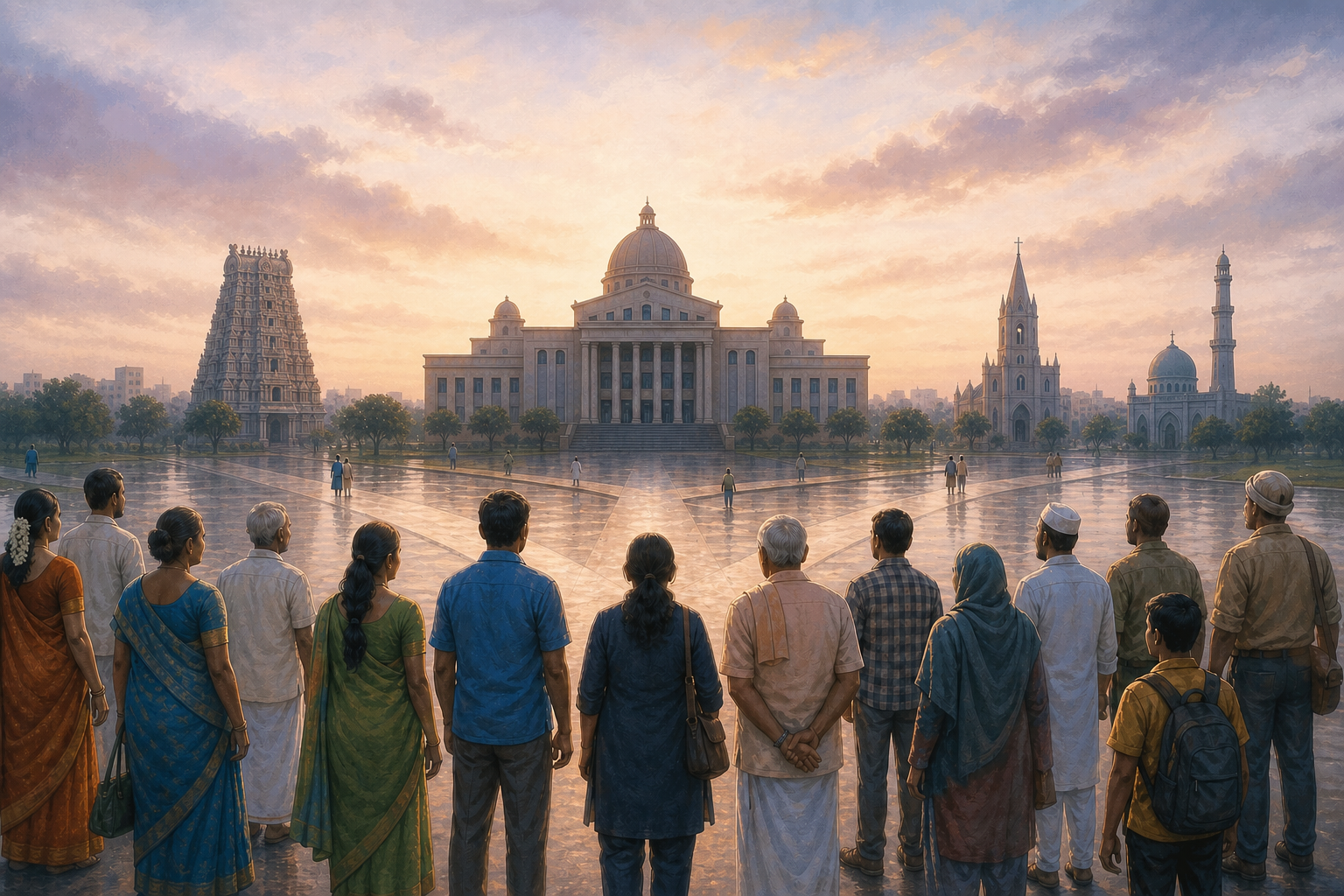
If you are trying to decide whether Tamil Nadu’s new religious language is ordinary personal faith or a shift in political power, do not begin with a politician’s name, family background, temple visit, church appearance, or festival greeting. Begin with four things: the office being used, the audience being addressed, the action being promised, and the consequence for citizens.
That method matters in the controversy surrounding Chief Minister Vijay Joseph and TVK. You can defend the full religious freedom of Christians, reject hostility toward Christian citizens, and still demand that the state treat Sanatan Dharma and Dharmic communities fairly. Those positions are not contradictory. They are the minimum conditions of principled pluralism.
Personal faith becomes political when public power enters the room
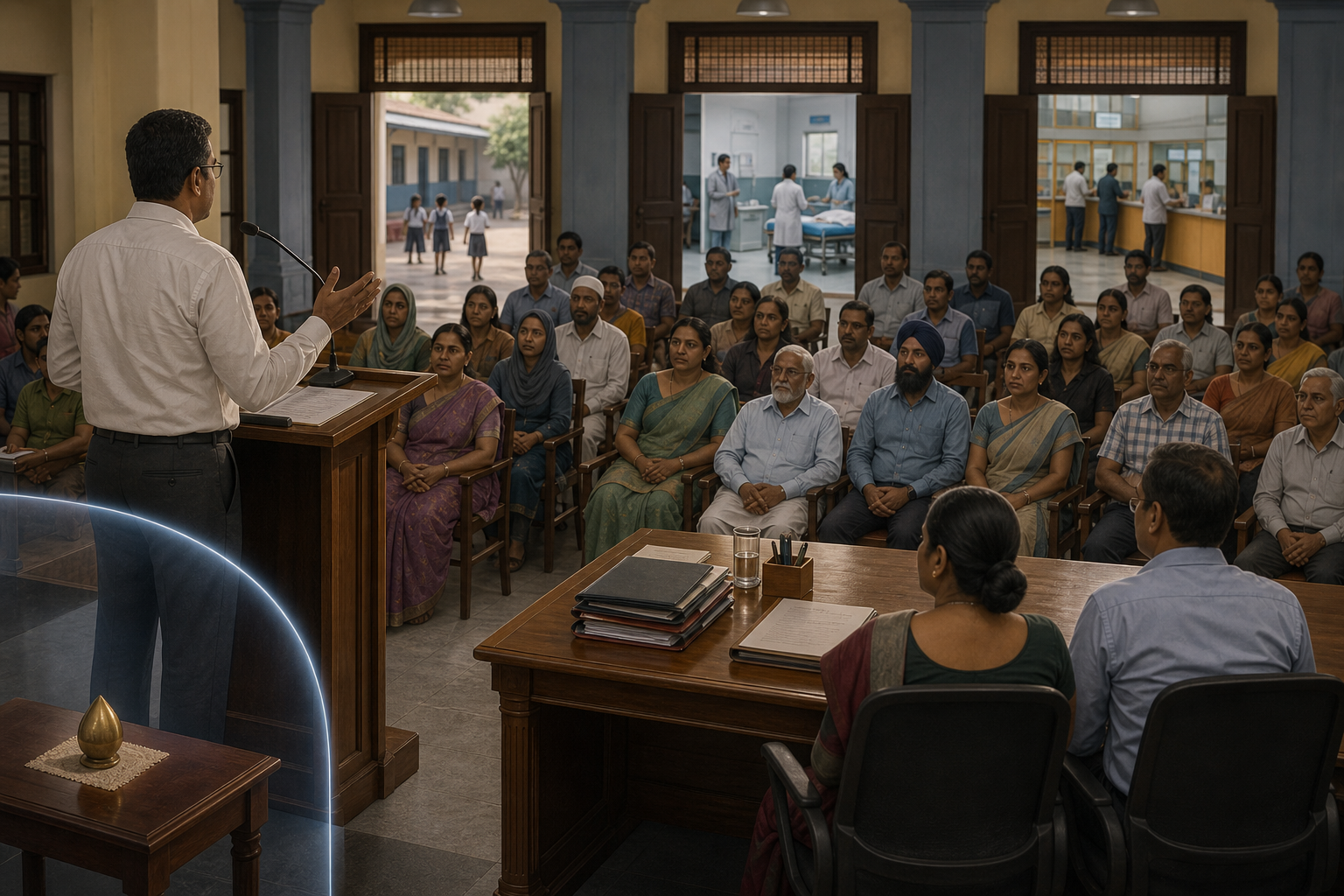
A public official does not surrender personal faith upon taking office. A Christian chief minister may speak about the Bible. A Hindu minister may visit a temple. A Sikh legislator may refer to the Guru Granth Sahib. Religious expression alone does not prove that the government has adopted a sectarian program.
The meaning changes, however, when the speaker invokes the authority of an office, uses an official platform, promises state action, or treats one community’s dignity differently from another’s. The relevant distinction is not religious versus irreligious. It is personal profession versus institutional preference.
This distinction is especially important in Tamil Nadu because its Dravidian political convention has generally discouraged chief ministers from making personal religion part of their official identity. A departure from that convention deserves examination, but not a verdict based solely on a religious appearance.
- Identify the capacity. Was the person speaking as a private believer, party campaigner, legislator, minister, Speaker, or chief minister?
- Identify the platform. Was the event privately organised, party-sponsored, or supported by government staff, publicity, money, security, or premises?
- Identify the demand. Was the speaker sharing a belief, attacking another tradition, directing officials, or promising a policy?
- Identify the consequence. Did anything change in funding, appointments, education, temple administration, policing, permits, or access to public institutions?
Before forwarding a clip, write down the answers. If you cannot identify the date, venue, speaker’s official role, complete sentence, and resulting action, you have material for further inquiry, not yet a reliable political conclusion.
The TVK controversy contains four different kinds of conduct
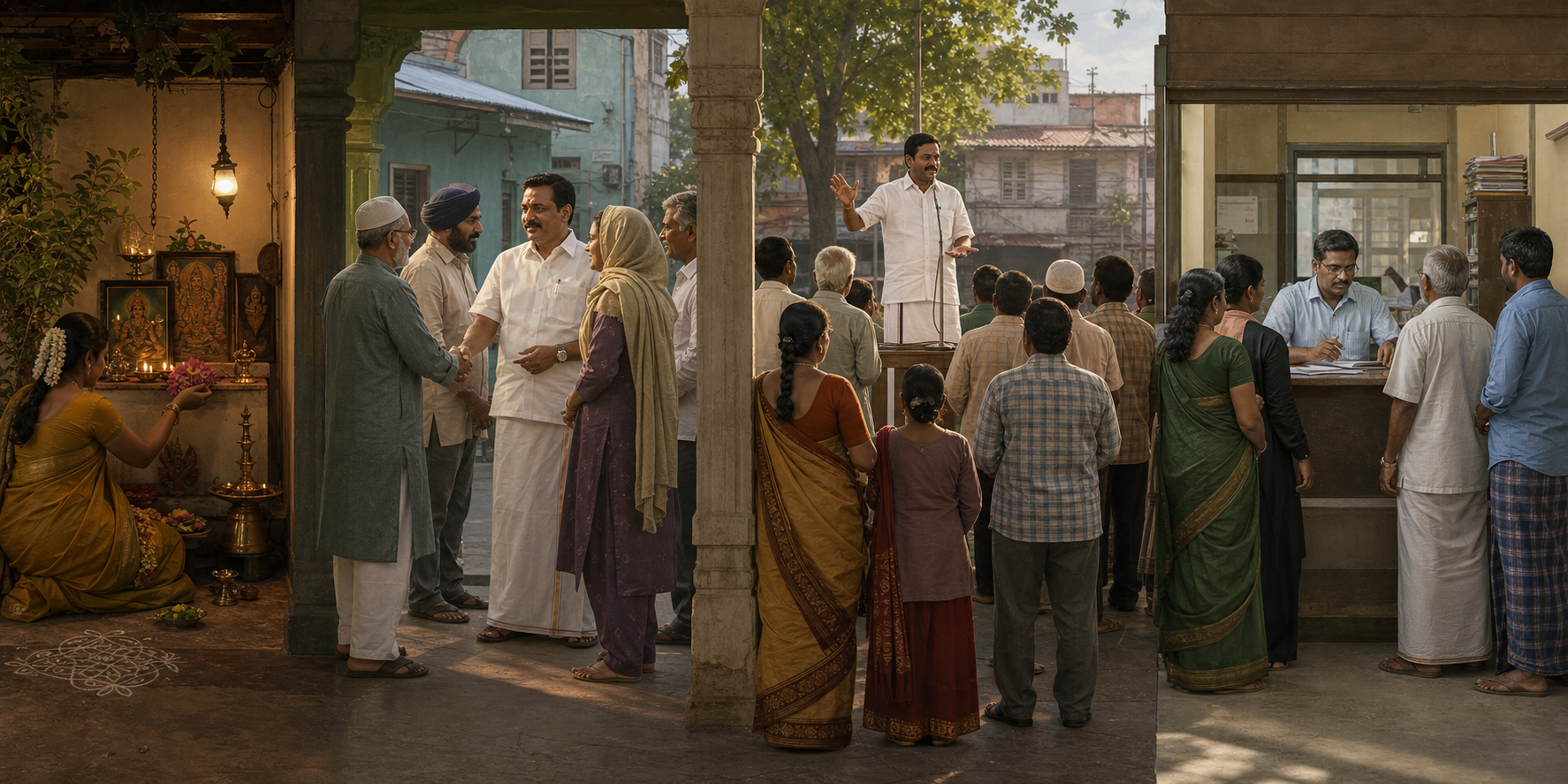
TVK’s critics are alleging a Christianity-first political direction. That is a serious charge. It should neither be dismissed merely because it is uncomfortable nor accepted merely because several religious episodes have been placed next to one another. Each episode asks a different question.
In December 2025, Vijay narrated the biblical story of Joseph at a Christian outreach event while serving as chief minister. On the facts presented, this shows public identification with Christianity. It does not, by itself, establish discrimination against Hindus. To judge its political weight, you need to know whether he appeared in an official capacity, whether state resources supported the event, what commitments he made, and whether Dharmic communities receive comparable access and respect.
A May 2026 statement attributed to TVK MLA Mustafa is different in character. He allegedly said that TVK entered politics to “abolish Sanatan”. This is not simply an expression of personal faith. It appears to target another community’s living religious and civilizational identity. The immediate questions should be precise: What did Mustafa mean by “Sanatan”? Was he opposing a defined practice, using a slogan, or calling for the displacement of a religious tradition? Did TVK endorse, reject, clarify, or discipline the statement?
A minister has also been accused of elevating what Christianity taught him above what Tamil could teach him. Context matters here. Personal testimony about religious transformation is one thing; using ministerial authority to set Christianity and Tamil identity against each other is another. Tamil is not the property of one creed, but neither can Tamil civilization be honestly detached from the Saiva, Vaishnava and wider Dharmic traditions through which much of its religious vocabulary, literature, sacred geography and public culture developed.
The participation of a TVK MLA and the Tamil Nadu Speaker in a Christian conservative march opposing abortion raises yet another question. Abortion is a moral and political issue on which people may take positions for religious or nonreligious reasons. The presence of Christian participants does not settle the issue. The concern is whether holders of constitutionally important offices are aligning those offices with a particular religious campaign, and whether they would permit equivalent public participation by Dharmic organisations without branding it communal.
These events do not all prove the same thing. A biblical narration, an anti-Sanatan declaration, a comparison between Christianity and Tamil, and participation in a moral campaign have different levels of relevance. Treating them as interchangeable weakens the case for accountability because it allows party defenders to answer the least serious example while ignoring the most serious one.
Use a five-part test before calling it a religious agenda

You do not have to choose between naive denial and instant condemnation. Apply the same test to TVK, the BJP, the DMK, the AIADMK, or any future party.
- Verify the complete act. Find the full speech, video, event description, date and official designation. A clipped sentence may omit a qualification; a party-friendly paraphrase may hide the plain meaning. If the full record is unavailable, label the claim unresolved.
- Separate belief from program. A testimony, prayer, blessing or scripture reference expresses belief. A manifesto pledge, administrative direction, budget decision, appointment pattern or legislative proposal indicates a program. Do not pretend these categories are identical.
- Apply the reciprocity test. Replace “Christian” with “Hindu” while keeping the office, venue and conduct unchanged. Would the same commentators defend the act? Would the party call it secular? If the judgment changes only because the religion changes, the standard is political convenience.
- Look for institutional adoption. One MLA’s rhetoric becomes a party-level concern when senior leaders repeat it, the party refuses a reasonable clarification, official channels promote it, or policy begins to reflect it. Silence is relevant, but it is weaker evidence than an explicit endorsement or government action.
- Follow the consequence. The strongest evidence is not a ceremonial appearance. It is unequal treatment: public benefits conditioned by religion, selective restrictions, biased administration, official denigration, or a rule that burdens one community while comparable conduct by another is protected.
This produces a practical ladder of concern. Personal religious expression calls for observation. Sectarian rhetoric by an office-holder calls for clarification and party accountability. Repetition by several party figures calls for scrutiny of leadership and institutional culture. Discriminatory state action calls for documented, lawful civic and political opposition.
Do not jump directly from the first rung to the last. But do not remain on the first rung after evidence of institutional adoption appears. The discipline lies in updating your judgment when the evidence changes.
A pro-Dharma response must defend parity, not collective blame

The strongest Dharmic response is not to treat every Christian voter, priest, school, charity, or church as an extension of TVK. Collective suspicion hands sectarian politics exactly what it needs: two frightened religious blocs, each told that the other threatens its existence. It also abandons the Dharmic claim that plural paths can share civic space without surrendering their integrity.
Focus responsibility on the person, party and institution that exercised power. Use names, dates and exact words. Ask for written answers. Preserve full recordings rather than edited clips. Track whether rhetoric is followed by appointments, money, regulations or administrative decisions. Correct an allegation publicly if the complete record disproves it. Credibility built this way will matter when a genuine case of unequal treatment appears.
For the “abolish Sanatan” allegation, citizens and journalists can put five direct questions to TVK:
- Does TVK confirm that Mustafa used those words, and what was the full context?
- What does TVK understand “Sanatan” to mean in this statement?
- Does the party reject calls to abolish any constitutionally protected religious tradition?
- Would it respond identically if an MLA called for Christianity or Islam to be abolished?
- Has the statement produced any proposed policy, party instruction or government action?
Those questions prevent an easy escape into slogans. A party cannot answer a concern about anti-Sanatan rhetoric merely by restating its commitment to secularism. It must explain how the contested words fit that commitment and whether they have institutional consequences.
At the same time, Hindus should distinguish criticism of a practice from a promise to erase a tradition. Political movements are entitled to challenge caste discrimination, social exclusion, priestly authority, particular customs, or any doctrine they can identify and debate. “Abolish Sanatan” is broader and more combustible because many Hindus hear Sanatan Dharma as the name of their entire living tradition. Anyone using the phrase in public office bears the burden of defining it.
There is also no need to accept a false choice between Tamil identity and Dharmic identity. Tamil belongs to Christians, Muslims, Jains, Buddhists, atheists and Hindus. Yet inclusion does not require the erasure of the profound Hindu and wider Dharmic inheritance within Tamil civilization. A plural Tamil identity should be capacious enough to acknowledge that inheritance without making non-Hindus lesser citizens.
Key takeaways
- A politician’s Christian identity is not evidence of a Christianity-first government. Public authority, institutional adoption and unequal consequences are the evidence that matter.
- The allegations involving TVK are not interchangeable. The claimed call to “abolish Sanatan” warrants a firmer response than the narration of a biblical story because it appears to target another tradition.
- Judge religious conduct through capacity, platform, demand and consequence, then apply exactly the same standard to Hindu, Christian, Muslim and other office-holders.
- Ask whether TVK endorsed, rejected or clarified the disputed statements, and whether any policy or administrative action followed them.
- Defend Sanatan Dharma without assigning collective guilt to Christians. Specific accountability is both more ethical and more politically effective.
- Refuse the claim that Tamil identity must be purified of its Dharmic inheritance in order to include citizens of other faiths.
Your next step is simple: choose the most consequential claim, obtain the fullest available record, and ask the responsible office-holder for a precise answer. Tamil Nadu does not need less religious freedom. It needs one civic standard strong enough to protect every faith and honest enough to recognise hostility toward Dharma when it occurs.
References
