
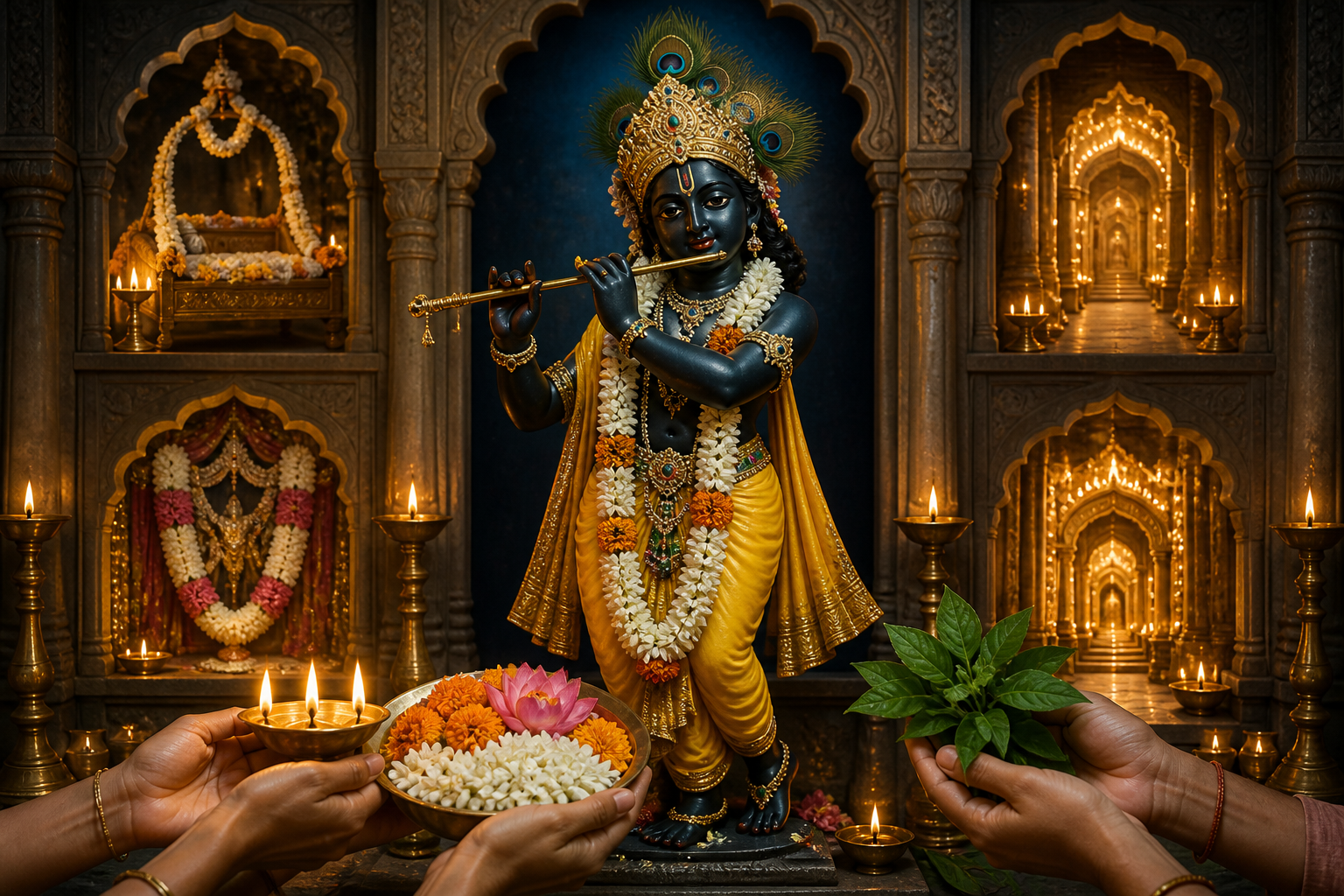
You may feel at home before Sri Krishna’s murti and still hesitate when someone asks what the traditions mean. Is Janmashtami only a birthday celebration? Is Rukmini Kalyanam a remembered marriage, a theological symbol, or both? And how should you understand the tradition of Krishna’s 16,000 queens without turning sacred narrative into either a joke or a vague metaphor?
You don’t have to choose between unthinking literalism and symbolism so loose that Krishna disappears from it. A sound devotional reading keeps three things together: what the tradition narrates, what the ritual enacts, and what the devotee is being asked to embody.
Begin with the ritual before decoding the symbol
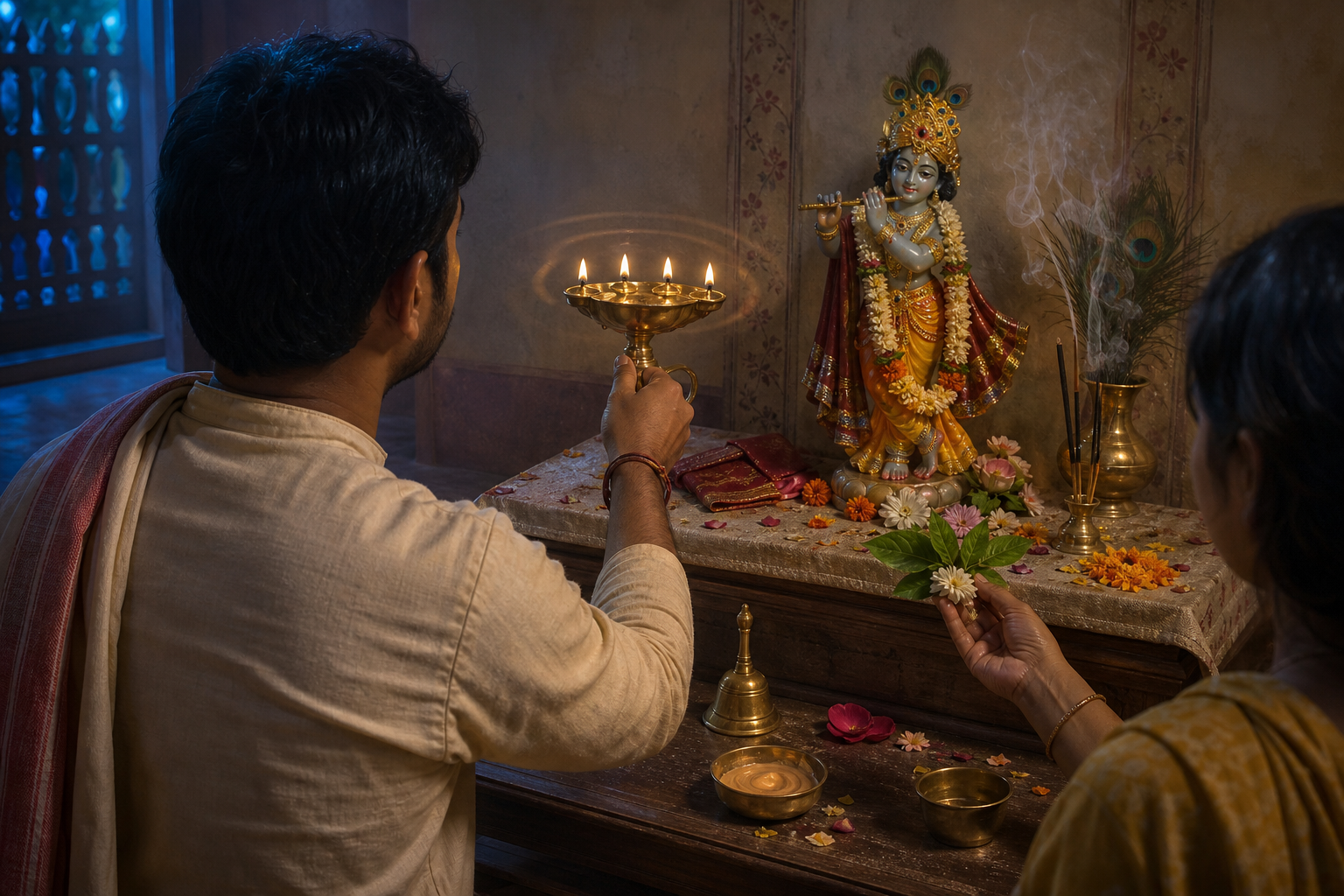
The fastest way to misread a Krishna tradition is to begin by asking what every object secretly represents. That approach usually imports a private theory into a living practice. Begin instead with what devotees remember and do.
- Observe the form. Identify the event, figures, objects, words, and actions that are actually present. Birth, marriage, adornment, and a sacred knot are not interchangeable symbols.
- Name the relationship. Ask how the devotee is approaching Krishna in this observance: through welcome, celebration, fidelity, dependence, love, or surrender.
- Find the response. Ask what the observance requires after the ceremony ends. A devotional symbol becomes useful when it disciplines attention, conduct, or commitment.
This method avoids two opposite errors. A museum-like reading describes costumes and customs but never enters their devotional logic. An over-allegorical reading dissolves Krishna, Rukmini, and the narrative into generic lessons about the mind. Neither is enough. In bhakti, a symbol does not have to be unreal in order to carry meaning; the remembered event, divine relationship, ritual action, and inward response can remain connected.
Not every sampradaya or temple will explain a festival in precisely the same language. When a local interpretation matters, ask which temple tradition, regional practice, or teacher it belongs to. That simple question prevents one community’s explanation from being presented as the only Hindu understanding.
Janmashtami turns divine birth into a present invitation
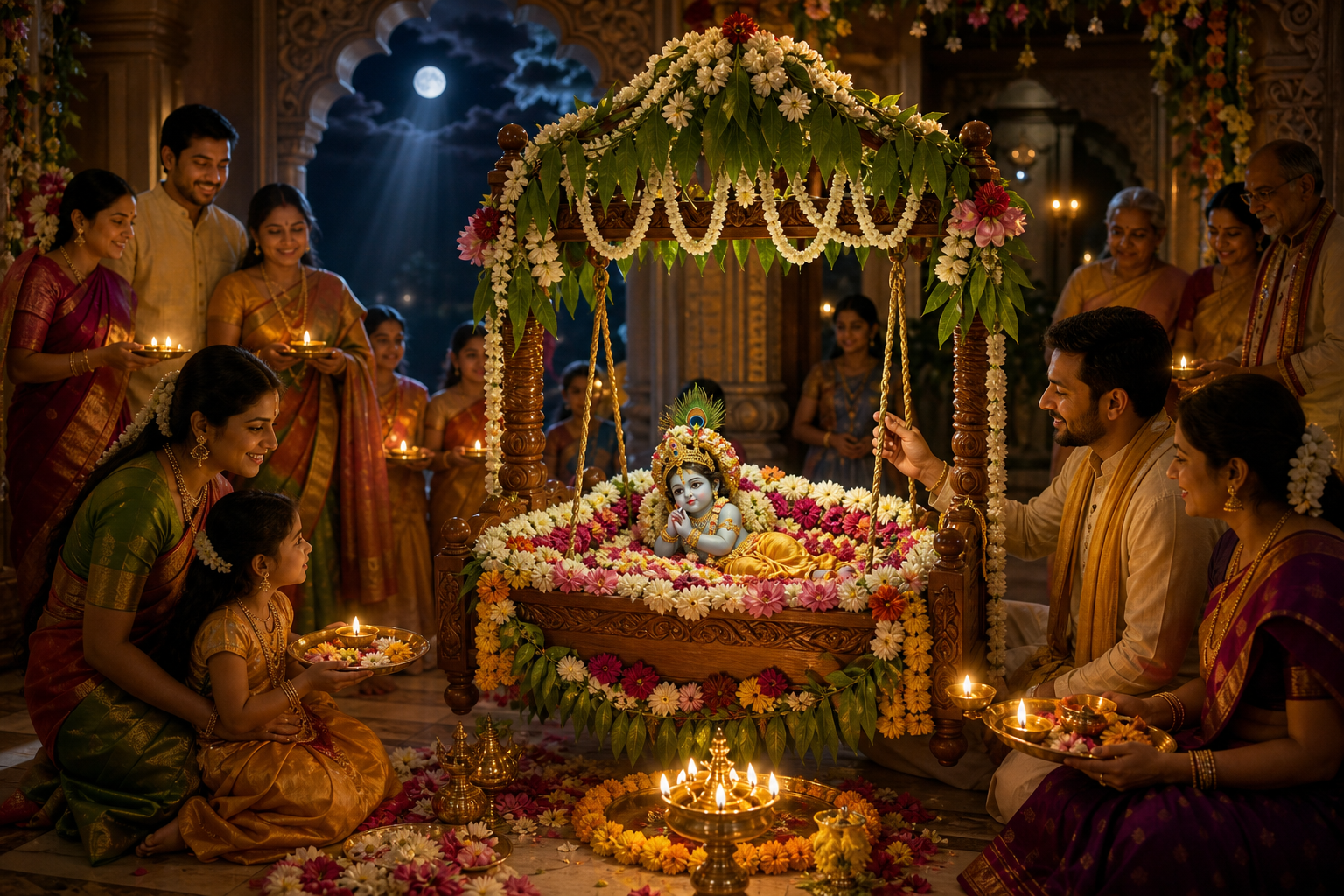
Janmashtami gives you a clear example of the three-layered approach. The narrative layer remembers Sri Krishna’s birth. The ritual layer marks that birth as an event worthy of renewed celebration. The devotional layer asks whether Krishna is being welcomed into your attention and conduct, rather than merely admired as a figure from the past.
The symbolism surrounding Janmashtami also places Krishna within the civilizational life of India, alongside the Ramayana and Mahabharata. This matters because the festival is not merely private spirituality. It renews a cultural memory through homes, temples, stories, names, arts, and shared observance.
To make that meaning practical, use three prompts during your next Janmashtami observance:
- Remember: What quality of Sri Krishna are you giving sustained attention to, rather than mentioning only ceremonially?
- Receive: What habit, attachment, or distraction prevents that remembrance from taking root in your daily life?
- Respond: What one action will show that the observance changed something after the lamps, flowers, and gathering are over?
The response need not be dramatic. It might be a neglected duty completed without resentment, a daily period of nama-smarana maintained consistently, or a promise kept when convenience pulls the other way. The test is not whether the action sounds spiritual. The test is whether it gives your devotion a durable form.
Do not reduce Janmashtami to generic self-improvement. The center is Sri Krishna, not a better-branded version of the self. Personal change matters because it becomes an answer to divine presence.
Rukmini Kalyanam makes commitment visible
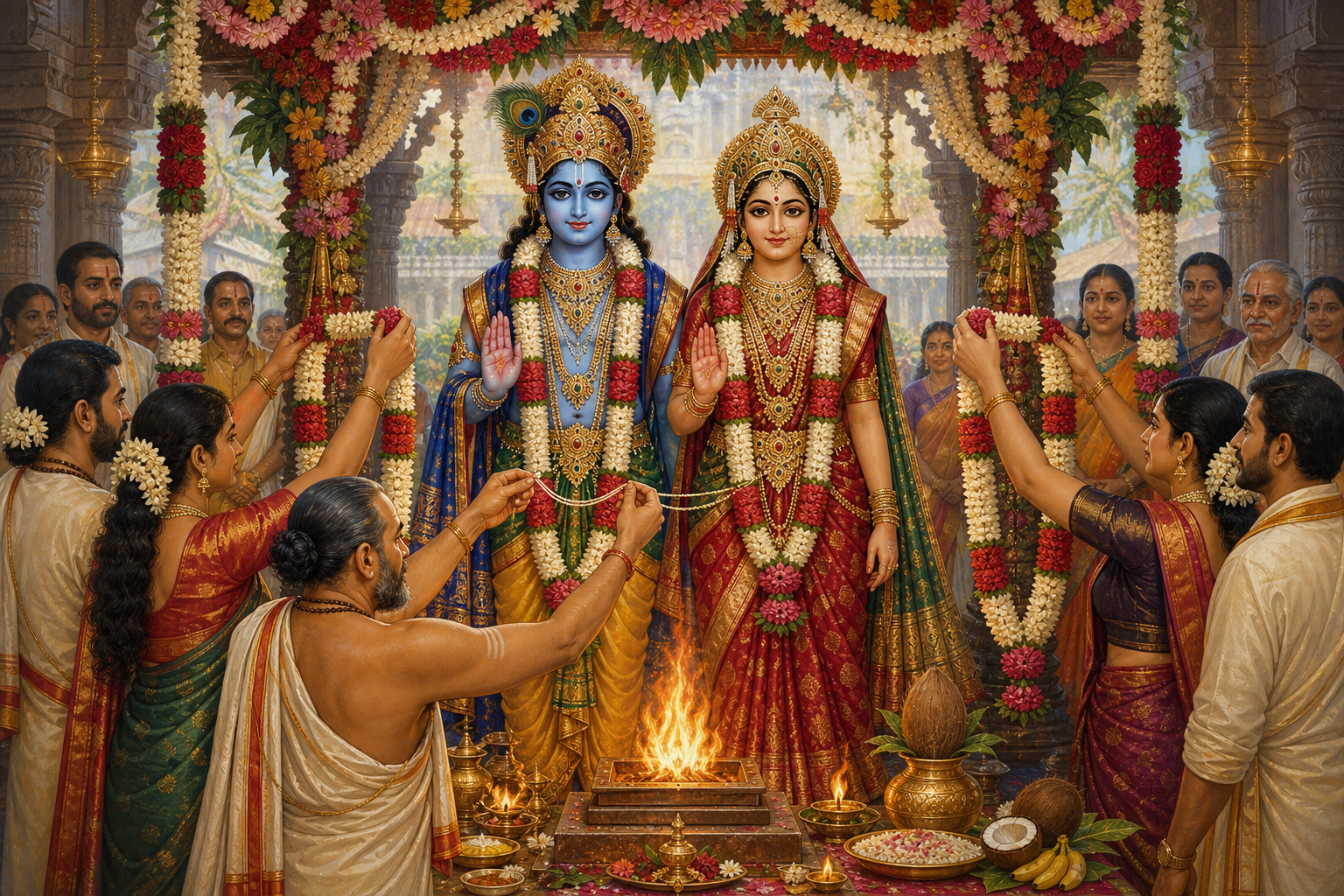
Rukmini Kalyanam approaches Krishna through marriage and sacred commitment. In temple celebrations, the utsava murtis of Sri Krishna and Ma Rukmini are adorned with flower garlands, fine garments, and ornaments, and the priest ties the sacred knot to Rukmini’s murti. The ritual does not leave relationship as an abstract idea. It gives it color, form, ceremony, and a binding gesture.
You do not need to invent a fixed code in which every flower or ornament has one universal translation. Notice the larger ritual grammar instead. Adornment expresses honor. The presence of both murtis directs attention to relationship rather than solitary divinity. The sacred knot gives visible form to a bond that is not meant to vanish with a passing emotion.
That distinction is useful in ordinary devotional life. Emotion can begin an act of bhakti, but commitment carries it through repetition, inconvenience, and dryness. If you attend Rukmini Kalyanam, do not watch only for visual beauty. Ask where your own devotion remains affectionate but uncommitted. Is your chosen practice regular only when you feel inspired? Have you made promises in family, seva, or worship that your routine no longer honors?
Choose one neglected commitment and give it a visible form. Put the time for daily practice on your calendar. Complete the seva you accepted. Restore a family observance that has been repeatedly postponed. The point is not to copy the temple’s sacred knot for private symbolism; it is to let the public act of fidelity expose where your own promises need substance.
If you want to conduct Rukmini Kalyanam at home, follow the procedure of your family, temple, or sampradaya. Ritual details belong within transmitted practice. A personal interpretation can deepen an observance, but it should not be presented as a universal liturgy.
The 16,000 queens require precision, not embarrassment
The number 16,000 often attracts attention before the devotional question has even been heard. That makes precision essential. The tradition of 16,000 queens accepting Sri Krishna as their husband is placed in a Padma Purana dialogue between Mahadeva and Parvati. Begin there, with the narrative’s own terms.
Do not casually substitute gopikas for queens. The words refer to different identities and narrative settings, and collapsing them produces confusion before interpretation begins. Do not reduce the number to sexual arithmetic either. That reading imports the limits and appetites of an ordinary individual into a narrative about divine capacity.
A devotional interpretation may understand the vast number as a sign that divine relationship is not governed by human scarcity. Sri Krishna’s fullness is not divided into smaller portions as the number of relationships grows. Each devotee can approach the divine personally without making another devotee’s bond impossible. This is a theological reading of the scale; it does not require you to erase the queens or pretend that the narrative never makes a claim of its own.
Keep three questions separate when the subject comes up:
- What does the narrative say? Here, it speaks of 16,000 queens accepting Krishna as husband and identifies a Puranic setting for the telling.
- What might the number disclose devotionally? It can direct attention to the inexhaustibility and personal completeness of divine relationship.
- What can the narrative establish historically? A sacred narrative should not be treated automatically as modern census documentation, just as its devotional character does not make it empty or disposable.
This separation keeps discussion honest. A historical question, a textual question, and a theological question require different forms of reasoning. Using one to silence the others creates heat but little understanding.
There is also an ethical lesson in how you speak about the tradition. A large number can tempt a listener to turn persons into a faceless mass. Bhakti moves in the opposite direction: plurality does not cancel particularity. When discussing the queens, retain their dignity as participants in a sacred relationship rather than using them as props in a joke, an apologetic calculation, or a slogan.
Key takeaways: five questions for any Krishna observance
You can use this short reading discipline at a temple, during a home observance, or while explaining a tradition to someone unfamiliar with it:
- What is being remembered? Name the birth, marriage, relationship, or divine act before interpreting it.
- What is being enacted? Pay attention to what the murtis, adornment, gestures, and ritual sequence actually do.
- Which relationship is central? Celebration of birth and celebration of marriage do not ask the devotee to stand in exactly the same posture.
- Which layer am I discussing? Distinguish narrative description, theological meaning, historical inquiry, and personal application.
- What response follows? Identify one duty, discipline, or commitment that prevents the symbolism from ending as decoration.
If an interpretation skips the first four questions and leaps directly to a life lesson, it is probably projecting onto the tradition. If it answers the first four but never reaches the fifth, it may be accurate yet devotionally inert.
The next time you encounter Janmashtami, Rukmini Kalyanam, or the 16,000 queens, resist the rush to find one secret meaning. Name the sacred event, preserve its own vocabulary, notice the relationship it reveals, and then make one corresponding commitment. That is how symbolism stops being an explanation you repeat and becomes a form of bhakti you can live.
References
- Hindu Pad – Sri Krishna Rukmini Kalyanam
- Hindu Pad – 16000 Queens of Lord Krishna: What is the real story behind 16000 Gopikas of Krishna?
- Hindu Pad – Symbolism of Janmashtami: Why celebrate Sri Krishna’s birth
