

You may want Rama nama to become part of your daily life, yet feel caught between short japa, longer Ramayana recitation, exact counts, and talk of mantra siddhi. The useful first decision is much smaller: choose one form you understand and can repeat with attention, then give it a stable place in your life.
Rama upasana matures through return. A modest practice that survives busy days will shape you more deeply than an elaborate routine repeatedly begun and abandoned.
Choose the form of Rama recitation you can sustain

Three related practices are often placed under the same label, but they ask different things of you. Nama-japa repeats a divine name such as Rama or Sita-Rama. Mantra-japa repeats a particular mantra, often one received through initiation. Patha recites a structured hymn or sacred composition. Upasana is the wider devotional discipline that holds any of these practices: preparation, attention, repetition, remembrance, and the conduct that follows.
If you have received a Rama mantra through diksha, keep that mantra and its instructions as your primary practice. Do not alter its wording, pronunciation, count, or method because another formula appears more impressive. Questions about an initiated practice belong with the qualified teacher or lineage that entrusted it to you.
If you have not received initiation and want a clear devotional beginning, simple Rama nama or Sita-Rama nama gives you fewer moving parts. You can focus on remembrance instead of wondering whether you have reproduced a complex formula correctly. Simplicity here is not spiritual inferiority. It is a way of making fidelity possible.
Choose a structured recitation when you also want the Ramayana narrative to occupy your attention. Ram Manka 108 presents the Ramayana through 108 chaupais, gathering an extended sacred narrative into a recitable form. Its scale makes it different from repeating a short name: you are moving through remembered episodes and devotional language as well as returning to Rama.
Do not choose by assuming that longer must mean higher. Choose by the function you need:
- Choose Rama or Sita-Rama nama when you need a compact daily anchor that can remain unchanged.
- Choose your initiated mantra when you already have diksha and lineage-specific instructions.
- Choose Ram Manka 108 when an unhurried, narrative recitation of the Ramayana is the practice you can actually complete.
- If both nama-japa and Ram Manka matter to you, make one the regular anchor and the other an occasional extended recitation. Constantly swapping the primary practice makes continuity harder to see.
Read the meaning of what you recite. Sound and meaning are not rivals. Sound gives the practice continuity; meaning prevents the words from becoming an empty verbal reflex. If the pronunciation is unfamiliar, slow down and seek correction from someone competent rather than rushing through uncertainty.
Turn the chosen recitation into a workable upasana
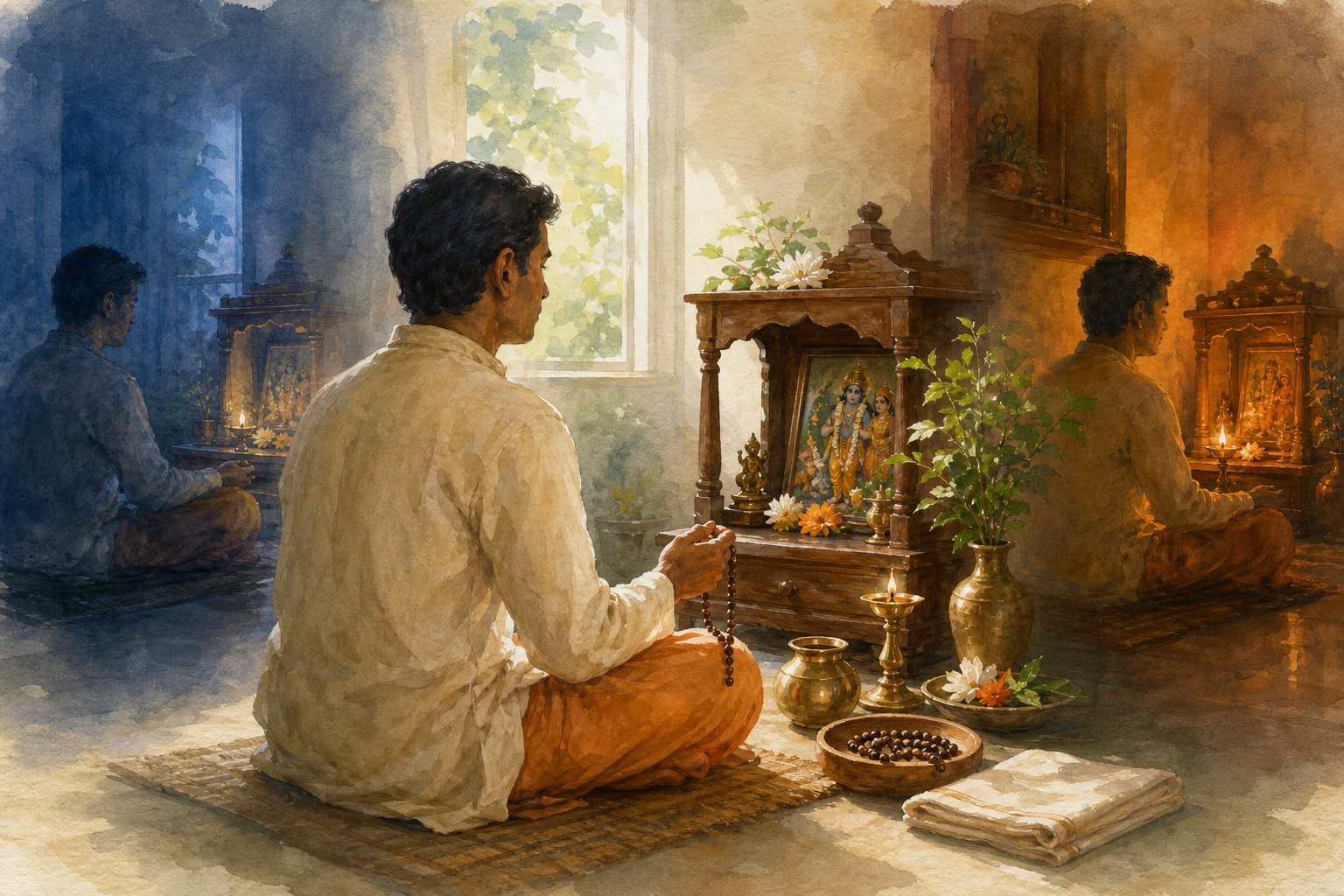
A mantra becomes easier to keep when the surrounding decisions have already been made. If you renegotiate the time, place, text, count, and method whenever you sit down, the negotiation will consume the energy meant for japa.
- Set a realistic minimum. Choose a repetition count or a complete recitation that still fits the hardest normal day in your schedule. The minimum is a floor, not a test of ambition. You may continue beyond it when circumstances allow.
- Attach the practice to a stable cue. Use the same part of your daily rhythm and, where practical, the same clean place. The cue should tell you to begin before mood gets a vote.
- Begin with a plain sankalpa. State why you are sitting: to remember Rama, steady the mind, and carry dharma into conduct. Avoid loading the practice with a long list of demands.
- Recite at a pace you can hear and understand. Clear repetition is more useful than speed that swallows syllables. If the mind is restless, gentle audible japa can give attention something definite to follow. Quieter repetition can follow when attention is stable.
- Return without drama. When you notice that the mind has wandered, resume at the present repetition. Do not turn the discovery of distraction into a second distraction built from self-criticism.
- Close deliberately. Sit briefly after the final repetition, remember the meaning of the name, and choose one way its dharma will enter the next part of your day.
A mala or counter can keep arithmetic out of your head, but it cannot measure devotion. Use it to protect attention, not to turn practice into a score. The count should serve continuity; continuity should serve remembrance.
Ram Manka 108 needs a slightly different scheduling decision. If you cannot complete it without racing, do not crush a long recitation into an unsuitable daily window. Keep a shorter Rama nama practice as the regular anchor, and undertake the full Ram Manka when you can give the complete text unhurried attention.
If you miss the practice, return at the next available opportunity. Do not double the count as punishment unless that discipline was specifically part of instructions you received. Guilt tends to enlarge a single interruption into abandonment; a quiet return keeps the interruption small.
Understand mantra siddhi without chasing a spectacle
Mantra siddhi can sound like a hidden threshold reached when the correct total has been accumulated. That expectation can quietly replace upasana with spiritual bookkeeping. A repetition total may organize discipline, but arithmetic alone cannot demonstrate realization.
Traditional descriptions use mantra siddhi for spiritual attainment or a mantra’s realized potency, placing dedicated japa and sadhana at the center and preferring qualified initiation and guidance. The practical emphasis is therefore not on discovering a shortcut. It is on becoming steady enough to remain with the discipline.
For an initiated mantra, let the lineage define the method and any criteria attached to siddhi. A generic online timetable cannot overrule instructions tied to a particular mantra and sampradaya. If you do not have such instructions, do not declare siddhi from an unusual dream, bodily sensation, emotional surge, or a period of effortless concentration. Experiences can be meaningful without functioning as certificates.
You can still notice whether the practice is maturing. Look for changes that can be tested in ordinary life:
- Less negotiation: you begin the practice with fewer excuses and less dependence on a special mood.
- Greater fidelity: you stop changing the mantra, method, or goal whenever novelty appears.
- Clearer recitation: pronunciation, pace, and attention become more stable rather than merely faster.
- Readier remembrance: Rama nama returns during difficulty without needing a dramatic setting.
- Better conduct: the practice makes dishonesty, cruelty, vanity, or neglect of duty harder to excuse.
These are signs of integration, not a private declaration of supernatural rank. They keep your attention on what upasana is doing to the practitioner. If thousands of repetitions leave speech harsher and duty easier to avoid, the count is not the part that needs admiration.
Correct the habits that quietly weaken japa
Changing mantras whenever enthusiasm drops: novelty produces a brief lift, but it prevents depth from becoming visible. Keep the chosen Rama practice unchanged until a considered review with your teacher, or until the review point you deliberately set before beginning.
Racing to finish: speed often increases when the count has become more important than the name. Slow down until the words are distinct. If a mistake becomes clear, correct it and continue; do not restart the entire sitting out of anxiety unless your received instructions require that.
Expanding the ritual faster than the practice: lamps, images, flowers, bells, and other familiar supports may have a proper place, but they should not make Rama nama impossible on an ordinary day. Keep the essential practice identifiable even when the full setting is unavailable.
Treating the mantra as a transaction: repeating Rama nama only to force a preferred outcome makes devotion dependent on whether events obey you. Bring your concern honestly, but do not make continued practice conditional on receiving a particular result.
Comparing private disciplines: another person’s large count or elaborate observance tells you little about the quality of your attention. Compare your present fidelity with your own previous inconsistency. That comparison produces a decision you can act on.
Separating recitation from dharma: after japa, choose a concrete expression of the remembrance. Keep a duty you have postponed, remove cruelty from a conversation, admit an error, or repair harm where you can. Rama upasana should not remain sealed inside the place where you chant.
Key takeaways
- Begin with one form: simple Rama nama, Sita-Rama nama, an initiated mantra, or a structured recitation such as Ram Manka 108.
- If you have diksha, preserve the mantra and method you received; take doubts back to a qualified guide in that tradition.
- Set a minimum that survives difficult ordinary days, and let longer practice remain optional rather than necessary for success.
- Use counts to hold attention, not as automatic proof of mantra siddhi.
- Judge maturation through fidelity, clearer remembrance, steadier recitation, and more dharmic conduct.
- After an interruption, resume the practice quietly instead of turning one missed sitting into abandonment.
Before your next sitting, write down the form you will use, the minimum you can keep, and the daily cue that will begin it. Leave those choices alone until a review point you select in advance. Then sit, remember Rama, and allow consistency to do the work that excitement cannot.
References
- Hindu Pad — Ram Manka 108, Shri Ramayan Manka | रामायण मनका 108, राम मनका
- Hindu Pad — How to get Mantra Siddhi in Upasana
