

If you have heard that Sita was Mandodari’s daughter, you may be wondering whether that claim contradicts the familiar account of Raja Janaka finding her in a field. It does not belong to the same narrative frame as a simple retelling of the furrow episode.
The clearest way to understand the difference is to separate birth, discovery and belonging. Once you stop asking all three questions as though they were one, the Adbhuta Ramayana’s distinctive account becomes much easier to read.
The short answer: Mandodari gives birth to Sita
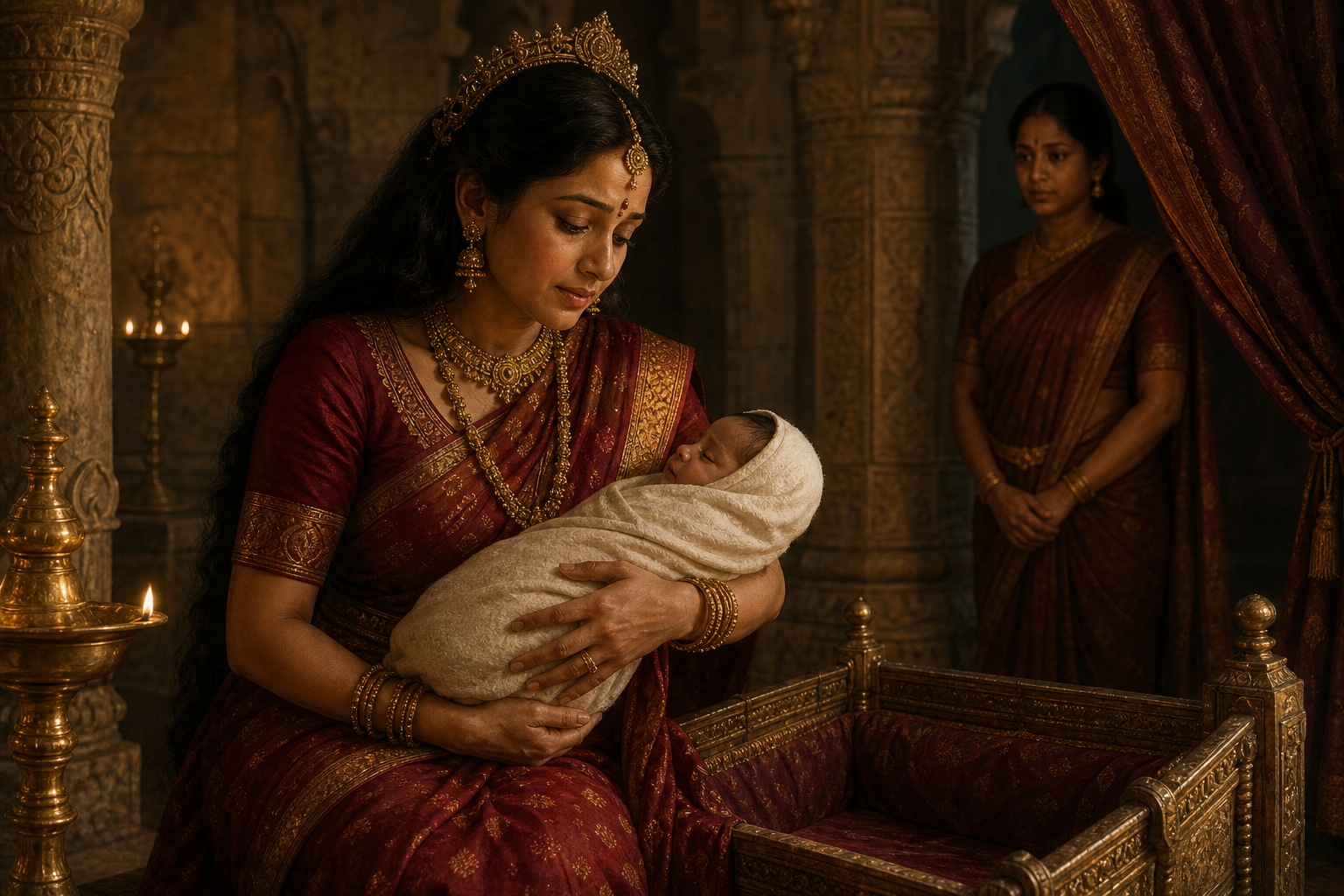
In the Adbhuta Ramayana’s alternative account, Mandodari gives birth to Sita. That is the central claim behind the frequently repeated statement that Sita is Mandodari’s daughter.
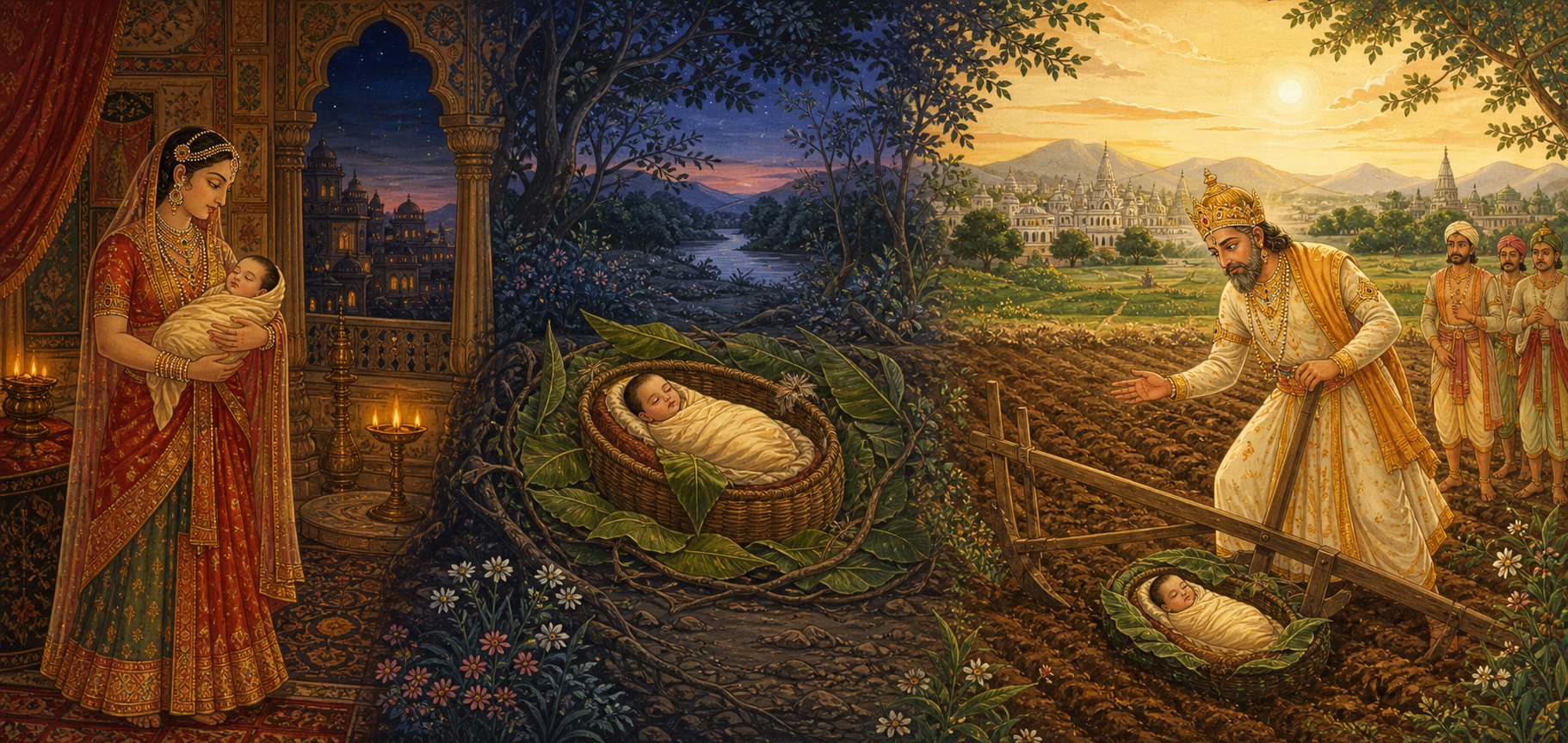
The more familiar telling places the emphasis elsewhere. Raja Janaka discovers an infant while ploughing a field in Mithila. He names her Sita, connecting her identity with the earth’s furrow. One account therefore answers the question of hidden birth through Mandodari, while the familiar episode explains Sita’s discovery and her recognized place in Mithila.
This distinction matters because phrases such as earth-born, found in the furrow and daughter of Mandodari are often repeated as if they were competing entries in a modern birth record. Ramayana traditions do not always organize sacred identity that way. Biological origin, miraculous appearance, discovery, naming and family belonging can carry different layers of meaning.
Birth, discovery and belonging answer different questions
When you encounter apparently conflicting claims about Sita, sort them into three categories before deciding that one must cancel another:
- Birth: Who gives birth to Sita? In the Adbhuta Ramayana account, the answer is Mandodari.
- Discovery: Who encounters the infant in the world known to her future family? In the familiar furrow account, Raja Janaka finds her while ploughing.
- Name and belonging: How does the child become Sita of Mithila? Her name and remembered identity remain connected with the furrow in which Janaka discovers her.
These categories prevent two common mistakes. The first is saying that all Ramayana traditions give the same account of Sita’s birth. They do not. The second is treating Mandodari’s maternity as proof that the Janaka tradition must be discarded. That conclusion also goes beyond what the existence of an alternative birth narrative establishes.
If you need one careful sentence for a discussion, use this: In the Adbhuta Ramayana, Mandodari gives birth to Sita; in the familiar furrow narrative, Janaka discovers Sita in Mithila and names her in connection with the furrow. This wording identifies the tradition and preserves the exact distinction.
What Mandodari’s motherhood changes in the story
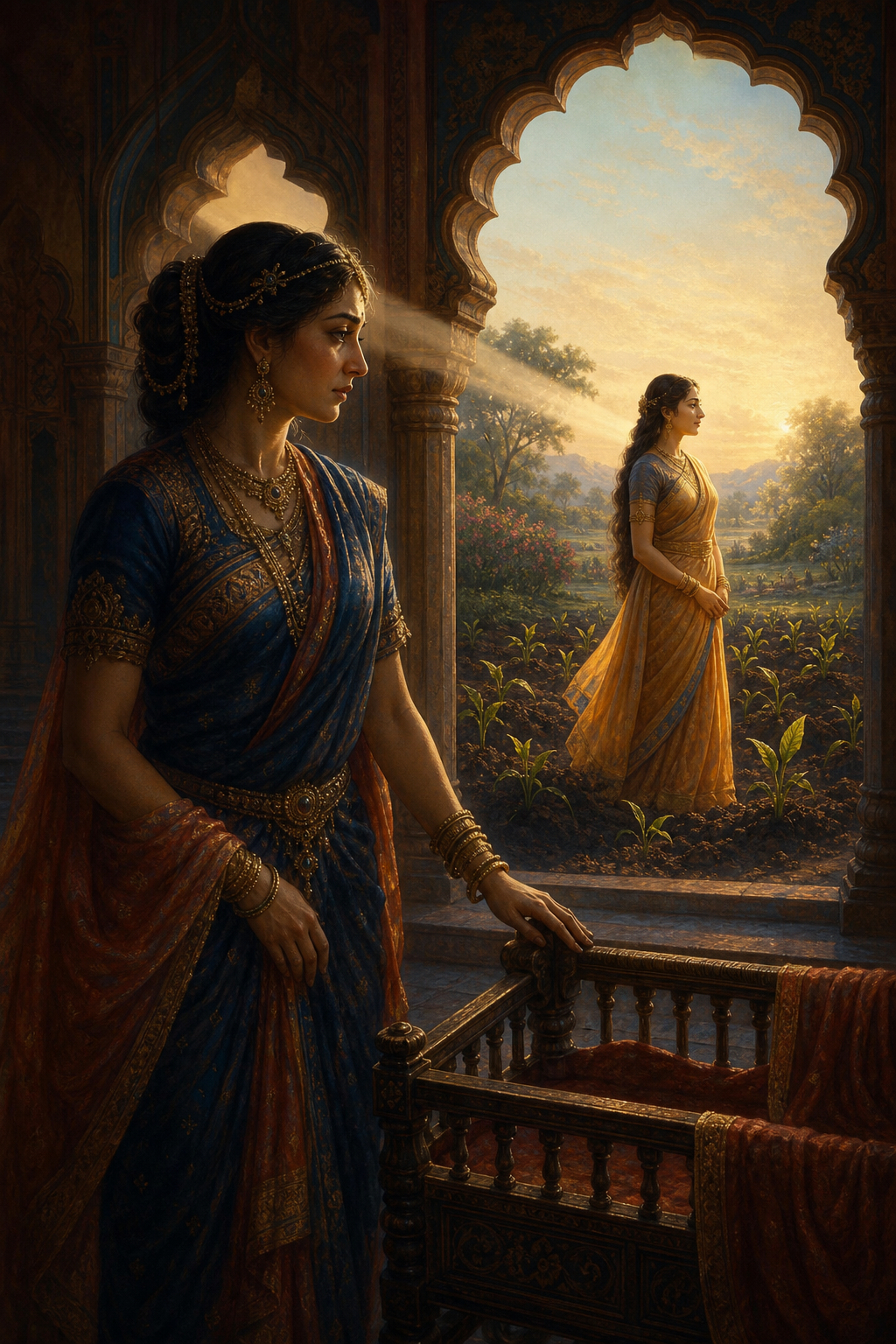
The Mandodari account changes more than a genealogical detail. It places concealed maternity behind a figure whose visible identity is associated with the earth, the furrow and Janaka’s discovery. Sita’s origin and her appearance in Mithila no longer have to be understood as one undivided event.
One reasonable spiritual reading is that a person’s deepest identity cannot be reduced to a single biological or social label. Sita may be approached through motherhood, discovery, name, place and sacred significance without making every layer perform the same function. This is an interpretation of the narrative structure, not a substitute for the narrative itself.
The alternative also invites you to notice how secrecy and recognition operate. Mandodari’s role concerns an origin that is not contained in the familiar public identity of Sita of Mithila. Janaka’s role concerns recognition: he finds the child, receives her and gives her a name tied to the place of discovery. Asking which role matters more is less illuminating than asking what each role contributes.
Keep the symbolic possibilities open, but do not turn them into unsupported facts. The secure claim is that the Adbhuta Ramayana attributes Sita’s birth to Mandodari. Broader statements about what every character knows, why every event occurs or which theological doctrine the episode proves require more textual detail than that core claim alone provides.
How to read variant Ramayana accounts accurately
You do not have to choose between blind harmonization and dismissing one tradition as a mistake. A more disciplined reading takes five steps:
- Name the text. Say Adbhuta Ramayana when discussing Mandodari’s maternity. Do not present that account as though it appeared identically in every Ramayana.
- Use precise verbs. Gave birth, found, named and raised are different claims. Replacing them all with was the daughter of creates avoidable confusion.
- Preserve the familiar account on its own terms. Janaka’s discovery of the infant while ploughing in Mithila explains why Sita is remembered through the furrow and the earth-born image.
- Separate narration from interpretation. State what happens first. Only then discuss what hidden birth, discovery or earth symbolism may mean.
- Avoid declaring a universal correct version. If your purpose is devotional, literary or historical, say which tradition you are following and why that tradition is relevant to the question.
This method works especially well in family discussions, study groups and online exchanges, where people often remember conclusions without remembering their textual setting. Asking which Ramayana is meant usually resolves more confusion than arguing immediately about which account is true.
It also protects the richness of the tradition. Variation is not the same as carelessness. A distinct account can redirect attention toward a different relationship or spiritual question while remaining recognizably part of the wider Ramayana world.
Key takeaways
- The Adbhuta Ramayana identifies Mandodari as the woman who gives birth to Sita.
- The familiar account emphasizes Raja Janaka discovering an infant while ploughing a field in Mithila.
- Birth and discovery are different events, so the verbs used to describe them matter.
- Sita’s name remains associated with the earth’s furrow in the familiar Janaka narrative.
- The safest way to discuss the variation is to name the relevant Ramayana and distinguish textual fact from spiritual interpretation.
The next time you encounter the claim that Sita was Mandodari’s daughter, do not answer with a flat yes or no. Ask which Ramayana is being discussed, separate birth from discovery, and let each tradition speak in its own terms.

References
