

You may have encountered the Tushita Devatas in a cosmological list, only to discover that the name receives far less explanation than familiar deities such as Agni, Indra, or Surya. The practical question is not only who the Tushitas are, but also how much the name allows you to conclude.
The sound answer is precise but modest: the Tushitas are a plural order of devas associated with satisfaction or contentment. Their name gives us a dependable interpretive centre. It does not, by itself, supply a complete genealogy, iconography, ritual, or celestial geography.
What the name Tushita actually tells you

Tushita is connected to the Sanskrit root tush, carrying the sense of being satisfied, pleased, or content. That derivation is the safest place to begin because it identifies the quality around which this divine order is understood.
Pay attention to the plural. Tushita Devatas does not ordinarily name one personal deity with a single biography. It designates a class or company of celestial beings. Translating the expression loosely as the gods of contentment can help at first, provided you remember that the English word god often erases distinctions that Hindu cosmology preserves among deities, divine orders, attendants, guardians, and other celestial beings.
The name therefore supports three conclusions:
- Linguistically: satisfaction, pleasure, and contentment belong to the name’s semantic field.
- Cosmologically: Tushita refers to a plurality of devas rather than merely to an abstract human emotion.
- Philosophically: contentment can be contemplated as a quality with a place in the moral and cosmic order, not just as a passing mood.
The third point is an interpretation of the first two, not permission to manufacture a detailed mythology. A meaningful name can reveal a being’s governing principle without telling you everything about that being.
A divine order rather than a single personal deity

Hindu cosmology is populated by many kinds and orders of beings. Some are remembered through vivid narratives and widely performed worship. Others appear primarily as members of a celestial class. The Tushitas belong to this less familiar part of the cosmological vocabulary.
This distinction changes how you should read the name. If you approach every devata as though you were looking for one individual with a fixed image, vehicle, consort, weapon, and temple ritual, you may ask the wrong questions. A collective name may identify a shared nature or cosmic function before it identifies individual personalities.
Begin, therefore, with the collective meaning: the Tushitas embody or represent contentment within a many-layered universe. Do not turn silence about individual members into evidence that the class is unimportant. Prominence in popular worship and significance within cosmological classification are different things.
This also helps with the phrase forgotten gods. Forgotten by whom, and in what setting? A divine order may be unfamiliar in contemporary popular conversation while remaining intelligible within the conceptual architecture of Hindu cosmology. Obscurity is not the same as absence.
Contentment here does not mean abandoning dharma
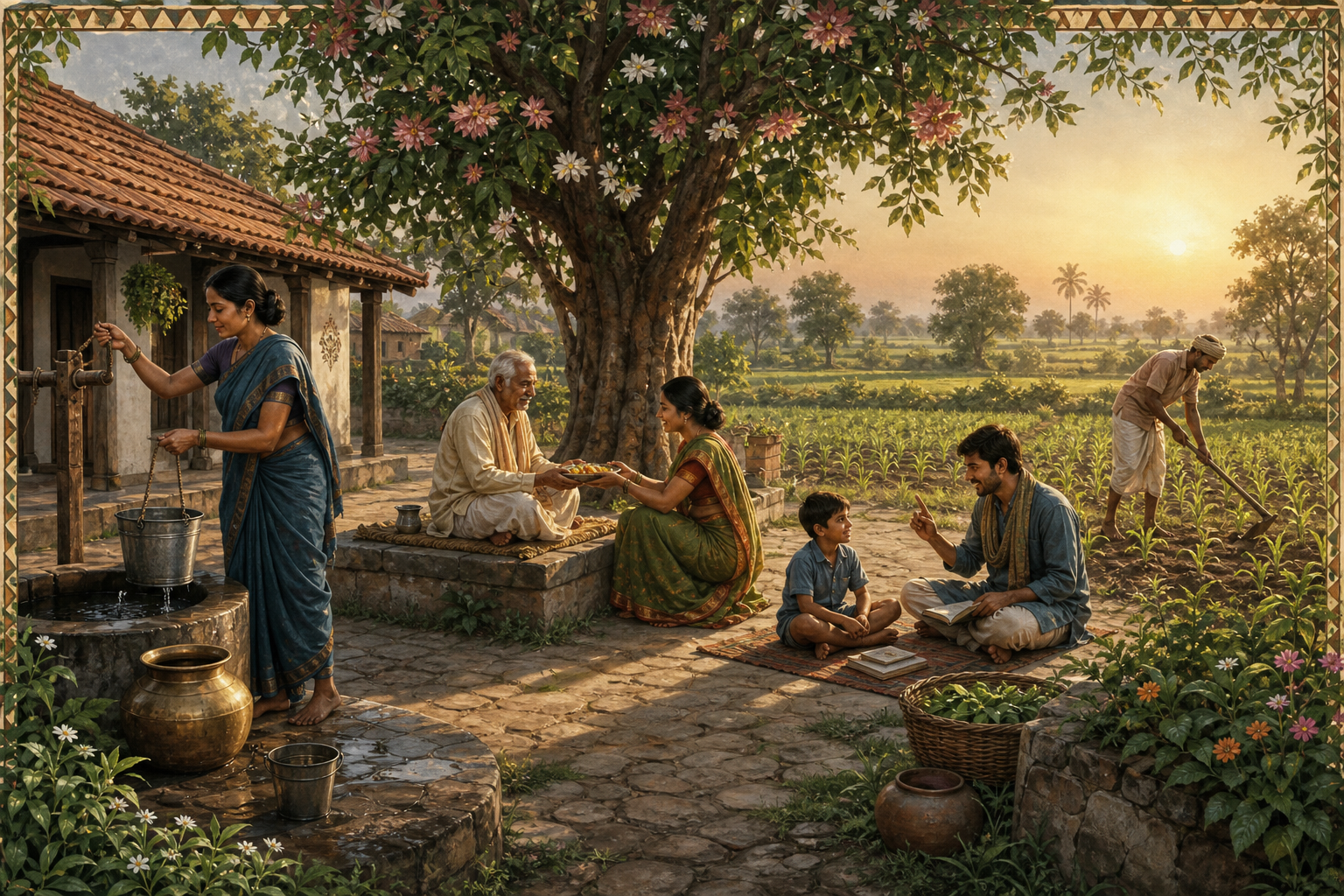
The word contentment can be misunderstood as approval of whatever happens. That reading turns a stabilising virtue into an excuse for passivity. A more useful dharmic distinction separates the duty to act from the craving to control every result.
You can be content without becoming indifferent. Contentment regulates appetite, comparison, resentment, and possessiveness. It does not erase the obligation to protect, learn, work, serve, repair an injustice, or keep a promise. If your supposed contentment makes you neglect a clear responsibility, it is functioning as avoidance rather than virtue.
The Tushita idea is therefore most useful as a diagnostic lens. When desire is disturbing your judgement, work through four questions:
- What is actually required? Name the duty, need, or legitimate commitment before discussing detachment.
- What am I adding to it? Separate the necessary aim from the wish for status, praise, superiority, or perfect control.
- What action remains mine? Do the work that falls within your responsibility rather than using spiritual language to avoid it.
- What can be released afterward? Notice whether continued agitation serves the duty or merely feeds dissatisfaction.
This is not a prescribed historical ritual for worshipping the Tushita Devatas. It is a disciplined way to apply the quality expressed by their name. The distinction matters: reflection inspired by a cosmological idea should not be presented as an inherited rite unless a particular tradition or text establishes one.
A simple test can keep the reflection honest. Genuine contentment should make you less governed by comparison while leaving you capable of decisive action. Complacency does the reverse: it leaves attachments untouched while weakening your willingness to fulfil a difficult obligation.
How to investigate Tushita references without inventing lore

Little-known cosmological terms invite confident embellishment. A short definition gets repeated, details from another tradition are attached to it, and speculation eventually looks like established doctrine. You can avoid that problem with a careful reading method.
- Record the exact form of the name. Transliteration and spelling variations can matter when you search an index, translation, or Sanskrit text.
- Check whether the expression is singular or plural. In this case, the plural points you toward a divine class rather than one individual deity.
- Separate etymology from narrative. The root meaning explains why contentment is central. It does not automatically prove a particular parentage, dwelling place, icon, mantra, or ritual.
- Read the surrounding passage. A name in a list of divine orders performs a different role from the same name in a story, hymn, or ritual instruction.
- Identify the textual and sectarian setting. Hindu cosmological descriptions need not use every classification in precisely the same way. Preserve the setting instead of flattening variations into one supposedly universal chart.
- Mark interpretation as interpretation. Saying that the Tushitas invite reflection on contentment is reasonable. Claiming an obligatory practice requires stronger textual or traditional grounding.
You should also resist merging similar terms across Dharmic traditions too quickly. Buddhist traditions use the cognate name Tusita in their own cosmological framework. The linguistic resemblance is important, but resemblance does not prove that every Hindu and Buddhist occurrence refers to an identical class, realm, doctrine, or narrative. Compare contexts before drawing a connection.
This method gives you a useful confidence scale. Treat the association with contentment and the collective character of the Tushitas as the firm core. Treat broader philosophical implications as reasoned interpretation. Treat unverified names, stories, locations, images, and ritual instructions as claims that still need an identifiable textual or living-tradition basis.
Key takeaways
- The Tushita Devatas are best approached as a plural order of celestial beings, not as one personal deity.
- Their name is rooted in the sense of being satisfied, pleased, or content, making contentment their clearest interpretive theme.
- Hindu cosmology can embody a moral or spiritual quality in a class of divine beings rather than presenting that quality only as advice for human conduct.
- Contentment should steady action and restrain craving; it should not excuse neglect of dharma.
- A name’s meaning does not establish an entire mythology. Verify any claimed genealogy, realm, iconography, mantra, or ritual in its specific textual or traditional context.
- The Buddhist cognate Tusita should be compared carefully, not automatically treated as identical to the Hindu classification.
The next time you meet the Tushitas in a cosmological list, pause over what their name preserves. Let it direct your attention to contentment as a power that can order desire, then return to the exact passage before making a larger claim. That combination of contemplation and textual care is the most respectful way to recover a little-known divine order.
References
