
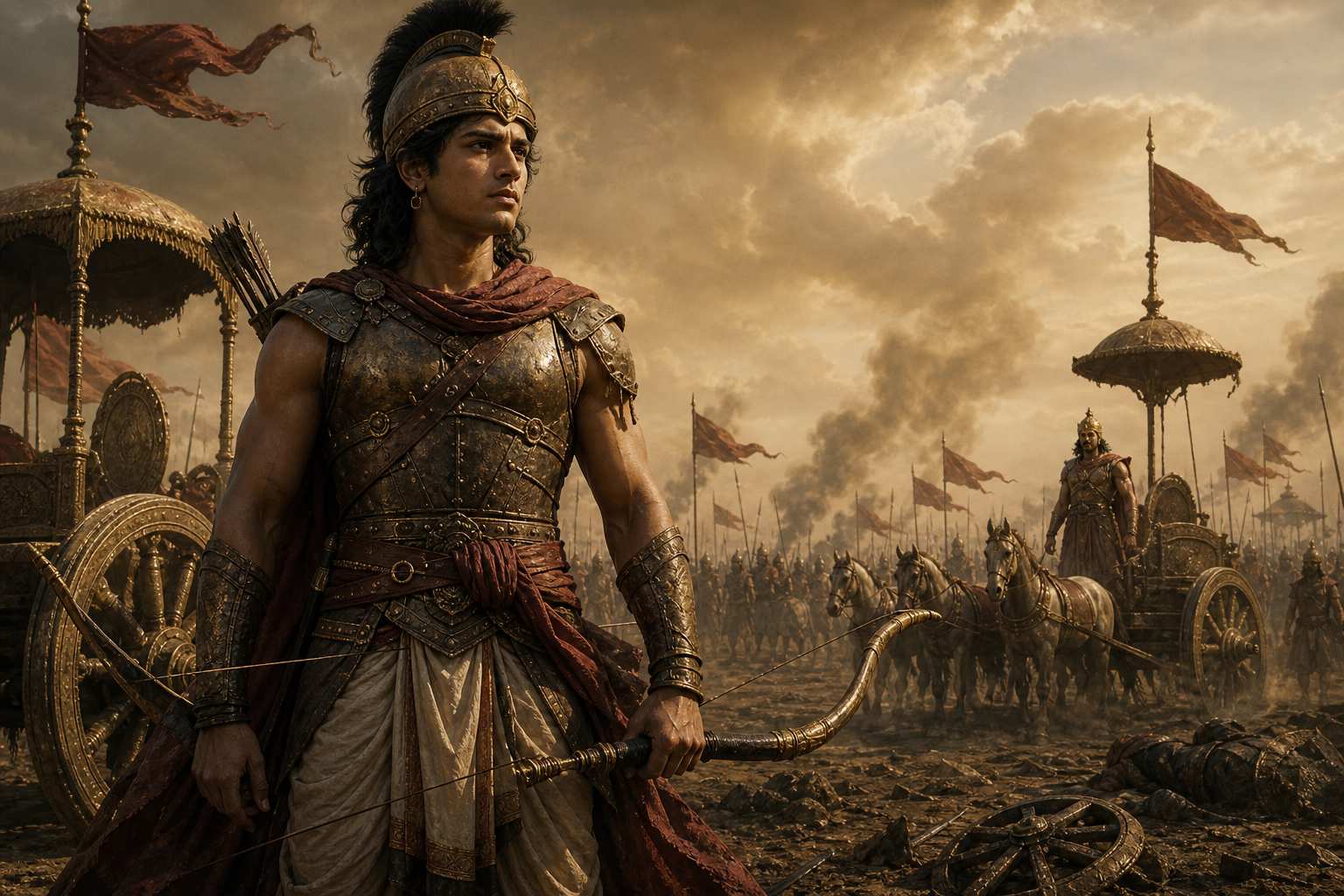
You may know Karna’s anguish, Arjuna’s prowess and Bhima’s force, yet still pause when Vrishasena appears. Who was he, and should you remember him as anything more than Karna’s son?
The clear answer is that Vrishasena belongs in the Mahabharata’s martial world as a warrior in his own right. His lineage explains where he stands, but it shouldn’t be allowed to consume his identity. That distinction is the key to reading him well.
Who Vrishasena was in the Mahabharata
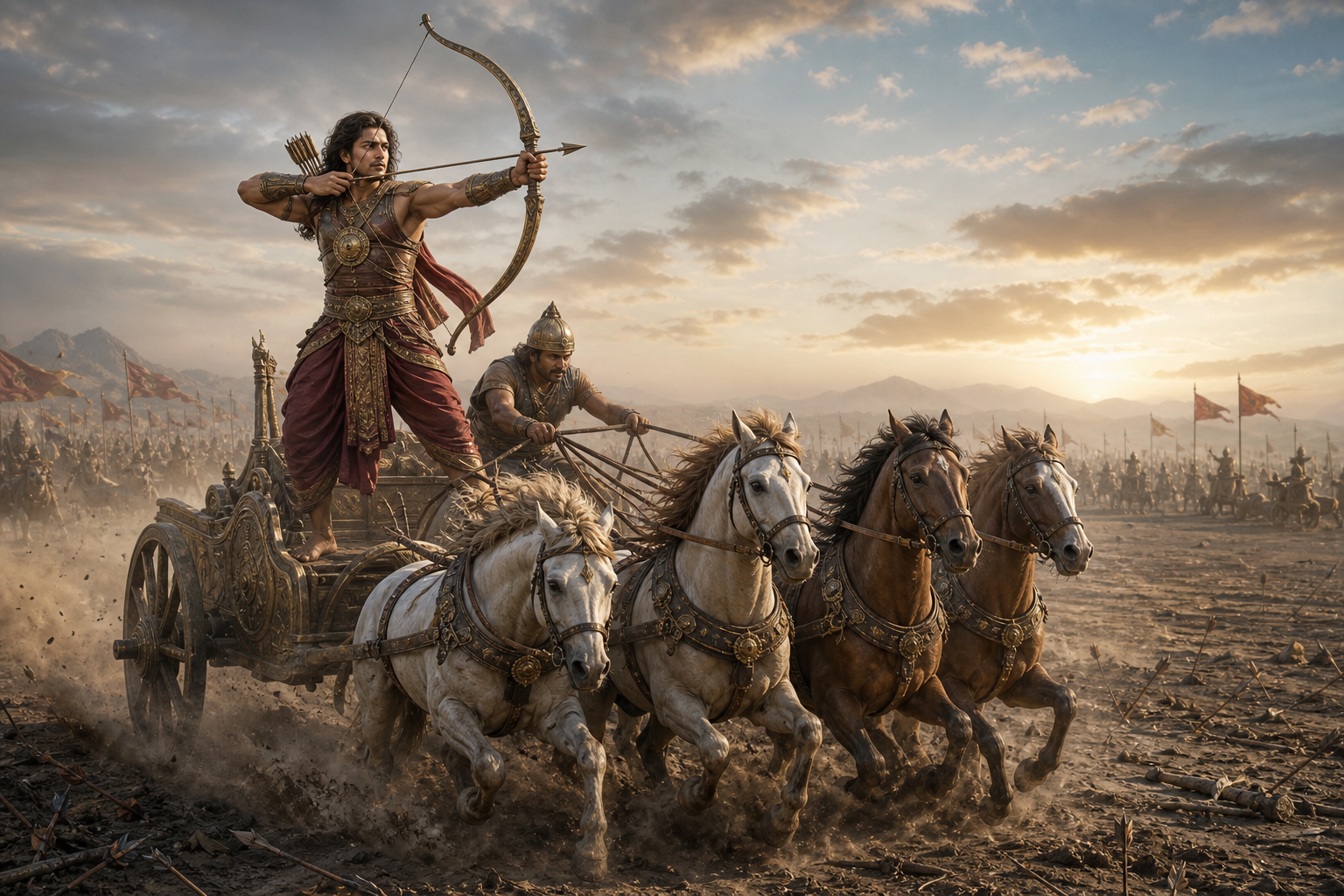
Vrishasena was Karna’s eldest son and a formidable warrior who fought in the Kurukshetra War. Those three facts give you the firm outline of his identity: he belongs to Karna’s family, he participates in the epic’s decisive conflict, and he possesses martial standing of his own.
The word “eldest” identifies his place within the family. It does not, by itself, prove that he was Karna’s political heir, his equal in ability or the most important of his children. Keeping that boundary in mind prevents a common error: turning a precise genealogical fact into several unsupported claims.
Vrishasena also tends to recede behind the much larger memories of Arjuna, Bhima and Karna. That difference in fame is not a measure of whether his conduct mattered. The Mahabharata’s great scale naturally produces figures whose importance is concentrated in the battlefield, the family or a particular moral relationship rather than spread across the entire narrative.
If you need a one-sentence identification for study or discussion, use this: Vrishasena is Karna’s eldest son, remembered as a capable warrior in the Kurukshetra conflict. It is concise, accurate and free of embellishment.
Why Karna’s name clarifies and obscures his son
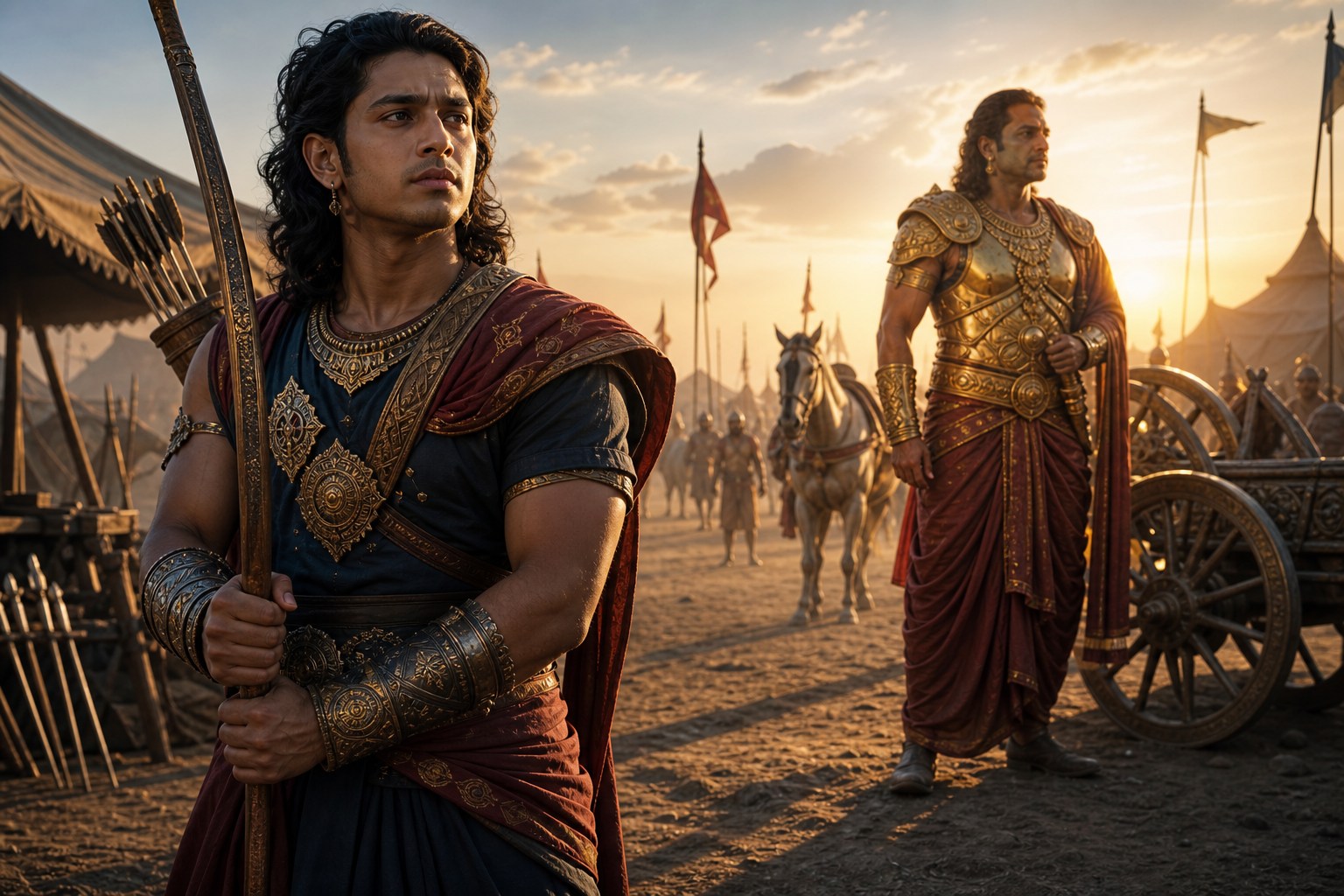
Karna’s fame gives Vrishasena an immediate place in the epic. It tells you that the younger warrior does not enter Kurukshetra as an isolated combatant. He carries a family connection to one of the conflict’s most consequential and tragic personalities.
That same connection can become a trap. When a father’s story dominates cultural memory, the son’s choices are often treated as an appendix to it. Vrishasena then becomes “Karna’s son” and nothing more. Yet the description of him as a formidable warrior requires a second line in your mental record: he is connected to Karna by birth, but he enters the war as an active combatant.
You can preserve that distinction with a simple reading habit:
- Record the relationship: Vrishasena is Karna’s eldest son.
- Record the independent role: Vrishasena is a warrior in the Kurukshetra War.
- Ask what the relationship explains about his loyalties and burdens.
- Ask what his own conduct reveals, without assuming that the father and son are interchangeable.
This approach is useful beyond Vrishasena. The Mahabharata repeatedly places people inside dense networks of kinship, obligation and inherited conflict. Lineage is therefore essential context, but it is not a complete moral biography.
Courage is not the same as a moral verdict
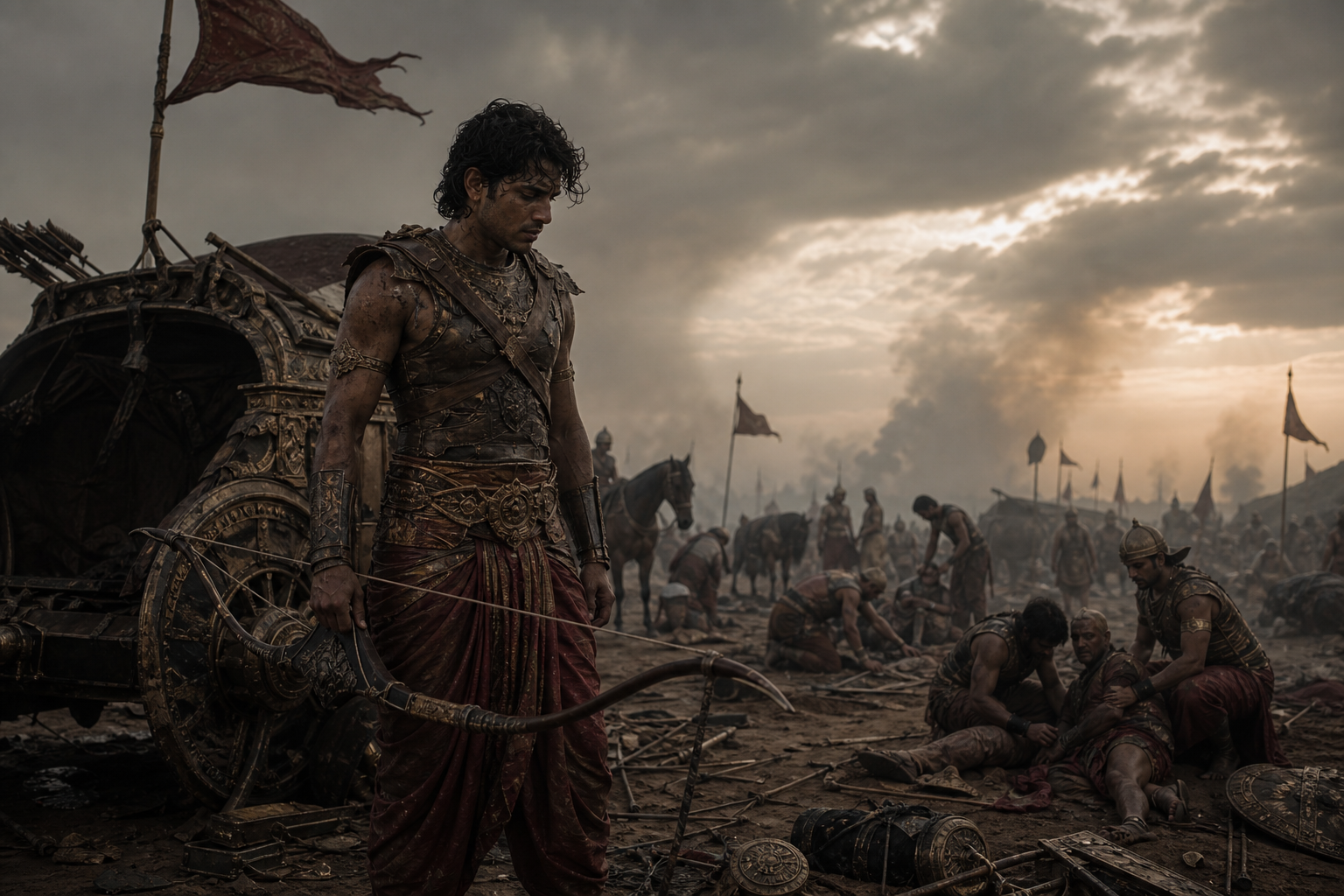
Vrishasena’s valor deserves recognition. It would nevertheless be a mistake to treat battlefield courage as automatic proof that every allegiance, decision or consequence surrounding a warrior was righteous.
This distinction is central to a mature Dharmic reading of the Mahabharata. The epic does not require us to flatten every participant into either a flawless hero or a worthless villain. A person can display discipline, loyalty and martial ability while standing inside a tragic or morally compromised chain of events. Conversely, fighting for a cause judged righteous does not make every act beyond examination.
When you encounter praise of Vrishasena’s bravery, read it through three separate lenses:
- Martial lens: What does the description establish about his ability and willingness to fight?
- Relational lens: How does being Karna’s eldest son shape the way you understand his presence in the conflict?
- Dharmic lens: What do loyalty, inherited obligation and the cost of war demand that you examine rather than excuse?
Keeping these questions separate lets you honour courage without converting admiration into moral simplification. It also prevents the opposite error: erasing a warrior’s ability merely because you disapprove of the camp in which he fought.
Vrishasena is particularly valuable in this respect. His position invites you to notice how war extends beyond the most famous rivals. The conflict absorbs sons as well as fathers, and the consequences of adult loyalties travel through families. That is not a decorative detail. It is part of the human cost by which the epic makes the burden of adharma visible.
How to separate the epic from later embellishment
Lesser-known Mahabharata figures are especially vulnerable to confident but unsupported storytelling. A vivid narration may add speeches, motives, private thoughts or rankings of warriors that sound plausible without being securely established. Repetition then makes the addition feel canonical.
You do not need to reject retellings. You do need to label them correctly. Use this four-step check whenever you encounter a detailed claim about Vrishasena:
- Identify the kind of claim. A relationship, a battlefield action, a moral judgement and an imagined conversation require different levels of evidence.
- Look for a textual location. A serious canonical claim should be traceable to a named edition, translation and passage of the Mahabharata. Use the book, parva and chapter numbering printed in that edition rather than assuming that every edition is organized identically.
- Separate description from interpretation. “Vrishasena was Karna’s eldest son” is an identity claim. “Vrishasena represents the burden of inherited loyalty” is an interpretation. The second may be insightful, but it should not masquerade as a line spoken by the epic.
- Leave gaps open. If a motive or conversation cannot be verified, say that it is uncertain. An honest gap is more useful than invented certainty.
This discipline matters because Vrishasena’s relative obscurity can tempt readers to fill the silence with whatever suits a preferred view of Karna. Admirers may idealize the son in order to magnify the father. Critics may diminish him for the same reason. In both cases, Vrishasena disappears again, this time beneath somebody else’s argument.
A better approach begins with the modest but meaningful record available to you: identify him accurately, recognize his martial character, and distinguish what is known from what you infer. If you later find a passage-level account of a specific encounter, add it with its textual location rather than rewriting the whole character around it.
Key takeaways for remembering Vrishasena
- Vrishasena is identified as Karna’s eldest son.
- He should be remembered as a formidable Kurukshetra warrior, not merely as an entry in Karna’s genealogy.
- His father’s fame supplies vital context but should not erase his individual role.
- Recognition of valor is not an automatic verdict on every allegiance or action surrounding a warrior.
- Detailed claims about his battles, words or motives should be checked against a named Mahabharata edition and a specific passage.
The next time Vrishasena’s name appears, do not hurry past it on the way to Karna or Arjuna. Pause over the family connection, the warrior’s own agency and the cost carried by the next generation. That small act of attention gives you a more faithful way to read both Vrishasena and the vast human field of the Mahabharata.
References

Leave a Reply
You must be logged in to post a comment.