

You are probably checking August 20 for a puja, vrata, sankalpa, temple visit, or family observance. The first thing you need to know is which tithi applies when you intend to act, because the answer changes late that evening.
On Thursday, August 20, 2026, Shukla Paksha Ashtami continues until 9:58 PM; Shukla Paksha Navami begins afterward. Use that transition as a calendrical boundary, but verify the clock time in a panchang calculated for your location before arranging a tithi-sensitive observance.
August 20 Panchang at a glance
| Calendar element | August 20, 2026 |
|---|---|
| Weekday | Thursday |
| Paksha | Shukla Paksha, the waxing or light half of the lunar month |
| Tithi until 9:58 PM | Ashtami, the eighth lunar day |
| Tithi after 9:58 PM | Navami, the ninth lunar day |
The practical point is that a Hindu lunar date does not wait for civil midnight to change. August 20 is predominantly an Ashtami day, but its final portion falls under Navami according to the published transition. You should not label the entire civil date Navami merely because Navami starts that night, nor assume that Ashtami remains in force until midnight.
Shukla Paksha identifies the brightening half of the lunar cycle. Ashtami and Navami identify successive tithis within that paksha. Keeping paksha and tithi together matters: saying only “the eighth” or “the ninth” leaves out which half of the lunar month you mean.
Use 9:58 PM as a tithi boundary, not a universal muhurta

The 9:58 PM transition answers one specific question: when Ashtami gives way to Navami. It does not, by itself, declare every moment before that time auspicious or every moment afterward unsuitable. Tithi and muhurta are related parts of calendrical planning, but they are not interchangeable.
A fuller muhurta decision can also depend on the weekday, nakshatra, yoga, karana, local sunrise, the nature of the intended act, and the rules followed by your sampradaya or family. Do not turn one tithi cutoff into a wedding, griha-pravesha, initiation, or other major-samskara recommendation without that additional examination.
- If you need the tithi presently running during a routine puja, use Shukla Ashtami before the transition and Shukla Navami after it.
- If a vrata is governed by the tithi at sunrise or during a particular part of the day, follow that observance-specific rule rather than choosing solely by convenience.
- If a temple has announced its observance schedule, use the temple’s local calculation and instructions. Its ritual timing may be tied to more than the tithi’s ending time.
- If you live outside the location or time convention behind the 9:58 PM figure, consult a city-specific panchang. Do not copy the displayed clock time directly into another time zone.
Plan a puja or vrata without straddling the transition
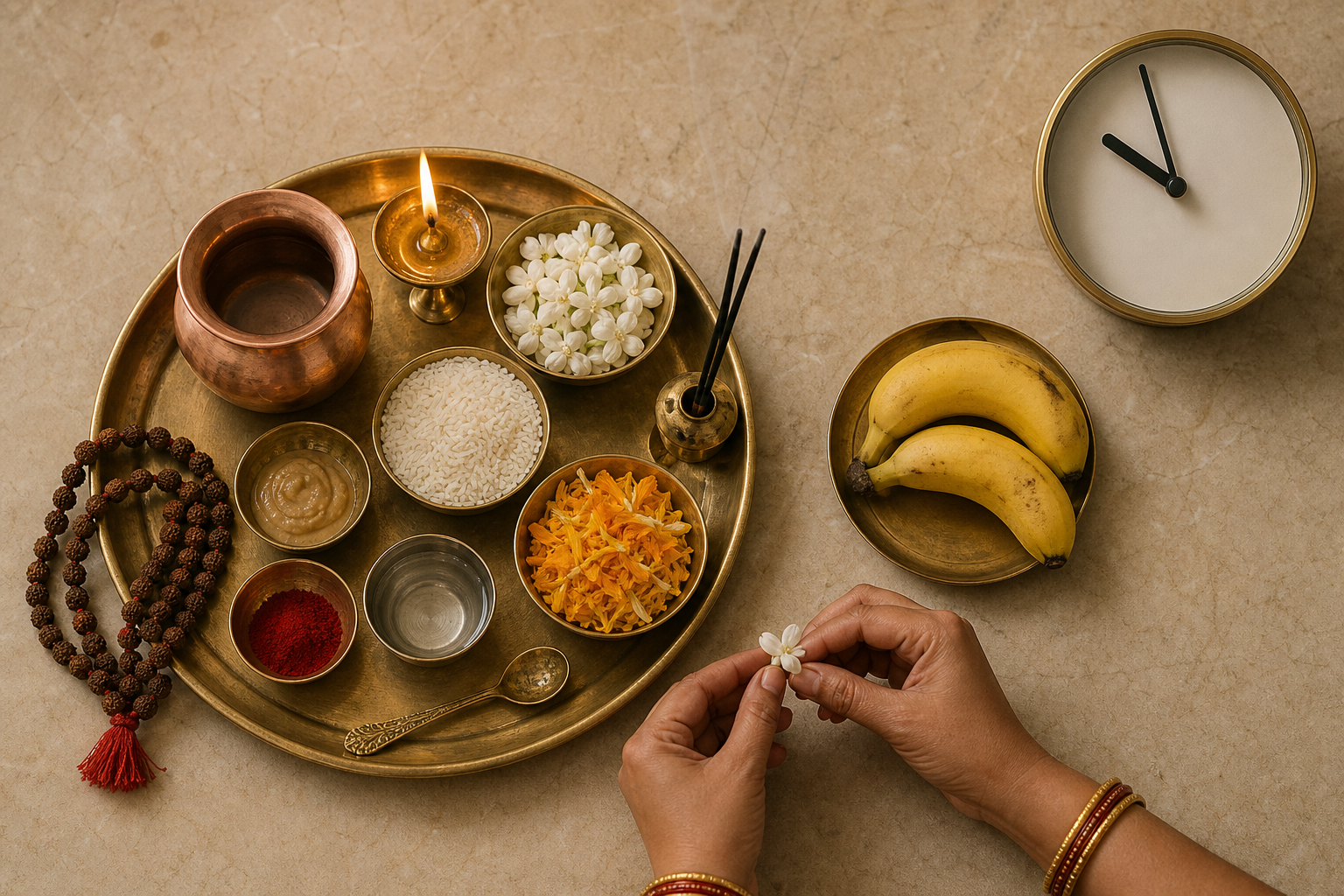
Most confusion can be avoided by deciding what your observance actually requires before choosing an hour. “We want to pray on Thursday” is a different requirement from “the sankalpa must be made during Shukla Ashtami.” The first allows broad flexibility; the second makes the tithi boundary decisive.
- Name the requirement precisely. Write down whether you need the weekday, Ashtami, Navami, or a formal muhurta. This prevents a general preference from being mistaken for a ritual rule.
- Identify the decisive moment. Ask whether your tradition applies the tithi at sunrise, at the beginning of the rite, during the main offering, or during another prescribed period. Observances do not all use one universal selection rule.
- Stay clear of the cutoff. If the rite must occur on Ashtami, plan to complete its tithi-sensitive portion clearly before 9:58 PM on the relevant local calculation. If it must occur on Navami, begin clearly after the verified transition. Avoid making the rite depend on a clock reading at the exact boundary.
- Confirm your location. Panchang use is local. Select the city where the observance will physically occur, not the location of relatives joining remotely or the location where a calendar was printed.
- Seek the missing ritual rule when necessary. For a vrata, samskara, or temple ceremony, ask the officiating priest which part of the observance must fall within the required tithi. That is a more useful question than simply asking whether August 20 is “good.”
What to record for your sankalpa

If your puja begins before the verified transition, the relevant tithi wording is Shukla Paksha Ashtami. If it begins after the transition, it is Shukla Paksha Navami. This distinction is the part of the sankalpa that changes during the evening.
A complete sankalpa commonly includes other calendrical and geographical elements. Those details are not established by the tithi cutoff alone, so do not assemble a full formula by guessing the lunar month, samvatsara, nakshatra, yoga, karana, or local place-name. Give your priest your city, the planned start time, and whether the rite must be tied to Ashtami or Navami; those facts allow the remaining wording to be checked properly.
Key takeaways
- August 20, 2026 is Thursday and falls under Shukla Paksha.
- Shukla Ashtami continues until 9:58 PM, after which Shukla Navami begins.
- The tithi transition is not a universal auspicious-time recommendation.
- A vrata or samskara may use sunrise, a prescribed part of the day, or another tradition-specific criterion.
- Verify the transition in a panchang for the city where the observance will take place.
Before putting the observance on your calendar, decide whether you merely want to worship on August 20 or specifically need Ashtami or Navami. Then confirm the local transition and place the tithi-sensitive part of the rite comfortably on the correct side of it.
References
