
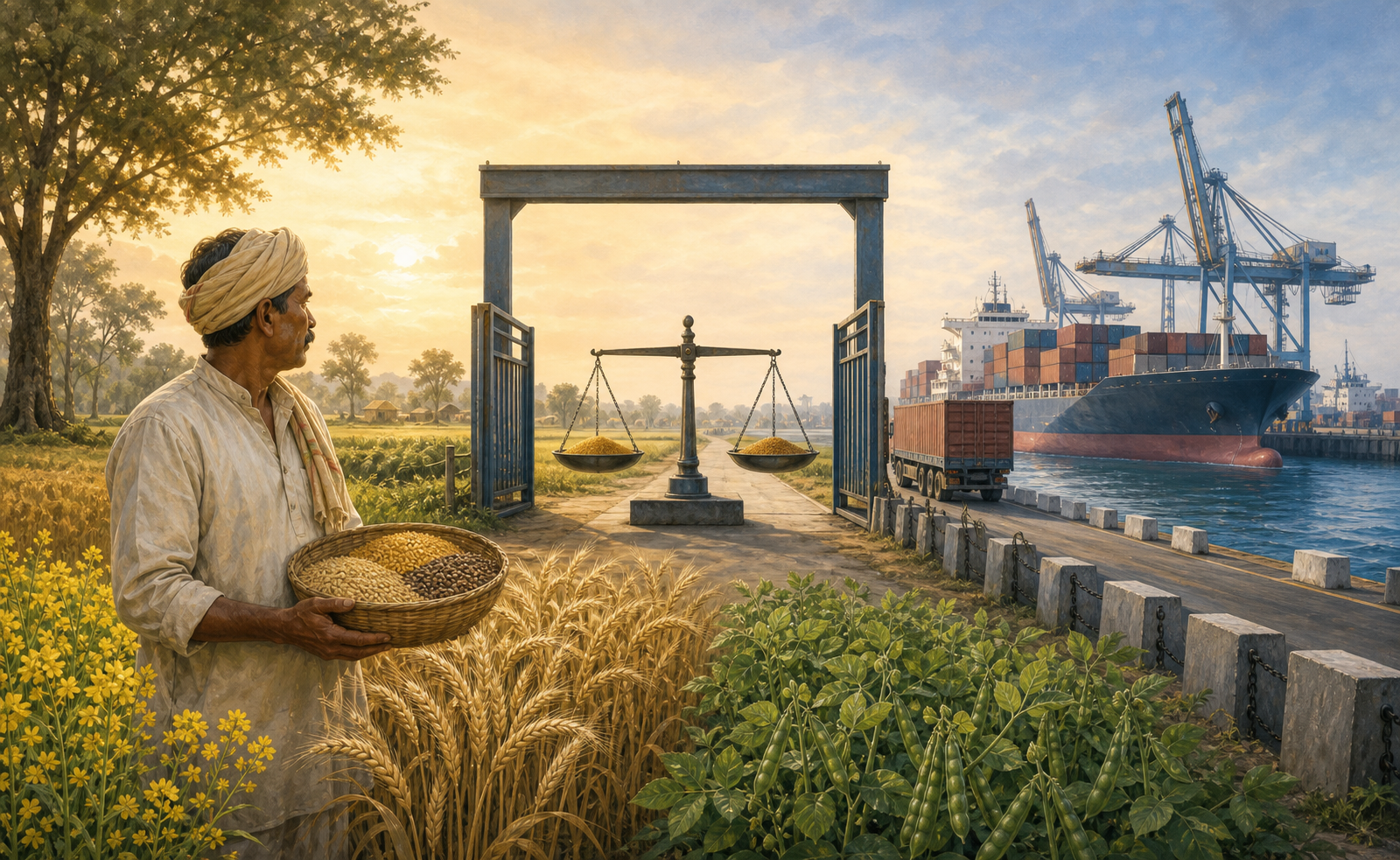
You see a headline saying US-India trade talks have stalled over agriculture, and the immediate question is whether New Delhi is defending vulnerable farmers or merely protecting an inefficient system. Both risks are real. Unconditional market opening can damage rural livelihoods, while permanent protection can leave farmers trapped behind the same middlemen and weak infrastructure.
The useful question is not whether India should be open or closed. It is whether a proposed concession identifies the products, limits the volume and pace of disruption, enforces India’s food standards, improves access for Indian interests, and gives farmers time to become more competitive. If those details are missing, there is not enough information to call the proposal either reform or surrender.
Agriculture is not just another tariff line
A tariff on an ordinary consumer product mainly changes its price and the competitive position of its producers. Agricultural access can reach much further. It can affect farmgate prices, rural cash flow, domestic processing, storage investment, and the country’s ability to maintain dependable food supplies during an external shock.
That is why India’s political memory matters. The country emerged from colonial rule with a damaged agricultural economy and later experienced dependence on foreign food assistance. The memory of food insecurity, food aid and PL-480 makes control over the food system a question of sovereignty, not merely sentiment.
This history does not prove that every tariff should remain in place. Food security does not require zero imports, and self-reliance does not mean producing everything domestically at any cost. It does mean that India should not become dependent on an external supplier for politically or nutritionally important food merely because imports are temporarily cheap.
The livelihood question is equally serious. Agriculture supports many Indians with little financial room to absorb a sudden fall in prices. A large foreign producer can survive a weak season, redirect shipments, or use established processing and logistics networks. A small cultivator facing debt, limited storage, and an immediate need for cash may have no comparable buffer.
When you assess a proposal, therefore, ask four questions before debating its ideology:
- Which exact products would receive lower tariffs or easier entry?
- Would the imports directly substitute for crops grown by financially vulnerable Indian farmers, or fill a genuine domestic shortage?
- How quickly could import volumes rise, and could India respond if the change caused serious disruption?
- Would the lower border price reach Indian consumers, or be captured by importers, processors and retailers?
A claim about “opening agriculture” that does not answer those questions conceals more than it explains. The effects must be evaluated product by product. A single slogan cannot describe an entire farm economy.
Separate the verified dispute from theories about US motives
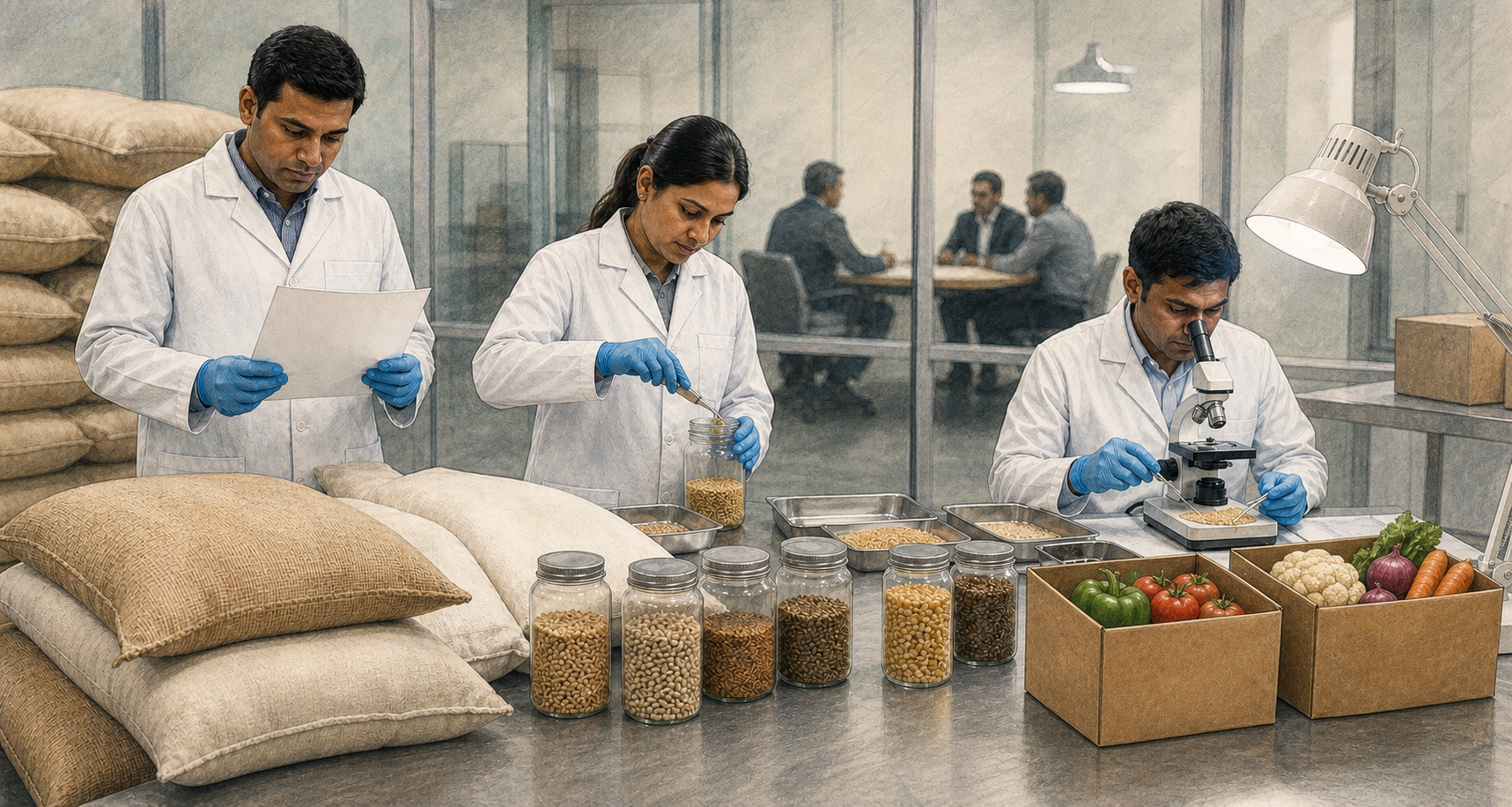
The established negotiating conflict is straightforward: the United States objects to Indian tariffs and non-tariff barriers affecting American agricultural exports. American producers want better access to a very large consumer market. India wants to preserve policy room around food security, rural livelihoods and domestic agricultural development.
That commercial incentive is sufficient to explain the pressure. An exporting country normally seeks lower duties, simpler approvals and predictable standards in a market where it expects to sell more. India does not need a hidden plot to justify careful negotiation. The visible clash of interests is consequential enough.
A further theory links Washington’s urgency to the Make America Healthy Again movement associated with RFK Jr. The concern is that health-driven changes could put as much as $1.2 trillion in US food sales under pressure, encouraging the industry to seek more growth abroad. The incentive is plausible, but the claimed connection to US-India negotiating demands has not been established. It should not carry an argument that can already be made from documented market-access demands.
You can keep the public debate honest by separating three levels of claim:
- Negotiating position: US exporters want fewer Indian barriers. This is the stated commercial dispute.
- Reasonable inference: American companies want access because India’s population makes it an attractive market. This follows from ordinary export logic.
- Unproven leap: US pressure necessarily means that products rejected by American consumers will be dumped in India. That possibility warrants strong inspection and traceability, but it cannot be assumed without product-level evidence.
This distinction strengthens the pro-Bharat position. It lets India defend legitimate interests without relying on a theory that negotiators on the other side can dismiss. A durable case rests on exposure, standards, reciprocity and strategic risk.
Use five tests before accepting agricultural market access
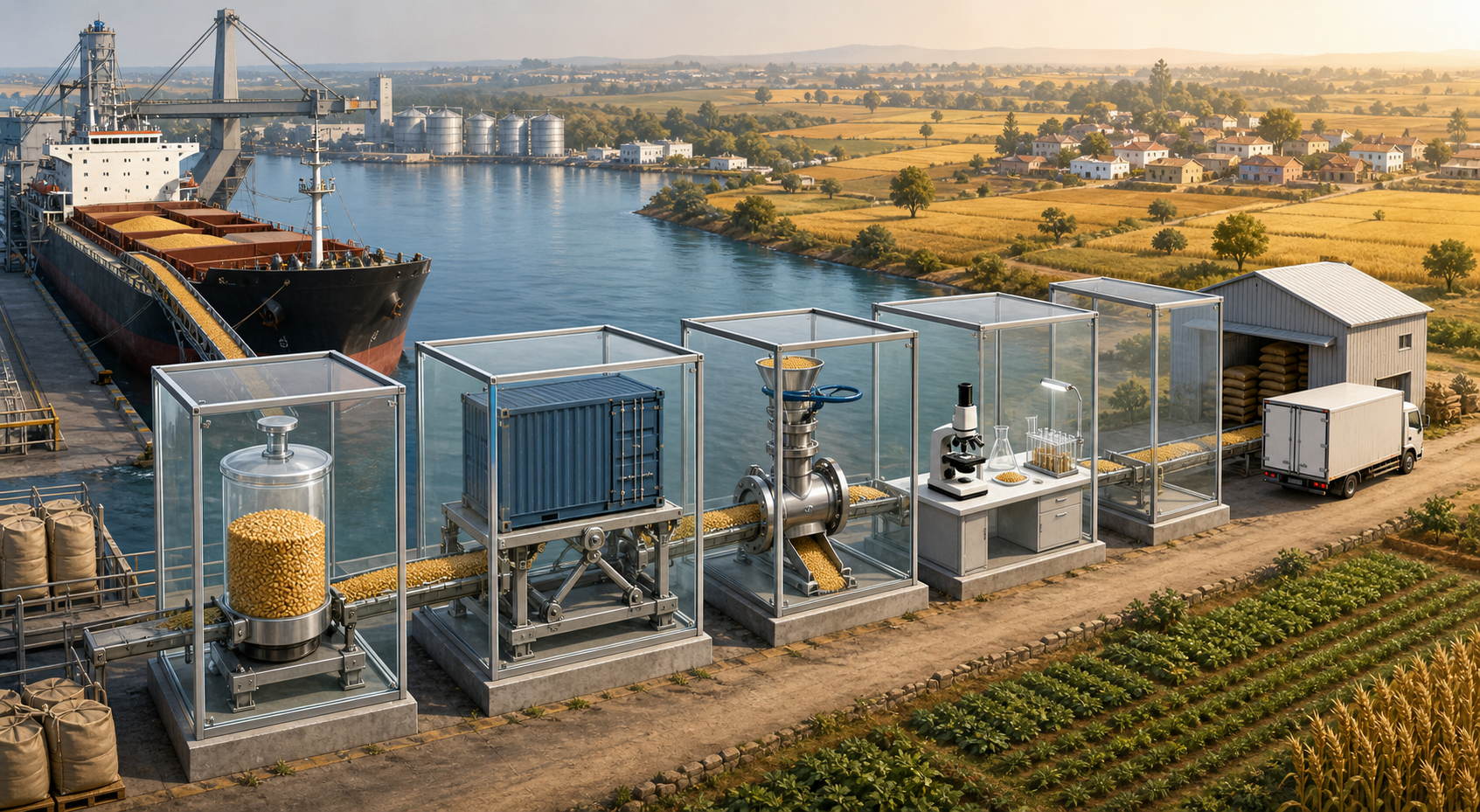
A sound agreement would not treat every agricultural product alike. It would turn broad promises about openness into conditions that India can measure and enforce. These five tests provide a practical way to judge the terms.
- Product specificity. Look for the customs categories covered by the concession, not a headline percentage. A processed branded food, an agricultural input, and a staple produced by small cultivators do not create the same livelihood or food-security risk. If the product schedule is unavailable, the likely effect cannot be assessed responsibly.
- Controlled pace. Immediate, unlimited access creates more adjustment risk than a phased reduction. Negotiators can use transition periods, limited lower-duty quotas and safeguard mechanisms. A tariff-rate quota, for example, permits a specified volume at a lower duty while retaining a higher duty beyond that volume. Such tools allow trade to expand without making the first concession irreversible in practice.
- Enforceable standards. Imported food should meet India’s rules on safety, additives, residues, labelling and traceability. The rules should be published, scientifically defensible and applied consistently to domestic and imported goods. That protects consumers without turning an arbitrary administrative delay into disguised protectionism.
- Reciprocal value. Agricultural access should not be surrendered as an isolated gesture. Ask what measurable access, regulatory treatment or strategic benefit India receives in return. A concession is not balanced merely because both governments describe the larger package as mutually beneficial.
- Adjustment capacity. The timetable should reflect whether exposed Indian farmers can store, process, transport and sell their produce competitively. Investment in cold chains and food processing should precede the most disruptive stages of opening, not arrive as compensation after farmers have lost bargaining power.
The order matters. Once importers establish supply chains and domestic buyers reorganise around them, reversing access can impose new costs on consumers and businesses as well as diplomatic costs on the government. India should therefore build the safeguard, review process and domestic transition plan before the first major reduction takes effect.
Conditional access can be more defensible than either blanket closure or blanket liberalisation. It lets India test whether competition improves price and quality without placing the entire adjustment burden on households least able to carry it.
Food standards and domestic farm reform must move together
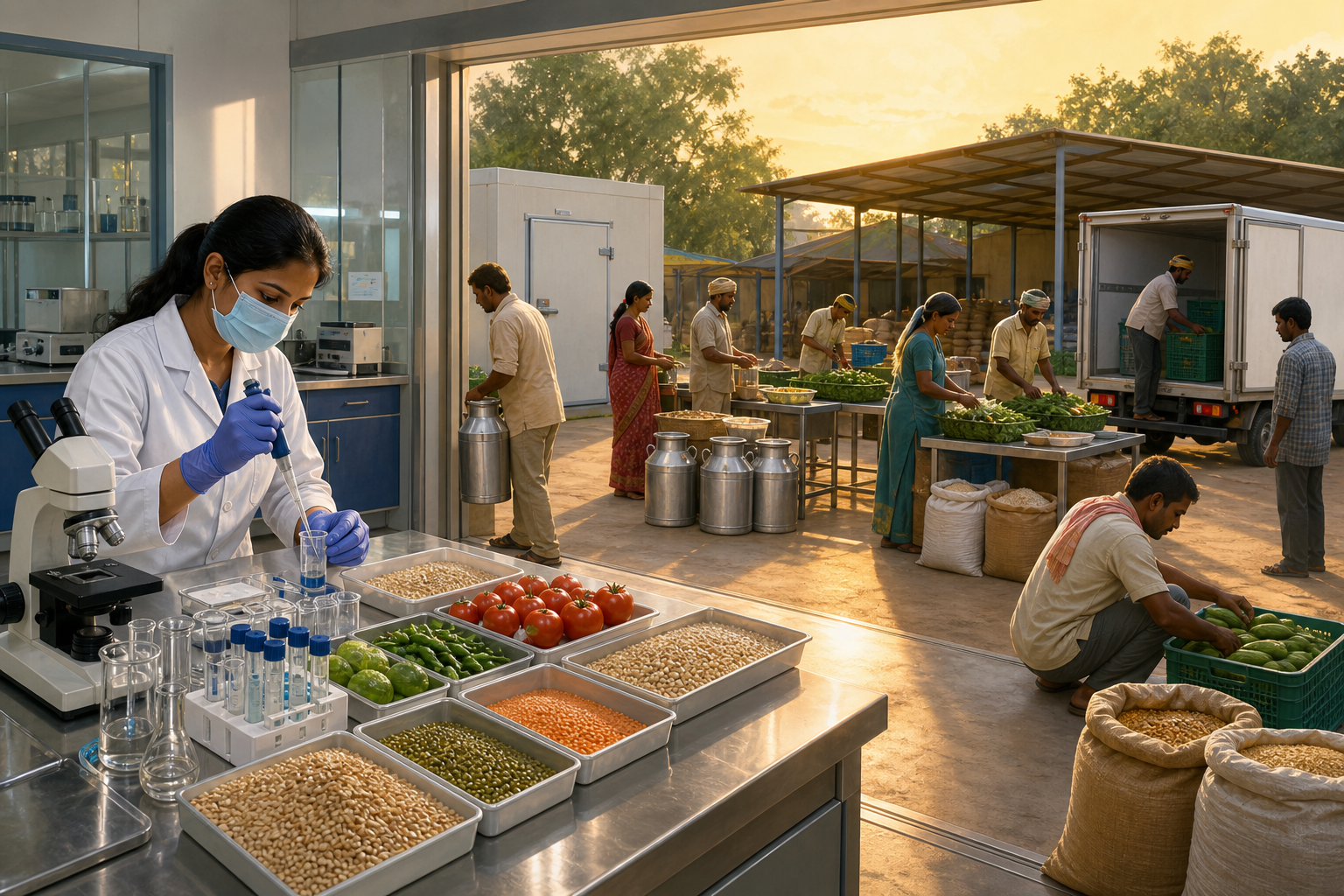
Make food-safety protection verifiable
The fear that unwanted or lower-quality products could be redirected to India should produce a stronger regulatory system, not a presumption that every American shipment is unsafe. Country of origin is not a substitute for inspection. A consignment that fails India’s published requirements should be rejected; one that satisfies them should not be condemned merely because it is foreign.
A credible system needs four visible controls:
- The same clearly stated safety thresholds for imported and domestically produced food.
- Documentation that connects certificates and test results to the actual shipment and production batch.
- Risk-based sampling at the border, with more scrutiny where a product, producer or supply chain has a record of non-compliance.
- A public record of violations, rejections and corrective action, accompanied by a defined review process for disputed decisions.
This is also how India should pursue a healthier, more organic food ecosystem. “Natural” is an aspiration, not an enforceable customs category. The country needs definitions, testing, transparent labels and traceability if consumers are to distinguish a genuine production standard from marketing language.
India should not lower a valid safety standard simply to complete a trade bargain. It should also avoid using an unpublished or inconsistently applied rule to block a safe product. The first mistake weakens public health; the second strengthens the US complaint that non-tariff barriers are being used without a defensible basis.
Do not let border protection preserve domestic gatekeepers
A tariff may protect the domestic market without ensuring that the benefit reaches the cultivator. In an intermediary-heavy sales system, traders with storage, finance and market information can capture much of the value. That means opposition to foreign access cannot substitute for reform at home.
The withdrawal of attempted farm reforms also shows that political consent is a practical constraint, not an inconvenience that can be ignored. Changes affecting how farmers sell, contract or resolve disputes need consultation, understandable protections and a route to remedy. A reform that farmers do not trust will not become durable merely because its economic theory looks coherent.
Before exposing a vulnerable segment to stronger import competition, policymakers should track the conditions that determine whether its farmers can respond:
- How much of the final consumer price reaches the farmer.
- How long payment takes and who carries the financing burden.
- Whether farmers can store produce rather than selling immediately under pressure.
- Whether local processing can turn perishable or low-value output into a higher-value product.
- Whether farmers have more than one transparent route to a buyer.
These indicators should be reviewed before each phase of market opening. If logistics and farmer bargaining power have not improved, the next concession should not proceed automatically. If they have improved, India can negotiate from greater confidence rather than permanent fear of competition.
Key takeaways for judging the next trade headline
- The core dispute is real: the United States wants fewer Indian barriers to agricultural exports, while India has livelihood and food-security reasons to retain policy space.
- A national-interest test must work product by product. Broad language about opening agriculture is not enough to estimate who gains and who carries the risk.
- Phased access, volume limits, safeguards and scheduled reviews are practical negotiating tools. They are more credible than an unconditional yes or a permanent no.
- Food-safety concerns should produce equal standards, testing and traceability. Nationality alone neither proves safety nor proves danger.
- Tariffs cannot repair weak storage, processing or farmer bargaining power. Domestic capacity must be built before the most disruptive concessions begin.
- Claims about US domestic health reform driving export pressure remain a theory. India’s strongest case does not depend on proving that motive.
The next time you hear that India has either blocked or advanced a trade deal, look past the announcement. Ask which products are covered, how much can enter, how fast the terms change, which standards apply, what India receives, and what farmers can do before the next phase begins. Without those answers, the headline cannot tell you whether the bargain serves Bharat.
India should not trade away food security or rural resilience for the appearance of diplomatic progress. Nor should it confuse sovereignty with an untouchable system that benefits intermediaries more than cultivators. The defensible path is conditional and reversible opening under Indian rules, matched by investment that leaves farmers stronger when the transition ends.
References
