
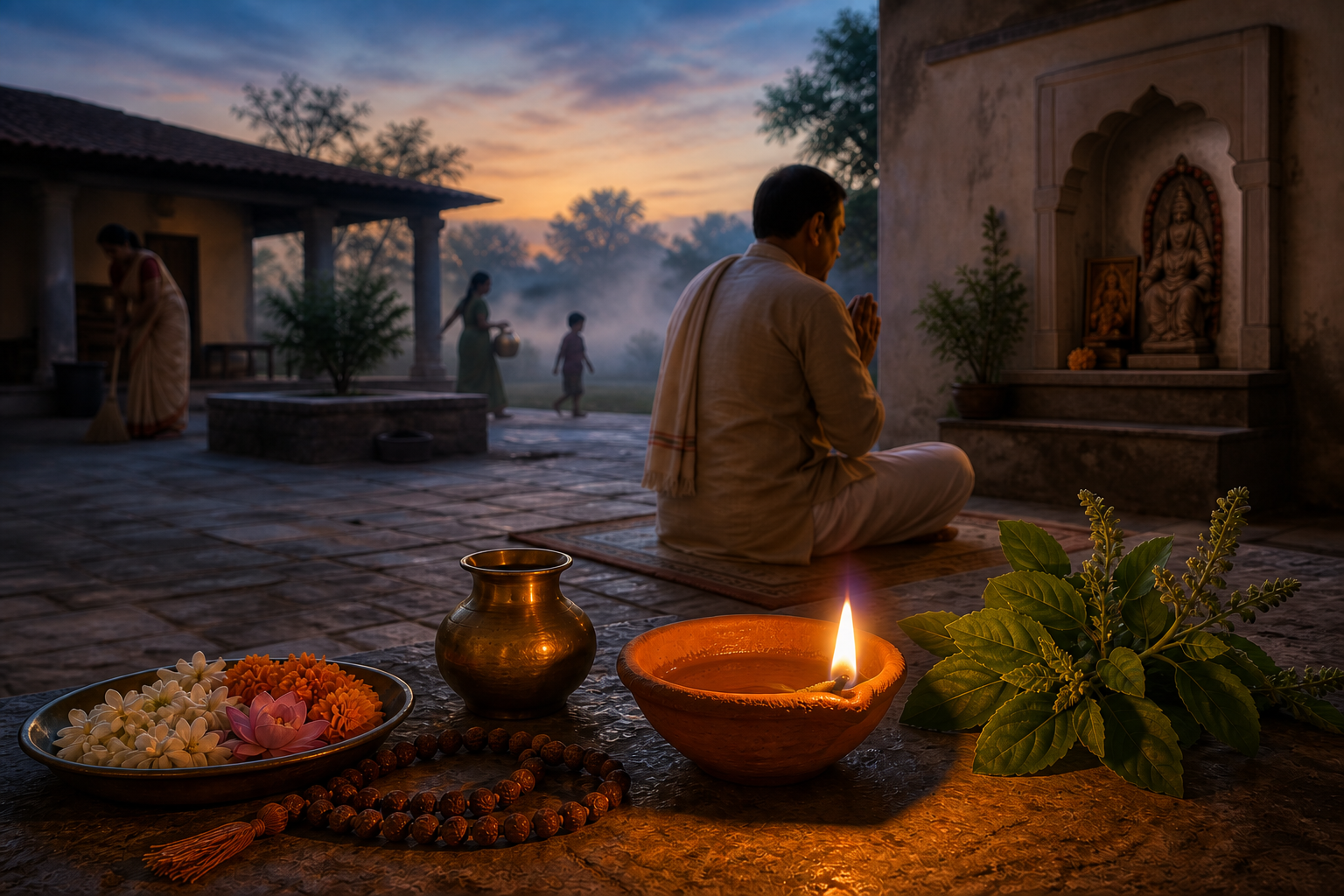
If Kartik is approaching and you are wondering which rules actually matter, resist the urge to collect every vrata, temple event, fast, and family custom into one exhausting schedule. The month becomes spiritually useful when your practices form a coherent vow that you can keep with attention.
You need a clear devotional center, a sustainable daily rhythm, and an honest way to turn worship into conduct. Deepa, japa, sacred listening, food restraint, Somavara worship, and seva can then reinforce one another instead of becoming separate religious tasks.
What Kartik is trying to change in you
A vrata is a deliberately chosen religious discipline, not merely a restriction on food. It brings the body, attention, household, and ethical life under a shared intention. Restraint exposes habit. Japa gathers a scattered mind. Sacred listening places your private concerns inside a larger spiritual horizon. Deepa makes the commitment visible in the home. Seva prevents devotion from closing in upon itself.
Within the Puranic frame of Kartik Maas Mahatmya, shravan, purification from accumulated demerit, and the attainment of Vaikuntha belong to one devotional movement. Its language of spiritual fruit is deliberately expansive. It directs the practitioner toward purification and liberation, not toward calculating how many lamps or fasts will purchase a desired result.
This is why the evening lamp is more than seasonal decoration. Its outward light represents clarity, but the symbol becomes truthful only when you also illuminate a concealed habit, a neglected duty, or a hard corner of your conduct. A bright doorway combined with harsh speech inside the house misses the theological point.
Kartik also accommodates distinct Shaiva, Vaishnava, and Shakta expressions without forcing them into a single ritual program. Somavara vrata and Shiva worship have a prominent place in many regional traditions. Remembrance of Sri Krishna, the aspiration toward Vaikuntha, and reverence for Tulsi belong to Vaishnava expressions of the month. At Srisailam, Mallikarjuna and Bhramaramba embody a Shaiva-Shakta confluence. The unity lies in a shared grammar of devotion, restraint, light, and service; it does not require every lineage to use the same theology or rites.
Your first decision, therefore, is not which observance promises the largest merit. Decide which devotional center is authentic to your family, sampradaya, guru, or temple. Let that inheritance give the month its shape.
Make a sankalpa your household can actually keep
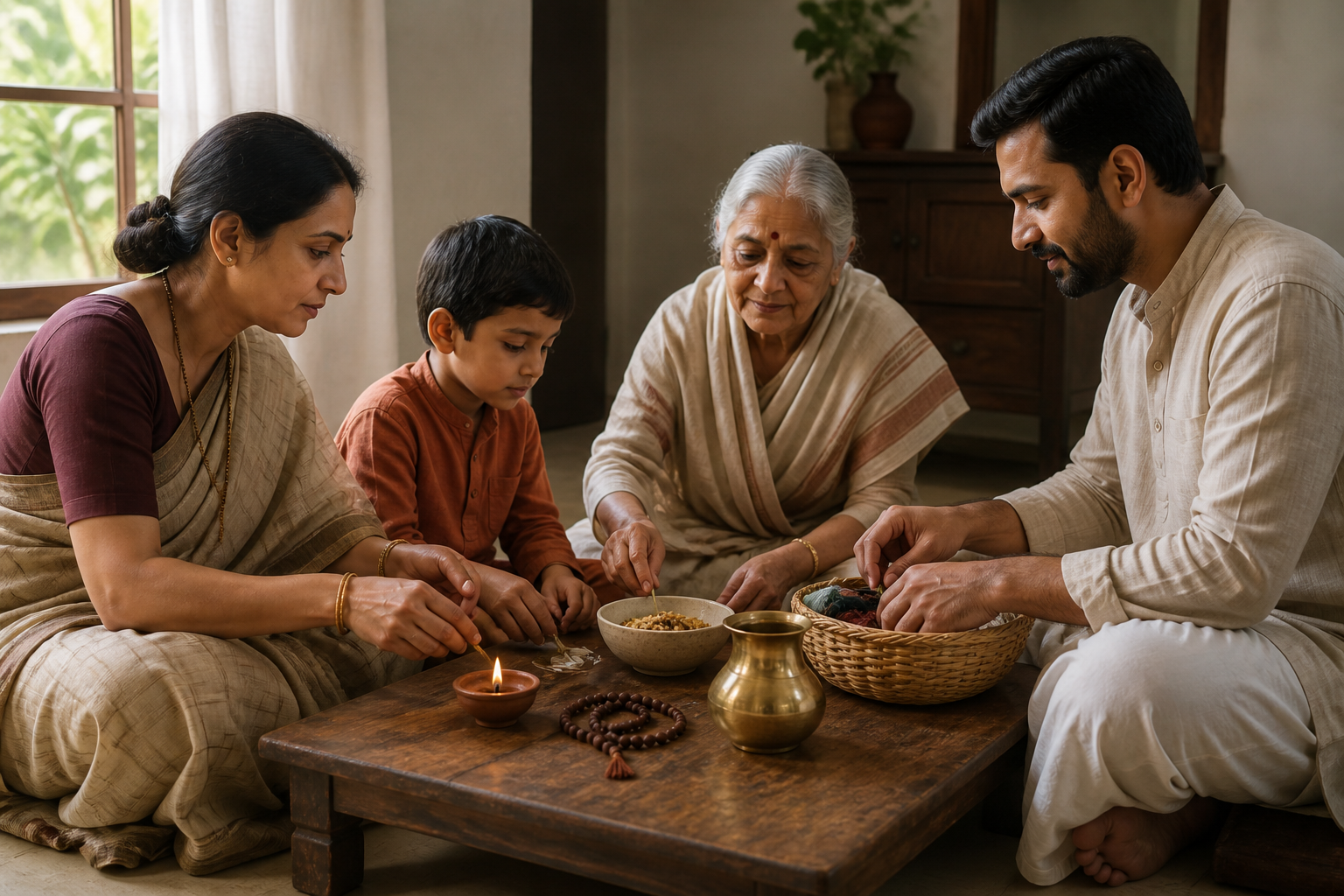
A useful sankalpa is precise enough to guide you on a tired evening. It should answer the following practical questions before the month begins.
- Which tradition will lead? Begin with an inherited family rule, a guru-given discipline, or the established practice of your temple. If these differ, seek guidance instead of silently combining incompatible procedures.
- What will happen regularly? Choose a stable anchor such as lighting a deepa at dusk, performing your received japa, or listening to a portion of Kartik Mahatmya. A modest practice kept attentively is stronger than a crowded plan abandoned after enthusiasm fades.
- What will you restrain? Select a food discipline your health permits, or restrain another habitual excess that genuinely consumes attention. The point is conscious mastery, not public severity.
- Which days will carry greater intensity? Mark the Somavaras and Kartik Purnima using the panchangam followed in your region. Decide in advance whether those days will include fasting, temple darshan, abhishekam, extended prayer, or community worship.
- How will devotion become seva? Choose a concrete form of charity, annadanam, practical assistance, or care for someone vulnerable. Do not leave service as a vague intention to be fulfilled if time remains.
Your written rule might be simple: During Kartik, I will light a lamp at dusk, perform my received japa, listen to or read a portion of Kartik Mahatmya, keep the restraint my health permits, observe Somavara in my family’s manner, and complete a chosen act of seva. If you have no received japa, use a divine name or prayer accepted in your family tradition rather than inventing an elaborate formula from scattered online instructions.
Fasting is a means of discipline, not the measure of your devotion. If a full fast is medically unsuitable, choose a partial fast or a non-food restraint. Do not stop prescribed medicine or disregard necessary nutrition to preserve the outward form of a vrata. Ask an appropriate clinician when your health needs make fasting uncertain, and let your religious discipline take a safe form.
Build recovery into the sankalpa as well. If illness, travel, care work, or simple human failure interrupts the practice, resume at the next opportunity. Do not double the austerity as self-punishment, and do not treat one missed observance as permission to abandon the month. Steadiness is itself part of vrata.
Use Somavara and Purnima as points of intensification
Kartik follows a lunisolar calendar, so its practical dates depend on regional reckoning. A calendar disagreement is not automatically a theological disagreement. If you follow a Telugu panchangam, Kannada calendar, or another local system, use that system consistently and verify important observances with the temple where you intend to worship.
Give each Kartik Somavara a complete arc
Monday worship works best when it is more than a temple visit inserted into an otherwise unchanged day. Give the observance a beginning, a devotional center, and a conscious close.
- Reaffirm the sankalpa before the day’s ordinary demands take over.
- Keep the chosen fast, partial fast, or restraint without turning it into a comparison with other devotees.
- Make space for japa, sacred listening, or quiet contemplation rather than filling the saved time with distraction.
- Visit a temple if that belongs to your rule. Shiva worship is central to many Kartik Somavara traditions, while some families also include Vishnu worship according to their lineage.
- Light the evening lamp with the household, then conclude the fast or restraint with a sattvic meal in the manner prescribed by your tradition.
- Attach an act of charity or practical care to the day so that austerity softens rather than hardens you.
Common Kartik Somavara practices include fasting or partial fasting, temple worship, deepa, japa, and charity. Some communities also recognize special observances such as Koti Somavaram according to local reckoning. Treat such a day as a tradition-specific observance, not as a universal date that overrides your temple calendar.
Let Kartik Purnima gather the month into light
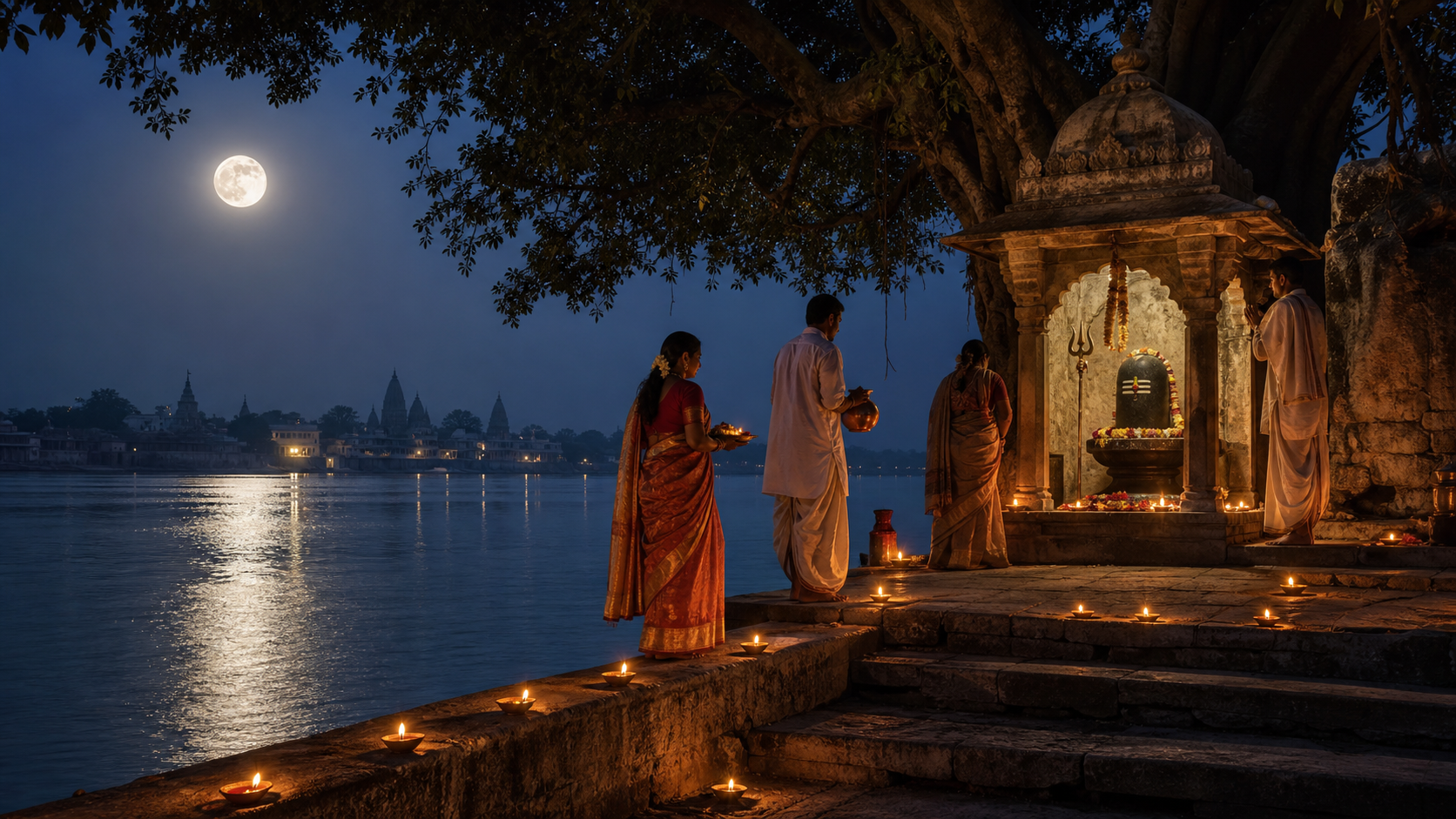
Kartik Purnima functions as a luminous culmination in many traditions. Deepotsava, collective prayer, temple darshan, and rows of lamps make private discipline visible as shared sacred culture. Prepare for it as the completion of a vow rather than as a stand-alone festival. Bring forward the japa, restraint, study, and seva cultivated through the month.
Before committing to a temple plan, confirm which calendar the temple follows, when its darshan and abhishekam windows open, and whether deepotsava has separate participation rules. Mondays and Purnima attract greater numbers of pilgrims, so early planning matters. The date on a general calendar cannot tell you whether a particular temple requires registration or follows a locally defined schedule.
Kartik Purnima also overlaps with Guru Nanak Jayanti in many years, while the month’s themes of restraint, compassion, non-harm, learning, and service resonate more broadly across Sikh, Jain, and Buddhist ethical life. These resonances reveal a Dharmic civilizational kinship, but respectful kinship does not make distinct doctrines or observances interchangeable. Honor the shared light without appropriating another tradition’s practice as a decorative addition to your own.
Turn the ritual sequence into lived dharma
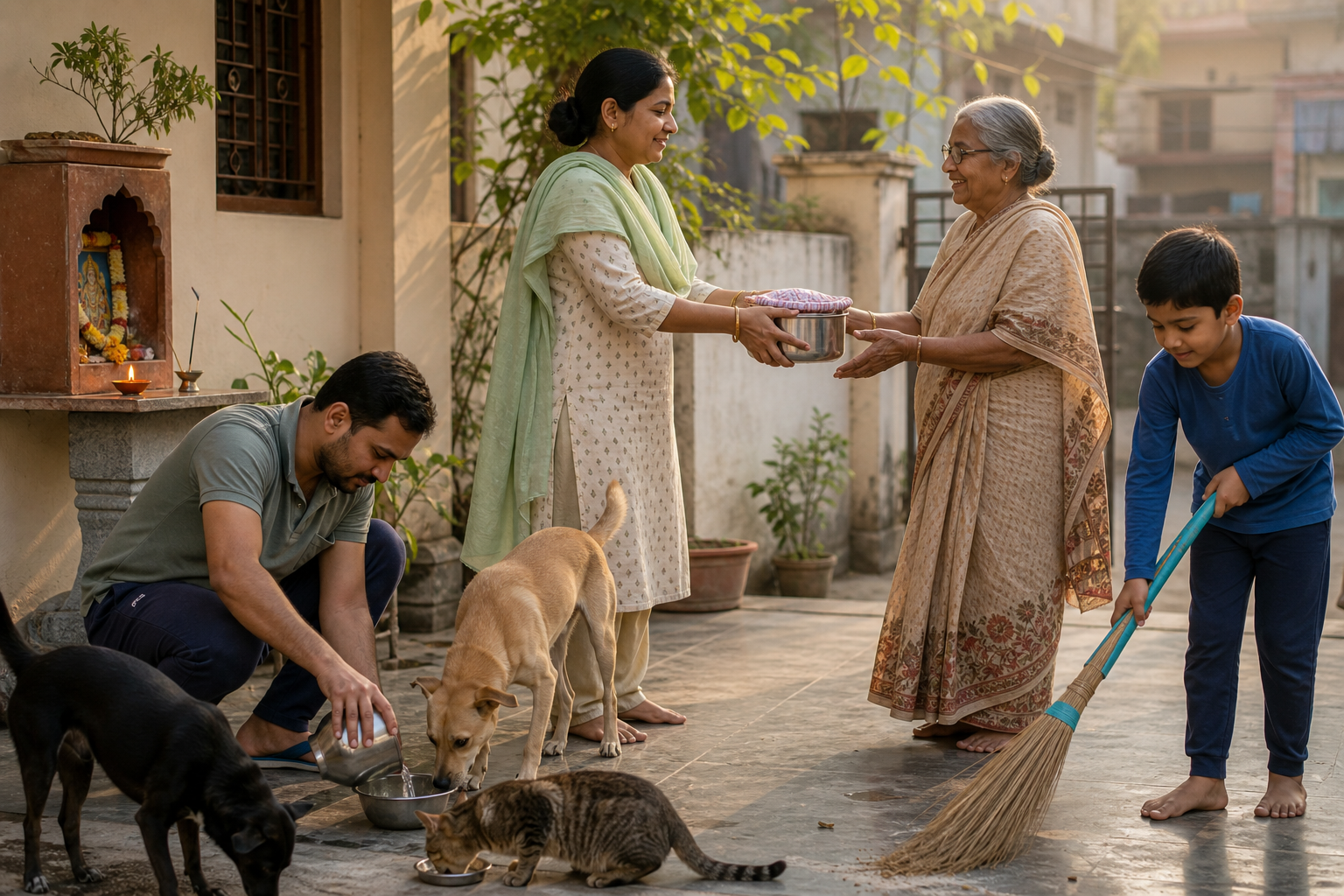
A workable sequence for home worship
You do not need a large domestic ceremony to establish a serious Kartik rhythm. Use the same sequence each evening so that preparation gradually gives way to recollection.
- Prepare a clean, stable place for the lamp before dusk. Keep it away from loose cloth, drafts, and anything that can catch fire.
- Pause before lighting it and recollect the sankalpa. This keeps the action from becoming an automatic household chore.
- Offer the deepa with attention. If family members are present, let the moment gather the household rather than turning it into a performance for a camera.
- Perform your established japa or recitation. Keep the form you actually know and can pronounce with care.
- Read or listen to a manageable portion of Kartik Mahatmya or another text accepted in your tradition. Shravana requires attention; playing a discourse in the background while remaining absorbed elsewhere does not serve the same purpose.
- Sit quietly long enough to notice what the practice has revealed: agitation, gratitude, resentment, grief, or a neglected responsibility.
- Close by naming the next dharmic action. It may be an apology, assistance to a family member, charity, annadanam, or a duty you have postponed.
Never leave a burning lamp unattended. Protecting children, elders, animals, and the home is not external to dharma. A devotional symbol should not be maintained in a manner that creates a preventable danger.
A temple day should deepen the vow, not replace it
Check the temple schedule and its rules before travelling. Wear clothing appropriate to the shrine, arrive with enough time to avoid pushing through the queue, and follow local instructions for offerings. If Rudrabhishekam, bilva archana, pradakshina, or deepa participation is available, choose what belongs to your sankalpa rather than attempting every listed ritual.
At Srisailam, devotees commonly combine snana at Pathala Ganga with darshan, Rudrabhishekam, bilva archana, and pradakshina. The Mondays of Kartik and Kartik Purnima are especially sought-after pilgrimage days. If you go, let the forested setting and the Krishna River sharpen your environmental discipline. Minimize plastic, use permitted eco-conscious materials, and do not leave the physical cost of your worship for temple workers or the landscape to bear.
Let grief and difficulty simplify the practice
Kartik does not require you to pretend that sorrow has disappeared. The Gunavati episode places bereavement, vulnerability, devotion, and dharmic responsibility in the same moral field. Grief is acknowledged, then held within remembrance, duty, and care.
If you enter the month while grieving, reduce the ritual load rather than abandoning devotion or using austerity to suppress pain. Keep a lamp, a prayer, sacred listening, and the support of trustworthy people. Direct seva toward someone facing vulnerability if that is within your capacity. Devotion can give the day structure, but it should never become an excuse to refuse practical, familial, or professional support when that support is needed.
Several distortions are worth noticing while you practice:
- Merit anxiety: You keep adding rites because another devotee appears to be doing more. Return to the sankalpa you made with discernment.
- Calendar policing: You treat a regional difference as evidence that someone else’s observance is invalid. Confirm your own reckoning and allow legitimate local custom to remain local.
- Austerity without duty: Fasting makes you irritable with dependants or unable to perform necessary work. Modify the fast; household responsibility is not an obstacle to dharma.
- Sectarian scoring: You use Shiva, Vishnu, or Devi devotion to diminish another Kartik tradition. Practice your lineage fully without manufacturing a rivalry the month does not require.
- Lamp-lighting without ethical light: The home glows while speech, consumption, or treatment of others remains careless. Choose a specific correction and carry it beyond the puja space.
- Religious display that creates waste: The visual scale of the observance grows while cleanup and ecological responsibility are ignored. Reduce the display and preserve the sacred place.
Key takeaways
- Kartik vrata is a coherent discipline of devotion, restraint, sacred listening, light, and service; it is not merely a fast.
- Choose a Shaiva, Vaishnava, Shakta, or family-centered form according to an authentic lineage instead of mixing rites to maximize merit.
- Build the month around a sustainable daily anchor, then intensify the practice on Somavara and Kartik Purnima.
- Use the panchangam followed in your region and verify temple-specific dates, schedules, and participation rules.
- Modify fasting when health or essential duties require it. A safe partial fast or non-food restraint is better than harmful severity.
- Make every deepa answer an ethical question: what in your conduct, household, or community now needs light?
- If the practice is interrupted, resume without self-punishment. Steadiness matters more than maintaining an image of perfection.
Before the month begins, check your calendar, prepare the place for the lamp, choose the text or discourse you will hear, agree on the household rule, and name the seva you will complete. Then, when Kartik arrives, you will not have to negotiate with yourself each evening. You can simply return to the vow and let repetition deepen it.
References
- DharmaRenaissance Blog — Karthika Somavaram Vratham 2025: Essential Dates, Significance, and Koti Somavaram
- DharmaRenaissance Blog — Complete Guide to Karthika Masam at Srisailam: Discover Proven Rituals and Timeless Devotion
- DharmaRenaissance Blog — Kartik Maas Mahatmya Chapter 1: Essential, Proven Insights to Transform Your Devotion
- DharmaRenaissance Blog — Proven Insights on Kartik Maas Mahatmya Chapter 2: Discover the Katha’s Transformative Power
