
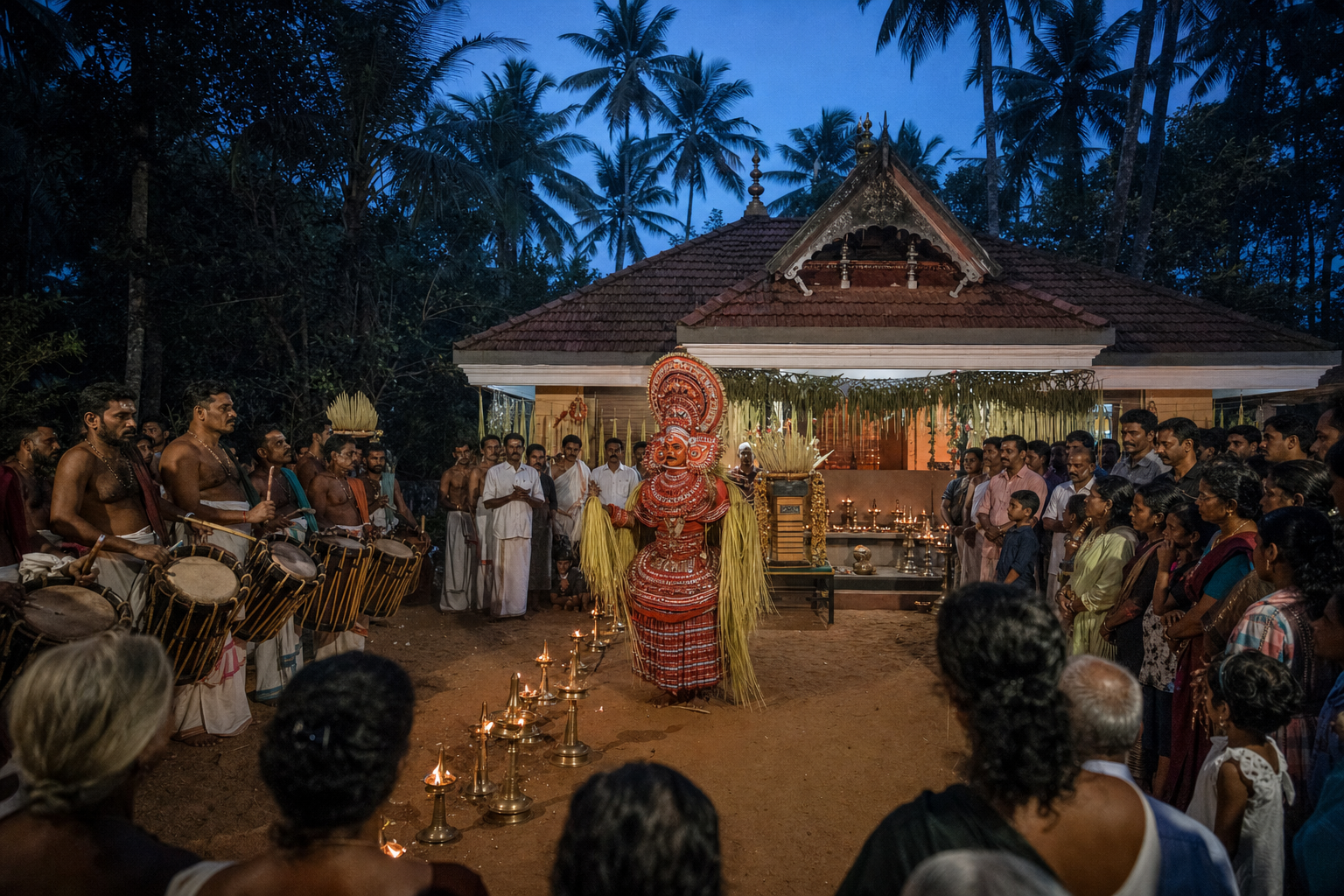
You are planning to witness a goddess Theyyam in North Malabar, but a festival listing rarely tells you what kind of encounter you are entering. The practical question is not merely where to stand or when to take a photograph. It is how to recognize worship while it is unfolding around you.
The most useful shift is simple: do not approach Theyyam as a costumed performance with religion added to it. Approach it as a local act of devotion expressed through embodied presence, percussion, narrative, movement, sacred space, and direct contact between deity and community. Once you make that shift, the names, sequence, etiquette, and emotional force of the rite become easier to understand.
Key takeaways
- A goddess Theyyam is worship in a temple or kavu, not a stage production detached from its sacred setting.
- Learn the name used by the particular shrine. Similar names can belong to closely connected traditions, but local custodianship determines the story and ritual you will actually encounter.
- The main Theyyam season generally runs from November through May in parts of Kannur and Kasaragod, but each shrine follows its own calendar.
- Watch the whole ritual arc: invocation, narrative song, embodied appearance, interaction, and blessing. The most dramatic image is not necessarily the most important moment.
- Ask before photographing, remain outside marked or explained boundaries, dress modestly, and let devotees complete their worship without obstruction.
Enter a sacred relationship, not a spectacle
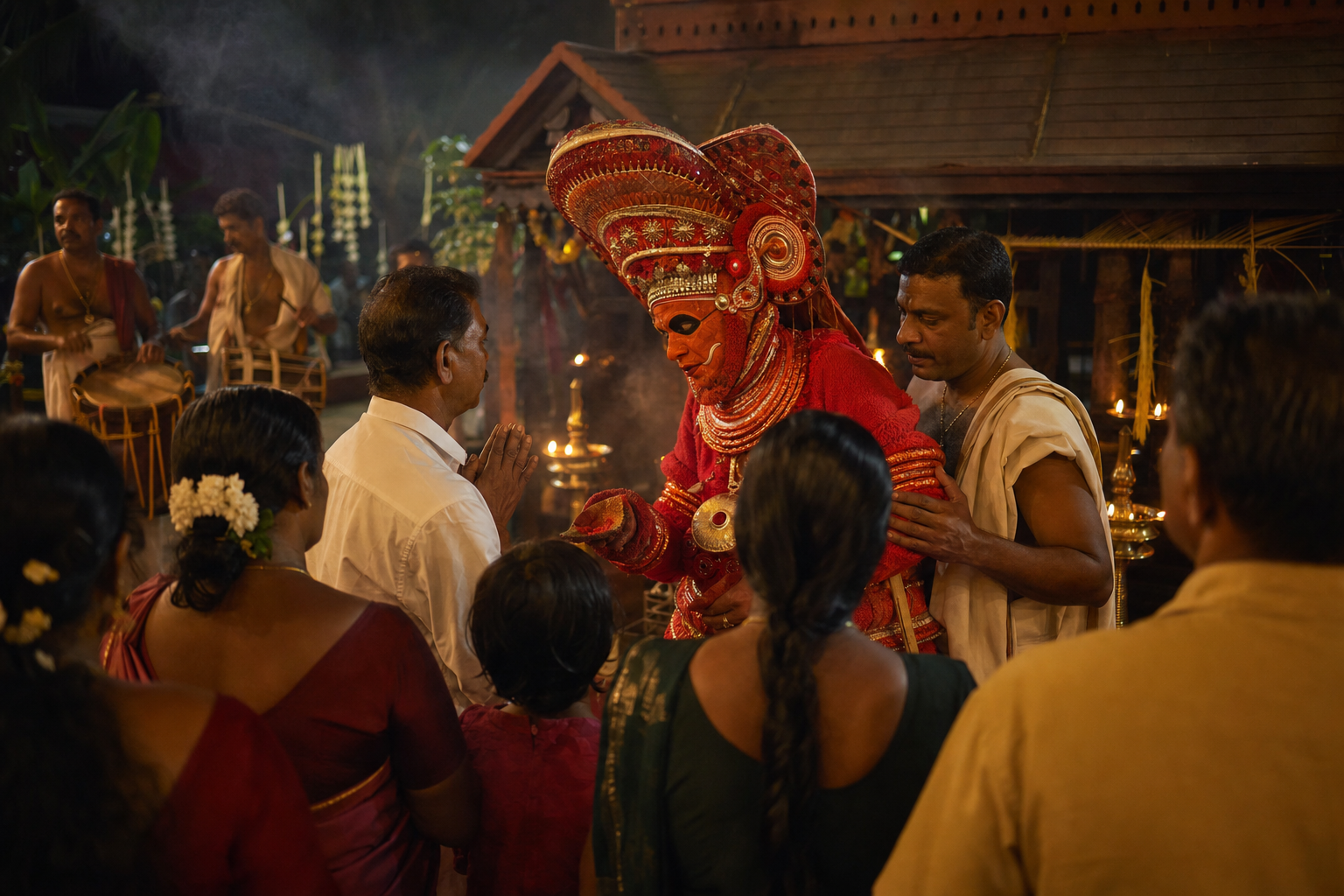
In North Malabar, Theyyam is often called Kaliyattam. A trained ritual performer embodies a deity through established invocations, song, dance, percussion, costume, and sacred insignia. The rite can preserve folklore and display extraordinary artistry, but neither description is complete by itself. Within the devotional setting, the performer becomes a channel through whom the goddess is approached, heard, and received.
That distinction should change your attention. If you look only for visual drama, you will naturally concentrate on the painted face, red and orange forms, geometric designs, elaborate costume, and towering headdress. These are meaningful parts of the sacred language, particularly its expression of protection and Shakti. Yet the transformation is also carried by sound, disciplined movement, invocatory words, and the community’s recognition of the divine presence.
The percussion is not incidental background music. Instruments including the chenda and elathalam establish the cadence within which the ritual presence takes form. Instead of asking whether the drumming is exciting, notice what it organizes: the performer’s movement, the congregation’s attention, the progression of the rite, and the change in atmosphere as invocation gives way to encounter.
The location matters just as much. A kavu is a sacred grove, while village temples provide another setting for these traditions. In both cases, place, deity, hereditary or community custodianship, and collective memory are joined. Uchitta Bhagavathy’s presence in village temples and local kavus, for example, cannot be separated from the communities that maintain those spaces and recognize her form of Devi.
Your first task on arrival is therefore to read the room before trying to read the iconography. Notice where devotees wait, where ritual specialists move, when conversation quiets, and which areas people avoid entering. If local guidance differs from a general travel rule, follow the local guidance.
Let the shrine tell you which goddess you are meeting
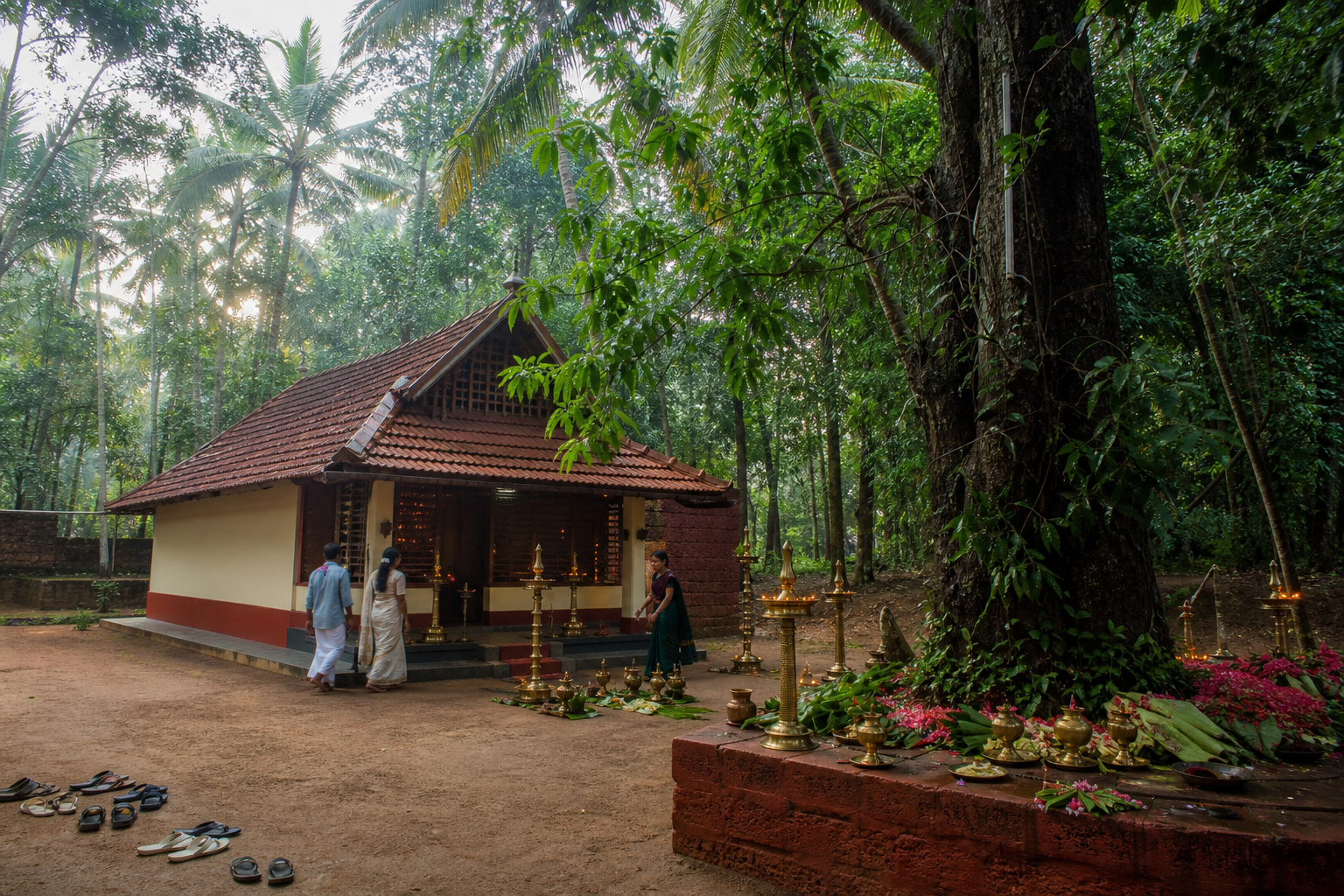
North Malabar’s goddess traditions are intensely local. Names travel through temple lore, family memory, devotional usage, and oral narration. Arya Poonkani is also known as Aryakkarakani. Poomala Bhagavathy is also called Aryapoomala and Aryappunkani. The resemblance among these names is important, but it does not give a visitor permission to collapse every local form, story, or rite into a single standardized biography.
Use the shrine’s own name first. Ask a caretaker or knowledgeable elder how it is pronounced, whether another name is used locally, and which story accompanies the day’s appearance. This is more reliable than arriving with a fixed narrative gathered elsewhere and trying to fit the ritual into it.
Arya Poonkani and Bappiriyan
At select temples and kavus, Arya Poonkani Theyyam appears with Bappiriyan Theyyam. Oral tellings commonly describe Arya Poonkani undergoing a perilous journey and receiving Bappiriyan’s aid. Bappiriyan is associated with seafaring and courage, while the paired appearance gives ritual form to rescue, trust, gratitude, and cooperation.
The word select matters. Do not assume that every Arya Poonkani observance includes Bappiriyan or that every locality sings the narrative in precisely the same way. Before planning around the pairing, ask two direct questions: Will both Theyyams appear at this observance, and what version of their relationship is remembered here? The pairing of Arya Poonkani and Bappiriyan is meaningful because a community keeps it alive in ritual, not because it can be reduced to a portable plot summary.
Poomala Bhagavathy
Poomala Bhagavathy is revered as protective, benevolent, and auspicious, with important devotion among the Thiyya community in Kannur and Kasaragod. Her worship also welcomes reverence from devotees of varied backgrounds. That combination teaches an important lesson about access: broad devotion does not erase the responsibility owed to the communities that have historically maintained the rites.
In some localities, worship may include simple offerings, collective singing, circumambulation, lamps, and ritual arts such as Theyyam. These elements should not be treated as a mandatory checklist for every shrine. Ask what is customary before bringing an offering or joining a movement around the sacred space. Poomala Bhagavathy’s worship is rooted in local temple life, so attentive participation is more appropriate than self-directed improvisation.
Uchitta Bhagavathy
Uchitta Bhagavathy is revered as a form of Devi within the Shakti tradition. Her Theyyam joins codified performance, local folklore, temple worship, and community gathering. Devotees associate her presence with protection, grace, and moral courage. If you encounter Uchitta, do not treat her as a generic goddess substituted into a common costume. Listen for the invocations and local explanations that identify who is present and what relationship the community has with her.
A useful rule applies across all three traditions: similarity can help you recognize a shared sacred vocabulary, but difference tells you where to listen. Record the name used at the shrine, the paired figures if any, and the qualities emphasized in the songs or blessings. Keep those observations separate from your own interpretation.
Follow the ritual arc instead of chasing one dramatic moment
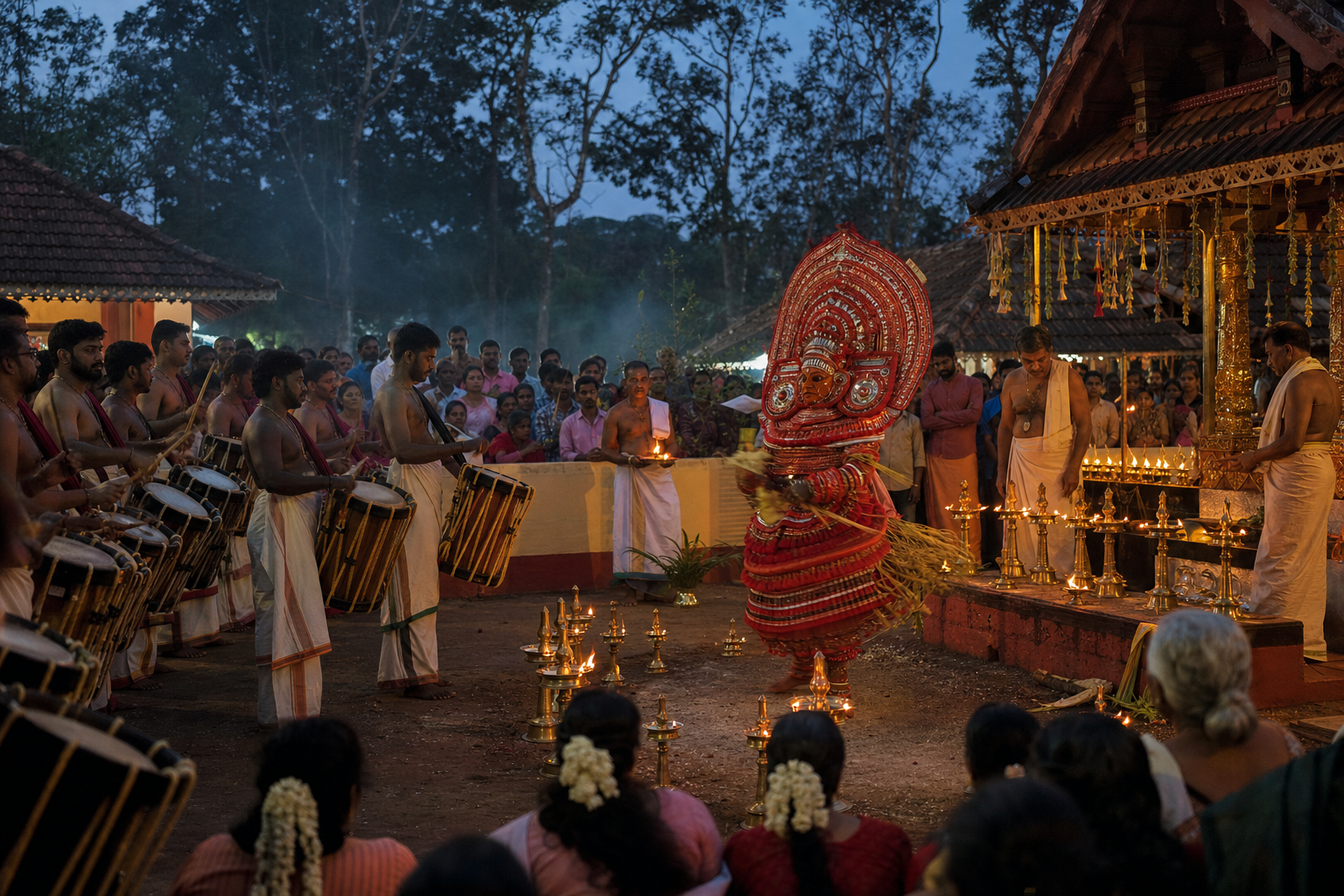
A goddess Theyyam often moves through invocations, narrative songs, embodied movement, and blessings. The precise order and form can vary by deity and locality, so there is no universal minute-by-minute script to impose on every event. There is, however, a practical way to follow what is happening.
- Settle during the invocation. This is when sacred attention is being established. Avoid moving around in search of a better angle just because the most recognizable costume has not yet appeared.
- Listen to the narrative song. The song may carry names, relationships, ordeals, acts of protection, and the memory of the deity’s connection to the place. Even when you do not understand every word, you can notice repeated names and ask about them later.
- Observe how embodiment is constructed. Face-painting, costume, insignia, headdress, drumming, and choreography work together. Do not isolate the costume as if it were a museum object temporarily placed on a dancer.
- Make room for the devotees’ encounter. Blessings and oracle-like exchanges are not an informal photo session after the main event. Devotees may be seeking protection, guidance, well-being, or auspiciousness. Their access takes priority over your view.
- Stay through the quieter transitions when permitted. A single spectacular image cannot show how invocation becomes presence or how presence returns to the continuing life of the shrine. The transitions reveal the ritual’s structure.
This way of watching also prevents a common misunderstanding. Theyyam is not valuable only when it looks visually extraordinary. Its cultural depth lies in the joining of local language, music, costume craft, oral memory, ritual knowledge, place, and community obligation. If you leave knowing only what the headdress looked like, you have seen a fraction of what was offered.
Plan the visit around local authority and temple etiquette
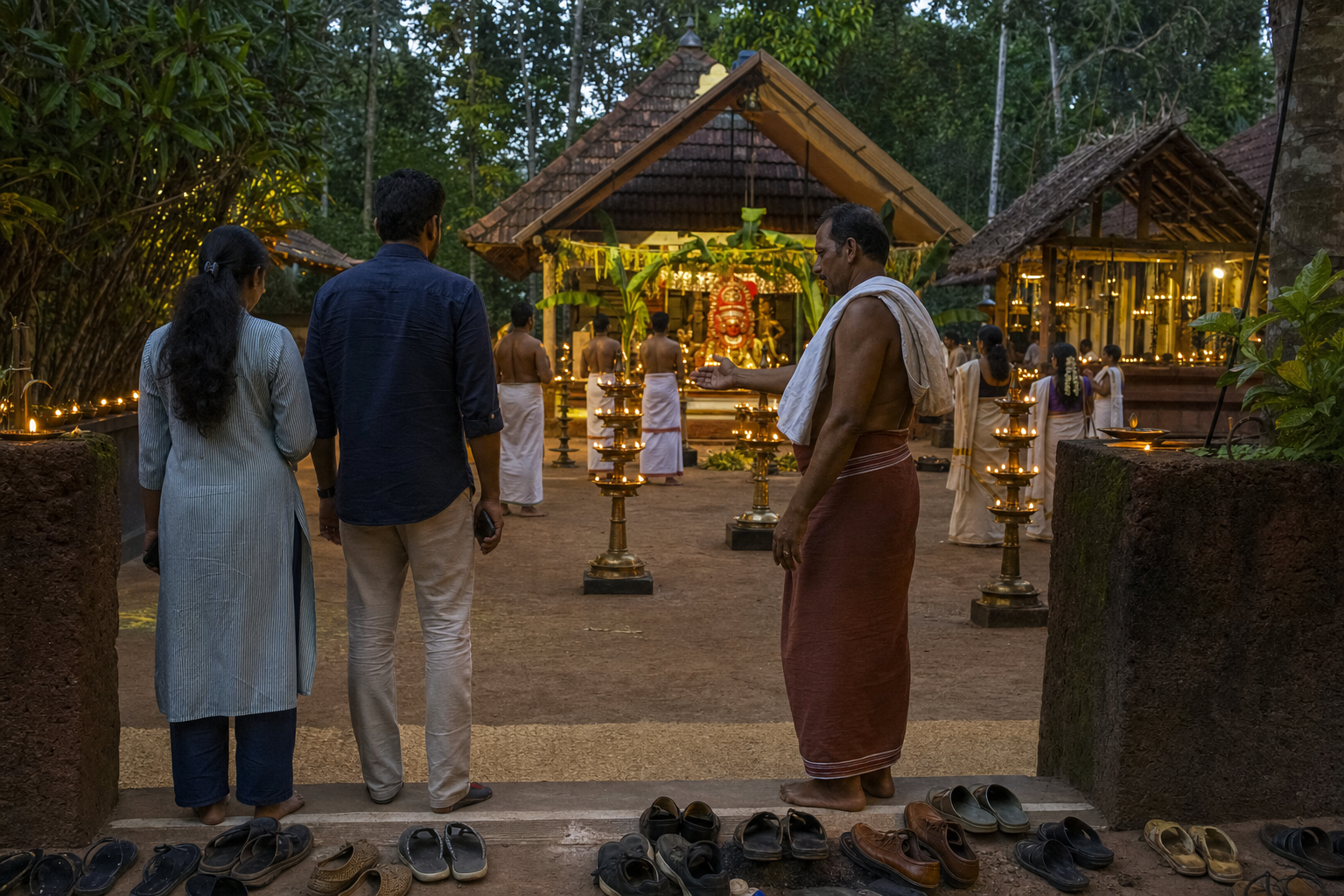
The Theyyam season generally extends from November to May in parts of Kannur and Kasaragod. That range helps you choose when to travel, but it does not confirm that a particular goddess will appear on a particular day. Festival schedules differ by locality, and temples may publish their own seasonal calendars. Verify the shrine, deity, date, and local conditions before building the rest of your journey around one appearance.
A practical planning sequence
- Choose a deity or shrine, not just Theyyam in general. A focused choice gives you a name, local tradition, and community context to learn before you arrive.
- Check the local calendar. Treat the November-to-May season as a planning window, not a guaranteed daily program. Confirm details with the temple, kavu custodian, or a knowledgeable local contact where possible.
- Confirm whether the observance is paired. This is especially important if you hope to witness Arya Poonkani with Bappiriyan.
- Ask about visitor boundaries. Find out whether photography is permitted, whether some stages are restricted, and where observers should stand. Permission for one moment does not automatically cover the entire rite.
- Wear modest clothing and follow site-specific practice. Near a sanctum, keep conversation quiet and defer to the behavior expected by the shrine. If you are unsure about an offering or circumambulation, ask before joining.
- Leave room for local variation. A schedule, story, or custom learned at one temple should not be treated as a rule for the next one.
Photography without turning worship into content
Seek explicit permission before photographing or recording. Then continue to watch for changing boundaries. A ritual specialist may allow images from one area while a blessing, sanctum-facing moment, or private interaction remains inappropriate to record.
Do not step into a ritual path, crowd a devotee receiving a blessing, or press closer after a boundary has been indicated. If permission is refused, accept the refusal without negotiation. The absence of a photograph does not make the visit incomplete; it may mean that you correctly placed the sacred relationship ahead of documentation.
How to learn without flattening the tradition
When the appropriate moment comes, ask a caretaker or elder a small number of precise questions: What name does this shrine use for the goddess? Is another deity paired with her? What part of the story is central here? Is there a custom visitors commonly misunderstand? Specific questions invite local knowledge without demanding a complete explanation during a busy observance.
If you take notes afterward, separate three things: what you directly observed, what someone locally explained, and what you inferred. This prevents a partial translation or an unfamiliar gesture from becoming a confident but inaccurate claim. It also respects the fact that oral narratives can preserve complementary versions rather than one centrally standardized account.
Your next step is concrete: choose one goddess tradition, identify a shrine in Kannur or Kasaragod, verify its seasonal calendar, and learn the local name before you travel. Arrive prepared to listen longer than you photograph. That is how a visit becomes an encounter with North Malabar’s living dharma rather than a collection of striking images.
References
- Hindu Pad — Discover Arya Poonkani (Aryakkarakani) Theyyam: The Complete Guide to a Sacred Kerala Tradition
- Hindu Pad — Discover Poomala Bhagavathy of Kerala: The Complete Guide to Aryapoomala Worship and Temples
- Hindu Pad — Discover Uchitta Bhagavathy: The Essential Guide to the Living Theyyam Goddess of Malabar
