
You may already know when Pradosham occurs and still feel that you are only moving through the outer forms. The missing piece is usually not another ritual item. It is a way to read Shiva’s symbols as instructions: contain what is harmful, become still enough to see clearly, and choose a dharmic response.
That approach gives you a meaningful practice whether you attend a temple or observe quietly at home. You do not have to reproduce every regional custom. You do have to let the worship affect what you carry into the following day.
Begin with the crisis that Pradosham remembers
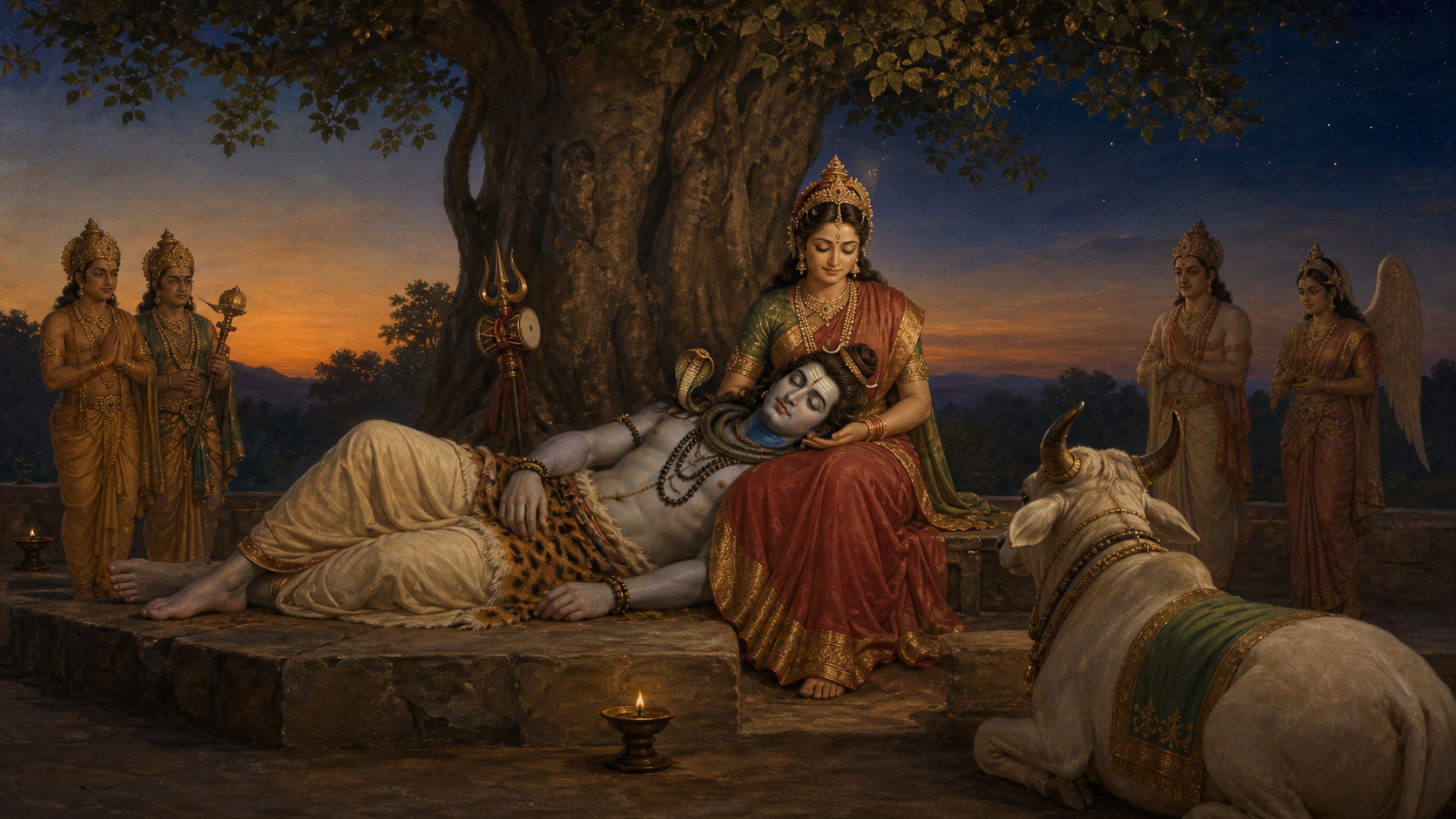
Pradosham is observed twice each lunar month, during the twilight period associated with Trayodashi, the thirteenth lunar day of both Shukla Paksha and Krishna Paksha. Its devotional setting comes from the Samudra Manthan narrative: Shiva receives the dangerous Halahala poison to protect the cosmos and is worshipped as Nilakantha, the blue-throated one. Local sacred memory at Surutapalli continues the account with Shiva resting on Parvati’s lap after the crisis.
This movement from poison to repose is the interpretive key to Pradosham. Shiva does not pretend that the poison is harmless. He also does not allow it to spread through the world. The symbol asks you to notice what has entered your own field of awareness without immediately transmitting it through anger, gossip, blame, panic or retaliation.
Containment is not passive submission. The narrative begins with protective action. It does not instruct you to tolerate abuse, hide wrongdoing or remain in danger. Its discipline is narrower and harder: respond to harm without becoming another carrier of it.
The reclining form of Pallikondeswarar at Surutapalli completes the lesson. Reclining iconography is more commonly associated with Vishnu, so Shiva’s repose there is especially striking. Strength is not represented as endless agitation. After decisive action comes release, support and restoration. If you habitually treat exhaustion as proof of devotion, this murti offers a correction: rest can preserve your capacity to act according to dharma.
Before worship, ask yourself three concrete questions:
- What difficult experience am I still carrying as poison?
- Where am I passing it onward through speech, mood or conduct?
- What boundary, repair or period of rest would stop that transmission?
Do not search for a grand answer. Name the nearest real situation: a message you are tempted to send, resentment entering family life, work pressure turning into contempt, or an obligation that now requires an honest boundary. That is the material you bring to Pradosham.
Read the Shivling vertically through the five faces of Shiva
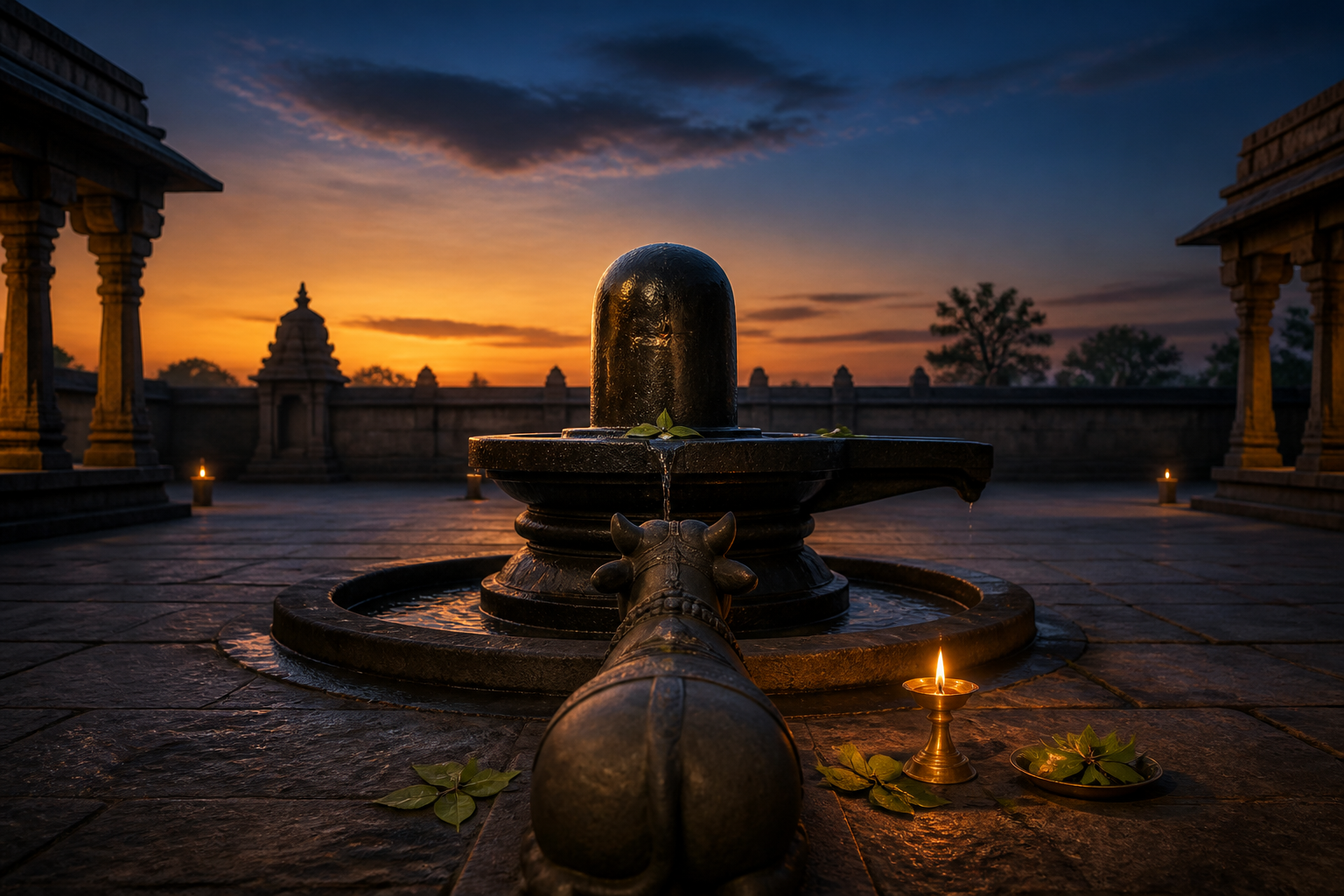
The Shivling is not merely an object placed at the center of worship. It signifies Shiva’s formless, all-pervading presence and acts as an axis joining embodied ritual with transcendent awareness. The Panchabrahma or Panchamukha framework helps you read that axis through five complementary dimensions of Shiva.
| Face | Orientation | Contemplative meaning |
|---|---|---|
| Sadyojata | West | Creation and emergence |
| Vamadeva | North | Preservation and continuity |
| Aghora | South | Transformation and dissolution |
| Tatpurusha | East | Concealment and inwardness |
| Ishana | Above | All-pervading knowledge and liberation |
These are not five competing deities. They are ways of contemplating one reality through different functions. Creation, preservation, transformation and inward concealment occupy the four cardinal directions. Ishana opens above them, exceeding the horizontal field rather than becoming another point within it.
Ishana is therefore often implied rather than carved as an ordinary visible face. It is associated with akasha, or space; jnana, or direct knowledge; and moksha, liberation. The upward form of the Shivling, the vertical rise of a temple tower above the sanctum, and abhishekam flowing from above can all turn your attention from mental congestion toward spacious awareness.
You can make that symbolism practical without forcing an unusual experience. As water descends during abhishekam, notice the difference between the awareness that knows a thought and the thought itself. When a mantra ends, attend to the silence that remains. During an unforced breath, notice its natural pause without manufacturing breath retention. The purpose is not to escape your problem. It is to create enough inner space that the problem no longer dictates your response.
Nandi adds a bodily discipline to this vertical contemplation. You stop, face Shiva and become steady before acting. If you are in a temple, let that orientation interrupt the impulse to rush through darshan merely because others are moving. A brief period of undistracted attention is more faithful to the symbol than a long sequence performed mechanically.
Build the observance around Trayodashi twilight
Pradosham is centered on the twilight period around sunset on Trayodashi, not simply on any convenient evening. Because the observance follows the lunar calendar, use the date and service time published by the temple or Hindu calendar you normally follow. Do not infer it from the numbered date of the civil month.
A workable observance has a clear sequence:
- Confirm the Trayodashi and Pradosha Kala followed in your locality. If you are attending a temple, use its announced service time.
- Choose a preparation you can sustain. Simple fasting or dietary restraint may be observed according to health, capacity and family tradition, but fasting is not the spiritual substance of Pradosham. If it is medically unsafe for you, omit it rather than turning worship into bodily harm.
- Before the twilight worship begins, name the harmful reaction or unresolved duty you are bringing before Shiva. Keep it specific enough that you can recognize your own conduct.
- At a temple, participate in the established sequence rather than imposing a private one. Abhishekam to the Shivling, archana with mantras and pradakshina around Nandi are prominent parts of South Indian Pradosham observance. Follow local instructions because the manner of circumambulation can differ.
- At home, keep the worship modest and consistent with your received practice. If your household tradition includes a Shivling, an offering of water from above can recall both abhishekam and Ishana’s upward symbolism. Otherwise, use a familiar Shiva prayer, nama or silent contemplation rather than inventing an elaborate ritual.
- End by choosing a visible dharmic action. It might be an apology without self-justification, a boundary stated without cruelty, a task honestly completed, an angry message left unsent, or an act of service performed without seeking credit.
The order matters. Preparation interrupts habit. Worship steadies attention. Reflection identifies your responsibility. Action carries the observance beyond the shrine. Without that final movement, it is easy to treat Pradosham as a transaction in which ritual is offered and obstacles are expected to disappear while conduct remains unchanged.
Use each Pradosham as an ethical checkpoint
A twice-monthly rhythm is frequent enough to reveal patterns. Keep the question from one observance alive until the next: did you contain the reaction, make the repair and protect the necessary rest, or did the same poison find another route into speech and behaviour?
You can structure that checkpoint around four movements:
- Contain: Identify the reaction you will not pass to another person merely because it has entered you.
- Clarify: Separate what actually happened from the story that anger, fear or pride has built around it.
- Repair: Decide what can be corrected before the next Pradosham, then give that action a real place in your schedule.
- Release: Once you have acted responsibly, stop using constant mental replay as proof that you care.
This makes obstacle removal less superstitious and more demanding. An obstacle may be external, but it may also be the habit that keeps feeding a conflict: the refusal to apologize, the need to win every exchange, the inability to rest, or the belief that devotion excuses neglected duties. Ask not only what you want Shiva to remove. Ask what you must stop reinforcing.
Compassion, self-restraint, mindfulness and service also form a shared ethical horizon across Hindu, Buddhist, Jain and Sikh traditions. That does not erase their distinct doctrines or practices. It shows why a Shaiva observance can strengthen a wider dharmic culture: inner discipline becomes trustworthy when it produces less harm and more responsible action.
If you visit Surutapalli, allow the reclining Pallikondeswarar to challenge the assumption that sacred power must always appear active, upright and forceful. If you worship elsewhere, carry the same sequence inward: meet the poison, contain its spread, rest in awareness and return to duty with greater clarity.
Key takeaways
- Pradosham centers on the twilight of Trayodashi in both lunar fortnights, so confirm the local date and service time rather than guessing from the civil calendar.
- Nilakantha represents protective containment: recognize harm without transmitting it through your own conduct.
- Pallikondeswarar’s repose shows that restoration after responsible action is part of strength, not a retreat from dharma.
- The Shivling and its upward Ishana dimension direct attention from passing mental content toward spacious, discerning awareness.
- Abhishekam, archana and pradakshina become more meaningful when they conclude with a specific repair, boundary or act of service.
- Fasting is an optional discipline governed by tradition and capacity; it is not a substitute for attention, ethical correction or safe care of the body.
At your next Pradosham, arrive with one poison clearly named and leave with one repair clearly chosen. When the following Pradosham comes, look honestly at what changed. That rhythm turns Shiva symbolism from something you admire into a discipline you can live.


References
- DharmaRenaissance Blog – Complete Guide to Pradosham at Surutapalli: Discover Shiva’s Pallikondeswara Legacy
- DharmaRenaissance Blog – Discover the Ishana Face of Shivling: The Ultimate Guide to Its Symbolism and Practice
