
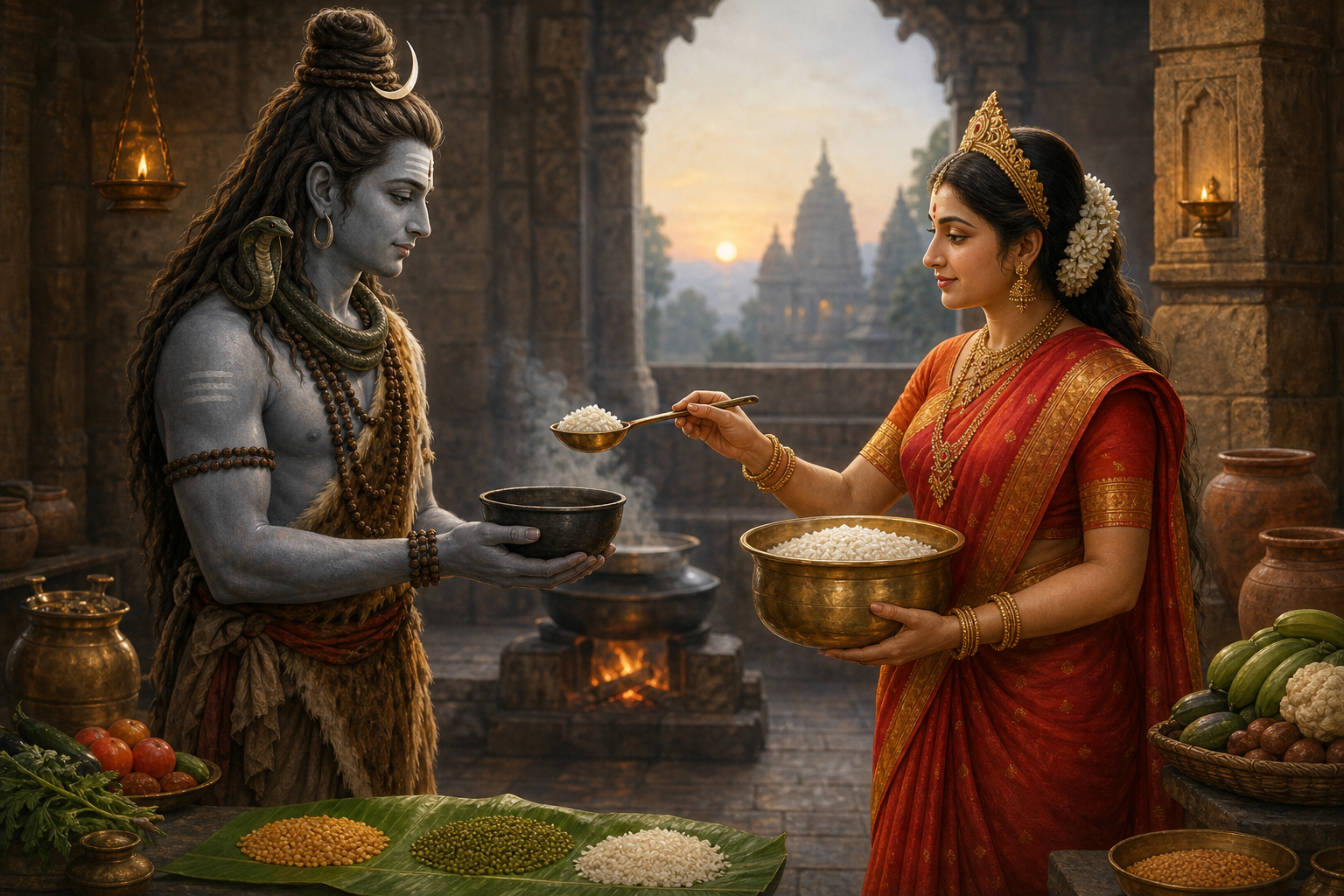
You may offer flowers to Shiva, recite a stotram to Annapoorna, and still wonder what their relationship asks of you when an ordinary meal reaches the table. The answer is not another layer of ceremony. It is a change in how you cook, receive, share, and refuse to waste food.
The Shiva-Annapoorna tradition joins two disciplines that are often separated: freedom from possession and responsibility for nourishment. If you want to live this teaching, your kitchen, dining table, temple service, and community giving all become places of sadhana.
Why Shiva receives food from Annapoorna
Shiva represents the ascetic insight that possessions, status, and sensory pleasures cannot give lasting freedom. Annapoorna, a manifestation of Parvati, represents the fullness through which living beings are sustained. Her name brings together anna, food, and purna, fullness or completeness.
The tension between them is deliberate. In the traditional Kashi narrative, nourishment disappears after Shiva emphasizes the world’s illusory character. Without food, embodied life and spiritual practice cannot continue. Annapoorna then feeds Shiva himself.
This episode should not be reduced to a quarrel over whether the world is real. Its practical warning is sharper: transcendence can be misunderstood as permission to neglect embodied beings. A person may speak about detachment while depending on food grown, transported, prepared, and served by others. Shiva’s willingness to receive from Annapoorna corrects that conceit.
Three distinctions help you apply the teaching accurately:
- Renunciation is not negligence. You can loosen attachment to possessions without becoming indifferent to hunger or household duty.
- Abundance is not excess. Annapoorna’s fullness means that nourishment is available and shared. It does not sanctify hoarding, over-serving, or waste.
- Receiving is not inferiority. Shiva receives food. The act does not diminish him, and the giver does not become spiritually superior to the one being fed.
When you hear lofty spiritual language, ask a grounding question: does this interpretation make people more attentive to the needs of living beings, or does it give them a reason to look away? The Shiva-Annapoorna relationship does not let wisdom escape that test.
Turn an ordinary meal into a daily discipline
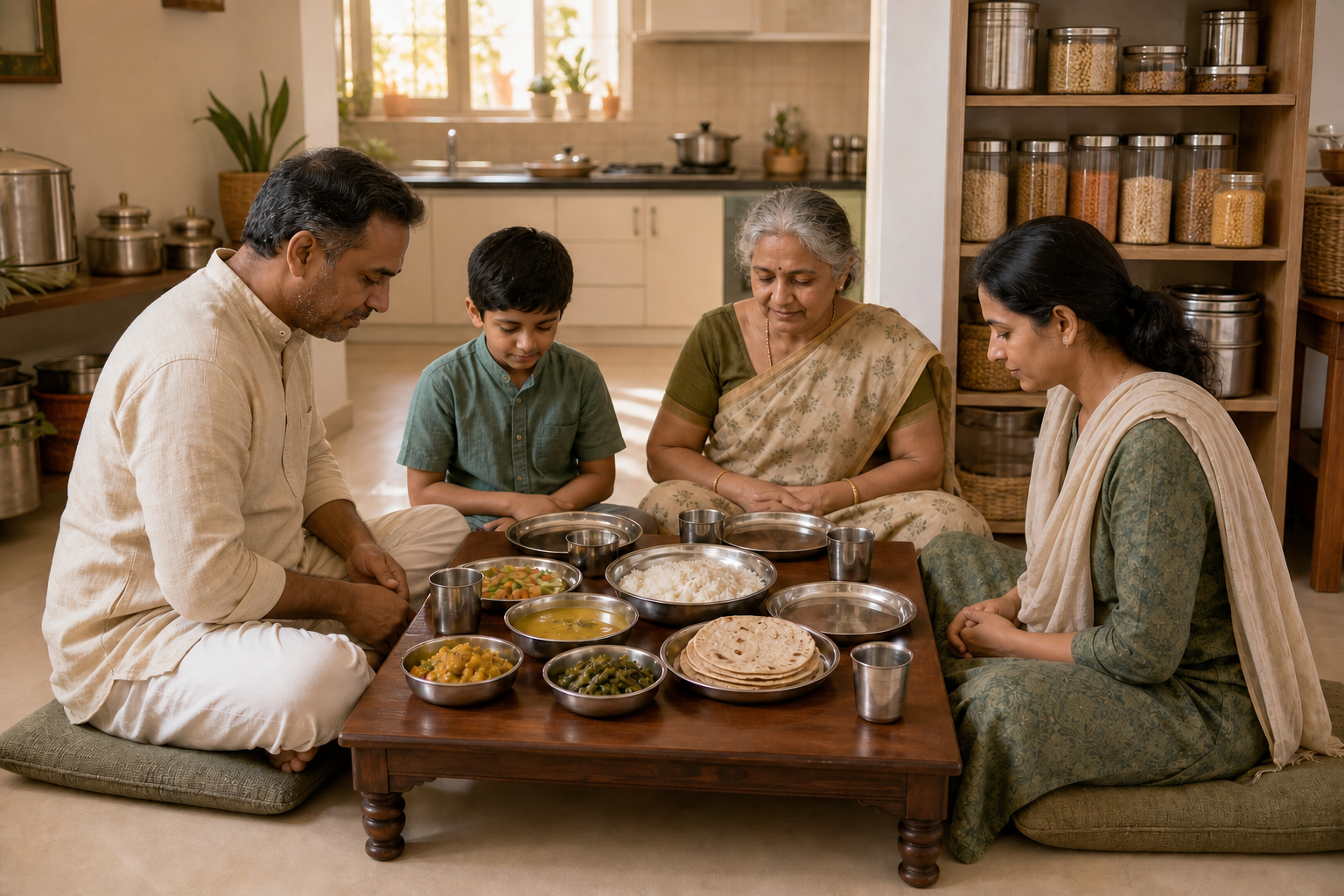
Sacred nourishment does not depend on elaborate ingredients. A simple meal becomes spiritually meaningful through attention, restraint, gratitude, and sharing. You can build those qualities into the sequence of preparing and eating food.
- Plan for the people who will actually eat. Before cooking, account for household members, guests, dependants, and anyone to whom you intend to give a portion. This turns generosity from a vague intention into provision.
- Prepare without contempt. Treat cooking and serving as necessary work rather than low-status work. If another person cooked, notice that labour instead of behaving as though the meal simply appeared.
- Pause before eating. Remember that the plate depends on many forms of effort and care. If your household has a mantra, prayer, or offering practice, use it. The pause should produce gratitude, not become a performance.
- Serve with proportion. Take what you reasonably expect to eat, then return for more if needed. This small restraint is more faithful to Annapoorna’s fullness than filling a plate that will be discarded.
- Give the meal your attention. Receive food without treating it as background noise. Attention helps you notice sufficiency, the work behind the meal, and the difference between nourishment and restless consumption.
- Deal with surplus responsibly. Store usable food safely, incorporate it into another meal, or share it while it remains suitable to eat. Do not call avoidable disposal an offering.
Devotional recitation can support this discipline. The Annapurna Stotram is traditionally attributed to Adi Shankaracharya, and many devotees use it to connect knowledge, humility, and the request for nourishment. If you recite it, let at least one behaviour follow: waste less, thank the cook, feed someone, or accept what is served without entitlement. Recitation and conduct should confirm each other.
This is a household discipline, not a claim that every family must follow one ritual sequence. Preserve the vidhi of your sampradaya where you have one. The common test is whether remembrance of Annapoorna changes your relationship with food after the prayer ends.
Make annadana dignified, not self-congratulatory
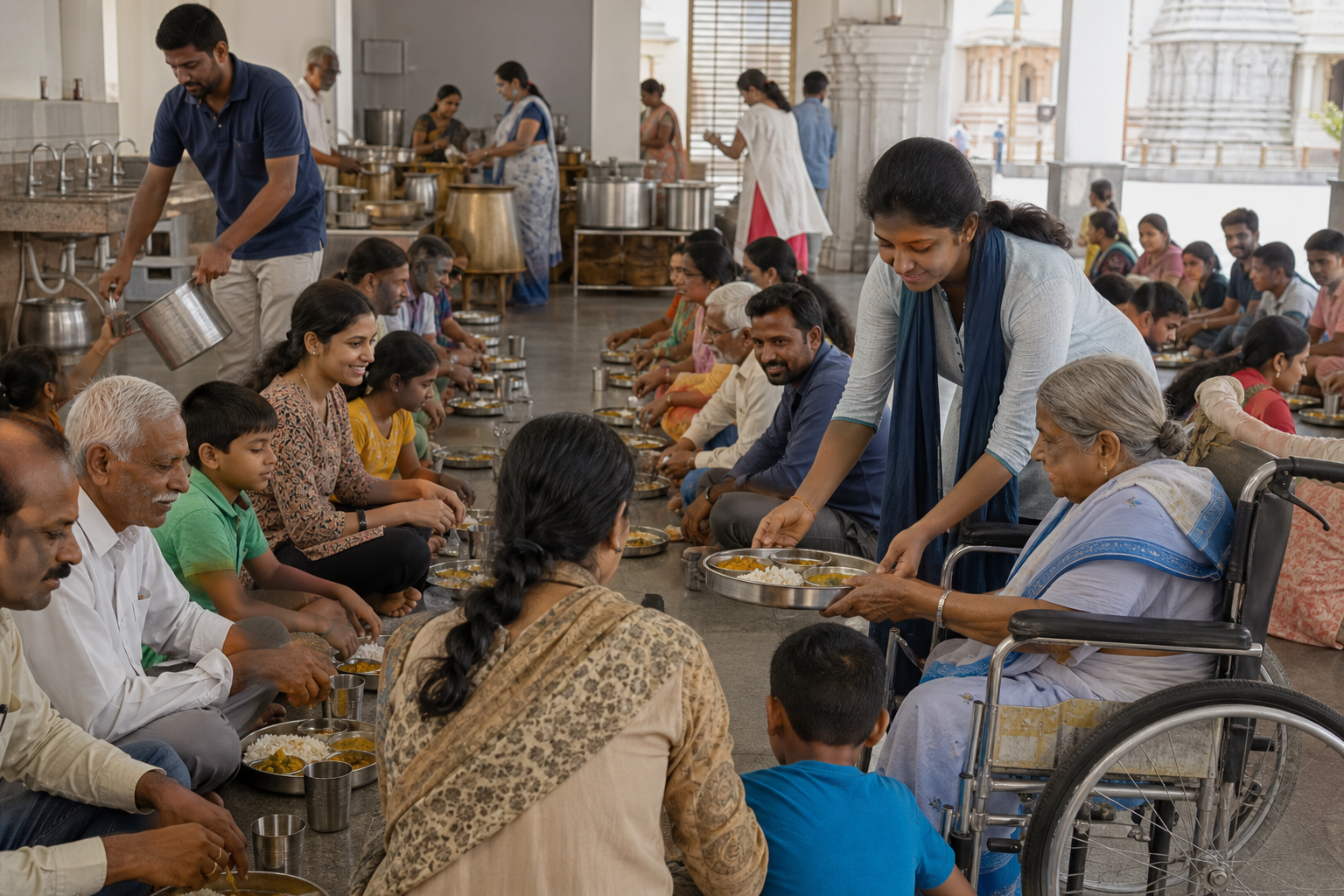
Annadana, the giving of food, is often translated as charity. That translation can hide the deeper relationship. In the Shiva-Annapoorna vision, the giver is not an independent benefactor dispensing personal greatness. The food, the capacity to give, and the need to receive all exist within a field of dependence. Feeding another being is therefore seva and duty as well as generosity.
You can use the following checks when organizing a temple meal, festival distribution, neighbourhood kitchen, or personal act of feeding:
- Begin with the recipient’s need. Ask what food is suitable, when it is needed, and how it can be distributed without making access burdensome.
- Offer food you can stand behind. Sacred language does not excuse careless preparation, poor handling, or giving away what you simply want removed from your own kitchen.
- Protect equality in the serving space. Avoid distinctions based on wealth, occupation, social standing, or the perceived religious merit of the recipient.
- Do not demand gratitude as payment. A person should not have to praise the donor, pose for publicity, or disclose hardship in order to eat.
- Plan quantities before invoking abundance. Too little leaves people unfed; unmanaged excess becomes waste. Annapoorna’s fullness calls for capable stewardship.
- Let service include unglamorous work. Preparation, carrying, cleaning, and orderly distribution are part of annadana, not lesser tasks beneath the spiritual event.
The importance of Kashi lies partly in how this teaching remains visible there. At the Annapurna Devi Temple near Kashi Vishwanath, annadana and prasad distribution embody nourishment as worship. Annapurna Jayanti, traditionally observed on Margashirsha Purnima, brings the same principle into focused remembrance. Yet you do not need to wait for a pilgrimage or annual observance. The nearest honest opportunity to feed someone is already a field of practice.
Receiving food deserves equal care. If you are served prasad or welcomed to a community meal, receive without treating the offering as insignificant. Take an appropriate portion, follow the host community’s discipline, and avoid waste. Shiva before Annapoorna teaches that accepting nourishment with humility can itself be a sacred act.
Recognize the shared Dharmic ethic without erasing differences
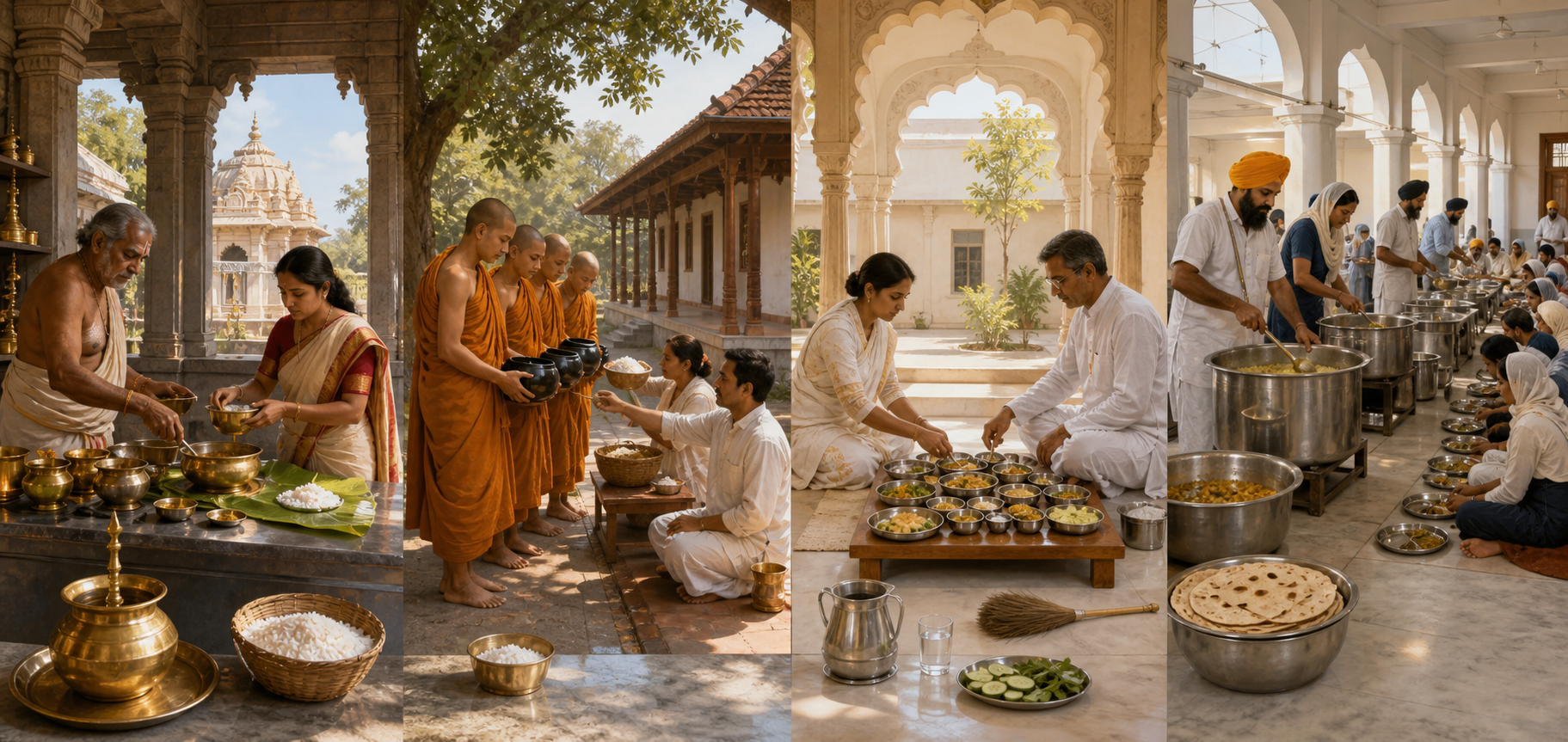
The sanctity of feeding is not confined to one Hindu form. Sikh langar, Buddhist dana, and Jain anna-kshetra and ahimsa also place generosity, interdependence, and care for living beings at the centre of practice. These traditions are not interchangeable, and each has its own theology, discipline, and institutional life. Their kinship lies in refusing to separate spiritual aspiration from the treatment of embodied beings.
If you participate in a feeding practice outside your own tradition, approach it as a learner rather than claiming that every practice is merely another version of yours. Observe how the community serves, who eats together, how volunteers divide the work, and what rules protect dignity. Join the labour that is requested. This is a better expression of Dharmic unity than flattening distinct traditions into a slogan.
You can also use these practices as a mirror for your own community. Notice who cooks but is rarely thanked, who serves but eats last, who can approach the meal freely, and who feels watched or judged. Sacred nourishment is incomplete when devotional symbolism is inclusive but the actual dining space is not.
Key takeaways
- Shiva and Annapoorna unite inner detachment with responsibility for the bodily needs of living beings.
- Annapoorna’s abundance means sufficient nourishment shared well; it does not mean careless excess.
- A meal becomes a practice through gratitude, proportionate serving, respect for labour, attention, and responsible handling of surplus.
- Annadana should preserve the recipient’s dignity and remove status distinctions rather than advertise the donor’s virtue.
- Receiving food humbly is part of the teaching, because Shiva himself accepts nourishment from Annapoorna.
- Langar, dana, anna-kshetra, and ahimsa reveal a shared Dharmic concern for compassionate provision without making the traditions identical.
Begin with the next plate in front of you. Take what you will eat, acknowledge the hands that made it possible, and decide where a share of your own food can go. That modest act brings Shiva’s clarity and Annapoorna’s care into the same place.
References
