
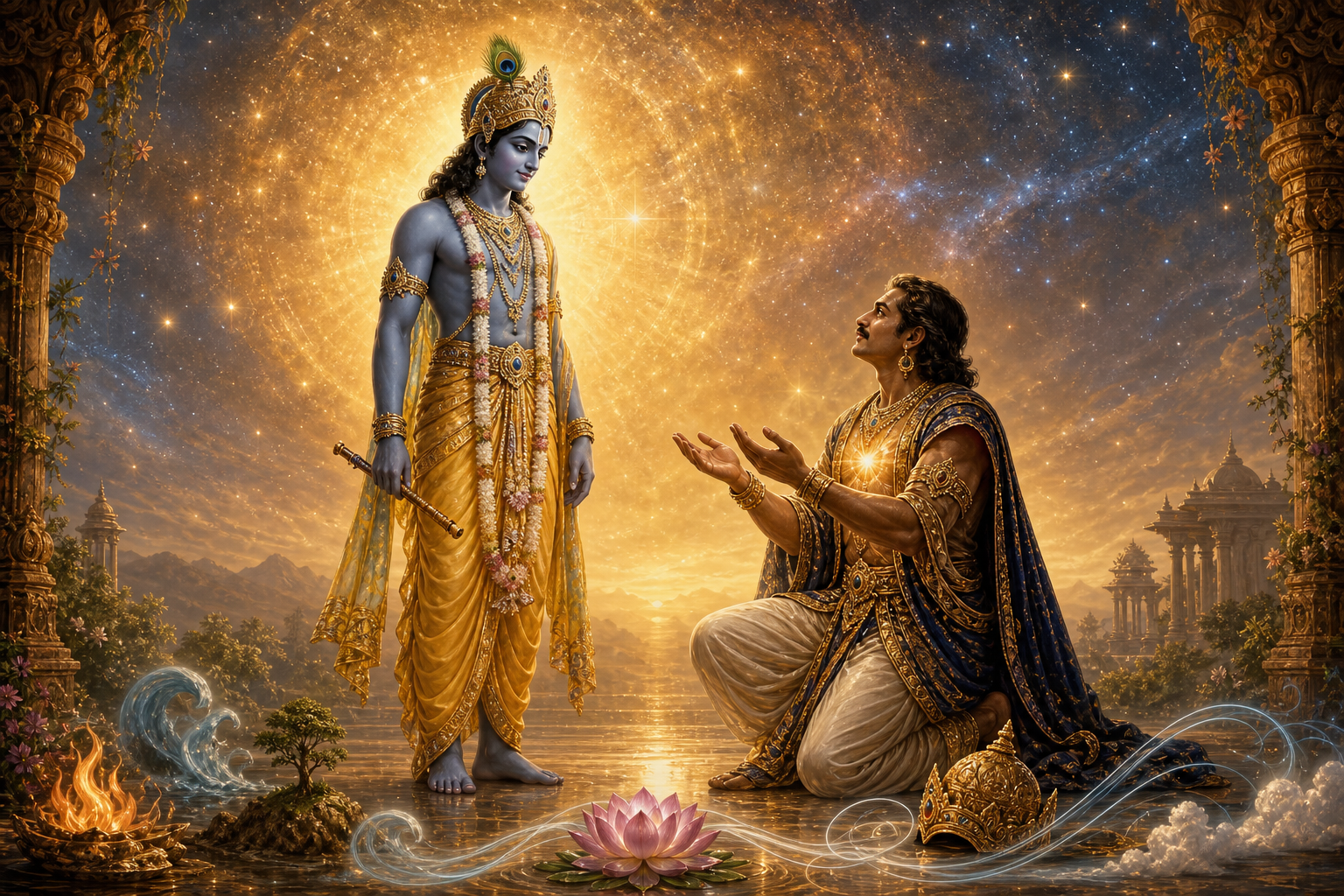
You may have arrived at King Bali’s hymn because one short verse appears to place Krishna, Brahman, Paramātmā, Sāṅkhya, Yoga, creation, and surrender in the same breath. The practical question is whether these are rival ideas loosely collected together or parts of one coherent spiritual vision.
They form a sequence. In Śrīmad-Bhāgavatam 10.85.39, Bali begins with who Krishna is, moves through His relation to the cosmos and spiritual knowledge, and ends with how the same supreme reality can be known. Once you see that architecture, the verse becomes a guide for discernment, practice, and action rather than a catalogue of divine titles.
Read the hymn as five theological movements
The terms in Bali’s salutation correct one another. Each prevents a partial understanding of Krishna from becoming the whole theology.
- Ananta means unlimited. Krishna cannot be enclosed by space, circumstance, or the categories the mind uses to understand finite things.
- Bṛhat means supreme and all-great. The Lord is not merely a powerful being within a reality larger than Himself; His greatness encompasses and exceeds every limited order of existence.
- Vedhase identifies creative intelligence. The cosmos is not presented as spiritually meaningless machinery but as an ordered field in which ṛta, dharma, responsibility, and restraint matter.
- The disseminator of Sāṅkhya and Yoga is the source of both clear understanding and disciplined practice. Analysis and spiritual training do not stand outside Krishna’s sovereignty.
- Brahman and Paramātmā name the absolute reality and the indwelling witness. The same Lord who exceeds the cosmos is present within living beings.
This sequence gives you a useful test whenever you interpret the verse. If your reading reduces Krishna to an impersonal abstraction, Paramātmā and Bali’s personal obeisance restore divine presence and relationship. If it reduces Him to a finite personality, Ananta and Bṛhat reopen the horizon. If it treats devotion as feeling without understanding or discipline, Sāṅkhya and Yoga restore discernment and practice. If it turns philosophy into intellectual self-display, Bali’s surrender returns it to humility.
Brahman and Paramātmā correct two opposite errors
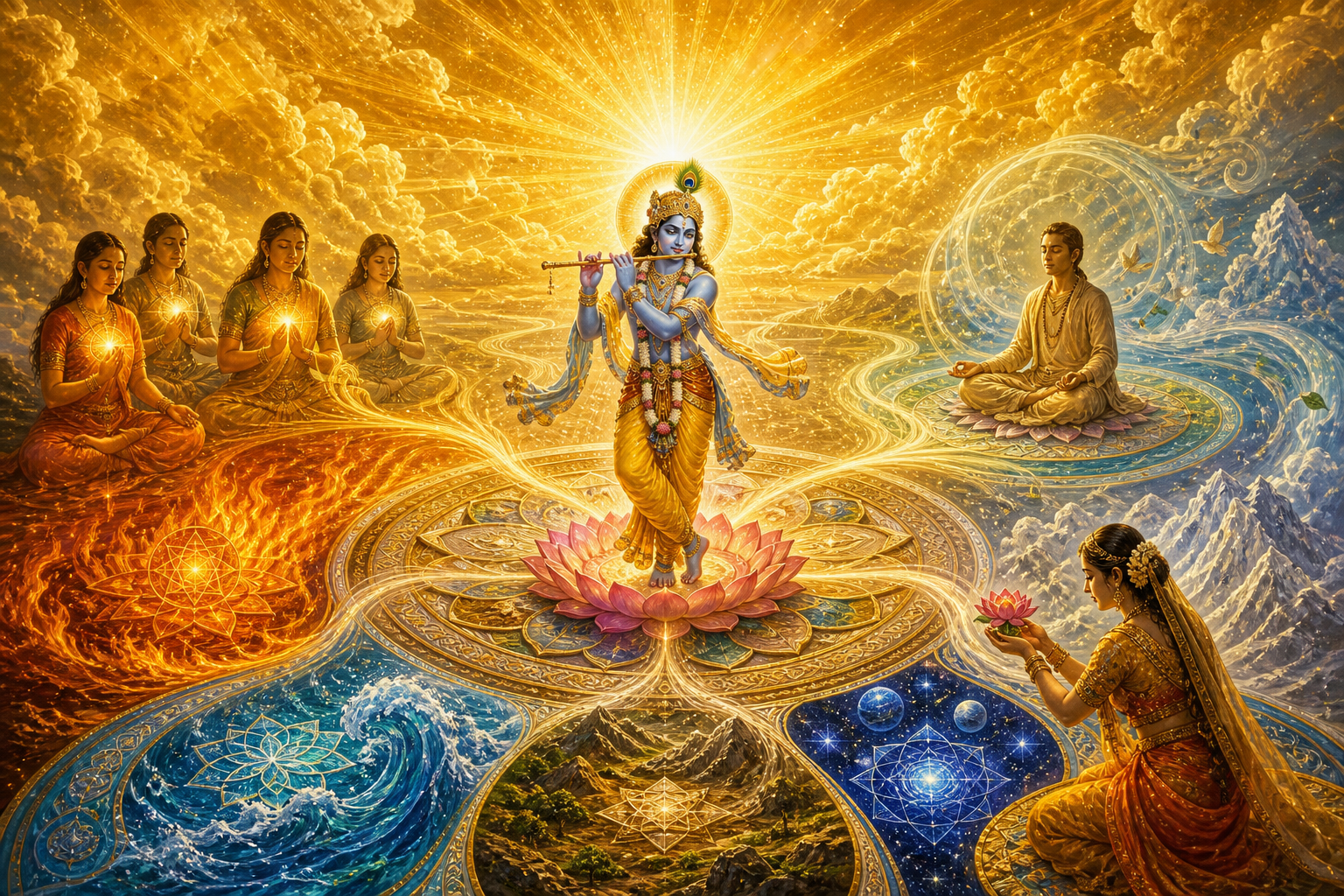
In classical Vedāntic language, Brahman denotes absolute, undivided reality. Paramātmā denotes the supreme presence as the witness within every living being. Bali does not invoke two competing deities. Within the hymn’s theological frame, he recognizes Krishna as the one reality approached under both descriptions: beyond every limit and intimately present within life.
This distinction matters because spiritual reflection commonly slips toward one of two extremes. You can imagine transcendence as so remote that it has no bearing on conduct, or imagine divine presence so narrowly that God becomes an extension of private preference. Brahman challenges the first reduction by placing your life within an immeasurable reality. Paramātmā challenges the second by placing a witness within you and within every being affected by your choices.
The verse does not require you to erase the real differences among Vedāntic schools. Those traditions do not all explain Brahman, Paramātmā, the individual self, and Bhagavān in identical terms. What Bali’s salutation does establish is that transcendence and immanence must not be torn apart when reading his prayer.
Turn that theology into a decision practice by asking two questions. First: what changes when you place this fear, ambition, or loss within the horizon of Ananta and Bṛhat? Second: what changes when you remember Paramātmā as witness within every person who will bear the result of your decision? The first question loosens the illusion that your immediate circumstance is the whole of reality. The second prevents transcendence from becoming an excuse to ignore another being.
Sāṅkhya and Yoga become one devotional method
Sāṅkhya contributes discernment between the seer and the seen. A role, possession, mood, reputation, or desired outcome can be observed; it therefore belongs on the changing side of the exercise. You don’t need to settle every metaphysical debate before this distinction becomes useful. Simply noticing that an experience is present, changing, and knowable weakens the reflex to declare that experience your complete identity.
Yoga supplies the discipline needed to live from that insight. Attention must be steadied. Breath, conduct, and action must be brought into alignment. Otherwise, the distinction between seer and seen remains an idea that disappears as soon as anger, praise, fear, or loss arrives.
Bali’s address to Krishna adds the decisive devotional orientation. Sāṅkhya is not merely a technique for becoming a more detached analyst, and Yoga is not merely a method of self-optimization. Both are received as divine instruction and directed toward the Lord. Discernment clears confusion; disciplined practice gathers the person; devotion determines where the clarified mind and gathered life are offered.
You can work through that movement in a short daily practice:
- Recall the names Ananta, Bṛhat, and Vedhase. Let each name challenge the assumption that your present concern is self-contained or ultimate.
- Name one object of attachment that is dominating your attention: a role, possession, opinion, recognition, or result.
- Observe it as something seen and changing. Do not deny it or pretend it has no consequences; stop treating it as the whole of who you are.
- Settle your attention and breath before choosing an action. Ask which response accords with truth, duty, care, and self-restraint.
- Complete one act of seva that does not depend on praise. This translates inward clarity into responsibility toward another being.
Other Dharmic traditions contain practices with recognizable family resemblances: dhyāna in Jain traditions, mindfulness and compassion cultivation in Buddhist traditions, and nām-simran in Sikh tradition. Those resonances can support mutual respect, but they should not be used to flatten distinct teachings into interchangeable terminology. A productive Dharmic conversation begins by recognizing shared commitments to disciplined attention, ethical conduct, and the uplift of beings while allowing each tradition to define its own theological claims.
Bali’s surrender tests whether the theology has changed you
The Vāmana-Trivikrama background gives Bali’s words their weight. He had surrendered his sovereignty, so his obeisance does not come from a position of untouched security. He praises the unlimited Lord after his own claim to possession and control has been tested. His theology is therefore inseparable from humility and trust.
That does not turn surrender into passivity. Dharmic surrender is not an instruction to abandon duty, tolerate adharma, or give another person unrestricted power over you. Bali’s example concerns the ego’s claim of ultimate ownership before the Lord. The meaningful question is not whether you should stop acting, but whether you can act rightly without pretending to own the entire field, every other person, and the final result.
When loss or uncertainty puts your own sense of sovereignty under pressure, use this four-question filter:
- What is changing? Identify the status, possession, expectation, emotion, or outcome that belongs to the seen side of experience.
- What duty remains? Separate the loss of control from the responsibilities that still belong to you.
- What am I trying to possess absolutely? Look for the demand that reality, another person, or the result must conform to your will.
- What would surrender improve in my conduct? It should make room for greater truthfulness, restraint, courage, care, or service.
This last question catches a common misreading. If your idea of surrender makes you less honest, less responsible, or more willing to excuse harm, it has moved away from dharma. If it loosens the need to control the result while strengthening truthful action and seva, it is closer to the humility Bali embodies.
Key takeaways
- Ananta and Bṛhat identify Krishna as limitless and unsurpassable, preventing a merely finite conception of the Lord.
- Vedhase connects divine greatness with creative intelligence, cosmic order, dharma, and ethical responsibility.
- Brahman and Paramātmā express transcendence and indwelling presence without requiring two separate ultimate realities.
- Sāṅkhya distinguishes the seer from what is seen; Yoga trains attention, breath, and conduct so that this discernment survives contact with daily life.
- Bali’s surrender relinquishes the ego’s claim to absolute ownership without relinquishing duty, truthful action, or service.
At your next difficult decision, take Bali’s theology in its own order. Place the problem within Ananta, remember the witness signified by Paramātmā, distinguish the changing object from the one who observes it, steady yourself through Yoga, and then perform the dharmic action still yours to perform. Release the claim to own the result, not the responsibility to act well.



References
