
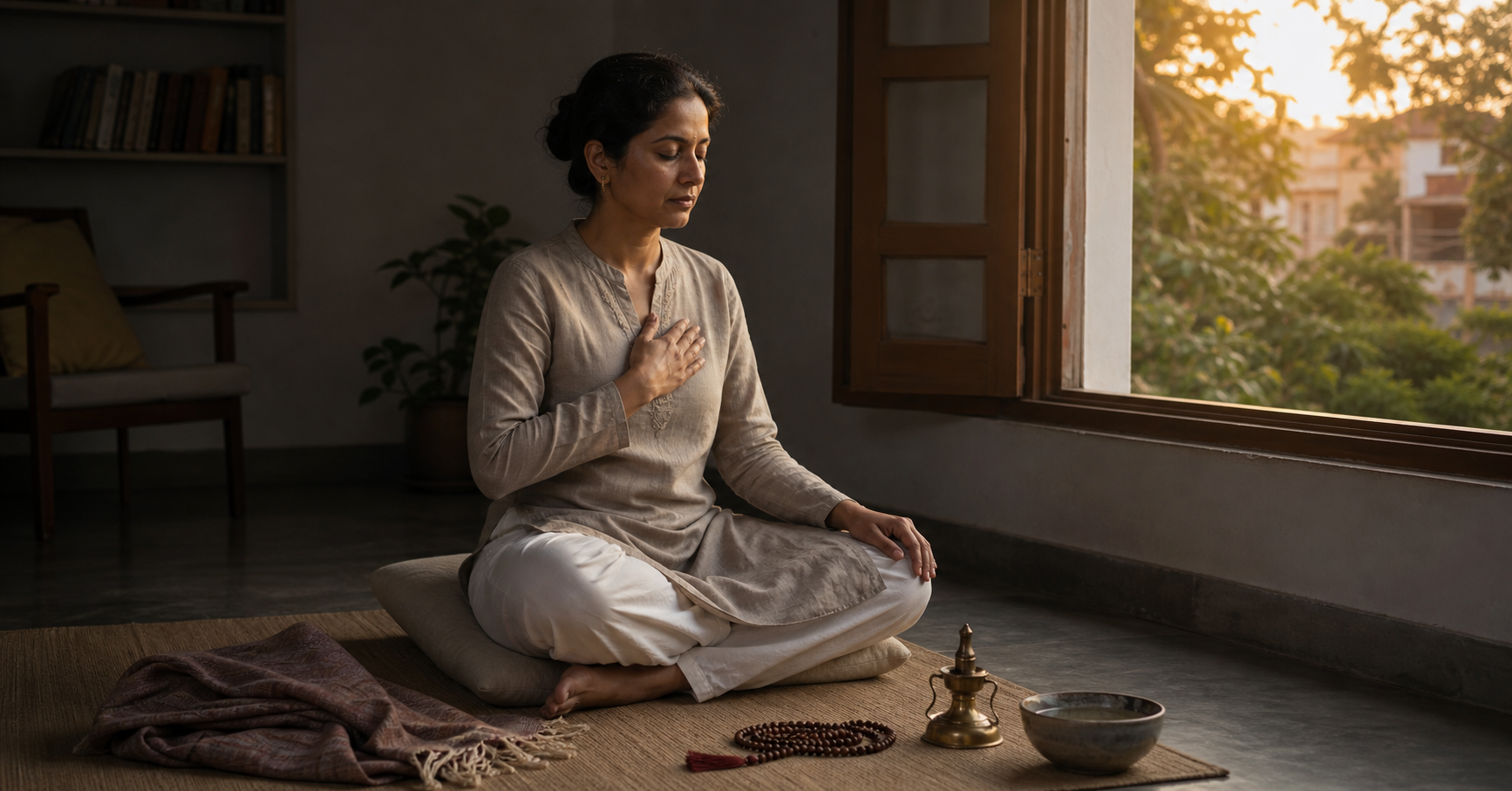
When fear, anger, grief, or uncertainty takes over, your immediate problem is rarely a lack of spiritual knowledge. It is the shrinking space between what you feel and what you do next. You need enough steadiness to keep a passing state from choosing your words, decisions, and treatment of other people.
Dharmic emotional balance is not the suppression of feeling. It is the capacity to notice what has arisen, settle your attention, loosen your grip on the outcome, and act without adding avoidable harm. Hindu, Buddhist, Jain, and Sikh traditions express that work differently, but they share a practical movement from compulsion toward clear, ethical action.
Key takeaways
- Balance does not mean feeling calm all the time. It means remaining responsible for your conduct while a strong feeling is present.
- Begin with the body and breath. Philosophy is difficult to use while attention is racing and the body is braced.
- Choose the practice that fits the disturbance: mindfulness for mental turbulence, non-attachment for outcome anxiety, manifold viewpoints for rigid anger, heart practice for defensiveness, and remembrance or seva for helplessness.
- Acceptance is not approval, fatalism, or passivity. Dharmic acceptance separates what cannot be controlled from the duty that still belongs to you.
- A short daily practice matters because it creates familiarity. You are training a response that must remain available on a difficult day.
Emotional balance begins between feeling and action
An emotion is information, energy, and an impulse. It is not automatically a command. Anger may reveal a crossed boundary, but it does not authorize cruelty. Fear may identify uncertainty, but it does not prove that the worst outcome will occur. Grief testifies to attachment and loss, but it does not mean you have failed at spiritual practice.
The first discipline is therefore neither indulgence nor denial. It is observation. Buddhism gives this work a particularly sharp frame through Anicca: whatever has arisen is changing. You do not need to pretend that the feeling is pleasant. You need to stop treating its present intensity as permanent. Mindfulness lets you watch sensations, thoughts, and urges arise and pass without obeying each one.
Hindu practice adds the question of Dharma. Even while the mind is unsettled, what conduct is appropriate to your role and circumstances? Karma directs attention toward action; non-attachment keeps the hoped-for result from becoming the sole measure of that action. The Upanishadic distinction between changing experience and the deeper Self, Atman, offers another form of steadiness: what you are experiencing is real as experience, but it is not the whole of what you are.
Jain practice brings Ahimsa, Aparigraha, Anekantavada, and Samayik into the same moment. Do not injure. Do not grip possession, status, or control so tightly that fear governs you. Remember that your present viewpoint may be incomplete. Return to equanimity before you make a reactive judgment. Sikh practice turns toward Hukam, Naam simran, seva, and Chardi Kala: recognize the order you do not command, remember the Divine, serve where you can, and sustain courageous hope rather than collapsing into resignation.
When a feeling is strong, move through these questions in order:
- What is here? Name the emotion plainly: anger, fear, shame, grief, envy, or confusion. Avoid turning it into a verdict such as everything is ruined.
- Where is it showing up? Notice the jaw, throat, chest, abdomen, hands, posture, and breath. Describe the sensation without trying to diagnose it.
- What is the urge? You may want to attack, withdraw, send a message, seek reassurance, or keep checking for an answer. Naming the urge helps separate it from action.
- What does Dharma require now? Look for the next truthful, non-harming, proportionate action. It may be speaking, waiting, apologizing, setting a boundary, completing a duty, or asking for help.
This sequence does not promise the disappearance of pain. It gives pain less authority over your character. You can still be grieving and speak gently. You can still be angry and refuse humiliation or abuse without dehumanizing the other person. That is a more demanding and useful definition of balance than appearing serene.
Begin with a five-minute settling practice
When the body is tense and attention is scattered, begin with a practice simple enough to remember. A five-minute combination of breath awareness, heart-centered attention, mantra, and kindness can become a reliable daily foundation.
- Take a stable seat. Let your feet, legs, or sitting bones feel supported. Release unnecessary tension in the hands, shoulders, and jaw. You are not trying to manufacture a spiritual mood; you are making it easier to notice what is already happening.
- Let the breath become slower and diaphragmatic. Allow the abdomen and lower ribs to move without forcing a large inhalation. Keep the breath comfortable. The purpose is steadiness, not performance.
- Rest attention near the center of the chest. If that area feels emotionally charged, keep part of your awareness on the contact of the body with the floor or chair. Grounding and openness should support each other.
- Choose a form of remembrance that belongs to your path. In a yogic practice, you may silently repeat the bija mantra Yam. If Naam simran is part of your Sikh discipline, remember the Divine Name. If mantra is not your practice, remain with the natural rhythm of breathing. You do not need to combine traditions to benefit from their shared ethical direction.
- Include goodwill. Offer a simple intention of non-harm and kindness toward yourself, someone you find easy to love, and those with whom you are struggling. This carries the spirit of Buddhist metta and karuna, Jain maitri-bhavana, Hindu bhakti and compassion, and Sikh remembrance expressed through care.
- End with conduct. Identify the next action that would make your day more truthful, less harmful, or more useful. Meditation becomes emotionally stabilizing when it changes how you answer, work, repair, and serve.
Keep the breathing gentle and do not turn it into an endurance exercise. Nadi shodhana and bhramari can also support calm attention, but use a version you have learned correctly and avoid forcing the breath. If any breathing practice produces dizziness, panic, pain, or marked discomfort, stop the technique and return to ordinary breathing.
The Anahata Chakra can be a useful contemplative map, but it should be understood on its own terms. In yogic subtle anatomy, Anahata is the fourth chakra, placed at the center of the chest and associated with the air element, the bija Yam, and a twelve-petaled lotus. It is described as a bridge between grounded, material life and higher spiritual awareness. That symbolism can guide attention toward compassion, forgiveness, trust, and discernment; it is not a medical diagnosis or a reason to ignore physical symptoms.
Match the practice to the disturbance you notice
You do not need every practice every time. Emotional balance improves when you identify the mechanism feeding the reaction. Clinging calls for a different response from isolation; rigid certainty calls for something different from helplessness. Use the following as a set of doorways, not as a diagnostic chart.
| What you notice | Dharmic doorway | What to do now |
|---|---|---|
| Your mind keeps rehearsing an outcome you cannot command. | Dharma, Karma, and non-attachment | Name the duty that remains yours. Complete the next appropriate action, then stop treating mental rehearsal as productive work. |
| A feeling seems permanent and fills the whole field of attention. | Anicca and mindfulness | Observe its changing sensations, thoughts, and urges. Do not demand immediate relief; notice the movement already present within the experience. |
| Anger has hardened into absolute certainty about another person. | Anekantavada and Ahimsa | State what you know, distinguish it from your interpretation, and identify what you may not see. Delay speech that is meant to wound, while preserving any necessary boundary. |
| Grief, defensiveness, or isolation has closed your attention around yourself. | Anahata, metta, maitri-bhavana, and bhakti | Use the five-minute heart-centered practice. Follow it with a bounded act of kindness that does not erase your own legitimate needs. |
| Uncertainty has become helplessness or resignation. | Hukam, Naam simran, seva, and Chardi Kala | Acknowledge what is outside your command, return to remembrance, and perform useful service within your actual reach. |
| Status, possession, or being proven right feels essential to your safety. | Aparigraha | Ask what you are afraid of losing. Release the demand to possess the result, the person, or the final word; keep only the responsibility to act well. |
These doorways overlap, but their differences matter. Anicca trains insight into changing experience. Anekantavada trains humility about viewpoints. Aparigraha loosens possessiveness. Hukam places acceptance within devotion and divine order. Dharma asks for right action in the concrete situation. Heart-centered practices cultivate compassion and relational openness. Respecting those distinctions prevents a rich set of traditions from being reduced to generic relaxation.
You can also choose according to the point at which your reaction is becoming harmful. If the body is braced, begin with breath. If the mind is repeating a story, observe impermanence and test the story against what you actually know. If speech is about to become cruel, invoke Ahimsa. If you are fixated on winning, use Aparigraha. If contemplation has become self-absorption, move into seva.
Let go of the outcome without abandoning your duty
Much emotional imbalance comes from confusing influence with control. You may be able to prepare carefully, speak honestly, make amends, request a fair decision, or protect a boundary. You cannot guarantee another person’s response, prevent every loss, or make a changing situation remain fixed. Repeatedly trying to control that second category consumes attention needed for the first.
The Dharmic move is not to stop caring about outcomes. It is to refuse to make inner integrity conditional on receiving the outcome you want. Anxiety softens when attention moves from controlling results to refining presence, conduct, and character. You still plan and act. You simply do not surrender your mind to a result that has not arrived.
Several common misreadings can turn this principle into avoidance:
- Non-attachment is not carelessness. You can prepare thoroughly and prefer a result without making your worth depend on it.
- Impermanence is not nihilism. The fact that an experience changes does not make your choices meaningless. It makes the present choice more consequential.
- Anekantavada is not moral paralysis. Recognizing that a viewpoint is partial does not require accepting cruelty or falsehood. It requires humility about what you know while you act against harm.
- Hukam is not resignation. Acceptance of what is not yours to command can coexist with courage, duty, community care, and resilient optimism.
- Compassion is not unlimited access. You may wish someone well while refusing abusive conduct. Forgiveness, when appropriate, does not require renewed exposure to harm.
When you are unsure whether you are practicing acceptance or merely giving up, ask three questions. What is changing or outside my command? What responsibility is still mine? What action reduces harm without pretending I control the result? A genuine practice of acceptance should make the second answer clearer, not erase it.
Consider the strain of waiting for an important decision. You can verify that your work is complete, communicate when appropriate, prepare for more than one possibility, and continue the duties already in front of you. You cannot force the decision through repeated worry. Each time the mind begins another round of imagined outcomes, return to the work that still belongs to you.
The same distinction helps in conflict. If another person’s words have angered you, Anekantavada asks what context or viewpoint may be missing. Ahimsa asks you not to answer with degradation. Satya, or truthfulness, prevents you from pretending that nothing happened. Aparigraha loosens the need to win the exchange. The balanced response may be a candid conversation, a clear refusal, a repair, or distance. What matters is that it is chosen rather than discharged impulsively.
Carry steadiness into speech, routine, and service
Emotional practice is tested in relationship. A calm meditation followed by contemptuous speech is not balance. Before you send the message, deliver the criticism, or defend yourself, check the action against a few ethical rails:
- Is this true as far as I can presently know, or am I presenting an interpretation as a fact?
- Can I say what must be said without attacking the other person’s humanity?
- Am I communicating a need or boundary, or trying to control the response?
- What part of the situation might I be failing to see?
- Will silence prevent harm, or merely postpone a truthful responsibility?
This is where the virtues associated with Anahata become practical. Compassion affects tone. Empathy makes room for another viewpoint. Discernment keeps empathy from becoming naivety. Forgiveness can release the demand to relive an injury, while boundaries protect against its repetition. The heart is balanced not when it is endlessly agreeable, but when openness and judgment can work together.
Seva provides a further correction. Strong emotion contracts attention around the self: my fear, my insult, my loss, my desired result. Useful service widens the field again. It does not erase your problem, and it should not be used to avoid necessary grieving or help. It reminds you that you still possess the capacity to contribute even when you do not control the larger situation.
Make the practices available through a modest daily rhythm:
- Anchor the five-minute practice. Place it after a stable part of your day so that beginning does not depend on inspiration.
- Use a shorter version at the point of reaction. Feel your physical support, let the breath remain gentle, name the emotion and urge, and wait until you can identify a Dharmic action.
- Review conduct, not just mood. At the end of the day, notice where you acted clearly, where attachment took over, whether harm needs repair, and what you can practice differently.
- Keep seva in the rhythm. Choose useful care that fits your real capacity. Service should make you more responsible, not depleted or avoidant.
- Return without drama. If the routine lapses, resume it. Abhyasa is built through returning, not through punishing yourself for inconsistency.
Consistency over weeks may make changes in clarity, trust, and reactivity easier to notice, but do not turn emotional balance into another result you must force. Look for functional signs: a little more space before speech, less compulsive checking, quicker repair after a mistake, firmer boundaries without contempt, and greater willingness to perform the next duty.
Dharmic practices can support emotional regulation, meaning, and ethical action, but they are not substitutes for medical or psychological care. Seek a qualified mental-health professional when distress is persistent, worsening, or substantially disrupting sleep, work, relationships, or ordinary functioning. If you may harm yourself or someone else, seek immediate help through local emergency or crisis services. Spiritual language should never be used to dismiss serious symptoms, trauma, or abuse.
On the next difficult day, do not demand that you become emotionless. Sit for five minutes, steady the breath, identify what is changing, and separate the outcome from the duty. Then carry out the smallest truthful, non-harming action that is actually yours. Emotional balance grows through that return.



References
- DharmaRenaissance Blog – The Ultimate Dharmic Guide to Life’s Inevitables: Discover Calm, Clarity, and Freedom
- Hindu Pad – Anahata Chakra Explained: The Complete Guide to Mastering Heart-Centered Balance
