

When illness enters your home, you may wonder what it means to light a lamp, invoke Rudra-Shiva, or recite the Mahamrityunjaya mantra while also seeking medical care. Is the practice a prayer, a therapy, a family custom, or all three?
The clearest answer is to keep the different forms of care connected without confusing their purposes. Rudra’s healing presence can steady attention, inspire service, and deepen respect for medicinal knowledge. It does not ask you to replace diagnosis or treatment with devotion.
Why the fierce Rudra is also invoked as a healer
Rudra’s fierceness and his healing power are not opposing identities. The same divine force that confronts danger is asked to protect vulnerable life. If you read Rudra only as an angry or destructive deity, you miss the petitions for mercy, relief, protection, and restoration that give his Vedic presence its fuller meaning.
The healing vocabulary is concrete. Rudra is associated with innumerable remedies, expressed through the term bheshaja, and with the medicinal abundance of forests and mountains. The Rig Veda and Atharva Veda traditions therefore place more than abstract consolation around him. They preserve a sacred regard for remedies found in the living world.
The Mahamrityunjaya invocation to Tryambaka belongs within this healing horizon. It seeks release from suffering through mantra, offering, and disciplined attention. Its importance does not depend on treating every recitation as a guaranteed cure. A mantra can orient the mind toward courage, surrender, and care without functioning as a measurable dose of medicine.
When you encounter Rudra’s fierce language, ask a practical interpretive question: what danger is being faced, and what form of protection is being sought? That question prevents the fearsome imagery from obscuring the healer.
Keep three forms of healing connected but distinct

Many misunderstandings disappear once you distinguish devotional, therapeutic, and communal care. They can support one another, but one cannot prove or replace another.
- Devotional care includes mantra, prayer, a lamp, an offering, and meditative attention. It gives the ill person and the household a way to express fear, hope, gratitude, and dependence on something larger than the immediate crisis.
- Therapeutic care includes assessment, diagnosis, medicines, diet, rest, and an appropriate daily regimen. Within Ayurveda, this is the trained responsibility of the vaidya, not a license for anyone with access to herbs to improvise treatment.
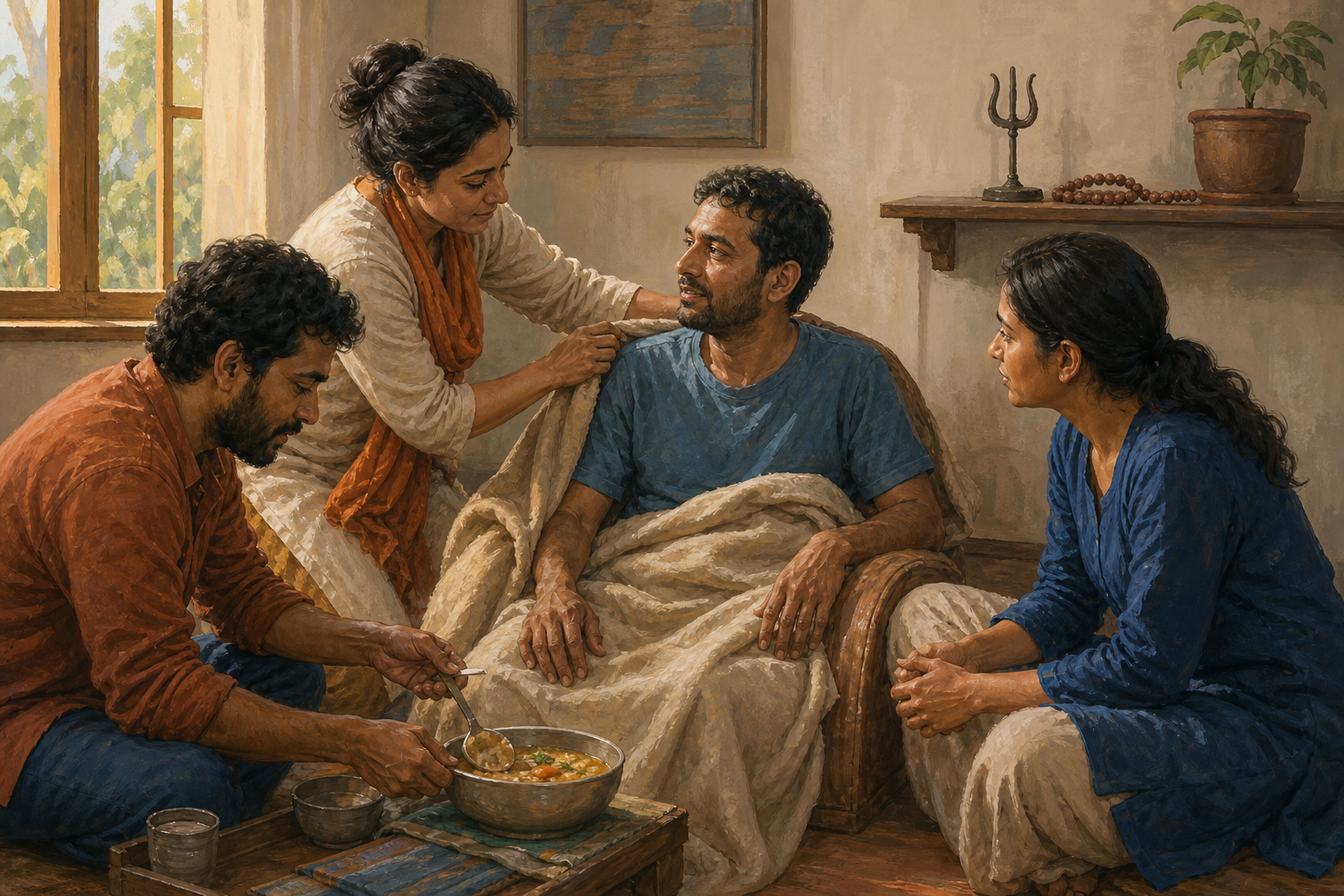
- Communal care includes preparing suitable food, arranging transport, keeping track of practical needs, relieving an exhausted caregiver, and remaining present without overwhelming the patient.
The distinction matters. Feeling calmer after recitation does not establish that a particular herb treats an illness. The ancient reputation of a plant does not establish its identity, preparation, suitability, or amount for a particular person. A clinical diagnosis, meanwhile, does not answer every spiritual or emotional need that illness exposes.
Ayurveda is traditionally associated with Dhanvantari, while Rudra-Shiva embodies a powerful healing archetype. These strands can be placed in harmony without claiming that every Ayurvedic practice is Shaiva or that every Shaiva ritual is medical treatment. Their meeting point is an ethic of attentive care: observe carefully, avoid harm, respect life, and use knowledge responsibly.
A safe Rudra-centered practice during illness

If you want to bring Rudra’s healing presence into a period of illness, use a sequence that protects both faith and the person who needs care.
- Attend to medical needs first. Arrange qualified assessment and follow the treatment plan. If symptoms are urgent, severe, or worsening, do not delay help in order to finish a ritual or recitation.
- Ask what support the ill person wants. A familiar mantra may be reassuring to one person and tiring to another. Devotion offered for someone’s welfare should not become pressure imposed on them.
- Keep the ritual simple. Use a familiar form of prayer, a quiet recitation, or a lamp where it can be used safely. There is no need to invent a special count, duration, vow, or austerity when your tradition or teacher has not given one.
- Fit the practice around treatment and rest. Medicines, meals, sleep, appointments, and clinical instructions take priority in the schedule. A helpful ritual creates order; it does not repeatedly interrupt care.
- Treat herbs as active substances. Do not prepare an unfamiliar root, bark, resin, mineral, or decoction merely because it is described as traditional or natural. Use qualified guidance, obtain the material from a reliable source, and tell the treating clinician what is being taken.
- Turn prayer into service. Assign practical tasks to family or community members. One person can manage food, another transport, another communication, and another quiet companionship.
Breath awareness and meditative observation may help someone settle attention, but illness is not the time to impose strenuous or unfamiliar pranayama. Gentle, familiar practice may accompany care when it is comfortable. Stop if it causes distress, and seek qualified guidance where the person’s condition makes breath practice uncertain.
This approach avoids two common errors. The first is dismissing devotion as useless because it is not a drug. The second is treating devotion as a substitute for professional care because it is sacred. Rudra’s healing ideal has room for disciplined prayer and disciplined medicine.
The forest belongs inside the healing ethic

Rudra’s association with forests and mountains places medicinal knowledge within an ecological setting. Roots, leaves, bark, resins, herbs, and minerals are not anonymous ingredients appearing on a shelf. They come from habitats, seasons, methods of gathering, and communities of knowledge.
Forest-dwelling ascetics, healers, and other votaries are remembered as guardians of practical plant lore. Their example points toward patient observation and seasonal discipline, not reckless experimentation. Romantic language about ancient wisdom becomes dangerous when it removes identification, preparation, restraint, and accountability from the practice.
If you buy or gather a traditional remedy, apply a simple test before using it:
- Can the plant or substance be identified without guesswork?
- Do you know who prepared it and how its quality was controlled?
- Has a suitably qualified practitioner judged it appropriate for the person using it?
- Can it be obtained without careless damage to a wild population or habitat?
- Have all current medicines and health conditions been disclosed to the professionals involved?
If you cannot answer those questions, pause. Reverence for Rudra as lord of medicines should make standards more exacting, not less. Biodiversity is part of the inheritance being protected. A remedy obtained through misidentification, irresponsible extraction, or needless ecological damage contradicts the ethic it is meant to serve.
Make relief from suffering the measure of the practice
Rudra-Shiva’s healing dimension also opens a meaningful conversation across Dharmic traditions. Buddhism venerates Bhaisajyaguru, the Medicine Buddha, as an image of compassionate healing. Jain ahimsa extends moral concern to living beings. Sikh seva and langar turn nourishment and assistance into disciplined service, while Bhai Kanhaiya exemplifies care offered without fear or discrimination.
These are not interchangeable doctrines, and they should not be flattened into a claim that all Dharmic paths teach the same theology. Their practical convergence is narrower and more useful: suffering calls for compassion expressed through conduct. Prayer becomes more credible when it produces patient attendance, suitable food, responsible treatment, ecological restraint, and respect for human dignity.
Key takeaways
- Rudra’s fierceness does not cancel his healing role; it expresses protective power directed toward threatened life.
- Mantra and ritual can support attention, courage, and communal solidarity, but they do not diagnose illness or guarantee a clinical outcome.
- Ayurvedic care requires trained judgment. Using a household herb is not automatically the same as practicing Ayurveda.
- Medicinal tradition carries ecological duties: accurate identification, responsible sourcing, restraint, and respect for biodiversity.
- The most faithful response to illness joins devotion with competent treatment and concrete service.
The next time illness enters your household, let each form of care do its proper work. Let prayer steady attention, let qualified practitioners diagnose and treat, and let the community remove practical burdens. That is not a compromise between faith and medicine. It is a responsible way to carry Rudra-Shiva’s healing memory forward.
References
