
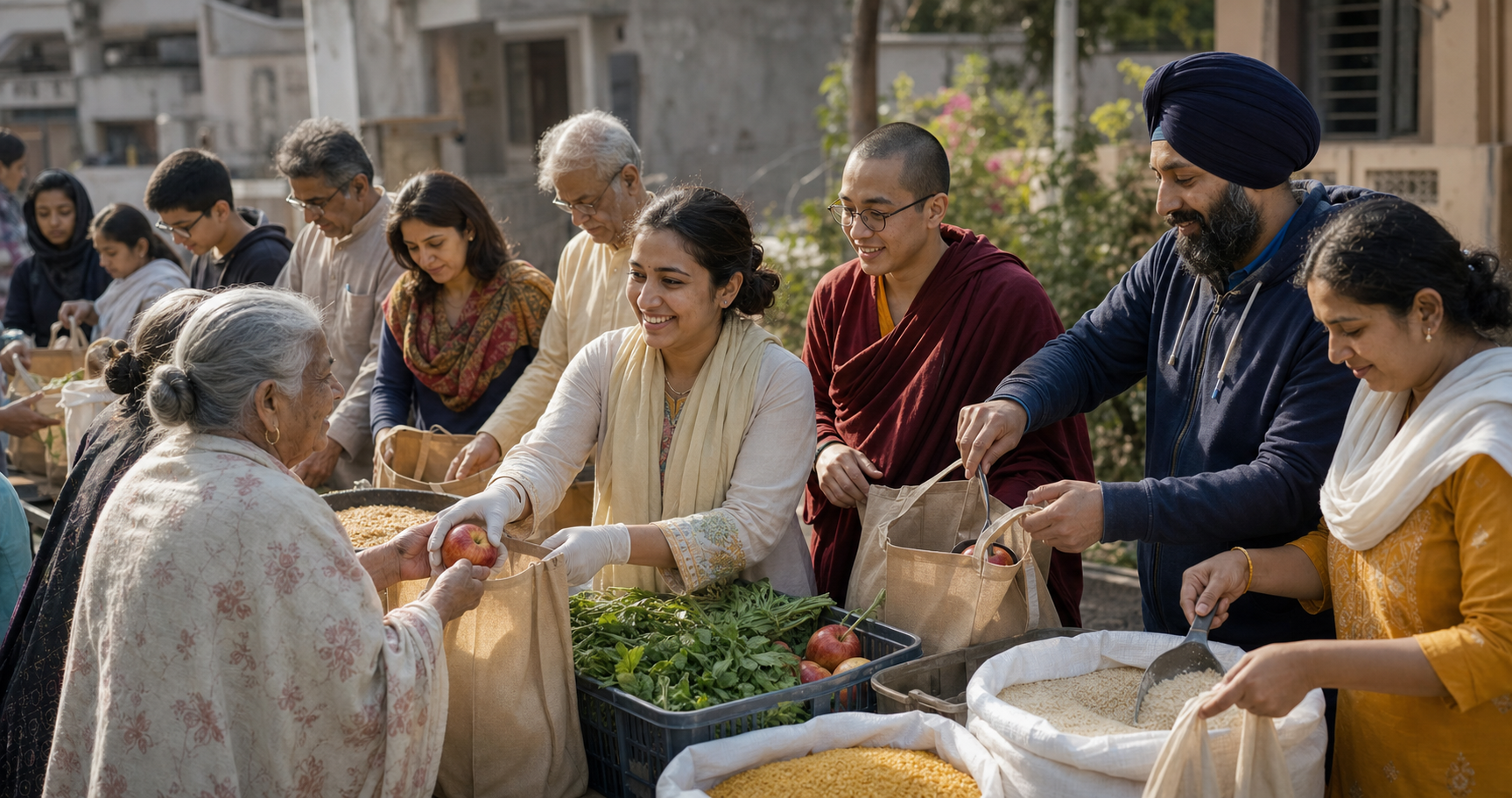
You want to serve your community, but you do not want the effort to become another ceremonial gathering, sectarian contest, or short-lived burst of enthusiasm. The real question is practical: how can seva meet an actual need while bringing Hindu, Buddhist, Jain, and Sikh neighbours into a more durable relationship?
Begin with a modest goal. Do one useful thing together, do it with integrity, and make participation dignified for everyone. Social harmony is not produced by declaring that all traditions are identical. It grows when people with distinct convictions learn that they can rely on one another.
Begin with a shared need, not a display of unity
A harmony initiative often starts in the wrong place. Organisers first decide that they want a large inter-community event, then search for an activity that can justify it. This puts appearance before service. It also creates pressure to recruit representatives, fill a stage, produce photographs, and make broad statements before anyone has agreed on the problem being solved.
Reverse the order. Identify a local need that different people can recognise without settling theological or political questions. It may be help for families facing a difficult period, practical support for elders, care for a neglected public space, assistance during a local emergency, or preservation work around a shared cultural asset. Choose only a need that your group has the competence and permission to address.
Before announcing the project, speak to the people who experience the need. Ask what would be useful, what has already been attempted, and what would create an additional burden. A food-distribution plan, for example, can fail in spirit even when supplies are abundant if recipients must endure intrusive questions, public exposure, unsuitable food, or a confusing collection process. Seva should reduce another person’s difficulty without making that person perform gratitude.
Write a one-sentence service aim before recruiting volunteers. It should identify the people being served, the practical task, and the boundary of the commitment. A useful aim sounds like this: provide a dependable form of assistance requested by a defined local group, through a process that protects privacy and offers help without religious or political conditions. If the sentence is mainly about promoting the organising bodies, revise it.
Use three questions to test the idea:
- Is the need confirmed? A request from affected people or a responsible local institution is stronger than an organiser’s assumption.
- Can the promise be kept? A narrow commitment fulfilled reliably builds more trust than an ambitious commitment abandoned halfway.
- Can anyone receive the service with dignity? Help should not depend on joining a prayer, endorsing an organisation, revealing unnecessary personal information, or appearing in publicity.
This approach changes the social dynamic. Participants meet one another as co-workers with a duty, not as labels assembled for display. They discover reliability through action: who arrives prepared, who listens, who handles an unglamorous task, and who remains calm when a plan changes. Those observations are the raw material of trust.
Turn shared Dharmic values into visible working rules

Hinduism, Buddhism, Jainism, and Sikhism are not interchangeable paths. Their teachings, institutions, disciplines, and understandings of ultimate reality must not be flattened into a vague claim that they all say the same thing. Cooperation becomes more credible when it respects these distinctions while identifying ethical commitments that can guide a common task.
Words such as seva, karuna, ahimsa, dharma, and daya carry different histories and emphases. Yet several practical commitments can overlap: relieve suffering where you can, accept responsibility for your conduct, avoid needless harm, tell the truth about what you are doing, and place collective well-being above personal recognition. The important step is to translate those commitments into behaviour that volunteers and recipients can actually observe.
- Make seva non-transactional. Do not attach conversion, partisan loyalty, sectarian affiliation, donations, or publicity consent to assistance. A person receiving help owes the group no ideological return.
- Practice ahimsa in speech as well as action. Do not use planning meetings to insult another sampradaya, community, teacher, or form of worship. Correct operational problems directly without turning them into judgements about an entire tradition.
- Treat responsibility as a duty, not a favour. A volunteer who accepts a role should complete it, arrange a replacement, or tell the coordinator early that the task cannot be done. Silent absence transfers the burden to others.
- Protect truthfulness. Describe the project’s reach, resources, and results accurately. Do not inflate participation, disguise expenses, or present intended work as completed work.
- Preserve the recipient’s agency. Where practical, offer choices about timing, method, food, privacy, or the kind of assistance provided. Service should not turn an adult into a passive object of someone else’s virtue.
- Share ordinary work. Leadership is not only speaking, blessing, or appearing at the opening. Senior participants should be willing to handle preparation, cleaning, transport, records, and follow-up.
Put these rules into a short service compact and read it during volunteer orientation. Keep the language plain enough that a new participant can understand it immediately. The compact is not a theological declaration. It is an operational promise governing how people will be treated.
A practical compact might cover respectful speech, truthful records, privacy, non-discrimination in delivery, responsible use of donations, suitable conduct around children or vulnerable people, and the right to decline photography. Add safeguards appropriate to the activity. If the work involves regulated services, specialised care, or access to sensitive personal information, use qualified people and follow the applicable rules rather than improvising under the name of goodwill.
Build accountability before goodwill is tested
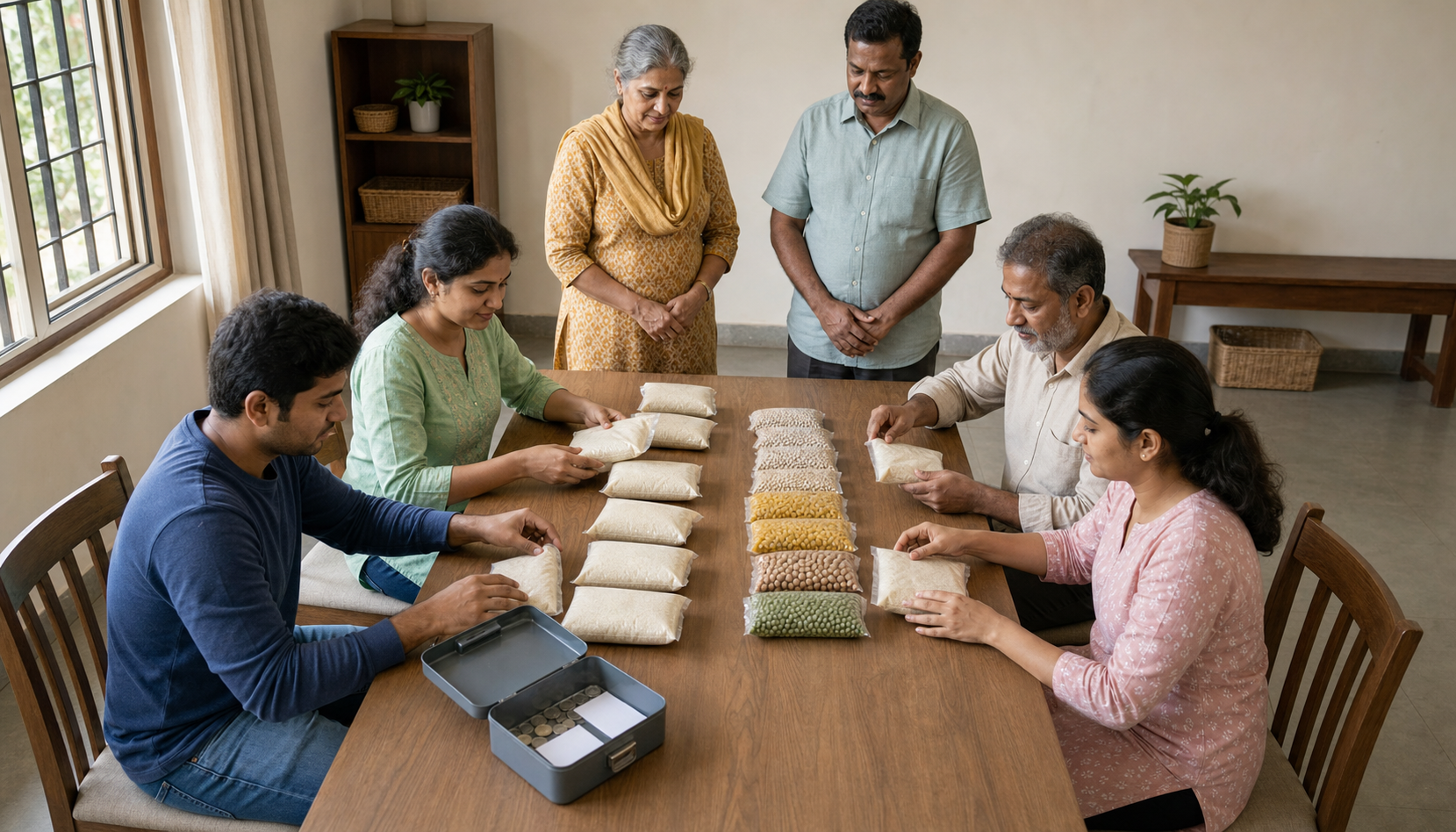
Warm intentions make it easy to begin; clear roles make it possible to continue. Confusion about money, credit, decision-making, or religious representation can damage relationships that the service project was meant to strengthen. Resolve those questions while everyone is still cooperative.
Use a simple operating structure:
- Name one accountable coordinator. This person keeps the agreed scope visible, confirms that tasks have owners, and makes sure concerns receive an answer. Accountability does not require one community to dominate the project.
- Assign roles by competence and consent. Record who is handling supplies, volunteers, recipient liaison, finances, safety, communications, and follow-up. Do not give someone a ceremonial title while another person quietly carries the work.
- Separate service records from publicity. Collect only information needed to deliver the service. Ask separately before using a person’s name, story, or image. Refusing publicity should never affect access to help.
- Keep a plain account of resources. Record what was received, what was spent or distributed, and what remains. Give participants an understandable summary. Transparency protects both donors and volunteers from suspicion.
- Create a route for concerns. Tell recipients and volunteers whom they can contact if they encounter disrespect, exclusion, unsafe conduct, or misuse of resources. A concern should not have to pass through the person whose conduct is being questioned.
- Close the loop. After the activity, ask whether the promised task was completed, whether recipients found it useful, what caused avoidable difficulty, and whether the effort should continue, change, or stop.
Handle disagreement without forcing consensus
People can cooperate without agreeing on every doctrine, historical interpretation, public policy, or community grievance. A seva project should not become a forum in which participants are expected to dilute their convictions to prove that they are harmonious. Its common ground can remain precise and limited: this need exists, this response is useful, and we will carry it out without humiliating one another.
When a disagreement affects the work, describe the operational issue first. Instead of accusing a community of being uncooperative, say that a delivery time conflicts with an observance or that a proposed meal does not accommodate the people expected to receive it. Then ask what adjustment preserves the service aim. Concrete language makes a solvable problem smaller; identity-based language makes it larger.
Set a boundary for disputes that do not affect the task. Participants should be free to discuss serious differences in an appropriate setting, but the service site is not the place for recruitment, provocation, or competitive preaching. This protects the recipient from becoming an audience and prevents the project’s practical purpose from being captured by its loudest participant.
If harm does occur, do not hide it to preserve an image of unity. Pause the affected activity where necessary, protect the person at risk, establish what happened, and correct the process. Harmony maintained by silence is fragile. Trust becomes stronger when a group can acknowledge a failure without blaming an entire community or shielding a well-connected individual.
Use recognition to multiply service, not personalities

Public recognition can give ethical community work visibility and encourage others to participate. It can also distort priorities if organisers begin designing activities for applause. The test is whether recognition sends people back toward the work with better standards, stronger partnerships, and a willingness to mentor others.
The value of honouring service was visible when Kranti Petkar received the State Level Navchetna Award 2025 at a civic gathering in Pune. The occasion connected public-spirited work with seva, integrity, cultural responsibility, youth engagement, and cooperation across community backgrounds. That kind of recognition is most constructive when the honour points beyond the recipient toward conduct that others can imitate.
If your organisation presents awards, publishes profiles, or thanks volunteers publicly, define what deserves recognition before choosing a name. Useful criteria include dependable service over time, respectful treatment of recipients, honest handling of resources, cooperation across institutional boundaries, willingness to do unseen work, and the ability to help new volunteers become competent. Fame, speaking skill, donor status, or organisational rank should not substitute for service.
Recognition should also be proportionate. Name the team and partner institutions where that reflects reality. Thank the people who identified the need and made the work possible, while protecting anyone who does not want public attention. Explain the practice being honoured, not merely the personality receiving the honour. A young reader should be able to finish the account and know what worthy conduct looks like.
Community-oriented journalism has a similar responsibility. Coverage can show how service was organised, which ethical safeguards mattered, and how cooperation was sustained. That is more useful than a sequence of flattering titles. It turns a ceremony into civic instruction and makes cultural stewardship something a reader can practise rather than merely admire.
Key takeaways
- Start with a need confirmed by the people affected, not with a symbolic event in search of a purpose.
- Respect the distinctiveness of Hindu, Buddhist, Jain, and Sikh traditions while agreeing on concrete standards for compassionate and responsible conduct.
- Make assistance unconditional: no conversion, political support, sectarian affiliation, donation, or publicity should be required in return.
- Define roles, resource records, privacy rules, and a route for concerns before the work begins.
- Treat disagreement as an operational problem when it affects service, and move unrelated debates away from the service setting.
- Use awards and public coverage to make exemplary conduct repeatable, not to turn seva into personal promotion.
Your next step does not need to be a grand coalition. Choose one local need, listen to the people closest to it, and invite a small group of dependable partners to write a shared service compact. Keep the promise narrow enough to fulfil. Once people have served together with dignity and accountability, social harmony is no longer only an aspiration; it has a working foundation.
References
