

You can complete every ritual correctly and still miss the festival’s demand. The difficult question comes after the arati: what in your conduct is supposed to change?
If you want to honour tradition without reducing its symbols to decoration, use a simple test. Identify the obstacle the symbol exposes, choose the virtue that answers it, and attach that virtue to a visible action. Skanda Shashti and Vasubaras approach this work from different directions: one dramatizes disciplined courage against adharma, while the other makes gratitude and interdependence tangible through care.
Read every symbol as an instruction, not an ornament
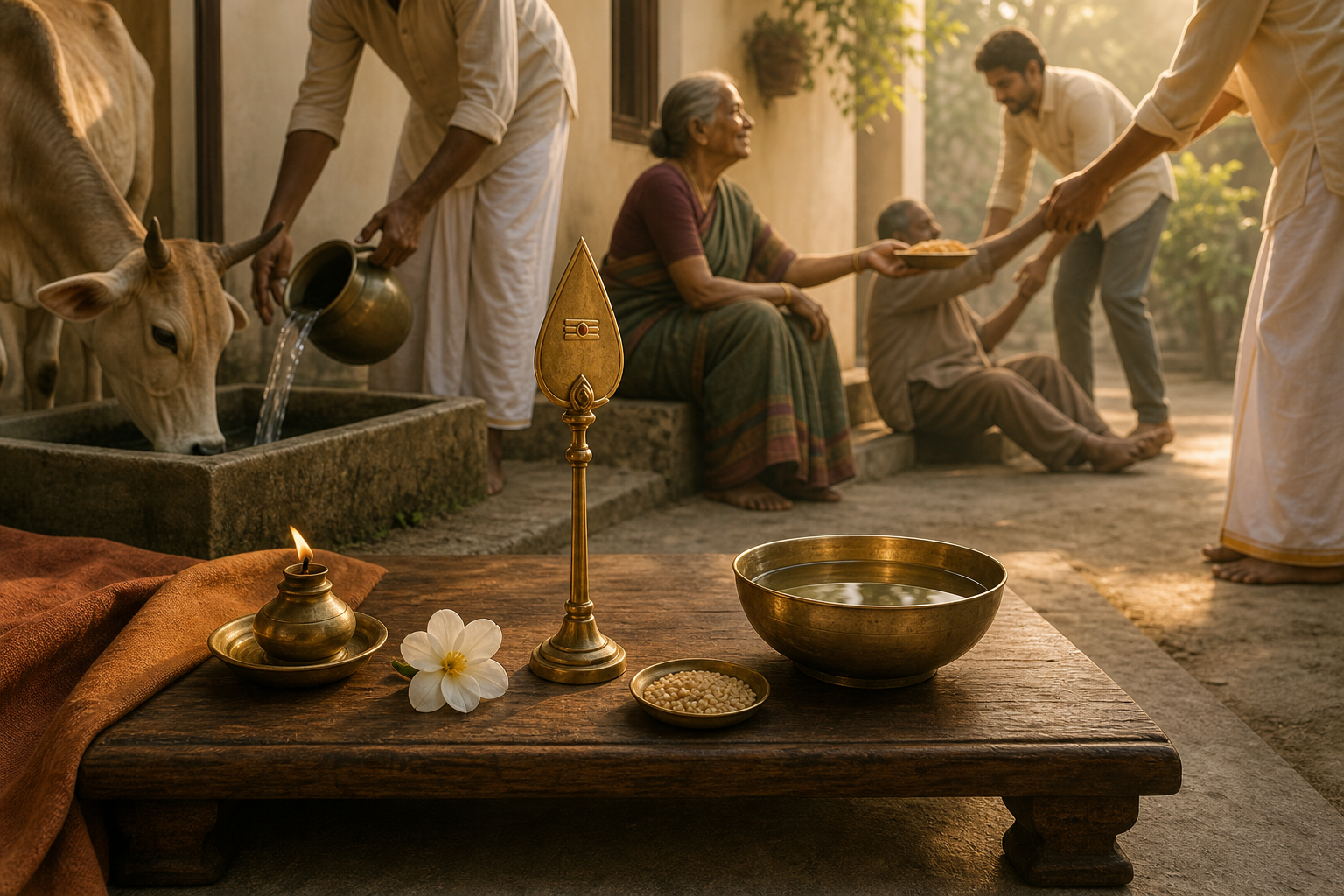
A sacred symbol is not a one-word code with only one permissible interpretation. Its ethical value appears when you ask what it requires of the person carrying, displaying or venerating it.
In Soorasamharam, Soorapadhman embodies hubris and the multiplying tendencies of ego. The first application is therefore inward. Before treating another person as the enemy, look for the pride, confusion or appetite for domination shaping your own response. The narrative does not give you permission to call everyone who opposes you an asura.
Murugan’s Vel represents discernment capable of piercing ignorance. That makes it a demanding emblem. Discernment requires you to separate fact from assumption, principle from wounded prestige, and a necessary boundary from a desire to punish. When you invoke the Vel, ask whether your speech is making that separation clearer.
The peacock points toward mastery of vanity and restless desire; the rooster signals wakefulness against spiritual inertia. Their significance deepens because Soorapadhman is transformed into Murugan’s peacock and rooster emblem. Victory is not represented only as destruction. What was disordered is brought into the service of Dharma. In daily life, that means asking whether a troublesome capacity can be disciplined: ambition can serve responsibility, anger can supply energy for a firm boundary, and the wish to be noticed can become accountability for work done in public.
Vasubaras begins from another ethical relationship. Honouring cows and calves acknowledges care, sustenance, agrarian life and dependence on more-than-human life. The traditional gestures — gentle bathing, tilak, garlands, arati, fresh fodder, seasonal grains and pradakshina — make gratitude bodily rather than merely verbal. Ahimsa, daya and seva give those gestures their ethical direction. If the animal’s comfort is ignored so that people can stage a more impressive ceremony, the symbol and the conduct have separated.
Use three questions whenever you encounter festival symbolism:
- What tendency in me does this symbol expose?
- What virtue does it train: discernment, humility, courage, restraint, gratitude, compassion or service?
- Who should experience a concrete benefit if I have understood it correctly?
Build one ethical vrata around the observance
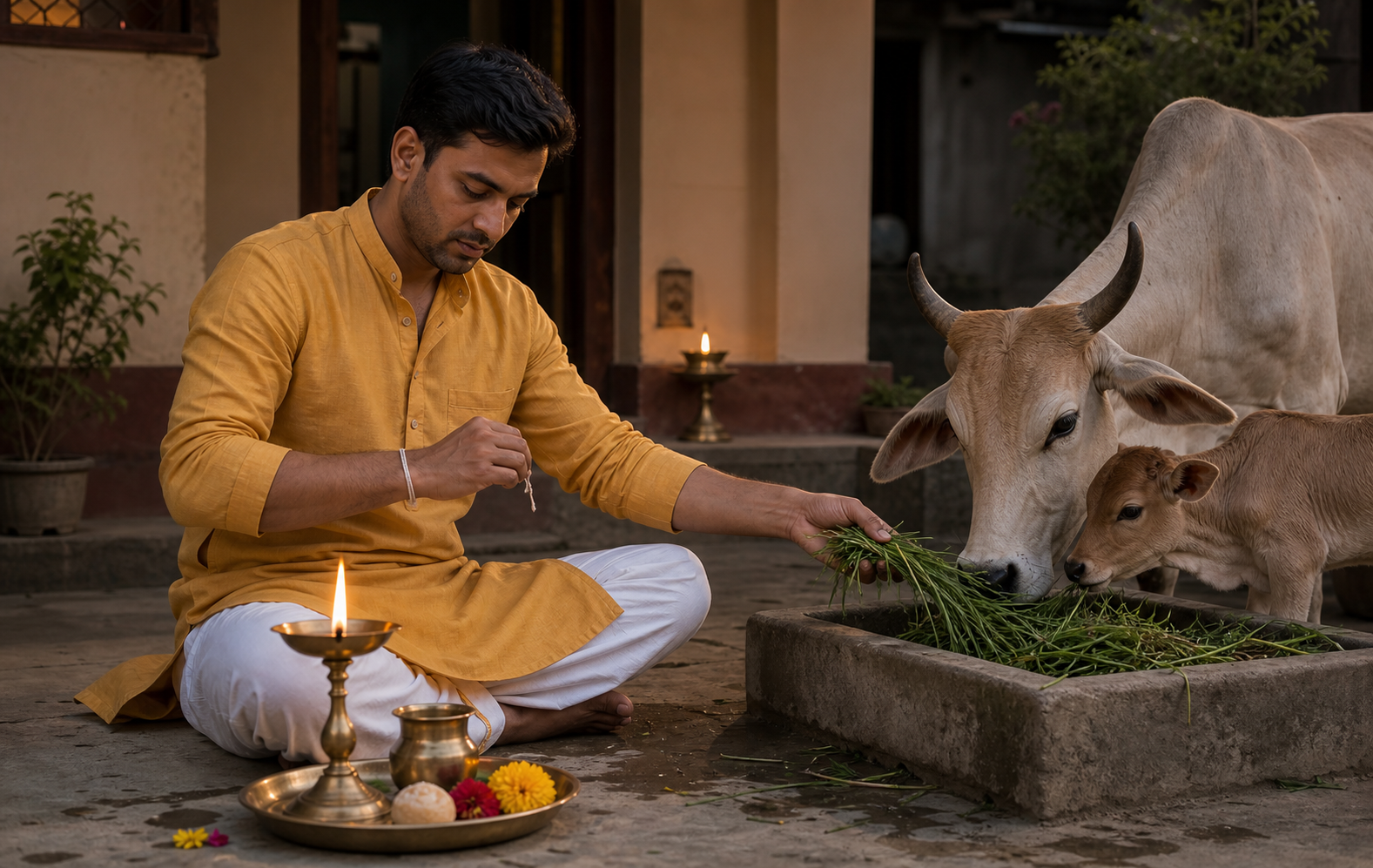
A broad promise such as overcoming ego is almost impossible to practise or examine. Ego will simply hide inside the promise. A useful vrata names one observable behaviour and gives you a different response to rehearse when its trigger appears.
- Name the behaviour, not just the vice. Replace anger with interrupting before another person finishes, pride with refusing to acknowledge a correction, or carelessness with wasting something entrusted to you.
- Choose the matching symbol and virtue. The Vel can anchor discernment; the peacock can anchor restraint of display; the rooster can anchor vigilance; Go-puja can anchor gratitude and responsible care.
- Write a response tied to a trigger. When someone corrects you, ask one clarifying question before defending yourself. When you are about to repeat a claim, separate what you know from what you have assumed. When you receive the benefit of another being’s labour or care, acknowledge it through service rather than sentiment alone.
- Give the vrata an embodied form. Skanda Shashti observances commonly join fasting with recitation, procession and the dramatic enactment of Soorasamharam. Vasubaras joins worship with feeding and gentle care. Let prayer steady attention, then let an action carry its meaning into the world.
- Review conduct without staging a performance. At the end of the observance, ask where you kept the discipline, where you broke it, and what repair is now due. The point is not to advertise purity. It is to make the next response more dharmic than the previous one.
Suppose your recurring pattern is the need to have the last word. Your inner adversary is not disagreement itself but ahankara acting through speech. Let the Vel represent the cut between defending truth and defending status. Your vrata could be to state your reason once, listen fully to the reply, and decline the final taunt. That is specific enough for you to notice when you fail and repeat when the next opportunity arrives.
Do not turn vrata into self-injury or a contest of severity. Follow the form appropriate to your sampradaya, responsibilities and circumstances. If a particular physical austerity is unsuitable, practise restraint in speech, consumption or self-display, or undertake a fitting act of seva. Discipline loses its purpose when suffering becomes a spectacle.
Confront adharma without copying its methods

The language of sacred battle can become spiritually dangerous when every disagreement is inflated into dharma-yuddha. A bruised preference is not necessarily a moral crisis, and an opponent is not automatically evil. Soorasamharam is most useful when it helps you confront falsehood without hatred, uphold truth without arrogance, and seek correction without delighting in another person’s humiliation.
Before escalating a conflict at home, in an institution or in public life, pass your response through four gates:
- Reality: What conduct, statement or harm can you identify without exaggeration?
- Dharma: Which duty, truth or legitimate boundary are you protecting?
- Proportion: What is the least harmful response that can still protect that duty effectively?
- Transformation: If the other person corrects the conduct and makes repair, have you left a path for them to return?
This changes the shape of confrontation. Instead of saying, You are dishonest, identify the discrepancy, explain its consequence, and state what must be corrected. Oppose the act firmly without pretending that you can see the entirety of the actor. If a stronger boundary becomes necessary, enforce it without adding contempt as a private reward.
The transformation of Soorapadhman offers a restorative lens, but it does not require naivety. Grace does not mean abandoning consequences, and compassion does not require continued exposure to harmful conduct. It means that consequence serves protection, truth and possible reform rather than vengeance. Ask not only whether you defeated an error, but what your manner of victory trained you to become.
Make community worship answerable to its symbol
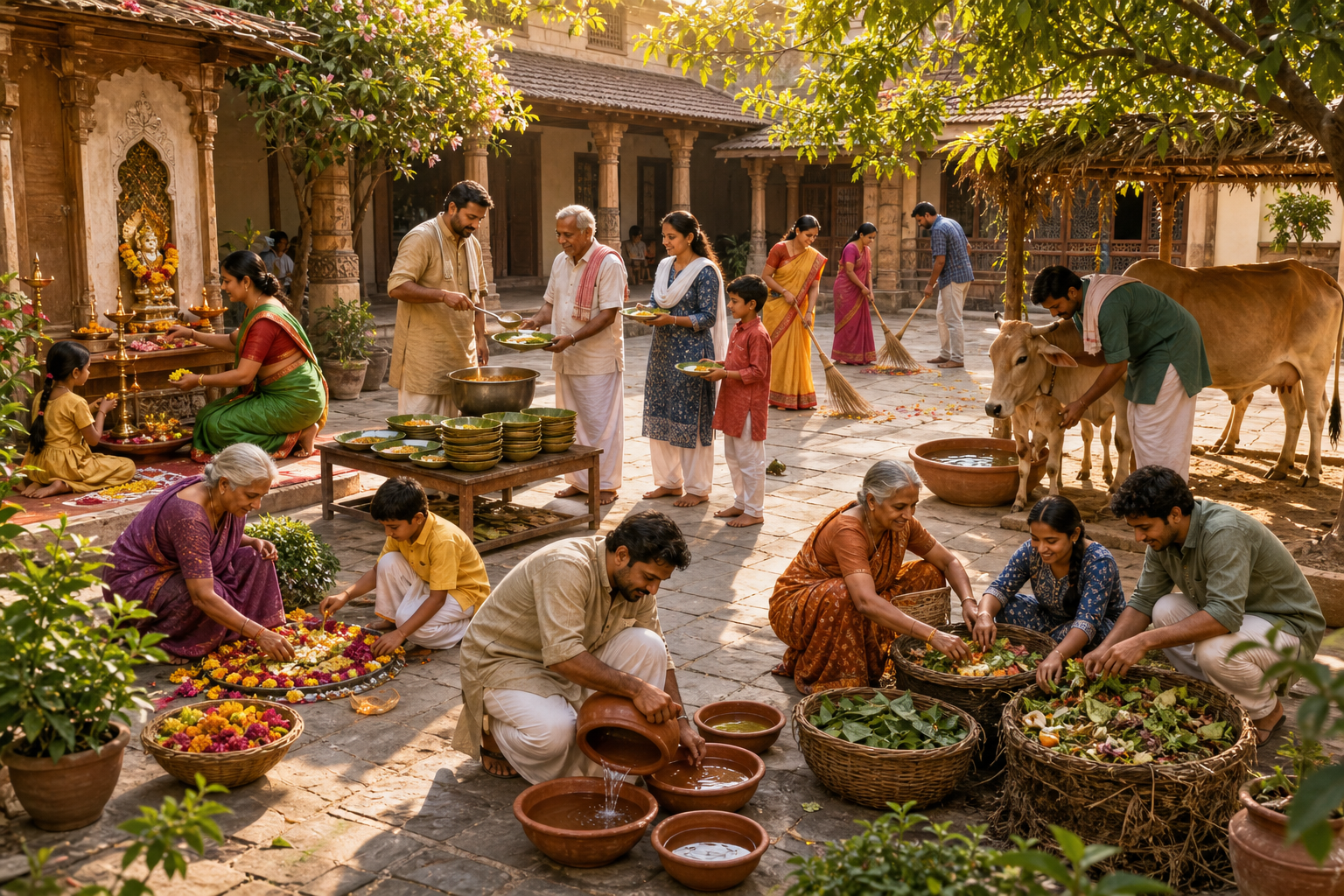
A public ritual teaches even when nobody gives a lecture. Children watch how adults approach an animal, how elders explain a gesture, whose labour is acknowledged, and whether reverence survives after the photographs are taken. In community Go-puja, careful participation and intergenerational explanation can transmit ethical memory through action.
Organisers can test the integrity of an observance before, during and after it:
- Before: Put the welfare of the cows and calves under the guidance of people responsible for their care. Plan gentle handling, suitable offerings and an orderly approach rather than treating the animals as ceremonial props.
- During: Explain why each gesture matters. Connect tilak, garland, arati, feeding and pradakshina to gratitude, restraint and responsibility. Give children a safe way to learn care instead of leaving them with only a visual spectacle.
- After: Carry reverence into a practical commitment. Support responsible animal care, respect the labour sustaining agrarian life, reduce avoidable waste, or undertake relevant seva. Choose an act the community can actually maintain.
- Evaluate: Ask whether the animals were treated gently, caretakers and farmers were respected, participants understood the symbolism, and some duty continued beyond the event.
The same test applies to processions, recitations and dramatic enactments. Does the event cultivate one-pointedness, humility and community responsibility, or does it reward noise, rivalry and display? Magnitude is not the measure of fidelity. A modest observance that changes conduct may preserve Dharma more faithfully than an elaborate one that leaves vanity untouched.
Recognise shared Dharmic values without erasing differences
Hindu, Buddhist, Jain and Sikh traditions do not become interchangeable because their ethical concerns sometimes converge. Their teachings, vocabularies and disciplines remain distinct. The practical kinship lies in a recurring demand: turn the struggle against disorder inward, join spiritual discipline to responsible action, and refuse to make hatred a virtue.
The Buddha’s victory over Mara offers a parallel struggle with defilements through mindfulness and compassion. Jain practice names the kashayas — anger, pride, deceit and greed — as passions to be conquered through self-discipline and Ahimsa. Sikh teachings bring spiritual and temporal responsibility together through miri-piri, the saint-soldier ideal and dharam yudh, while sarbat da bhala directs concern toward the welfare of all. These are distinct paths with a recognisable ethical resonance, not versions of a single flattened doctrine.
| Dharmic lens | Challenge brought into focus | Question for practice |
|---|---|---|
| Hindu | Hubris, confusion and adharma confronted through devotion, discernment and courageous duty | Am I defending Dharma, or merely defending my status? |
| Buddhist | Defilements met through mindfulness and compassion | Can I see the affliction clearly without feeding aversion? |
| Jain | Anger, pride, deceit and greed restrained through discipline and Ahimsa | What injury begins in the passion I am permitting? |
| Sikh | Courage held under spiritual duty and directed toward the welfare of all | Does my strength protect others, or enlarge the self? |
Use these parallels as mirrors, not as shortcuts around serious study. Shared values become meaningful when they deepen your fidelity to practice and your respect for another tradition’s integrity.
Key takeaways
- Read the symbol inward before using it to judge an opponent.
- Translate a broad virtue into one observable behaviour tied to a recurring trigger.
- Join worship to an embodied discipline: restraint, recitation, care, repair or seva.
- In conflict, protect truth and legitimate boundaries without making humiliation the goal.
- Judge a community ritual partly by what happens to the vulnerable being, worker or relationship represented within it.
- Recognise ethical kinship across Dharmic traditions without collapsing their distinct teachings.
At your next festival, write one sentence before the ritual begins: When this trigger appears, I will take this action because this symbol teaches this virtue. Keep the promise narrow enough to practise, and place the related act of seva or repair on your calendar. The festival has entered daily life when someone affected by your conduct can see the difference.
References
- DharmaRenaissance Blog — Soorasamharam Explained: The Complete Guide to Skanda Shashti’s Transformative Symbolism
- DharmaRenaissance Blog — Discover Vasubaras Go-Puja in Nandurbar: A Complete, Proven Celebration of Dharmic Unity
