
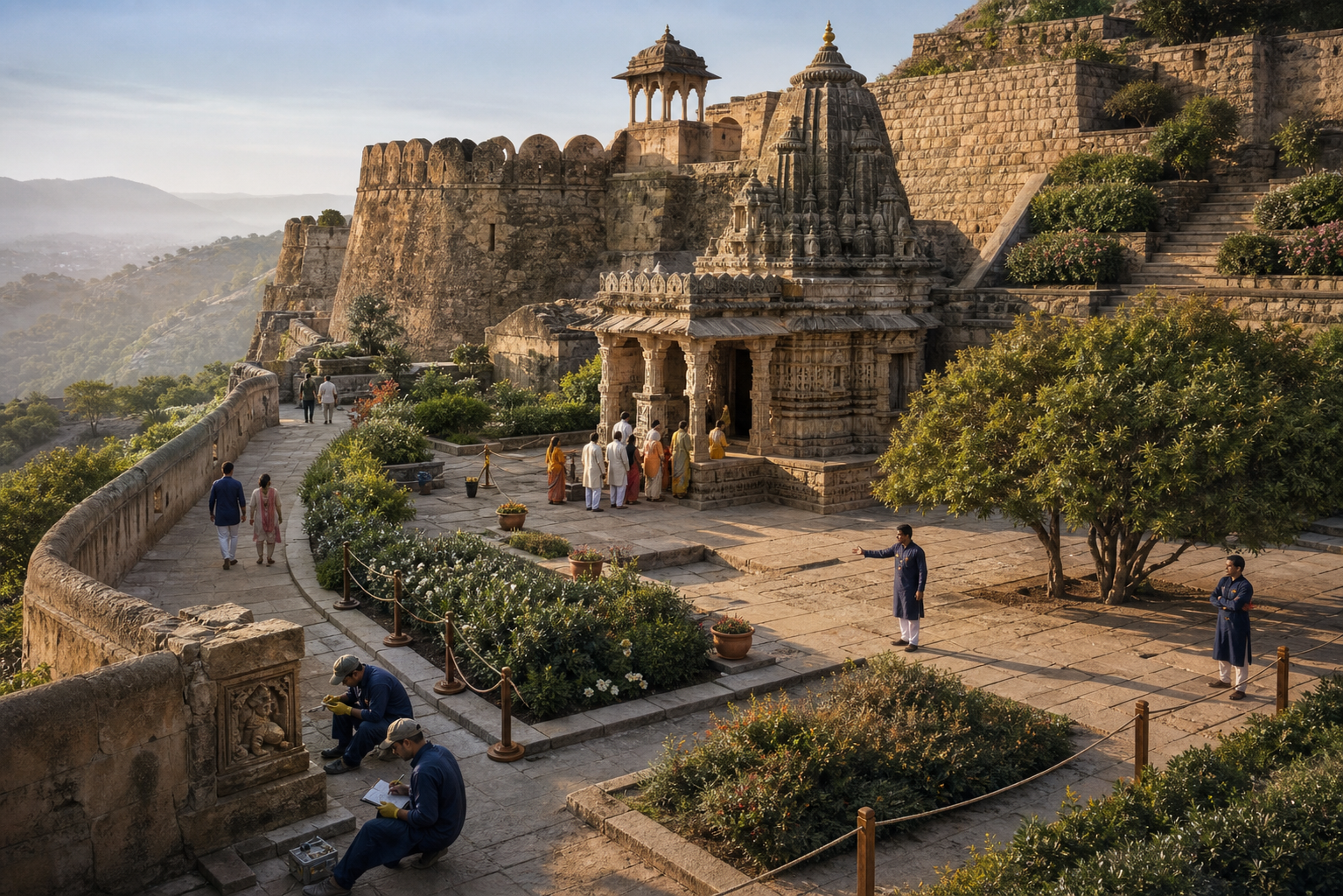
You may be trying to settle a difficult question before it becomes a confrontation: can an organized prayer gathering be allowed near a fort, temple, garden or hill shrine without weakening the site’s sanctity, endangering heritage or obstructing other visitors?
A blanket yes or no will not solve that problem. You need a site map, a short rulebook and a known response process. When everyone can see where a gathering may occur, who can authorize it and what happens when it is unplanned, officials can protect the place without turning every decision into a dispute between communities.
Separate the site into four kinds of space

The first mistake is to treat the entire location as one undifferentiated public space. A protected structure, a functioning temple, a municipal footpath and an emergency entrance may sit beside one another, but they do not serve the same purpose. Each needs a different default rule.
| Area | Default policy | What must be made clear |
|---|---|---|
| Protected heritage core | Conservation comes first. Large or unrelated assemblies should remain outside unless the competent site authority has explicitly permitted them. | The exact boundary and the site’s rules on sound, footwear, crowding and physical access. |
| Living sacred precinct | Established worship follows the norms of the temple trust or other responsible religious authority, subject to applicable law and conservation requirements. | Which rites belong to the site’s religious function, where devotees may assemble and which areas remain restricted. |
| Adjacent public area | Organized gatherings may be considered through a religion-neutral permission process, preferably in a designated zone and outside peak periods. | Who grants permission, what conditions apply and what alternative is available if the requested place or time is unsuitable. |
| Access and emergency route | Keep it unobstructed regardless of the gathering’s religious, cultural or political character. | Permanent ground markings, visible signs and an authority empowered to clear an obstruction safely. |
Do not draw these boundaries from memory. Walk the location with the site manager, temple trust where relevant, conservation personnel, municipal authority and police liaison. Mark the protected core, sacred precinct, public land, entrances, queues and emergency routes on one agreed plan. Verify ownership and legal control before adopting the map.
Pay particular attention to the seams: a gate opening onto a garden, steps shared by pilgrims and tourists, or a lawn beside a protected wall. Visitors may not know when they have crossed from one management regime into another. A line on the ground and a sign at the transition can prevent an argument that verbal instructions will only intensify.
Apply neutral rules without erasing a temple’s sacred purpose
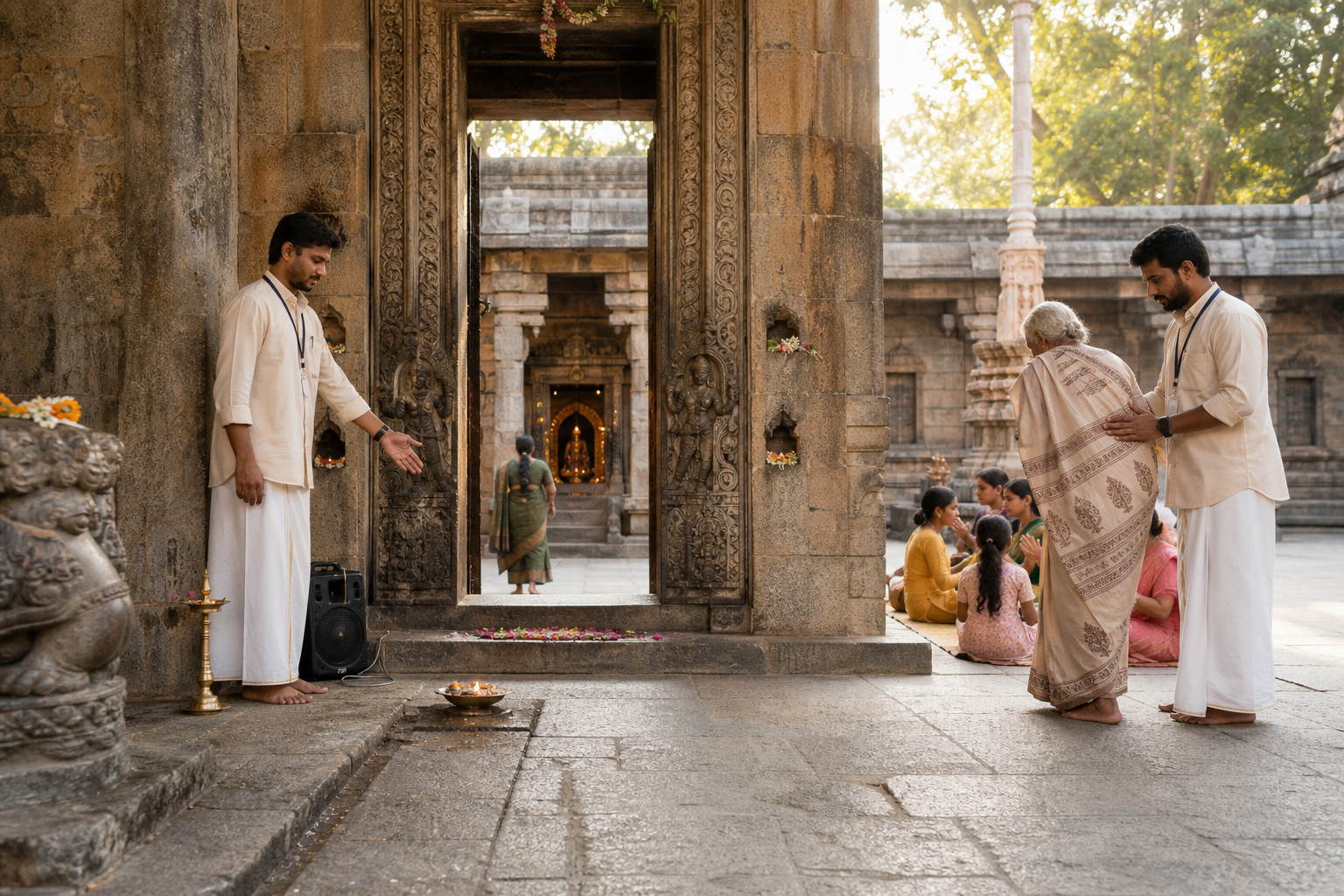
Religion-neutral management does not require officials to pretend that every place has the same purpose. A Ganpati temple is a living place of Hindu worship, not merely an open plot with an old building on it. Its established puja, darshan and authorized observances are intrinsic to the site. An unrelated organized gathering in the same sacred precinct is a different use and can be directed elsewhere.
Neutrality matters when comparable activities seek comparable use of public or protected space. A policy written only in response to namaz will look retaliatory and will be difficult to administer consistently. The physical-impact rules should also cover bhajan, kirtan, group chanting, meditation assemblies, speeches and other organized gatherings. The relevant questions are about place, authorization, obstruction, sound, attendance and conservation impact, not whether an official approves of a particular form of prayer.
- Is the proposed activity inside the protected core, within a living sacred precinct or on adjacent public land?
- Is it an established and authorized observance belonging to the site’s own religious function?
- Does the expected attendance fit the location’s assessed capacity without blocking ordinary visitors?
- Will sound equipment, temporary objects, footwear, waste or physical contact with the site conflict with published rules?
- Will entrances, queues, pathways or emergency access remain usable?
- Has the responsible authority granted permission in writing?
- Can the gathering use a designated alternative zone or a less congested time?
A useful model rule: organized gatherings not intrinsic to the protected or sacred site’s established function require prior authorization and must use the designated place and time. Restrictions are based on conservation, capacity, access, safety and sound. Comparable uses receive comparable treatment.
That wording is a starting point, not a legal instrument. Ownership, statutory protection and the authority of a temple trust or public body vary by location. Have the competent municipal and conservation authorities, and qualified legal counsel where necessary, review the final policy before enforcement. A management framework cannot create powers that the responsible body does not legally possess.
Build a permission path people can actually use
A permit process fails when nobody knows where to apply or when decisions are improvised after people arrive. Publish one contact point and ask every organizer for the same operational information:
- Record the organizer’s contact details, the activity, requested location, start and end time, expected attendance and accessibility needs.
- Ask about amplified sound, temporary structures or objects, footwear requirements, food distribution, waste removal and any effect on visitor movement.
- Assess the request against criteria published in advance rather than negotiating a fresh standard for each community.
- Give a written decision that names the approved zone, time, conditions, on-site contact and cleanup responsibility.
- If the requested arrangement cannot be allowed, state the site-based reason and offer a suitable location or time when one is available.
- Make approval event-specific. Recurring observances should be reviewed periodically rather than becoming an undocumented permanent allocation.
Designated prayer or reflection zones should sit outside the protected core, but they should not be token spaces chosen only to make a policy look accommodating. They need safe access, enough room for the approved use and a location that does not block devotees, tourists or emergency services. Time windows should avoid the site’s busiest worship and visitor periods. Capacity and timing must be assessed locally; copying an arbitrary number from another place creates false certainty.
Prepare one body for policy and another for incidents
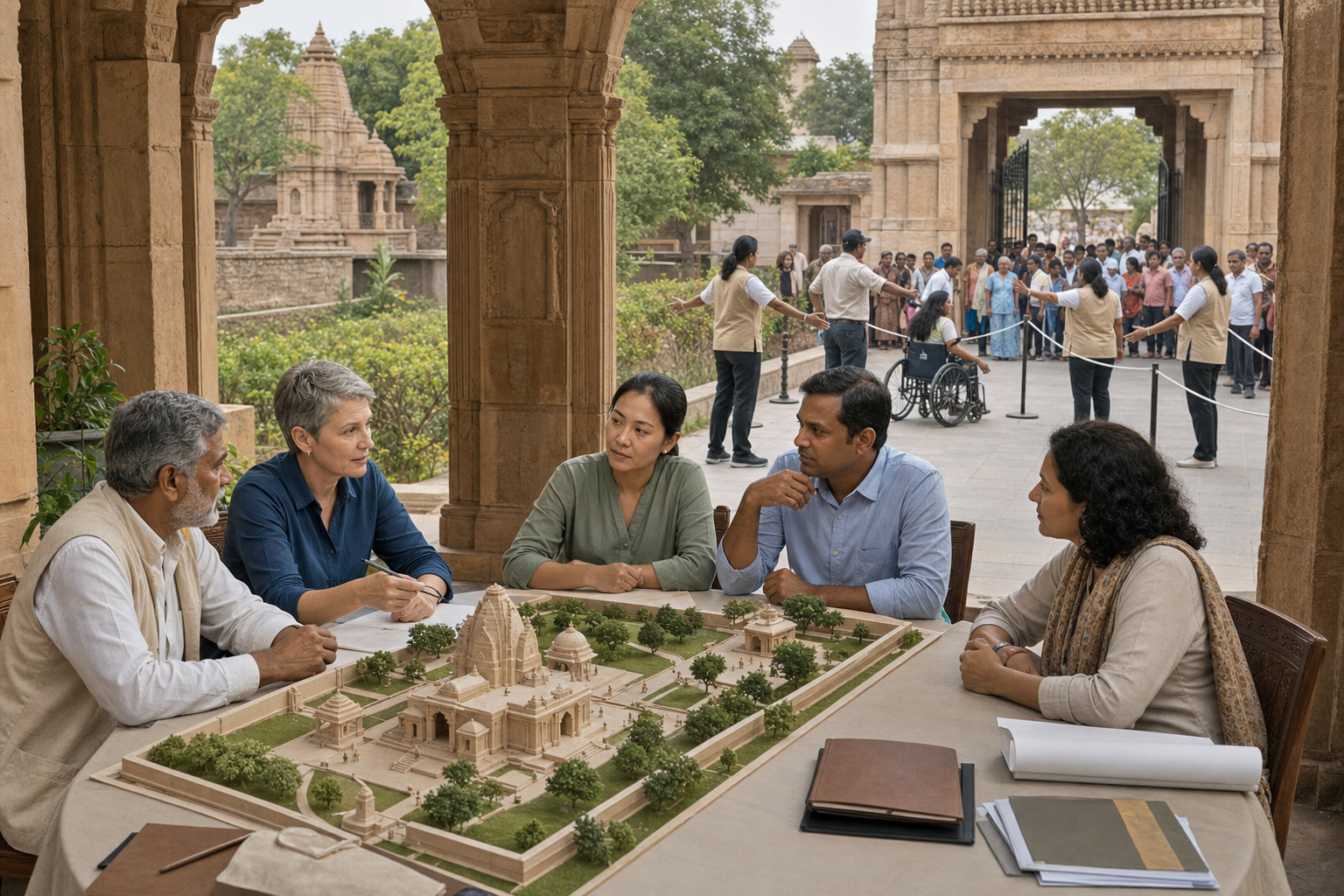
A long-term coordination council and an on-the-ground response cell do different jobs. Confusing them produces either endless consultation during an urgent incident or hurried policy decisions made by whoever happens to be present.
The stakeholder council sets the rules
Include the site authority, temple trust, representatives of affected nearby mosques, gurdwaras and Buddhist viharas, other local religious institutions where relevant, conservation experts, civil society and municipal officials. Their task is not to negotiate theology. It is to agree on the site map, identify peak periods, test the permission process, review proposed signs and resolve recurring operational problems before they harden into communal grievances.
The council should meet before predictable periods of heavy use and after any significant incident. Each decision needs an owner and a date for implementation. Minutes should distinguish an agreed rule from a suggestion still awaiting legal or conservation review; otherwise, different participants will leave believing that different policies were adopted.
The rapid coordination cell manages the moment
The operational cell should have named contacts for the site manager, municipal authority and local police, with a temple-trust representative or other site custodian available when the sacred precinct is affected. Those contacts need the same current map, permit list and incident checklist.
- Confirm the gathering’s location, whether permission exists and which posted rule applies. Start with observable facts, not assumptions about participants.
- Protect emergency access and vulnerable structures immediately. If there is an imminent safety or conservation risk, authorized officials should manage it as such.
- Use one designated liaison to explain the exact restriction. Multiple volunteers issuing competing instructions will increase confusion.
- Offer the designated alternative zone or an available time window. A workable alternative is usually more effective than a bare command to disperse.
- If participants refuse a lawful direction or a serious risk continues, leave enforcement to the competent authorities. Temple volunteers and bystanders should not improvise physical removal.
- Record the boundary involved, the rule cited, the alternative offered, the response and any damage, obstruction or delay. Keep the record factual.
Afterward, ask whether the incident exposed an unclear boundary, missing sign, unavailable alternative, inconsistent decision or genuine refusal to comply. That distinction matters. More forceful enforcement will not repair a policy that visitors could not understand in the first place.
Make the policy visible and test whether it is fair
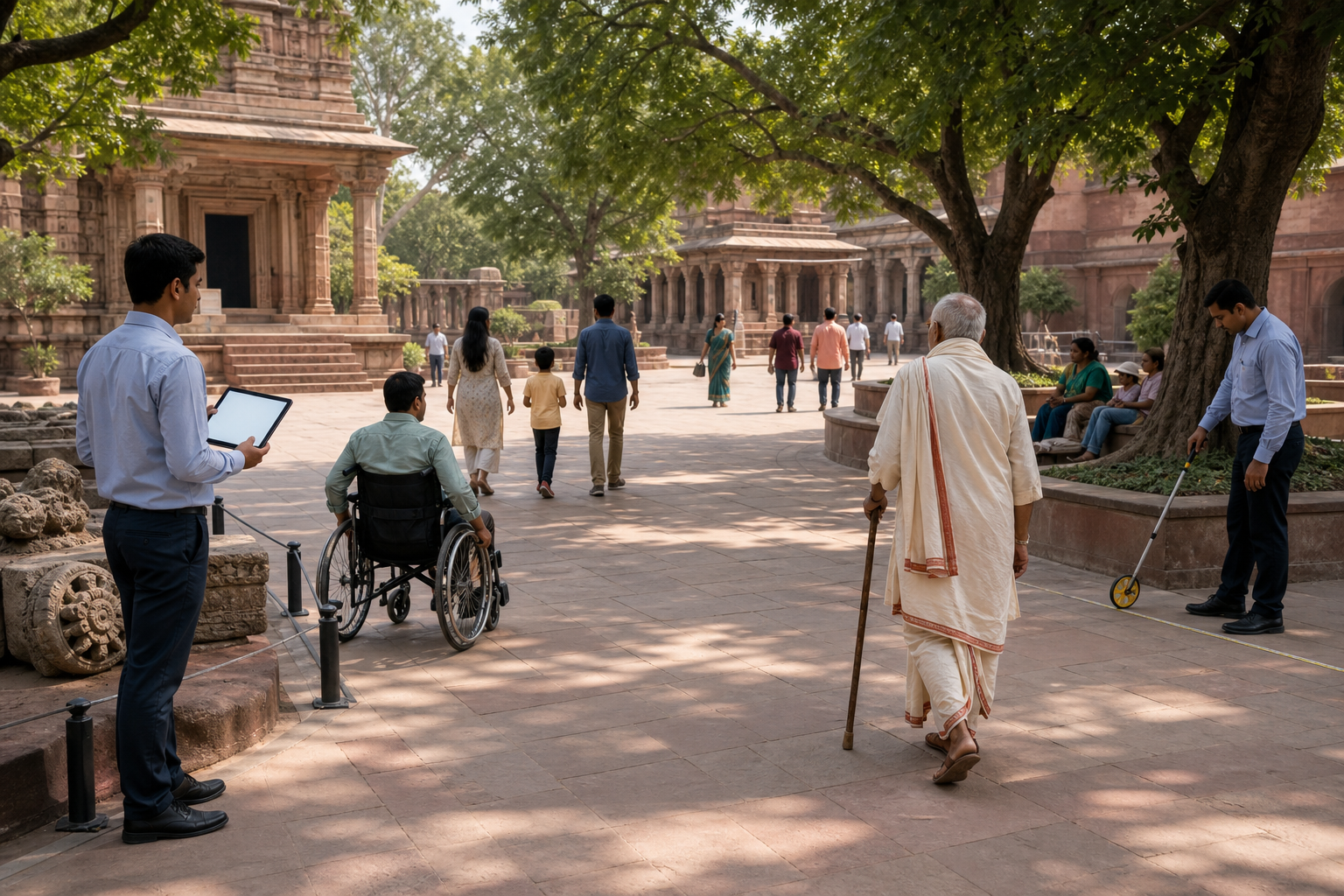
The civic debate around Shaniwarwada, Sarasbaug and Parvati hill shows why verbal custom is not enough at places carrying historical, civic and sacred meaning. Unclear expectations create anxiety for devotees and other visitors, while selective explanations make even a reasonable restriction look arbitrary.
Place concise, multilingual guidance at entrances, boundary transitions, the designated gathering zone and any permission office or digital request page. Every notice should answer the questions a visitor has at the point of decision:
- What kind of space am I entering: protected core, sacred precinct or public area?
- Which individual practices are permitted without advance approval?
- Which organized gatherings require permission?
- What restrictions apply to sound, crowding, footwear and physical use of the place?
- Where is the designated prayer or reflection zone?
- How do I request permission or contact the site manager?
- Which routes must remain clear?
Translate meaning, not just words. Ask people who use the relevant languages to check whether the instruction sounds respectful and whether terms such as protected core, sacred precinct and organized gathering are understood. Pair the text with a simple map so that compliance does not depend on interpreting an unfamiliar administrative phrase.
Review the policy using operational evidence. Track unplanned gatherings, blocked routes, conservation breaches, relocation offers, complaints by rule type and the time needed to reach an authorized liaison. Track the conduct and location involved rather than turning the record into a catalogue of communal identities.
An equality check should compare comparable cases. Did gatherings with similar attendance and physical impact receive the same decision? Was the same kind of alternative offered? Was an exception tied to an established site rite and documented as such? If two similar uses were treated differently, the authority should be able to identify a site-based reason. If it cannot, the policy or its enforcement needs correction.
Key takeaways
- Map the protected core, living sacred precinct, adjacent public space and emergency routes before writing rules.
- Protect a temple’s established religious function while applying the same physical-impact criteria to comparable outside gatherings.
- Use designated zones and non-peak time windows to provide a practical alternative, not merely a prohibition.
- Publish one permission path with consistent criteria, written decisions and named contacts.
- Let a stakeholder council shape the standing policy and a small coordination cell handle unplanned incidents.
- Require site-specific legal and conservation review before enforcement, then audit comparable cases for consistency.
Before the next disputed gathering, ask the responsible authority for four concrete items: an agreed boundary map, a one-page rulebook, a usable permission route and an incident contact list. If any one is missing, that is where you should begin. Arrange the site walk-through while the grounds are calm; once a crowd has assembled, the opportunity for careful policy design has already passed.
References
