
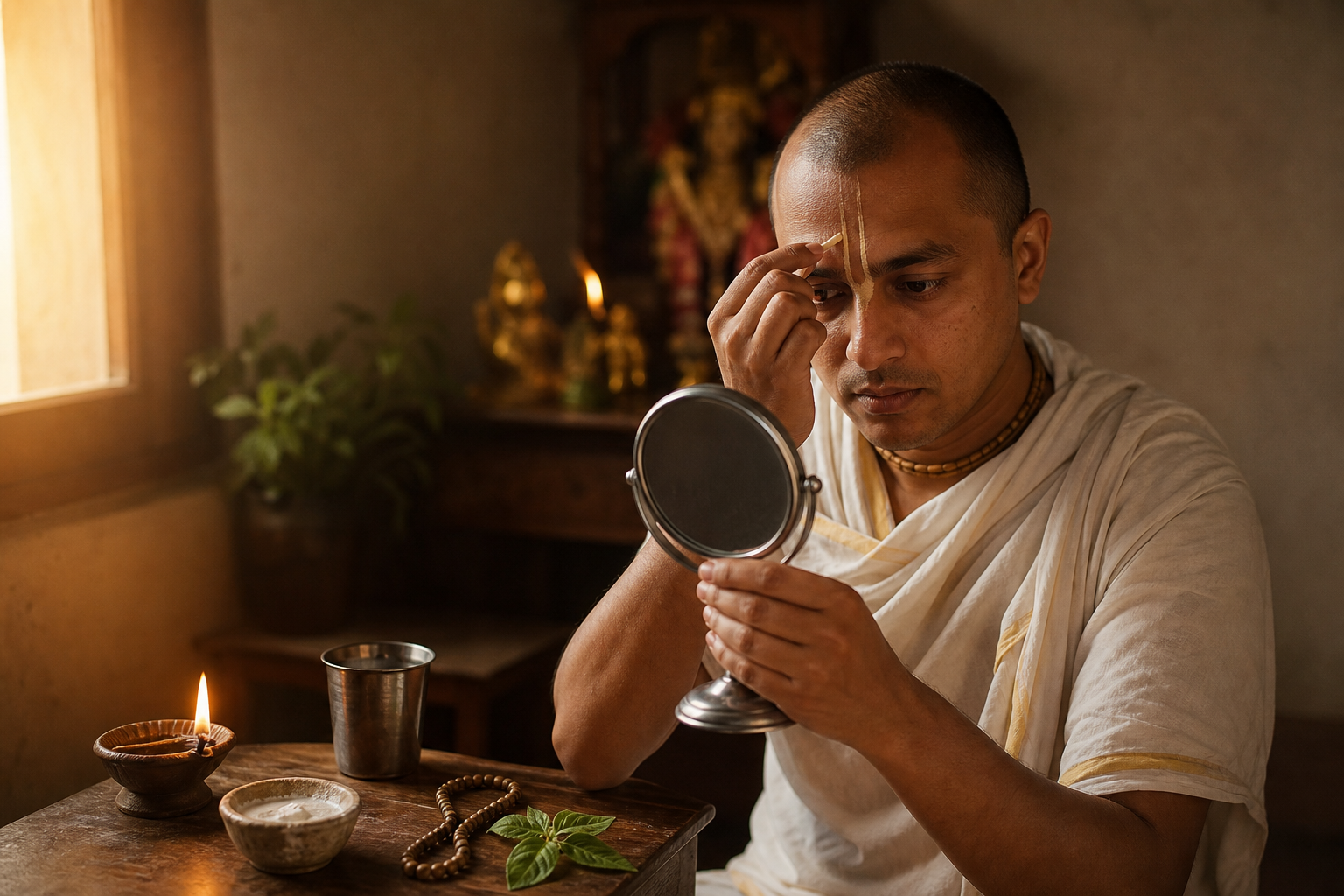
You recognize the Vaishnava mark, but you may still wonder which shape to wear, what belongs in the center, or whether one kind of sacred clay can substitute for another. That hesitation is reasonable. The differences are not merely artistic; they can identify a sampradaya and communicate a particular theological inheritance.
Before you apply Pundra, settle three questions: what the mark asks you to remember, which lineage form you intend to follow, and how you will carry its meaning into the rest of the day. Once those are clear, the practice becomes more than a mark placed on the skin.
The upward mark is meant to direct the person wearing it
Urdhva Pundra means an upward or elevating mark. Its vertical movement expresses the orientation of the mind and heart toward Vishnu. Its placement on the forehead, between the eyebrows, brings that intention to a place traditionally associated with focused awareness.
This gives you a practical way to understand the mark. Pundra is simultaneously a declaration of Vaishnava belonging and a discipline of smarana, or remembrance. You are not only showing whom you worship. You are giving yourself a visible instruction about how to think, speak, and act.
The deeper image is the body as a temple of dharma. That idea changes the standard by which the practice should be judged. Neat lines matter because care matters, but visual precision is not the final purpose. If the mark produces pride, contempt for another lineage, or carelessness in conduct, its outer form has stopped serving its inner work.
Use the moment of application as a brief examination. Ask what you are carrying into the day, which reaction needs restraint, and where service will be required of you. The mark then becomes a daily threshold: you apply it before worship or duty, and you cross that threshold with an intention you can actually test through your conduct.
Read lineage differences before copying a shape

The familiar U shape is not a single universal design. Sri Vaishnava, Gaudiya, and Madhva communities preserve recognizable variations in outline, material, and central detail. These common patterns help you identify the ritual grammar, but they are not a replacement for instruction within a living community.
| Vaishnava setting | Common form | Material or central detail | What to notice |
|---|---|---|---|
| Sri Vaishnava | Two white vertical lines with a stripe between them | White tiruman clay; commonly a red Sri stripe | The central stripe is associated with Sri, or Lakshmi, rather than being a decorative accent |
| Gaudiya Vaishnava | A vertical tilaka that curves or joins at the base, sometimes with a subtle leaf form | Gopi-chandana | The leaf form can signify Tulasi |
| Madhva | Two vertical clay lines with a fine central line | Gopi-chandana is common; the central line may be sacred ash or raksha | The center should not automatically be interpreted through another sampradaya’s symbolism |
| Festival use across contexts | The form follows the relevant custom | Fragrant sandalwood paste may be used | A festival material does not erase the lineage meaning of the shape |
Words such as commonly, often, and sometimes matter here. A lineage is not a font in which every practitioner must produce an identical mark. At the same time, variation does not make every combination interchangeable. A red center, a Tulasi-like base, and a line made with raksha arise from distinct devotional settings.
A central red or yellow line is often associated with Sri. It can express the inseparability of compassion and Vishnu’s preserving presence. That meaning is theological, not cosmetic. Yet it should not be imposed on every central line you see: the Madhva use of sacred ash or raksha has to be read within Madhva practice.
If you belong to a sampradaya, follow its received form rather than assembling features that appeal to you from several traditions. If you do not yet have lineage instruction, ask a knowledgeable family member, temple practitioner, or acharya five precise questions: Which material is customary? What is the exact outline? What belongs in the center? Is a mantra recited during application? Does this community teach the twelve-mark practice? Those answers are more useful than trying to reconstruct a sectarian form from a distant photograph.
Build a daily practice that joins form to remembrance
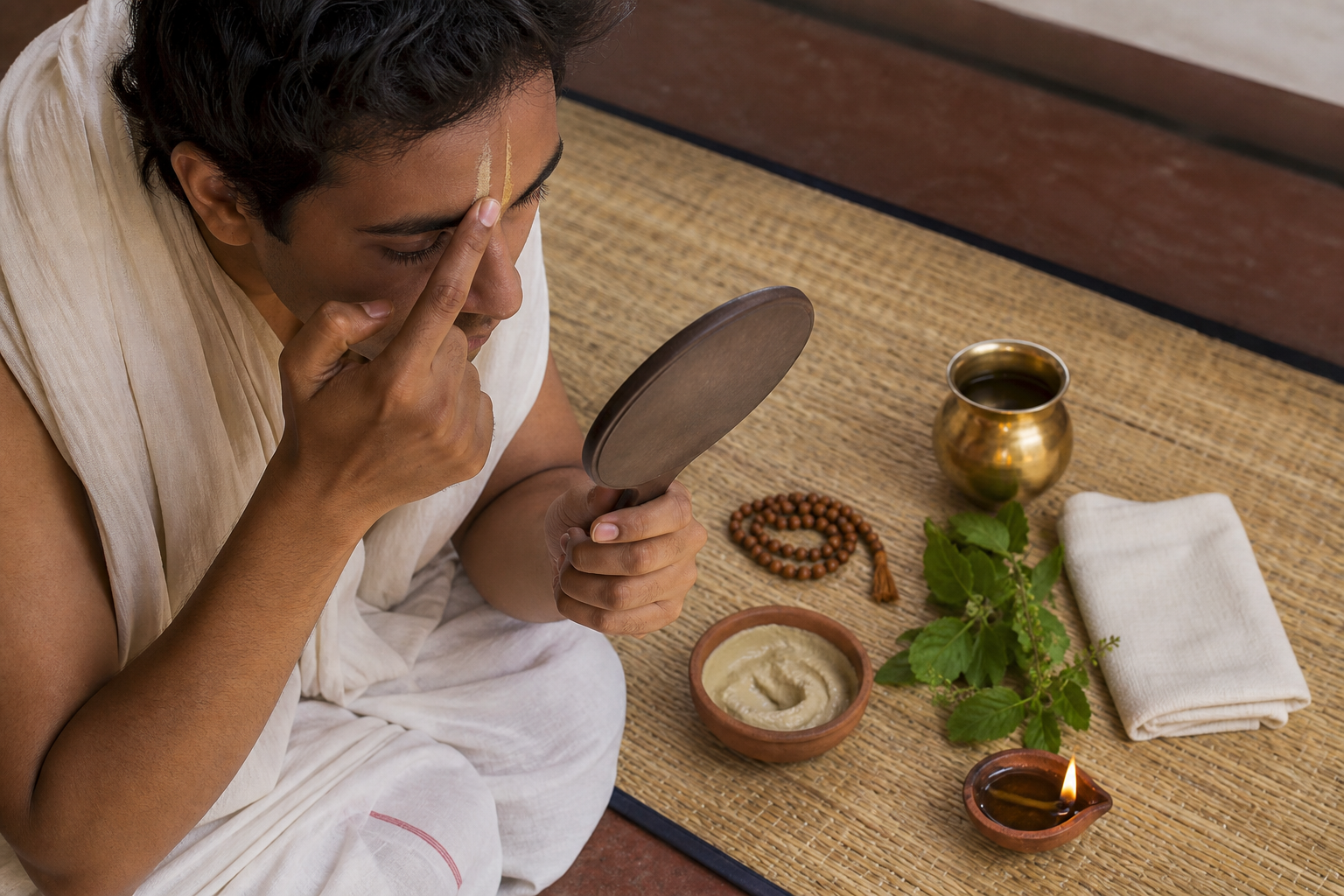
Pundra is commonly applied after bathing and before puja. It is also worn for temple visits and festivals. Some Vaishnavas wear it every day; others reserve it for explicitly sacred occasions. Choose a rhythm you can observe sincerely, then keep the sequence stable enough that application becomes a cue for attention.
- Begin after bathing when that is the custom available to you. This gives the act a clear place in the morning rather than leaving it to a rushed final minute.
- Use the material received in your tradition. Tiruman, gopi-chandana, sandalwood paste, and raksha do not all perform the same lineage function merely because each can be placed on the forehead.
- Apply the form you were taught. Pay attention to the two vertical lines, the base, and any central stripe as separate meaningful elements.
- Pause for smarana. Bring Vishnu to mind instead of treating application as a grooming step completed on autopilot.
- Carry the mark into one concrete duty. Let it govern the next difficult conversation, act of service, or moment in which pride would otherwise take control.
The physical qualities of the materials can support this rhythm. The clay feels cool against the skin; earth and sandalwood carry a faint scent; drawing an even line requires a slower hand. These sensations are not the theology of Pundra, but they can call your wandering attention back to it. Rather than rushing past them, use them as anchors for remembrance.
When the forehead mark becomes twelve marks
Some communities extend the practice through dvadasha-tilaka. Twelve small Pundras are placed across the body while names of Vishnu are recited. The whole person thereby becomes a field of remembrance rather than leaving devotion concentrated at a single visible point.
The practice is referenced in Puranic literature such as the Padma Purana and is elaborated in Vaishnava teaching. Its purpose is embodied discipline: body, name, attention, and devotion are brought together through repeated action.
Do not improvise the body locations, order, or accompanying names from a partial memory. Learn the complete sequence from someone authorized to teach the form observed by your community. Begin with the forehead practice if that is what you have actually received; take up dvadasha-tilaka when you can perform it as a coherent liturgy rather than as twelve disconnected marks.
Wear belonging without turning it into a boundary
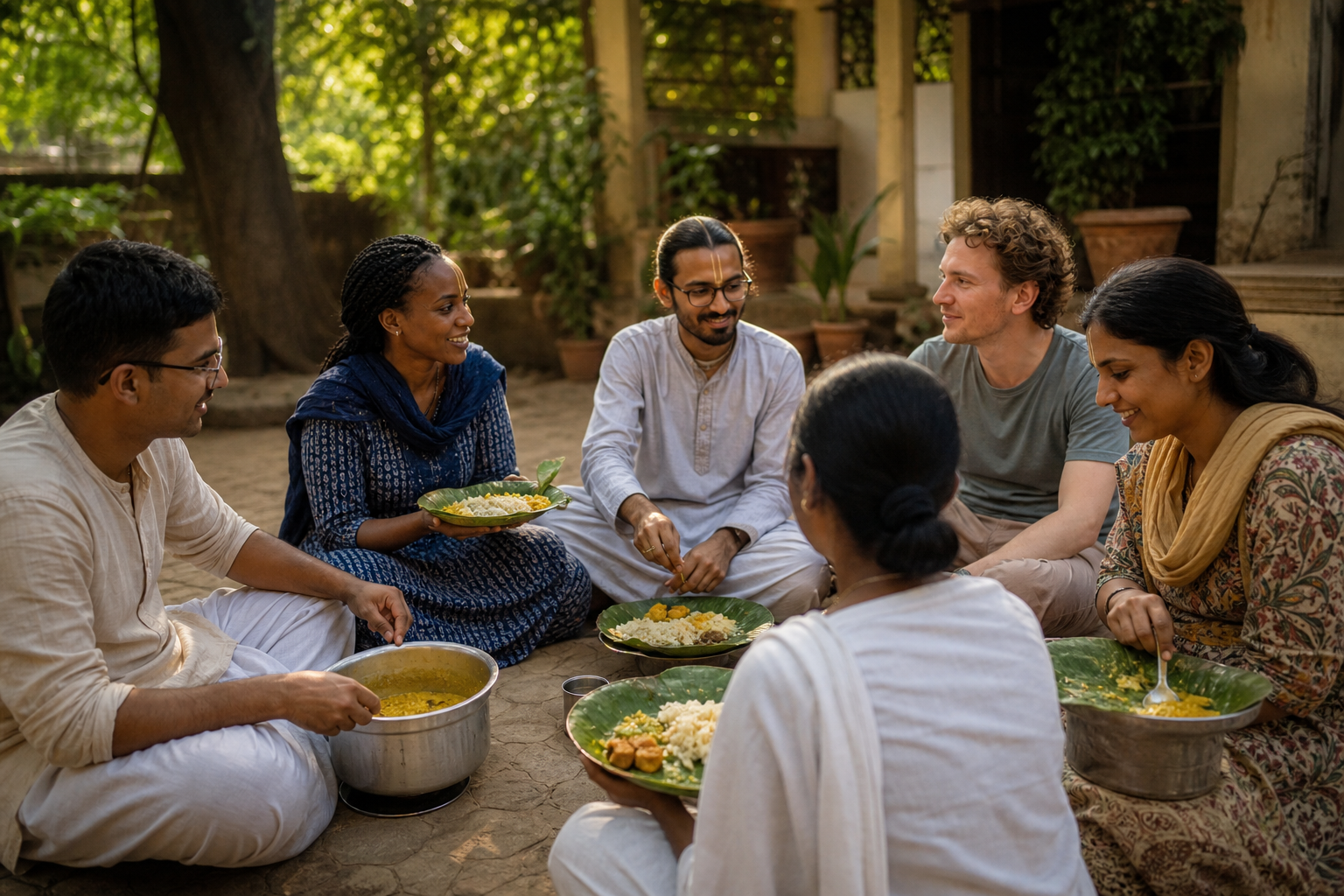
Pundra carries community memory as well as personal intention. A grandparent teaching a child to make the lines, a pilgrim refreshing the mark before entering a sanctum, and a congregation wearing shared forms during kirtan all transmit more than technique. They preserve belonging through the hand, the eye, sacred material, and repetition.
That visible belonging does not require you to rank other Vaishnava forms by their resemblance to your own. When you see a different center or base, first ask which sampradaya’s language you are seeing. The disciplined response is curiosity before correction.
If someone unfamiliar with the practice asks what you are wearing, a clear explanation is enough: it is a Vaishnava tilaka that expresses devotion to Vishnu and reminds the wearer to treat the body and daily conduct as belonging to dharma. That answer explains both identity and responsibility. It avoids reducing Pundra either to ethnic decoration or to a badge used only to separate insiders from outsiders.
The wider Dharmic world also teaches you to compare carefully. Sandalwood or kumkum may be placed on the forehead after puja in many Jain communities. Saffron or vermilion markings appear in particular Buddhist ceremonial settings in South Asia. Sikh thought generally avoids ritual forehead marks while giving central importance to remembrance of the Divine Name, disciplined living, and service.
These resemblances should neither be ignored nor flattened into a claim that all practices are identical. The more accurate point is that different Dharmic paths can use different outward forms while cultivating remembrance, self-restraint, compassion, and service. Respect begins by naming both the shared ethical direction and the real ritual difference.
Key takeaways for beginning or deepening the practice
- Urdhva Pundra is an upward Vaishnava mark intended to orient your awareness and conduct toward Vishnu.
- Identify the sampradaya before copying the design. Sri Vaishnava, Gaudiya, and Madhva forms have distinct outlines, materials, and central details.
- Tiruman, gopi-chandana, sandalwood paste, sacred ash, and raksha are not automatically interchangeable; use the material prescribed in the practice you have received.
- A red or yellow central line can signify Sri, but not every central line should be interpreted through that association.
- Apply Pundra after bathing and before puja when following the common daily rhythm, or observe it on temple and festival occasions according to your custom.
- Learn dvadasha-tilaka as a complete twelve-mark liturgy with its names and sequence, not as an improvised extension of the forehead mark.
- Let the outward sign produce inward discipline. Humility, remembrance, restraint, and service are the conduct by which the mark becomes lived practice.
Your next step can be very small. Ask one trusted person in your family, temple, or sampradaya to show you the correct material, outline, central detail, and recitation. Then apply the mark without rushing, choose one duty through which you will honor it that day, and allow repetition to turn a visible symbol into a stable discipline.
References
