
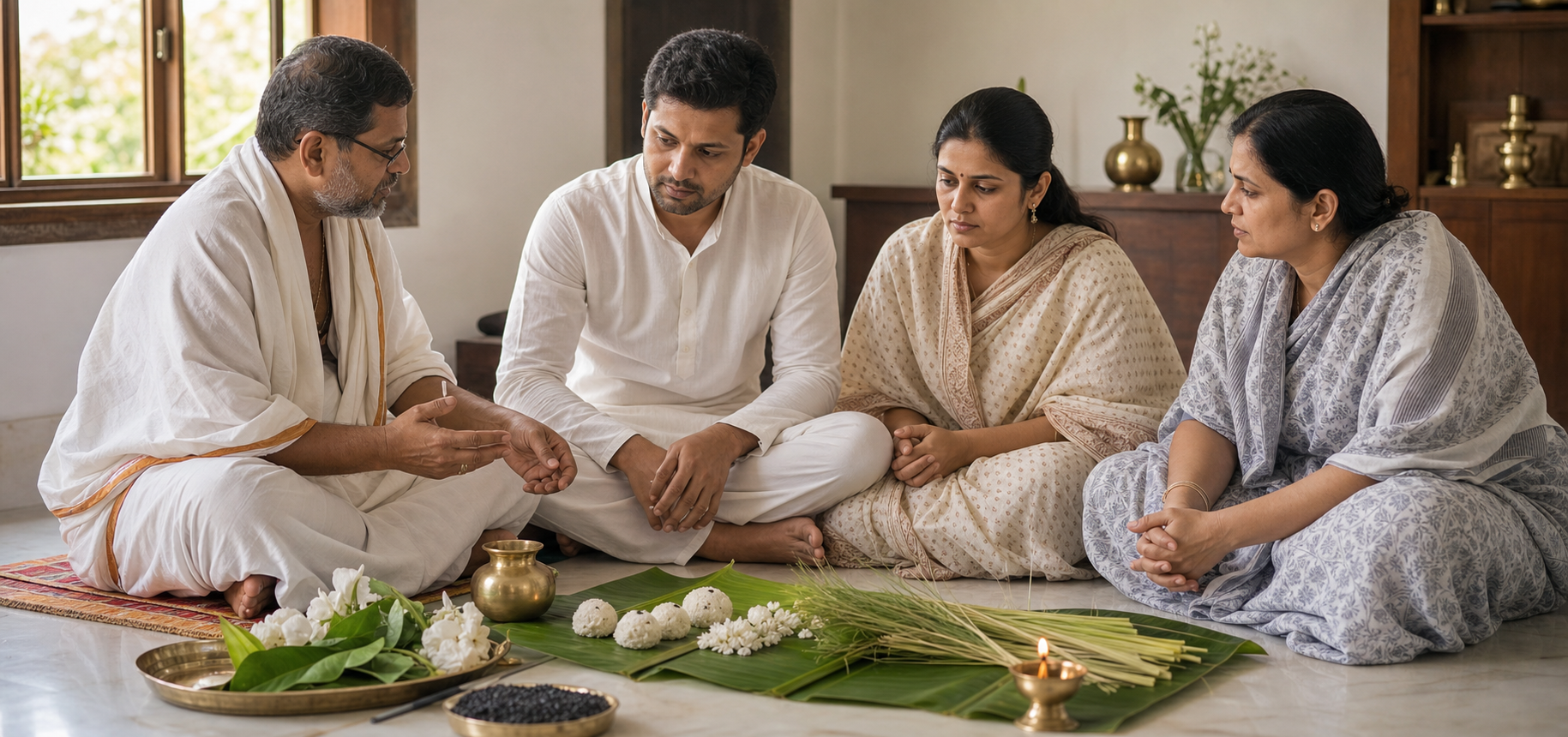
If someone in your family has recently died, you may be trying to mourn while also making ritual decisions that feel urgent and unfamiliar. Relatives may remember different rules, priests may follow different regional sequences, and an internet checklist may not match your family’s practice.
The first task is therefore not to buy ritual materials. It is to identify the observance your family actually needs. Ekoddishta Shraddha is directed toward one recently deceased person, with prayers for shanti, a peaceful transition, and gati, the onward journey. It is distinct from a general ancestral Shraddha. Once that distinction is clear, you can settle the sequence, karta, date, offerings, and practical adaptations without turning every variation into a family dispute.
Find your family’s ritual sequence before fixing a date
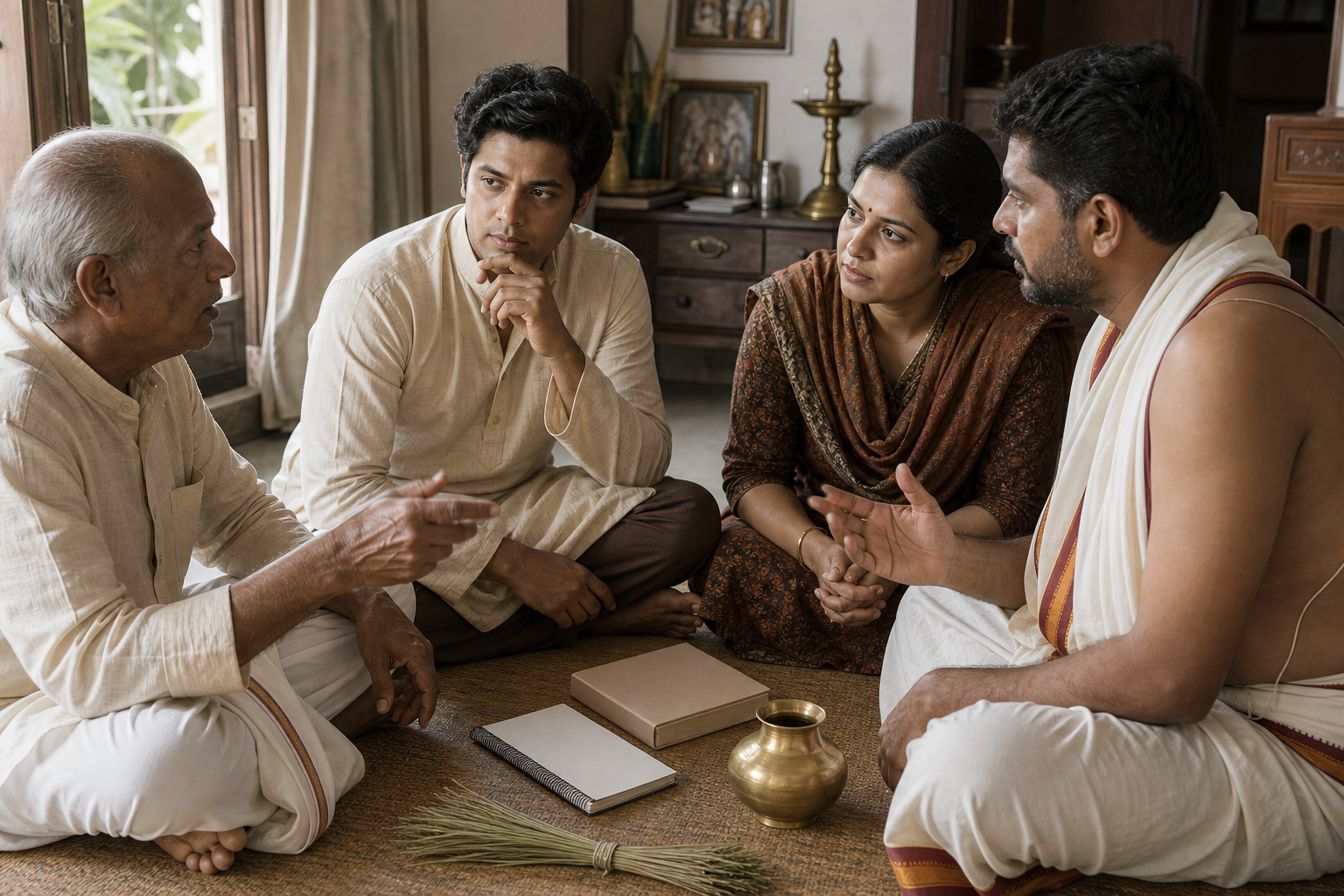
There is no single date rule that can be applied to every Hindu family. Ekoddishta commonly appears in the post-cremation sequence, often between the 10th and 13th day. Monthly observances may then continue until Sapindikarana. Some traditions conduct Sapindikarana comparatively soon; others place it at the first annual Shraddha.
| Stage | Ritual focus | What you need to confirm |
|---|---|---|
| Initial post-cremation period | Ekoddishta for the recently deceased individual | Which day your family observes it and whether it forms part of a longer sequence |
| Following months | Masika, or monthly, Shraddha where customary | The relevant lunar tithi and the number of observances required by your tradition |
| Sapindikarana | Integration of the departed with the ancestral lineage | Whether your family performs it soon after the initial rites or at the first annual Shraddha |
| After Sapindikarana | Remembrance with the forebears | How the departed will be included in annual ancestral observances |
Treat this sequence as a planning map, not as a universal ritual prescription. The lunar tithi of death is especially important for later memorial observances. Do not assume that the recurring English-calendar date is the ritual date. Give a priest the death details they request and ask them to identify the applicable tithi under the calendar and convention your family follows.
Before confirming a venue or inviting recipients for a meal, get clear answers to five questions:
- Which family or regional tradition will govern the rites?
- On which day does that tradition perform Ekoddishta?
- Will Masika Shraddhas follow, and if so, on which tithis?
- When will Sapindikarana be performed?
- Who will maintain the dates and instructions so the family is not reconstructing the sequence each month?
Write the answers down. Grief makes oral instructions easy to misremember, and the person coordinating the first rite may not be the person arranging the monthly or annual observance.
Prepare the rite by function, not by copying a generic list
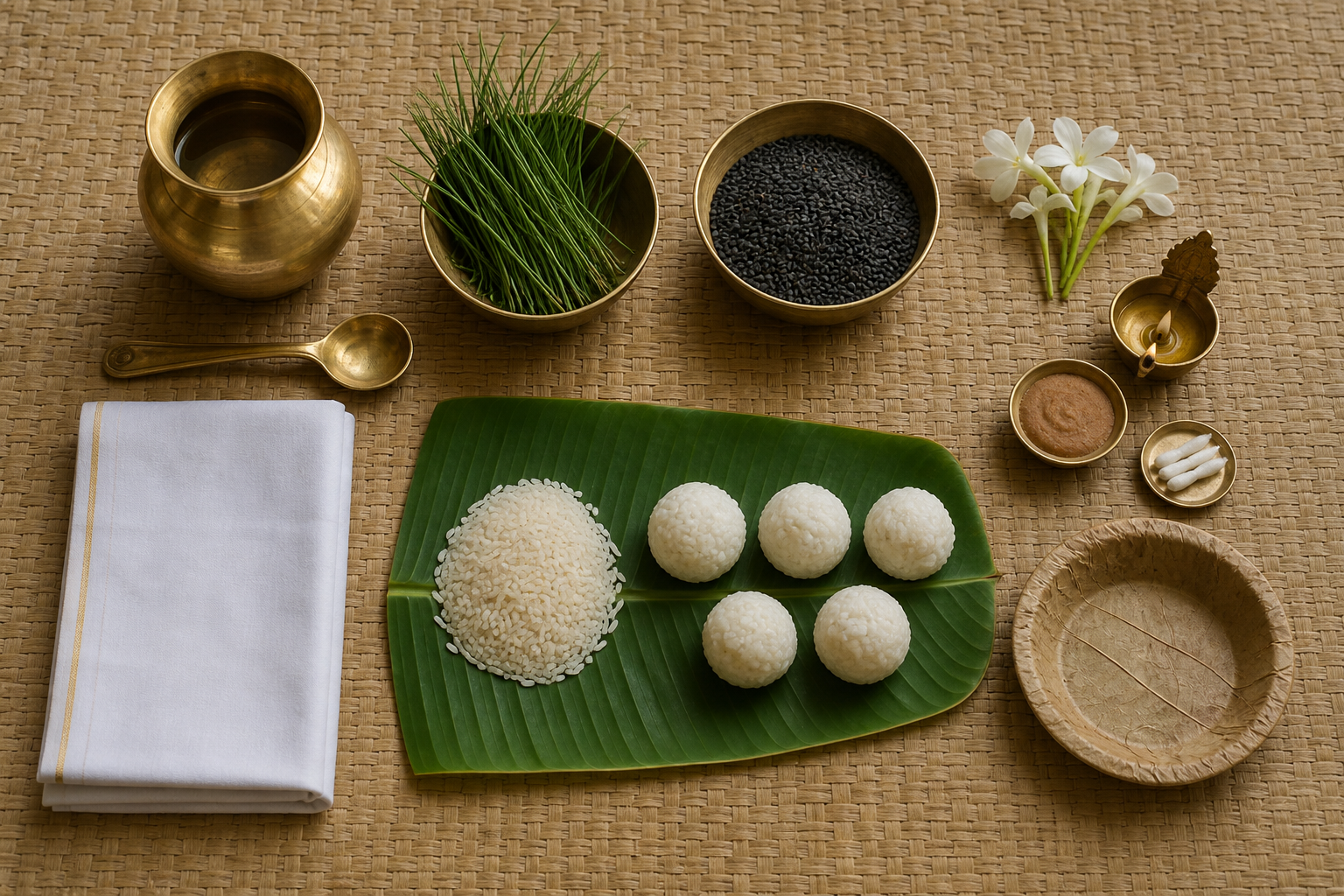
Once the ritual framework is settled, ask what each part is meant to accomplish. This makes preparation more reliable when ingredient names, quantities, mantras, and gestures differ between traditions. It also helps you distinguish a core act from a local accessory.
- Sankalpa: The karta makes the solemn intention that directs the observance toward the particular departed person. Confirm the form of identification and intention required in your tradition rather than improvising a formula.
- Pinda daan: Rice-ball offerings symbolically represent the body and are offered for the departed. Ask about the required ingredients, preparation, number, placement, and disposal because those details can vary.
- Tarpana: Water libations, often accompanied by sesame seeds, express remembrance and offering. Confirm what vessel, water, additions, recitation, and procedure will be used.
- Dana and feeding: Generosity is an integral part of Shraddha. The classical form includes feeding Brahmanas and making suitable gifts. Where that is not feasible, some families arrange food or aid for other deserving recipients or support a community kitchen.
- Prayer and shared remembrance: Make room for the family to participate with attention. The purpose is not served by allowing logistics, photography, or social expectations to overwhelm the rite itself.
Use those five functions to divide responsibilities. One person can coordinate with the priest, another can prepare or obtain the offerings, another can arrange the meal and dana, and another can keep relatives informed. The karta should not have to solve every logistical problem while also carrying the principal ritual duty.
Ask the officiating priest for two separate lists: what the family must provide and what the priest will bring. Confirm quantities, food requirements, recipients, and the expected duration before the day of the rite. A list copied from a different sampradaya or region may contain familiar objects but prescribe a different sequence.
Ekoddishta is undertaken as an act of dharma, gratitude, and prayer, not as an anxious transaction in which one unavailable object erases every sincere act. Yet sincerity does not make all forms interchangeable. Preserve the sankalpa, the one-person focus, the offering functions, and the sequence recognized by your family; adapt secondary logistics with informed guidance.
Settle who will act as karta before the ritual day
The karta is the person who assumes responsibility for performing the rite. Traditionally this responsibility falls to close kin, often the eldest child. Many communities also recognize a daughter, spouse, or another close relative when that person is the appropriate or available bearer of the duty.
Because customs differ, neither exclusion nor eligibility should be declared from a universal rule found online. Resolve the question in this order:
- Identify the practice followed in the deceased person’s household or lineage.
- List the close relatives who are willing and able to complete the required sequence, including any later monthly observances.
- Ask the chosen priest directly who may serve as karta under that practice. Mention a daughter, spouse, or other relative explicitly if that is the family’s situation.
- If the expected karta cannot travel, ask whether the rite may be performed locally or through a trusted representative.
- Tell the immediate family what was decided before invitations, meals, travel, and payments are arranged.
The important practical point is continuity. Choosing someone for the first observance without discussing Masika Shraddha or Sapindikarana may create a second eligibility dispute a month later. Ask at the outset whether the same karta is expected throughout the sequence and what should happen if that becomes impossible.
Adapt location and materials without losing the rite’s center
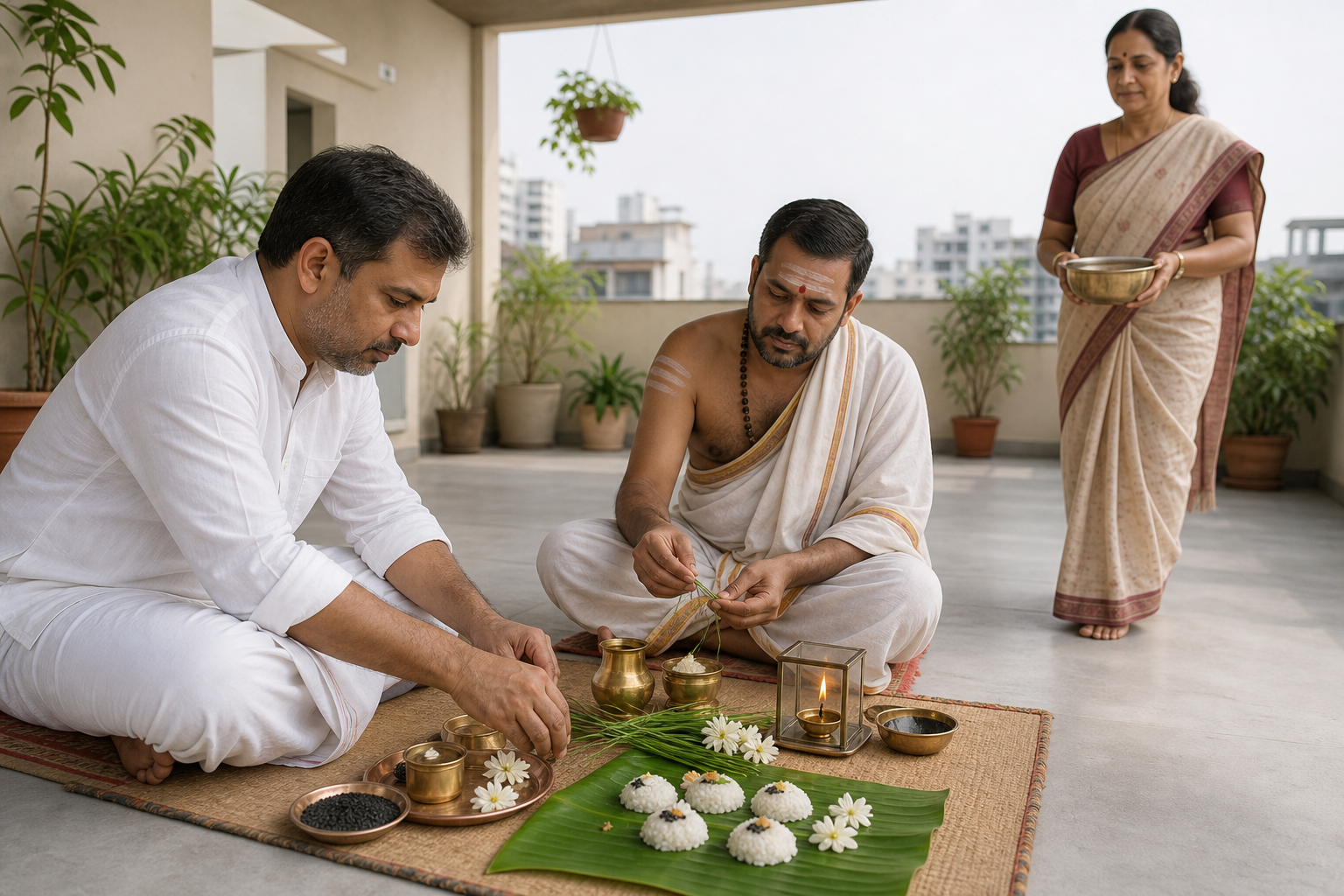
A family home is not the only possible venue. Ekoddishta may be arranged at home, at a sacred place associated with Shraddha, or in a suitable community space. Choose a location that allows the prescribed acts to be completed calmly and that can accommodate food preparation, water offerings, recipients, and any local restrictions.
Diaspora families often face a more specific problem: the family priest, sacred place, relatives, and karta may be in different countries. The venue, charitable offering, and available materials can be adapted while retaining the sankalpa and the rite’s purpose. Work through constraints one at a time:
- No family priest nearby: Find a trusted local priest, explain your family’s regional or sectarian background, and ask whether they can follow that practice. Do not discover major differences during the sankalpa.
- Travel is impossible: Ask whether the observance may be performed locally on the relevant tithi or arranged through a trusted representative at the customary location.
- An exact material is unavailable: Ask for a respectful local equivalent. Do not silently omit or substitute an item when its ritual function is unclear.
- Feeding Brahmanas is impractical: Discuss feeding other deserving recipients, giving food to people in need, or supporting a community kitchen while preserving the intended dana.
- The home is unsuitable: Use a temple-related, sacred, or community setting that permits the offerings and meal without rushing the family.
- Waste is a concern: Choose simple, sattvic food and environmentally considerate offerings, provided they remain consistent with the ritual instructions.
Do not let an adaptation erase a distinct ritual function. A donation, for example, can fulfil the dana component, but it does not automatically perform the work of sankalpa, pinda daan, or tarpana. If the full customary form is impossible, ask what simplified form preserves each essential element.
Questions families ask before Ekoddishta Shraddha
Is Ekoddishta the same as an annual Shraddha?
No. Ekoddishta has a one-person focus and belongs to the rites for someone who has recently died. Parvana Shraddha honours ancestors collectively. Sapindikarana marks the departed person’s integration with the ancestral lineage, after which annual remembrance can include that person with the forebears.
Must it be performed on the 10th, 11th, 12th, or 13th day?
There is no universal choice among those days. The rite often occurs within the 10th-to-13th-day period, but the applicable day depends on family, regional, and sectarian practice. Confirm the whole post-cremation sequence rather than selecting one of those days merely because it is convenient.
Can a daughter or spouse perform the rite?
Many communities recognize a daughter, spouse, or another responsible close relative as karta when appropriate. Other traditions apply narrower rules. Ask a priest familiar with the family’s practice, state the actual family circumstances clearly, and settle the decision before the ritual day.
What if the prescribed ingredients or recipients are unavailable?
Use close equivalents only after confirming their ritual function with a trusted priest. When the customary feeding of Brahmanas cannot be arranged, food or aid for deserving recipients may preserve the spirit of dana. Material flexibility should support the rite’s essential intention, not become a reason to discard its distinct components.
Your next useful step is a short family-priest conversation, not a shopping trip. Confirm the tradition, date, karta, sequence through Sapindikarana, and who will record the later tithis. Once those decisions are written down, the family can prepare a simple and coherent observance in which attention returns to the departed rather than remaining trapped in uncertainty.
References
