
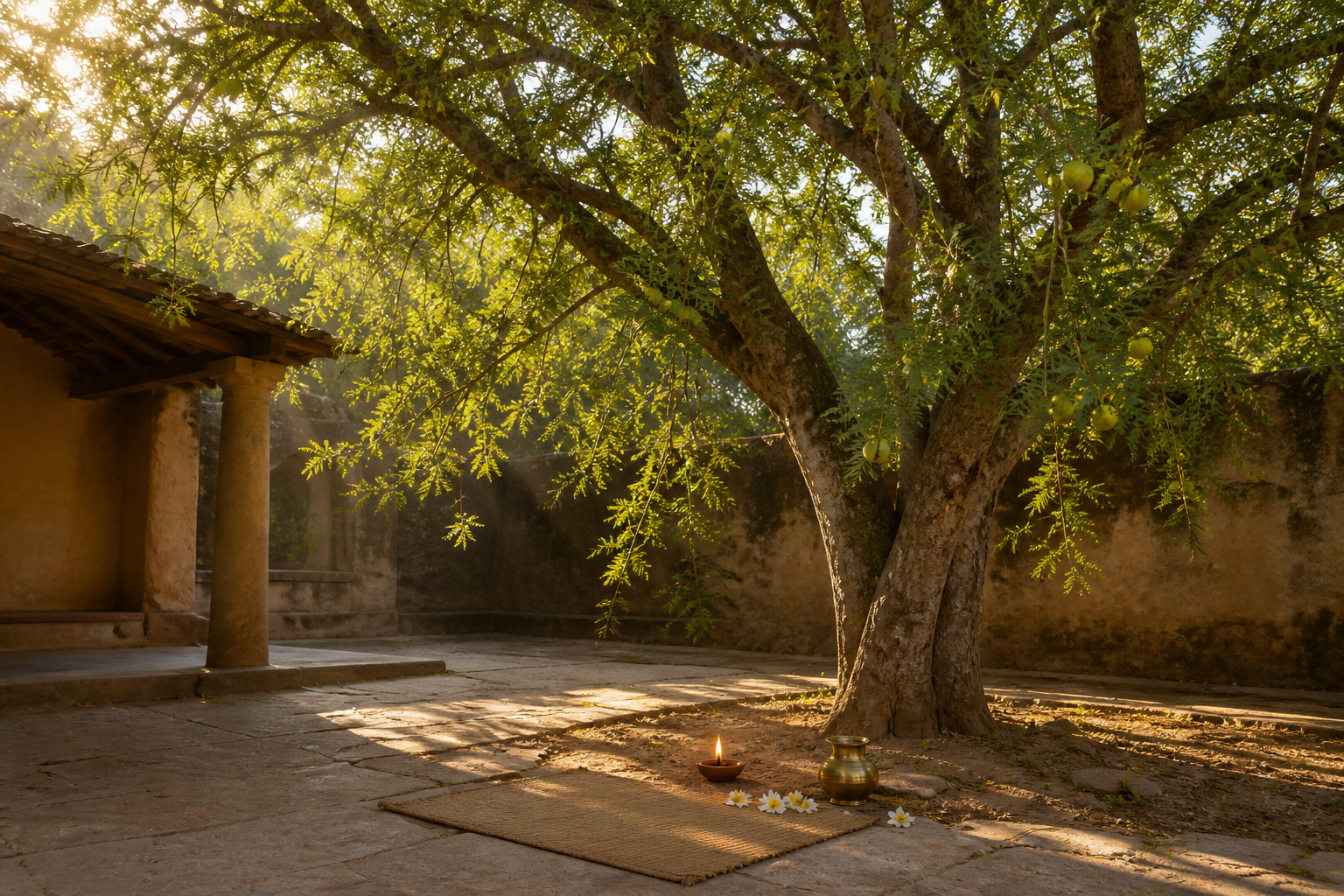
You may know amla as a tart fruit, an Ayurvedic ingredient, a tree worshipped during a vrata, or a plant that stood in an elder’s courtyard. If you are trying to understand what the tree means—or how to approach it respectfully—the important point is that these identities are not separate.
The amla becomes fully intelligible when devotion, nourishment, community memory, and care for the living tree remain together. You do not need to imitate every regional custom. You do need to avoid reducing the tree to either a ritual object or a wellness product.
Why the living tree matters as much as its fruit
Amla is commonly called Indian gooseberry and is identified botanically as Phyllanthus emblica, also known as Emblica officinalis. Its familiar name is connected with the Sanskrit term “Amalika.” These names identify the plant, but they do not by themselves explain its place in Hindu life.
In the Vishnu Purana, the amla is associated with the tears of Vishnu. The devotional meaning is not that a useful plant was arbitrarily decorated with a religious story. The tree is approached as a manifestation of divine grace and protection. Its traditional associations with purity, vitality, and auspiciousness arise from that sacred frame.
This changes how you look at the tree. Its value does not begin when a fruit is harvested and does not end when an offering is completed. The living plant, the soil supporting it, the people caring for it, and the community gathering around it all belong to the relationship.
If you are explaining the amla to a child or a visitor, use three connected ideas:
- Sacred presence: Hindu tradition recognizes the divine through living nature rather than treating nature as spiritually empty.
- Received nourishment: The fruit is valued, but receiving its benefits creates an obligation not to neglect the tree.
- Continuing responsibility: Reverence is demonstrated through protection, restraint, cleanliness, and dependable care.
That explanation is more faithful than saying merely that Hindus worship a particular species. It shows why worship and stewardship cannot be pulled apart.
How to observe Amalaki Ekadashi without inventing a custom
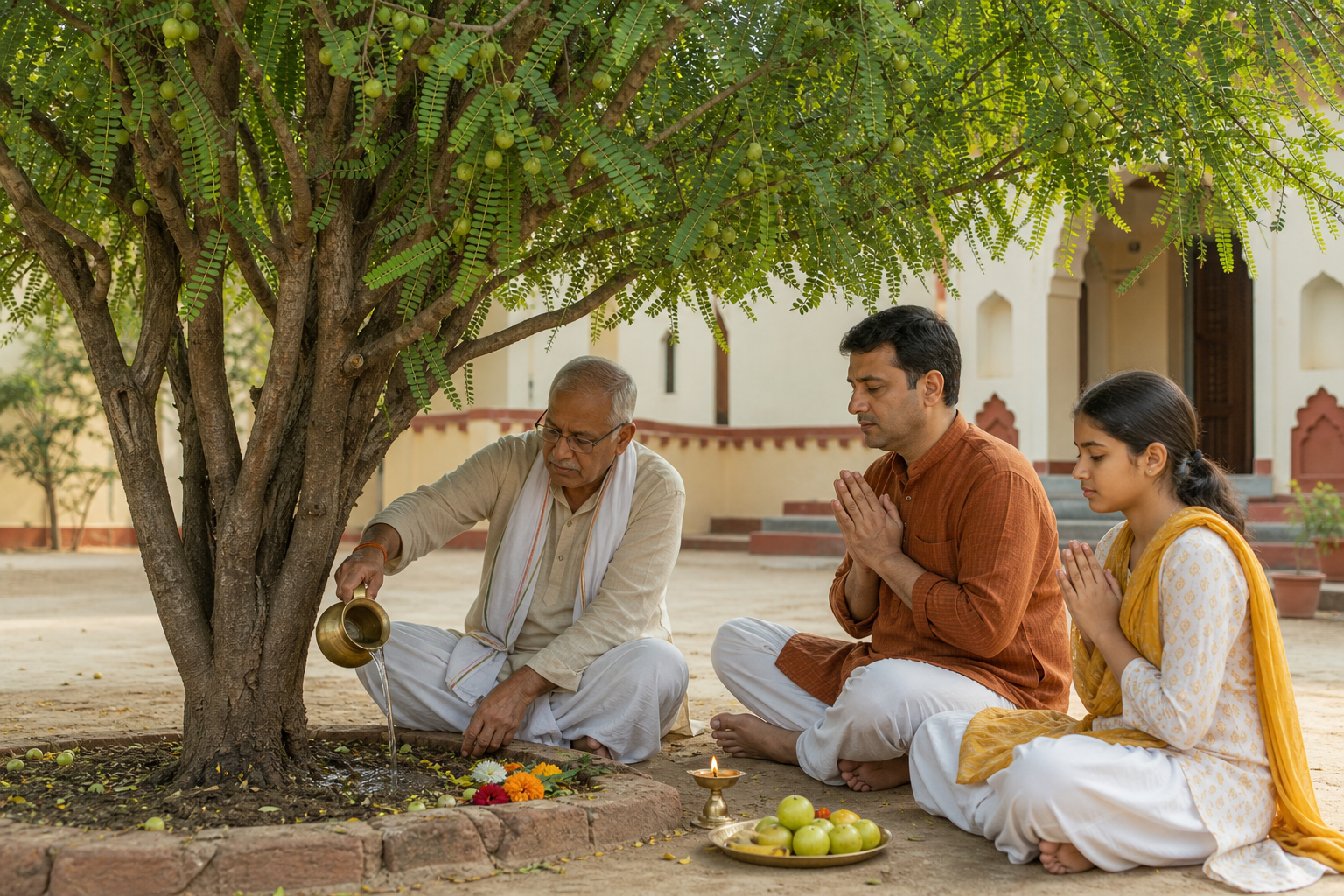
Amalaki Ekadashi gives the tree a visible place in devotional life. In several regions, observance can include offerings, circumambulation, lamps, and the distribution of prasad. The details are not necessarily identical from one family, sampradaya, temple, or region to another.
If you did not inherit a household procedure, do not assemble one from disconnected gestures and present it as universal. Begin with the people who maintain the tradition where you live. A family elder, temple priest, or established community organizer can tell you which elements are customary and which are optional.
A respectful practical sequence is:
- Ask before arranging anything. If the tree belongs to a temple, neighborhood, or another household, obtain the caretaker’s permission. Sacredness does not cancel ordinary responsibility.
- Clean the place gently. Remove litter without scraping roots, cutting branches, or disturbing the soil unnecessarily. The aim is to serve the tree, not merely prepare a decorative setting.
- Follow the local form of worship. Offer water, perform circumambulation, or recite an appropriate prayer only as your tradition directs. If no inherited text has been given to you, a simple, sincere act of reverence is better than claiming an invented mantra or procedure.
- Use lamps with care. Keep flame away from dry leaves, bark, roots, cloth, and other combustible material. Supervise it continuously and follow the rules of the site. A devotional lamp should never become a fire hazard.
- Keep offerings compatible with the tree’s welfare. Do not drive nails or fasteners into the trunk, tighten thread or wire around growing bark, or leave plastic and synthetic decoration behind.
- Complete the observance through sharing. Where customary, distribute prasad and include younger family members in both worship and cleanup. This is how a festival becomes transmitted practice rather than a performance witnessed from a distance.
- Return after the occasion. Check that lamps are extinguished and that no waste remains. If the tree needs continuing attention, coordinate it with the person responsible for the site.
The final step is easy to overlook, yet it reveals the purpose of the others. Circumambulation places the tree at the devotional center for a moment; continuing care refuses to abandon it when the ceremony is over.
How to understand amla in Ayurveda without making medical promises
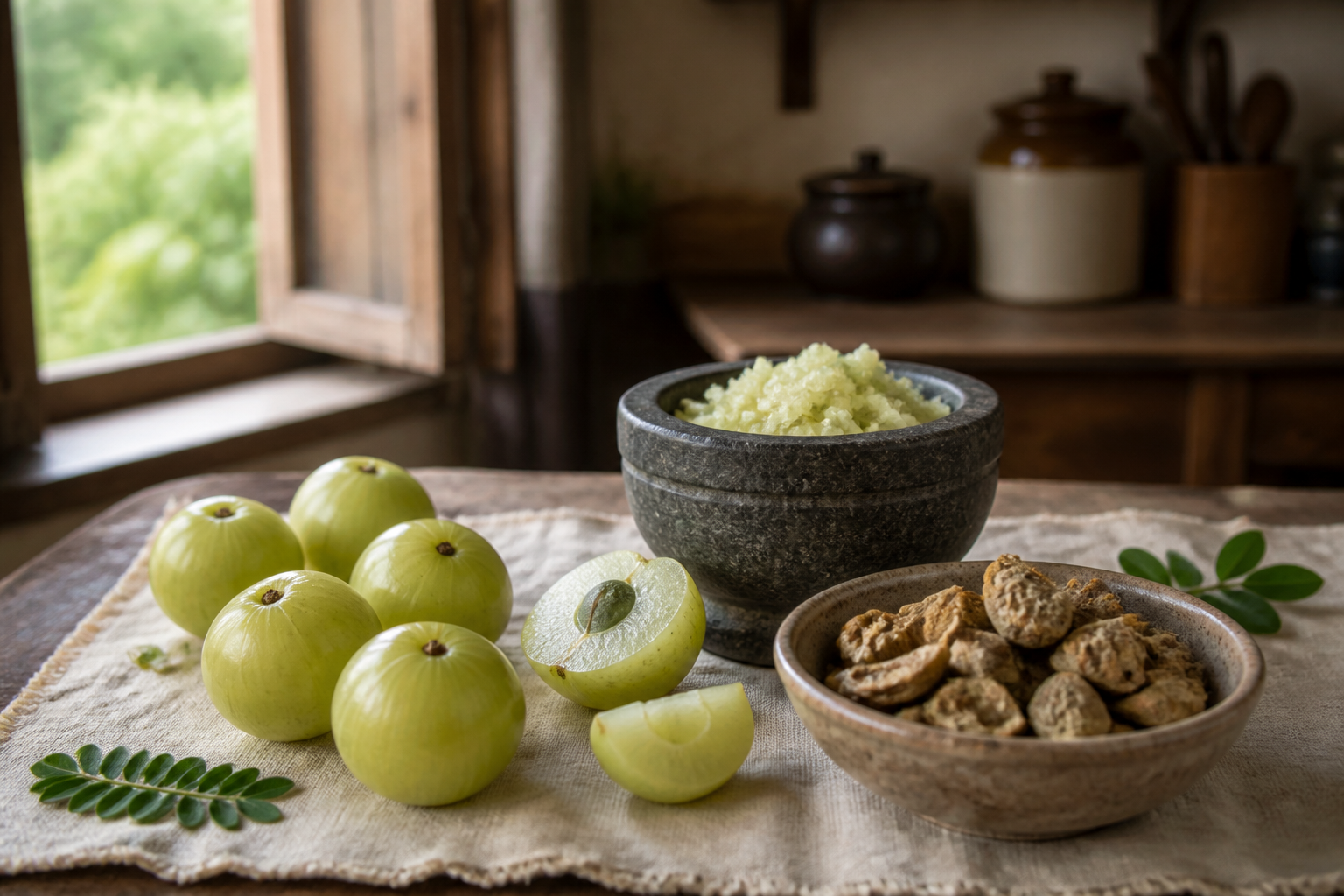
Ayurveda traditionally values amla as a prominent rasayana. Rasayana belongs to an Ayurvedic framework concerned with nourishment, balance, and rejuvenation, while amla is also described in terms of a nourishing and sattvic character. This helps explain why the fruit can appear in the household at the meeting point of food, disciplined living, and sacred regard.
That traditional esteem should not be converted into a promise that one fruit or preparation cures every condition. A scriptural association, a ritual use, a food tradition, and an individualized Ayurvedic recommendation are four different kinds of claim. Treating them as interchangeable weakens both religious understanding and health judgment.
Use a simple test when you encounter a strong claim about amla: ask whether the speaker is describing its sacred meaning, its traditional classification, an ordinary culinary practice, or a treatment for a particular person. Only the last of these is individualized medical advice. If you are considering amla for a health condition, or alongside medicines or an existing treatment plan, consult an appropriately qualified health professional rather than relying on devotional status or promotional language.
You do not protect tradition by exaggerating it. You protect it by naming accurately what Ayurveda values while declining to turn that valuation into an unsupported guarantee.
Make reverence visible through everyday stewardship
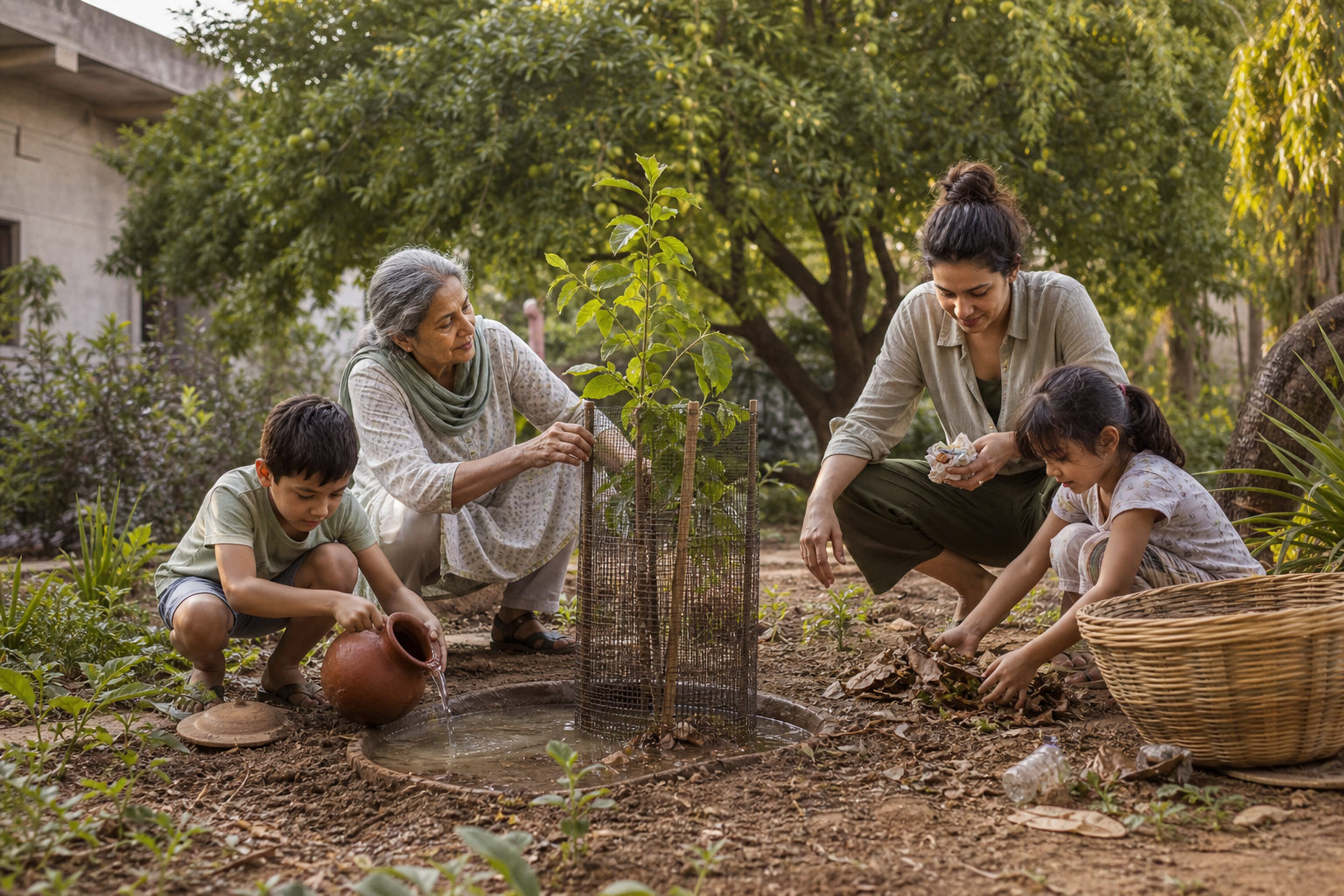
Amla trees have served as cultural anchors in courtyards and sacred groves. Around them, families can preserve festival rhythms, the memory of homemade preparations, the light of lamps, and the habit of gathering across generations. The tree is therefore more than a symbol observed from afar; it can become a participant in the continuity of a household or neighborhood.
You do not need to own land to participate in that continuity. Choose the form of service that matches your circumstances:
- If you already care for an amla tree: learn who is responsible for watering, seasonal maintenance, and the area around it. Make that responsibility explicit so it does not disappear between festivals.
- If you want to plant one: first confirm with a knowledgeable local nursery that the identified species and planting place are suitable for your conditions. Planting is a long-term commitment; decide who will care for it before making the ceremonial gesture.
- If a temple or community has one: ask what help is actually needed. Cleaning the surroundings, supporting appropriate maintenance, or helping organize a careful observance may be more useful than bringing another decoration.
- If no tree is accessible: learn the tradition, share the story with your family, support the protection of a sacred grove or community planting, and avoid pretending that purchasing a packaged amla product is equivalent to caring for the living plant.
This ethic also creates meaningful common ground within the wider Dharmic family. Hinduism gives the amla a specific devotional and scriptural place. Buddhist, Jain, and Sikh communities should not be assumed to assign the tree an identical ritual status. What can be shared honestly are related commitments such as ahimsa, humility toward living nature, and seva.
That distinction matters. Dharmic unity does not require us to erase differences in theology or worship. It becomes stronger when each tradition is represented accurately while communities cooperate in protecting life, sustaining biodiversity, and teaching responsibility to the next generation.
Key takeaways
- The amla is sacred in Hindu life not only because its fruit is useful, but because the living tree is associated with divine grace, purity, vitality, and auspiciousness.
- Amalaki Ekadashi practices vary by family and region. Ask a knowledgeable elder or temple authority before presenting any procedure as universal.
- Offerings, lamps, and decorations must not injure the tree or create a fire hazard. Cleanup and continued care are part of the observance.
- Ayurveda’s traditional valuation of amla as a rasayana is not a universal medical prescription or a substitute for individualized professional advice.
- Ahimsa, seva, and care for living nature provide shared Dharmic ground without requiring Hindu, Buddhist, Jain, and Sikh practices to be treated as identical.
Choose one durable act now: ask an elder how your family observed Amalaki Ekadashi, learn who cares for a nearby tree, remove litter from its surroundings with permission, or help establish a responsible plan for future care. The most convincing expression of reverence is what remains after the lamp has gone out.
References
