
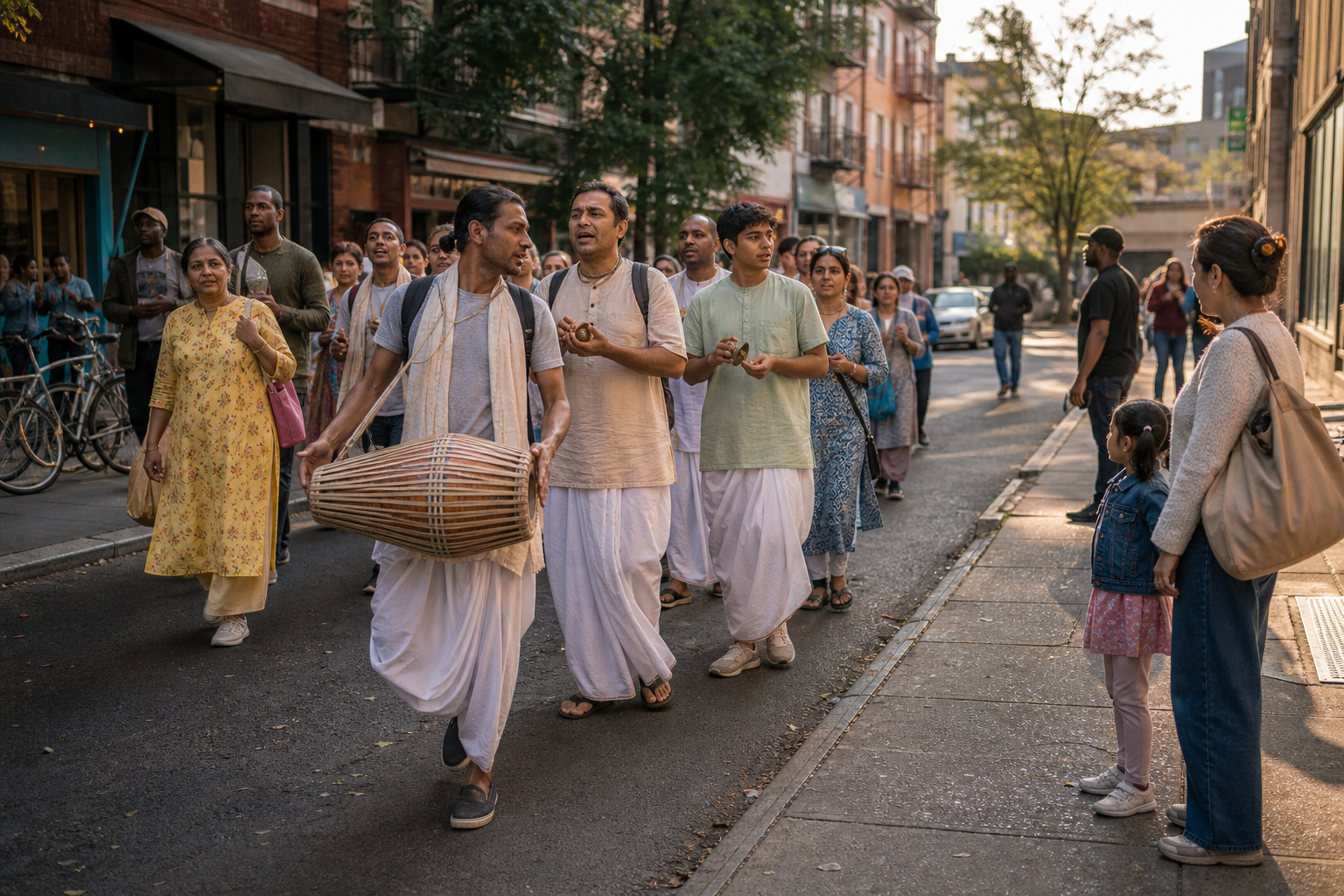
If you encounter Harinama on a Brooklyn street, it is easy to misread what is happening. It may look like a religious procession meant only for initiated devotees, or like musical entertainment that happens to use sacred words. It is neither closed ritual nor ordinary performance. You are encountering worship carried into shared civic space.
That distinction matters if you want to participate, bring your children, photograph the gathering, or organize something similar. Once you understand what the chanting is doing, you can join without pretending expertise and help diaspora bhakti remain both rooted and open.
What you are encountering on Atlantic Avenue
Harinama is devotional chanting of the sacred names. In a public setting, a lead voice offers a phrase and the gathering responds. The repetition is not filler between musical passages; it is the center of the practice. Instruments establish rhythm, bodies move together, and people who arrived separately begin to act as a temporary devotional community.
At the October 5, 2025 Harinama during Brooklyn’s Atlantic Antic on Atlantic Avenue, that pattern took visible form through mridanga and kartal accompaniment, call-and-response chanting, rhythmic movement, and encounters with families, children, elders, visitors, and passersby. Children echoed the rhythm, some adults joined, and others watched from the edge. These are not lesser forms of participation. Public bhakti naturally produces different distances from the devotional center.
You can therefore read the gathering on three levels at once. For committed practitioners, it is spiritual discipline and service. For diaspora families, it places inherited culture in the world their children actually inhabit. For neighbors, it is an invitation to encounter a Hindu devotional tradition through sound, movement, and human presence rather than through an argument about religion.
The practical point is simple: do not wait for everyone around you to behave like an expert. The person singing with concentration, the child following the drum, and the passerby listening quietly are having different encounters with the same public practice.
Why diaspora bhakti needs more than private preservation
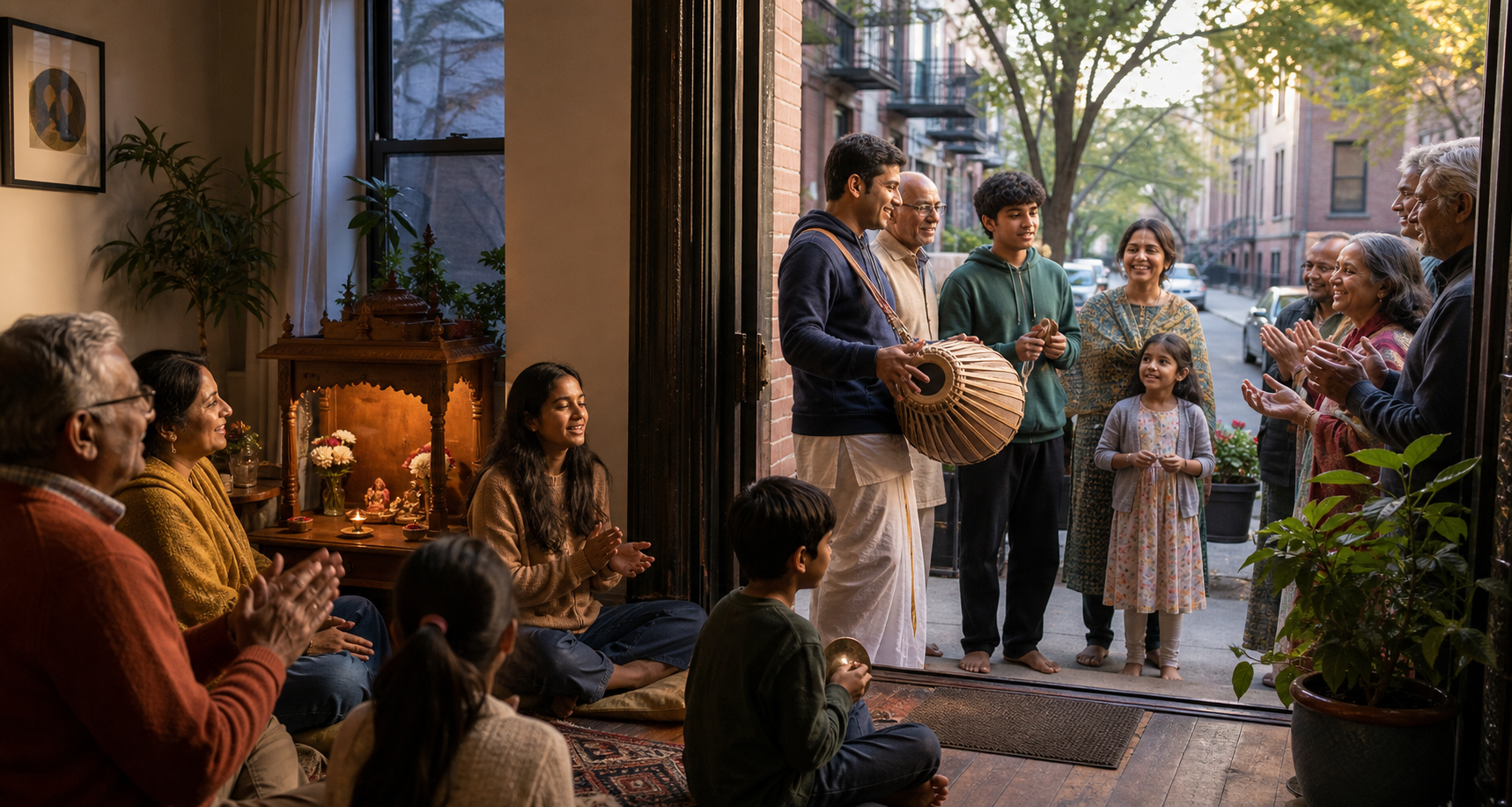
A tradition can survive inside a household yet become invisible everywhere else. Children may know that their family chants, visits temples, or marks sacred days, while still absorbing the idea that these things belong behind closed doors. Public Harinama interrupts that division. It lets a child see adults carrying devotion confidently into an ordinary city street.
This is cultural continuity through practice, not display alone. A photograph, costume, recipe, or festival booth can preserve recognizable forms. Bhakti asks for something more: attention, repetition, relationship, and participation. Sacred sound has to be voiced. Rhythm has to be kept. A response has to follow the call. The tradition remains alive because people do it together.
The Brooklyn setting also reveals what adaptation should mean. Harinama does not need to imitate a historical Indian streetscape to remain authentic. It can move amid vendors, traffic, families, and the pace of New York while retaining its devotional center. The surroundings change; the purpose of the chanting does not.
That gives you a useful test whenever diaspora culture enters a public festival. Ask whether the setting has made the practice understandable and accessible, or whether it has quietly turned the practice into decoration. Adaptation is healthy when it helps people encounter the tradition. Dilution begins when the sacred act becomes incidental to the spectacle around it.
Public bhakti can also create points of recognition across dharmic communities. Seva, ahimsa, disciplined attention, and the importance of spiritual community have meaningful resonances within Hindu, Buddhist, Jain, and Sikh life. Those resonances should open conversation, not erase distinctions. Sangha, sangat, and a Gaudiya devotional gathering are not interchangeable institutions, just as different dharmic understandings of liberation, the self, and the Divine are not identical.
Use shared values as doors rather than equations. You can affirm a common ethic of service or non-harm without claiming that every dharmic path teaches the same theology.
How to join Harinama without pretending to know more than you do
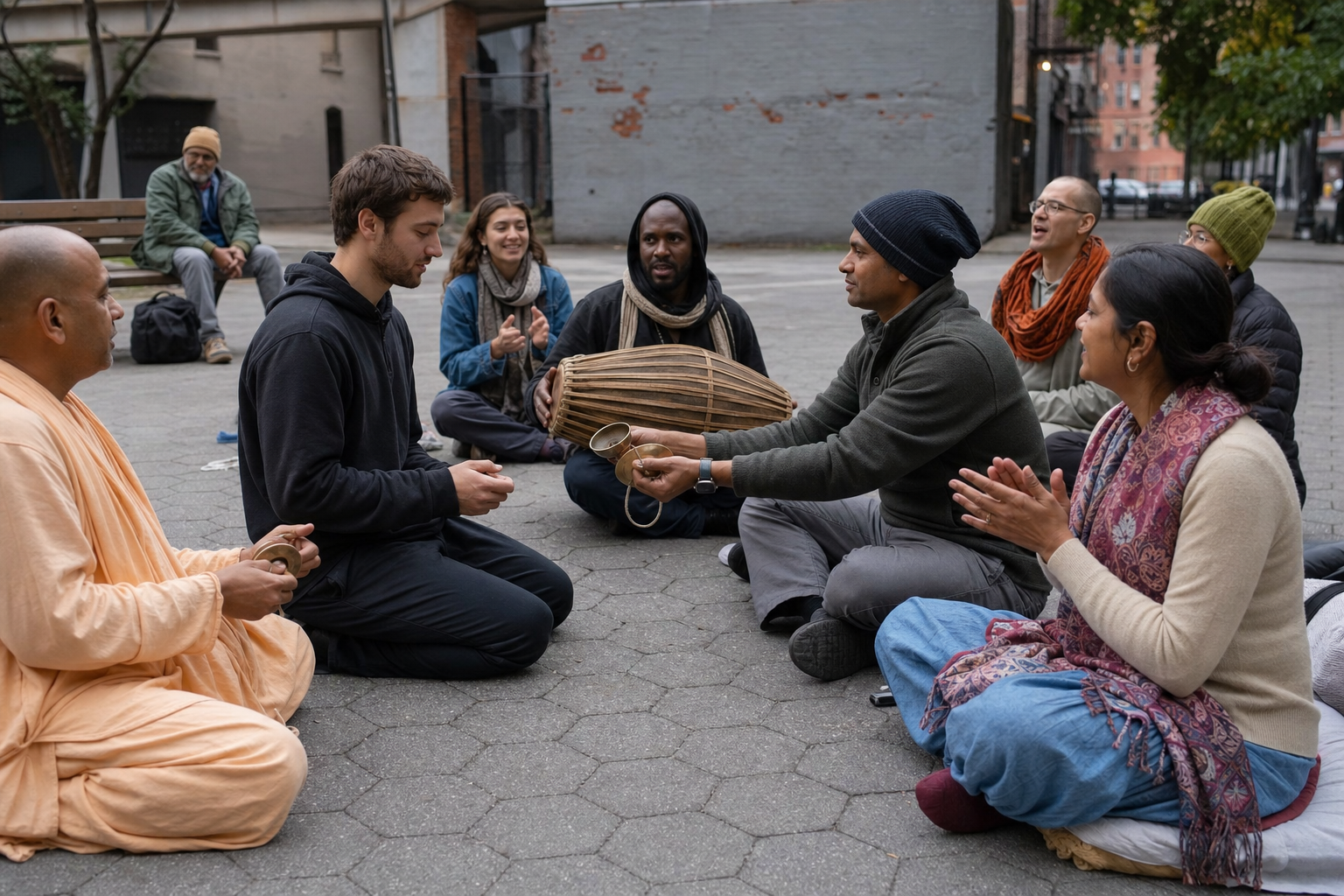
You do not need initiation, fluency, or a rehearsed explanation of Gaudiya philosophy to receive a public invitation respectfully. You do need to recognize that the people chanting are practicing devotion, not merely producing atmosphere.
- Begin at the edge. Listen through one call-and-response cycle before deciding what to do. This shows you which words belong to the lead and which belong to the response.
- Join at your actual level. You may chant the response, clap with the rhythm, walk alongside the gathering, or simply listen. Quiet attention is better than exaggerated participation performed for a camera.
- Follow the established rhythm. Mridanga and kartal help hold the gathering together. If you are unsure of the beat, watch the regular participants before adding your own clapping or movement.
- Keep the sacred act in view. Speak normally with people at the edge, but do not shout questions over the chant leader or treat musicians as though they are buskers taking requests.
- Photograph with restraint. A wide view of a public procession is different from a close portrait of a worshipper or child. Ask before taking an intimate image, and do not block the movement of the gathering to obtain a better angle.
- Let children approach at their own pace. A child may mirror the rhythm before learning the words. That embodied curiosity is a real beginning; it does not need to become an impromptu lesson or a test of religious knowledge.
- Ask one concrete question when the chanting pauses. Questions such as “What are you chanting?” or “Is there a local gathering I can attend?” create a better conversation than demanding a complete defense of the tradition in the middle of the event.
If the practice is not yours, respectful participation does not require adopting a new identity for the afternoon. Listen, respond if invited, and let the encounter remain honest. Openness is strongest when it does not depend on imitation.
What families and organizers should carry forward
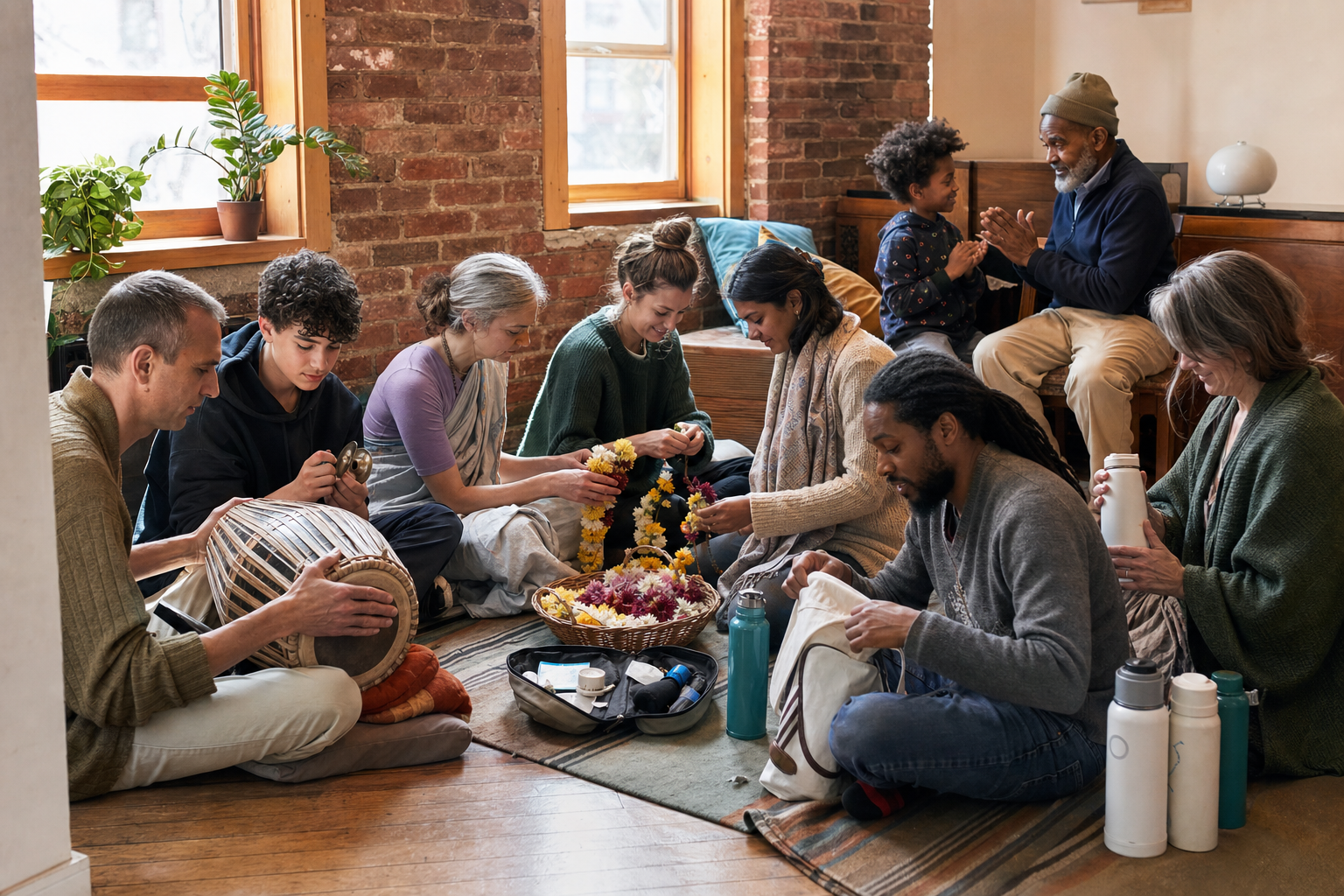
For parents bringing children
A public Harinama can give a child something a formal explanation cannot: a memory of dharma inhabiting the same city streets as the rest of life. You can deepen that memory without turning the outing into a classroom exercise.
- Before you arrive, offer one clear sentence: “This is devotional chanting of sacred names, and people answer the lead singer together.” That is enough orientation for a first encounter.
- During the gathering, point out one element rather than explaining everything. Help the child notice the mridanga, the kartals, or the way the response follows the call.
- Do not measure engagement only by whether the child chants. Listening, watching elders, following the beat, and asking a question afterward are all forms of attention.
- Afterward, ask what the child noticed before telling them what they should have noticed. Their answer will show whether sound, movement, people, or sacred meaning made the first connection.
- Return when possible. One vivid event can create curiosity, but repetition turns an unusual outing into recognizable community life.
For people organizing public kirtan
The main challenge is not making Harinama more spectacular. It is holding devotional integrity and public hospitality together. A gathering can be reverent yet difficult for newcomers to read, or welcoming yet so event-driven that the chanting becomes background music.
- Keep the chant visibly central. The lead, response, and instrumental support should remain coherent even when the surrounding fair is loud or visually busy.
- Place a few informed participants near the outer edge. Their role is to greet people, give a one-sentence explanation, answer questions, and protect the concentration of those leading the chant.
- Make the invitation legible without pressure. A simple statement such as “You are welcome to listen or join the response” gives newcomers permission while respecting those who prefer to observe.
- Assign route and space stewardship separately from musical leadership. The person absorbed in leading kirtan should not also have to watch pedestrian flow, keep the group together, and answer logistical questions.
- Set a clear norm for close photography, especially around children. A public setting does not remove the need for judgment, consent, and consideration.
- Explain shared dharmic values carefully. Seva, ahimsa, community, and mindful presence can support bridge-building, but avoid presenting distinct traditions as interchangeable versions of one generic spirituality.
- Provide a next step. If a curious person asks where the practice continues, someone should be able to identify the relevant local gathering, temple, or community contact.
A useful way to assess the event afterward is to ask four questions. Did the chanting remain devotional? Could a newcomer understand how to participate? Did the procession care responsibly for shared space? Did interested people have a path from a brief street encounter to sustained community? Crowd size alone cannot answer any of them.
Key takeaways
- Brooklyn Harinama is worship in public space, not merely a cultural show or street concert.
- Call-and-response allows people to participate at different depths without requiring instant expertise.
- For diaspora families, public devotion connects inherited practice with the city their children experience every day.
- Adaptation preserves bhakti when the setting changes but sacred purpose remains central.
- Shared dharmic values can build relationships without erasing differences among Hinduism, Buddhism, Jainism, and Sikhism.
- Good participation begins with listening; good organization combines devotional focus, hospitality, consent, and a clear next step.
The next time Harinama crosses your path, stay for one complete exchange between the lead voice and the gathering. Listen before deciding whether you belong. Then take one honest step: answer the chant, help your child notice the rhythm, greet someone at the edge, or ask where the community meets again. Diaspora bhakti becomes durable through precisely these small movements from encounter to relationship.
References
