
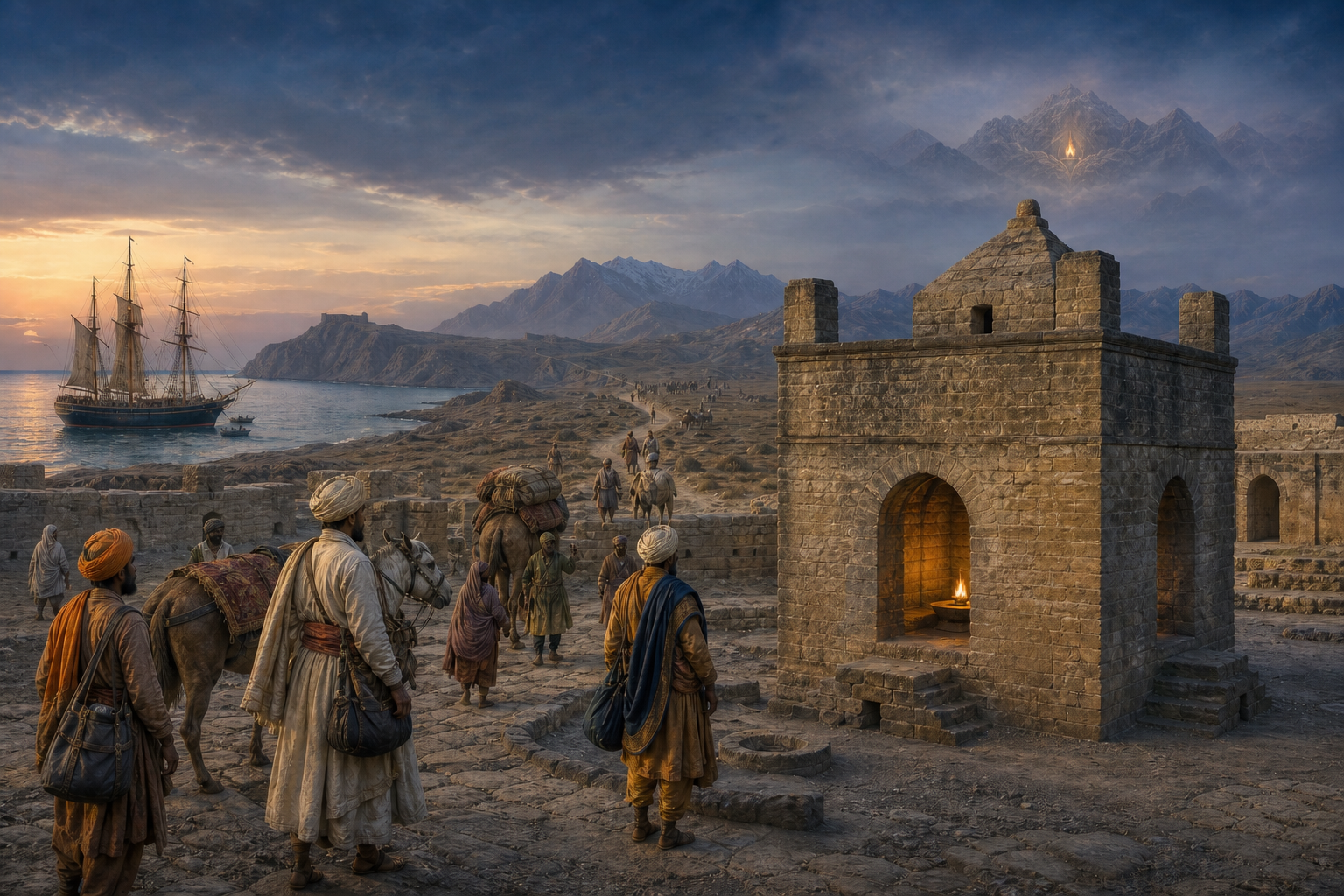
You may be trying to decide whether the Kangra-Baku connection is history, devotional memory, or modern overreach. The most defensible answer is that it contains both history and devotional memory. Indian merchants reached the Baku region, Hindu and Sikh communities worshipped at its fire shrine, and devotees placed that shrine and Kangra’s Jwalamukhi Mandir within one sacred geography.
The case becomes stronger when you resist turning it into a tale of one ship sailing directly from Kangra to Baku. What emerged was a chain: Indian Ocean commerce connected with inland trade, trade sustained diaspora communities, communities established places of worship, and pilgrims joined those places to older sacred centres in Bharat.
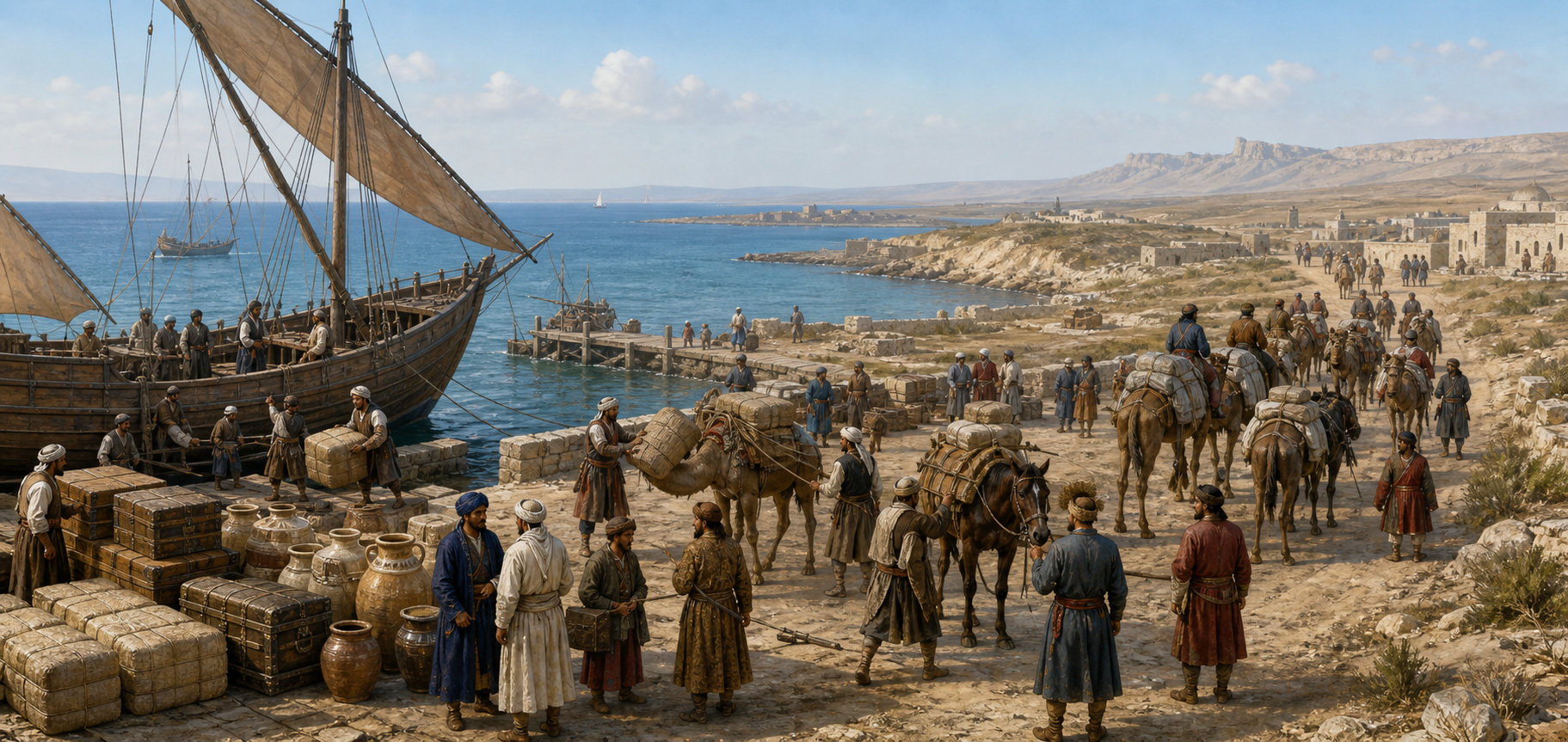
Read Baku as part of a maritime-and-overland network
Baku is a Caspian city, not an Indian Ocean port. That geographical fact does not weaken its place in Indian maritime history, but it does tell you how to describe the connection accurately. Maritime trade created the larger commercial system; inland roads, regional markets, and pilgrim journeys carried people through its continental extensions.
Commercial contact between India and the region had been active for at least three centuries before the Russo-Persian War of 1722. Hindu and Sikh merchants, traders, and bankers were present not only in Azerbaijan but also in centres such as Bukhara and Samarkand. The surviving record does not give us one continuous itinerary from an Indian port to the Baku shrine, so we should not manufacture one.
A parallel western example makes the underlying pattern easier to see. Sindhi Bhatiya merchants were established in Muscat by the sixteenth century, with Kutchi Bania communities following them. They maintained temples and festivals alongside their commercial networks. The Motisvar Temple, associated with a nineteenth-century Sindhi Bhatiya patron, shows how a merchant settlement could become a durable Dharmic community without ceasing to participate in its host society.
Baku belongs to this history of connected corridors. The precise formulation matters: call it an Indian maritime-commercial system joined to overland and Central Asian routes. Do not call it a proven direct maritime route from Kangra to Baku. The first claim is supported; the second asks the evidence to do something it cannot do.
What the Baku fire shrine actually establishes
The Jvalaji shrine associated with 1745 is now widely known as the Ateshgah of Baku. Its Persian name is straightforward: atesh means fire and gah means place. A proposed relationship with the Sanskrit words Atharvan and gruha is suggestive but speculative. You do not need that linguistic argument. The inscriptions, ritual features, and pilgrimage accounts are much firmer evidence.
| Evidence | What it supports | What it does not prove |
|---|---|---|
| A fire-shrine complex associated with 1745, after centuries of Indo-regional commerce | A resident community had enough continuity and resources to establish a substantial religious institution. | That every part of the surviving complex was built at the same moment or for one community throughout its entire history. |
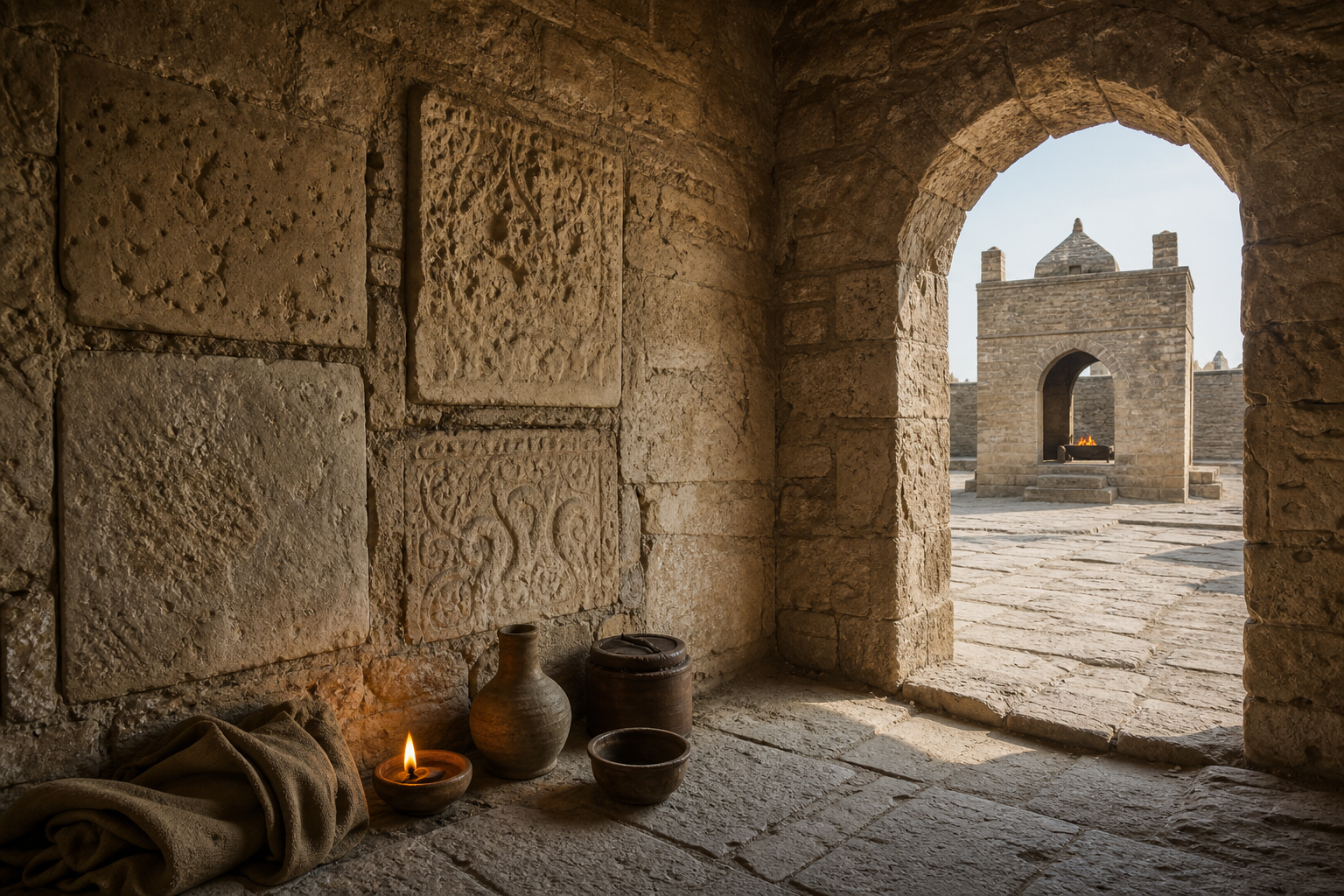
| Seventeen inscriptions: fourteen in Sanskrit using Nagari or Devanagari, two in Gurmukhi, and one in Farsi | A strong Hindu and Sikh presence within a multilingual commercial environment. | The exact population, proportion, or identity of every worshipper who used the site. |
| An early inscription invoking Ganesha and another containing an extended praise of Shiva | Recognisably Hindu liturgy, not merely an unspecified reverence for natural fire. | That the site had an exclusively Hindu identity in every later period. |
| Seven sacred fires within the enclosed precinct | An Agni-centred ritual setting that can reasonably be read alongside the Vedic image of Agni’s seven tongues. | An uninterrupted performance of one specific rite across all generations. |
| Accounts of saffron-marked pilgrims and Hindu fakirs travelling to or from Baku | The shrine functioned as a pilgrimage destination rather than only as a private merchant chapel. | A reliable headcount, a fixed itinerary, or continuous pilgrimage in every decade. |
| Jivanji Jamshedji Modi’s 1925 examination of the architecture and inscriptions | His conclusion that the complex was a Hindu temple where Brahmins worshipped Agni, rather than a Parsee Atash Kadeh. | Exclusive ownership of the site’s symbolism or denial of its importance to Zoroastrian visitors and memory. |
The inscriptions deserve priority because they identify languages, deities, and liturgical culture at the site. The fourteen Sanskrit inscriptions greatly outweigh a claim based only on resemblance. The two Gurmukhi inscriptions also matter: they place Sikh participation inside the history rather than treating the shrine as the work of an undifferentiated Hindu merchant population.
At the same time, a Farsi inscription and the later Zoroastrian association warn against a simplistic ownership contest. Sacred fire has meaning across neighbouring traditions. Hindu evidence at Ateshgah is substantial, but substantial evidence does not require erasing every later layer. Azerbaijan’s designation of the complex as the Ateshgah Temple State Historical Architectural Reserve in 2007 appropriately preserves a site whose history is layered.
The Kangra connection is a sacred map, not a shipping map
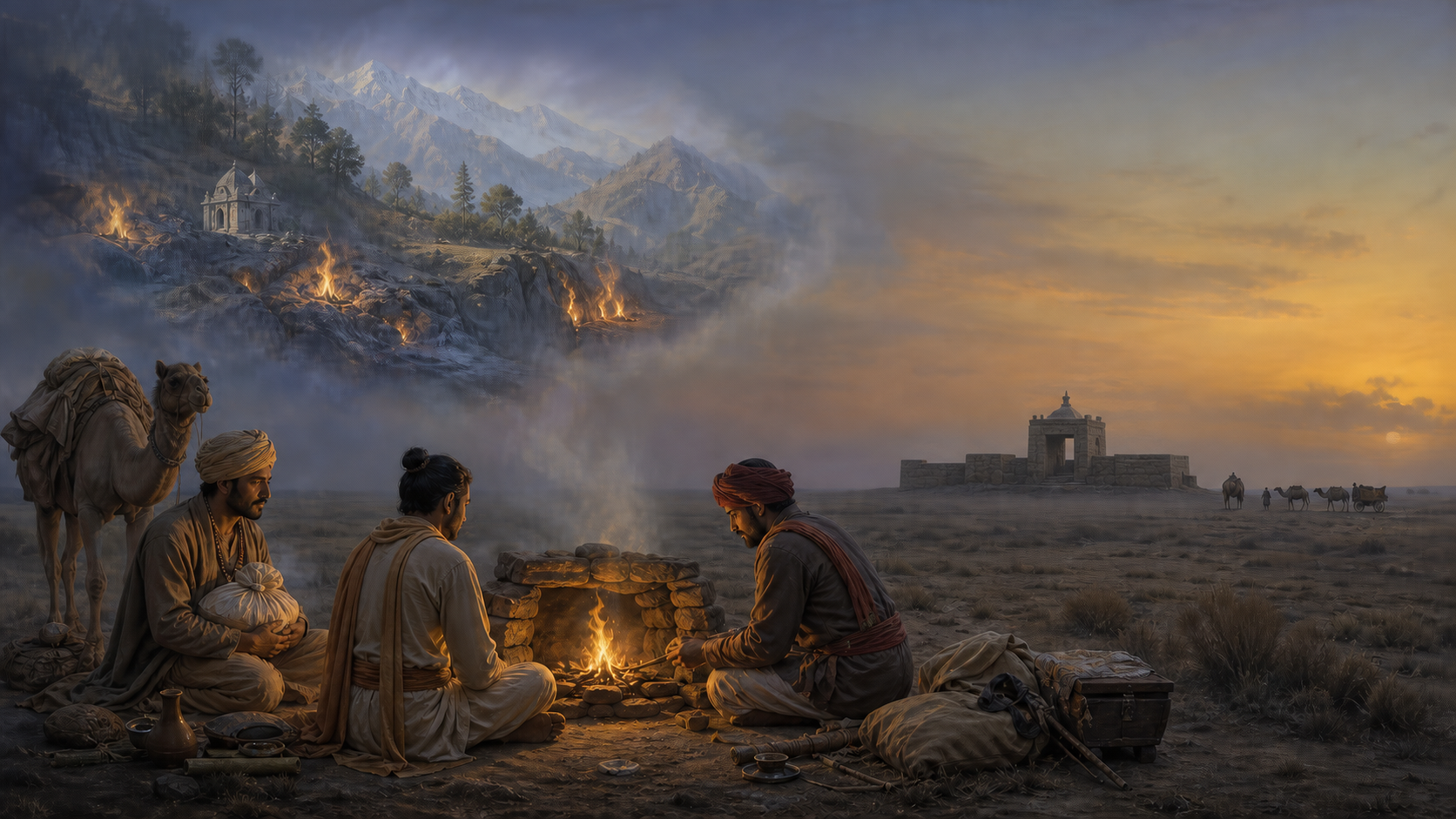
Jwalamukhi Mandir in Kangra is a Shakti Peetha centred on the manifestation of sacred flame. Baku’s Jvalaji was an Agni shrine. Their theological settings were therefore related through fire without being institutionally identical. The decisive connection is the way devotees themselves understood the two places: Kangra was called the Chhota Jvala Ji and Baku the Bada Jvala Ji.
Those names are historical evidence of devotional relationship. They show that worshippers did not regard Baku as an isolated foreign curiosity. They placed it within a recognisable Jvala tradition extending back toward Bharat. We do not know from the surviving details why Baku received the designation Bada, or greater, while Kangra was called Chhota, or smaller. It would be a mistake to turn those terms into an unsupported claim about age, authority, or institutional control.
The word connection can conceal several different claims. Separate them before you decide what the evidence proves:
- Shared sacred symbolism: Both places centre divine flame. This connection is clear.
- Devotee identification: Worshippers explicitly paired the shrines through the Bada and Chhota Jvala Ji names. This is also clear.
- Pilgrimage circulation: Travellers encountered devotees undertaking long journeys to and from Baku. An 1818 encounter with a solitary sadhu returning from Baku toward Benares shows that the shrine belonged to a much wider sacred itinerary.
- Formal institutional descent: The available details do not establish that Baku was administered by Kangra, founded under its authority, or built as an architectural copy. Do not present any of these as settled facts.
This distinction gives you a useful way to speak about sacred geography. A pilgrimage network does not require two temples to share a governing body. It requires communities to recognise a relationship, repeat it through names and rites, and sustain the journeys that make the relationship socially real.
Trade carried ritual obligations as well as merchandise
Merchants did not move through an empty commercial world. Indian routes also carried monks, pilgrims, itinerant sellers, horse traders, performers, students, and other travellers. Stories, scripts, rites, and artistic traditions travelled because the people who knew them travelled. Trade provided movement and resources; community practice gave culture durability.
Baku makes that mechanism visible. A merchant can conduct business without commissioning Sanskrit inscriptions or maintaining a sacred fire. A settled community, however, must decide how to use its earnings, how to educate the next generation, and how to preserve obligations far from ancestral temples. The Ateshgah inscriptions show that its Indian residents answered those questions through identifiable liturgy rather than a vague memory of home.
One Sanskrit verse associated with the site places wealth within a Dharmic economy of responsibility. Its sense is that wealth finds righteous use through yajnas, vows, pilgrimage, feeding Brahmanas at sacred places, offerings to ancestors, and gifts placed in a mendicant’s hands. That teaching is especially revealing in a merchant shrine. Commerce was not imagined as separate from Dharma; wealth acquired its proper purpose through ritual, generosity, remembrance, and service.
The mixture of Sanskrit, Gurmukhi, and Farsi also helps you notice unity without flattening difference. Hindu and Sikh merchants could participate in overlapping commercial and pilgrimage worlds while retaining distinct scripts and religious identities. Zoroastrian reverence for fire supplied another point of contact. The result was not one blended religion. It was a shared environment in which elemental symbolism could be recognised across traditions while each community preserved its own forms.
This continuity depended on people, not stones alone. Warfare and colonial rivalry made parts of Arabia and Central Asia increasingly dangerous in the late nineteenth century, and many Hindu residents left Baku. The building remained, but living worship declined. By 1925, the complex no longer functioned as an active Hindu temple or Zoroastrian shrine. That sequence is important whenever you assess an overseas Dharmic monument: the disappearance of a resident community can end a ritual tradition even when its architecture survives.
Key takeaways for discussing the Kangra-Baku link
- Describe the route precisely. Say that Indian maritime commerce connected with inland and Central Asian trade. Do not claim a documented direct sea route between Kangra and Baku.
- Lead with the inscriptions. The seventeen inscriptions, their scripts, and their invocations of Ganesha and Shiva are stronger than visual resemblance or speculative word origins.
- Use the devotees’ own sacred geography. Bada Jvala Ji and Chhota Jvala Ji establish a remembered relationship between Baku and Kangra, but not administrative dependence.
- Keep Hindu, Sikh, and Zoroastrian layers visible. Acknowledging the site’s plural history does not reduce the strength of its Hindu and Sikh evidence.
- Treat the shrine as an institution of diaspora life. Its fires, inscriptions, pilgrimage, and teaching about righteous wealth show how commerce supported Dharma beyond Bharat.
If you cite Baku as evidence of India’s maritime legacy, begin with what can be checked: the commercial presence, the 1745 shrine, the multilingual inscriptions, the pilgrims, and the names devotees gave the two Jvala centres. That disciplined account is more powerful than an exaggerated one. It shows that Indian influence abroad was sustained not only by ships and goods, but by communities willing to turn mobility into worship, wealth into duty, and distant places into sacred homes.
References
