

You may have learned to push through pain, hide how much effort ordinary tasks require, and keep searching for an explanation that never feels complete. That effort becomes its own burden. It can leave you braced against your body before the day has properly begun.
A mind-body approach gives you another way to respond. It does not ask you to deny physical causes, abandon medical care, or pretend that pain is imaginary. It helps you work with the fear, tension, emotional strain, and protective habits that can intensify suffering around the pain.
Start by rejecting the "body or mind" false choice
Pain is real whether its strongest driver is injury, illness, nervous-system sensitivity, emotional distress, or some combination of them. The useful question is not whether pain is physical or psychological. It is which influences are active now and which of them you can safely address.
The nervous system continually interprets signs of safety and danger. When it remains oriented toward threat, it may increase muscle guarding, vigilance, fatigue, and the intensity assigned to bodily sensations. In that sense, pain can function as protection rather than serving only as a direct measure of tissue damage. Protection can be necessary, excessive, or both at different times.
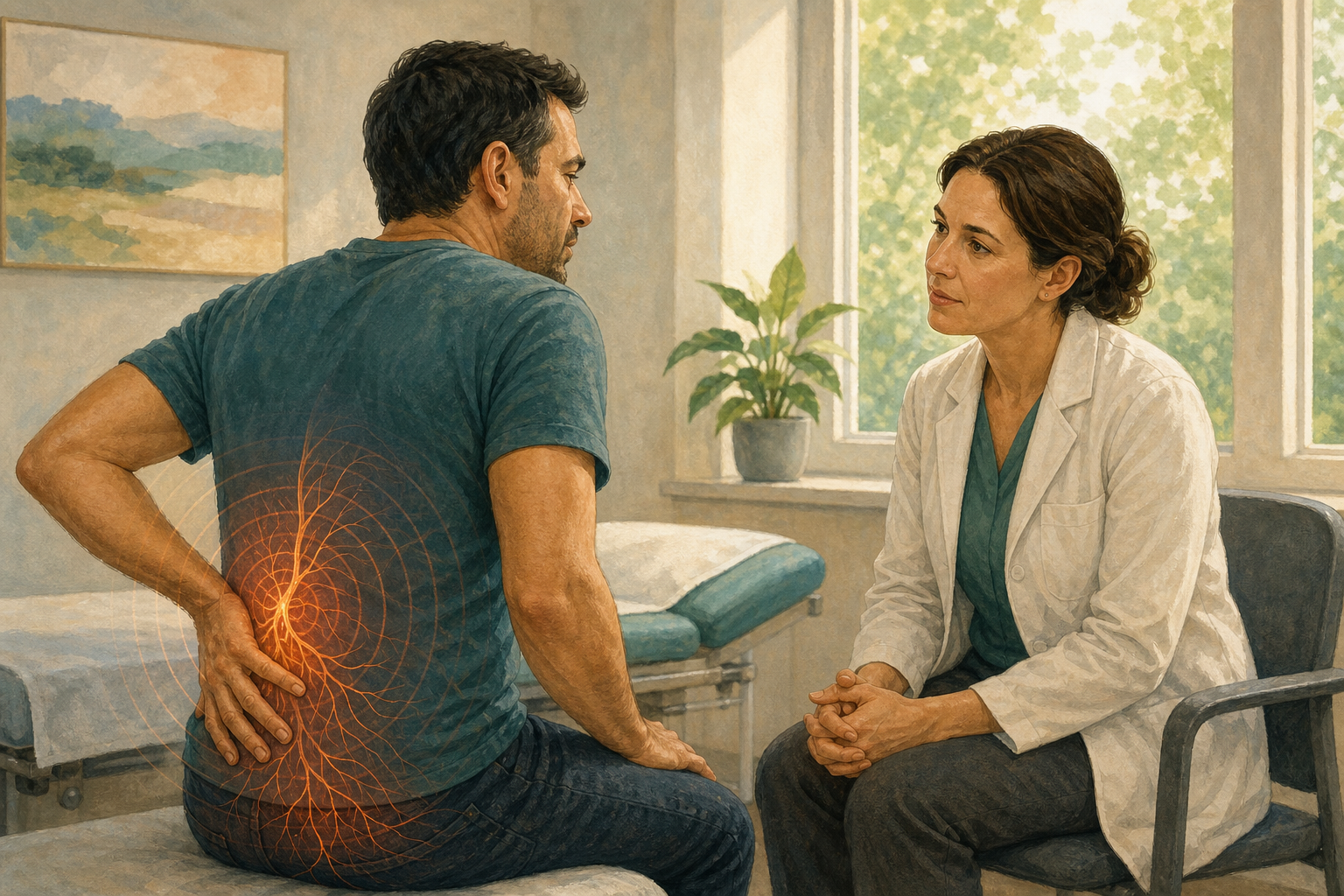
This does not mean that you should explain every symptom as stress. If pain is new, changing quickly, follows an injury, or appears with other concerning symptoms, seek an appropriate medical assessment rather than assuming it is a nervous-system pattern. Established chronic pain also deserves continuing clinical care when it is limiting your function or changing in character. Mind-body practices complement that care; they do not replace diagnosis or treatment.
For pain you already understand medically, begin noticing the protective layer around it. Do you hold your breath when a sensation rises? Brace before a familiar movement? Scan your body repeatedly for evidence that a flare is coming? Interpret every increase as proof that more damage is occurring? These reactions are understandable, but they can keep the alarm active.
Separate two questions whenever you can: "Does this need medical attention?" and "Is fear adding another layer of protection right now?" The first question protects your health. The second opens a path for regulation. You do not have to answer one by denying the other.
Use a repeatable regulation sequence, not a battle with pain
A useful routine should be gentle enough to repeat. Its purpose is not to force the pain down during a single session. It is to give your nervous system regular experiences of attention without panic, breathing without strain, and movement without punishment.
- Choose a supported position. Sit, stand, or lie down in a way that does not demand unnecessary effort. Notice the floor, chair, bed, or wall supporting you. Let your eyes remain open if closing them makes you more vigilant.
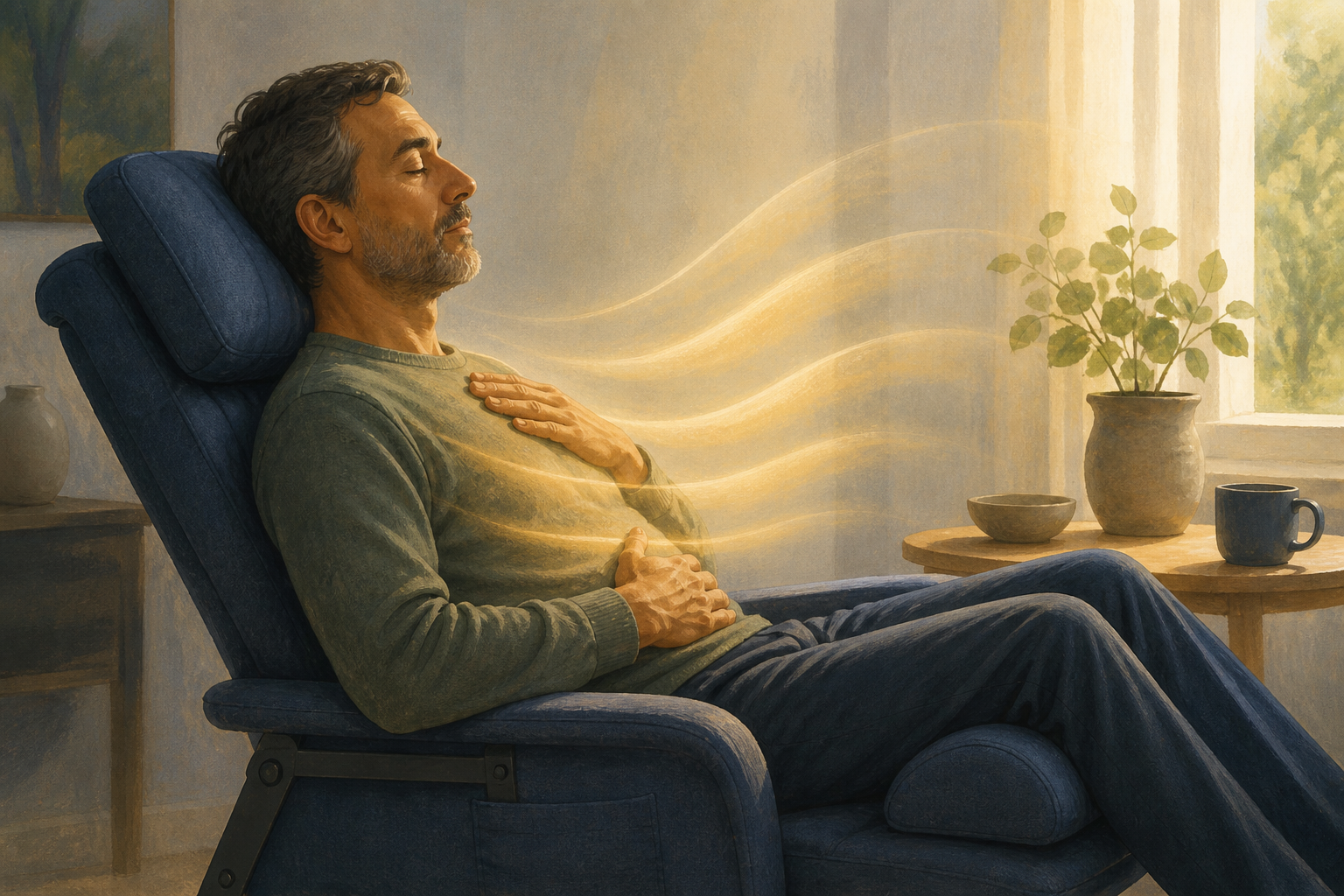
- Allow the breath to become easier. Notice the movement of the abdomen and ribs without trying to take the deepest possible breath. Let the exhale become slow and unforced. An extended exhale or gentle diaphragmatic breathing can provide a cue of relative safety. If deliberate breathing causes strain or dizziness, return to your natural breath.
- Track sensation instead of immediately interpreting it. Choose a tolerable area and describe what is actually present: pressure, warmth, tightness, pulsing, movement, or a clear edge. Notice whether the sensation stays fixed or changes. When the mind predicts catastrophe, label that as a prediction and return to direct sensation.
- Broaden attention. Include a neutral contact point such as your feet on the floor or your back against a chair. Pain may still be present, but it is no longer the only information in awareness.
- Add the smallest comfortable movement. Try a gentle range that feels manageable rather than testing your maximum. Move with curiosity, pause, and notice the response. The aim is to reduce habitual guarding and rebuild confidence, not to prove toughness. Stop and seek professional guidance if movement produces new or concerning symptoms.
- Close deliberately. Notice whether anything changed in your breathing, bracing, fear, or willingness to move. No change in pain intensity does not make the practice a failure. A softer jaw, a resumed breath, or less alarm around the same sensation can also be meaningful.
This sequence combines breath awareness, somatic tracking, mindfulness, and gentle mobility. Keep the elements that leave you steadier. Shorten or modify anything that repeatedly increases distress. Regulation is not achieved by overpowering the body; it grows through tolerable experiences that do not confirm danger.
Judge progress by function as well as pain intensity
A pain score alone can miss important changes. At a consistent interval, ask whether you are noticing tension earlier, recovering from a flare with less panic, moving with less anticipatory fear, or completing an ordinary task with less inner struggle. Also notice whether you can distinguish a sensation from the frightening story attached to it.
These signs do not prove that an underlying condition has resolved. They tell you whether the practice is changing your relationship with protection, fear, and movement. That is a more realistic test of mind-body work than demanding immediate symptom elimination.
Give unspoken emotion a safe and bounded outlet
Some people respond to difficulty by becoming highly capable on the outside. Anger is swallowed, grief is postponed, fear is hidden, and shame is never named. The emotion does not have to be the original cause of pain to affect breathing, muscular tension, fatigue, sleepiness, vigilance, or the effort required to get through a flare.
Expressive journaling can help you organise what has been held internally. Set a clear stopping point before you begin so the exercise has a boundary. Write privately and plainly rather than trying to sound wise or spiritually composed. Useful prompts include:
- What am I forcing myself to push through?
- What do I fear this pain will take from me?
- Which feeling do I judge myself for having?
- What am I angry about but reluctant to admit?
- What grief, need, boundary, or request have I postponed?
- What does my body seem to prepare for, even when the immediate moment is safe?
Do not use the exercise to manufacture a dramatic explanation for your pain. You are not hunting for one hidden memory that will unlock a cure. You are making emotion more nameable and coherent so that suppression does not remain the only available strategy.
End by reorienting to the room, feeling the support beneath you, and returning to an ordinary activity. If writing repeatedly leaves you flooded, detached, or unable to settle, stop the exercise. A qualified mental-health professional, particularly one familiar with chronic pain or trauma, can help you approach difficult material with more support. Emotional honesty should expand your capacity, not overwhelm it.
Let dharmic practice guide the manner of healing
Hindu yogic disciplines, Buddhist mindfulness, Jain dhyana, and Sikh simran arise from distinct traditions and should not be collapsed into one technique. Yet each offers resources for disciplined attention, ethical restraint, steadiness, and a less hostile relationship with experience. Those qualities matter when pain has turned the body into an apparent enemy.
Ahimsa provides a clear test: does your practice reduce unnecessary violence toward yourself? For someone living with chronic pain, self-directed violence may look like punishing movement, contempt for fatigue, forced breathwork, or shame about needing rest and support. It may also appear as total avoidance driven by fear. A gentler approach respects real limits while exploring what remains safely possible.
Mindfulness and dhyana train you to notice sensation without instantly turning it into a verdict about the future. Acceptance here does not mean approving of pain or surrendering the wish for relief. It means recognising what is present accurately enough to choose the next response rather than reacting automatically.
Pranayama can support regulation when the breath remains comfortable and unforced. Simran or another familiar sacred remembrance can steady attention when it is already part of your practice. Neither should be used to silence emotion or prove spiritual advancement. If a devotional or contemplative practice makes you more ashamed of pain, less willing to seek care, or determined to endure harmful intensity, its application needs to change.
Abhyasa, disciplined repetition, is more useful here than heroic effort. Choose a modest practice you can return to: an easy breath, a brief period of non-judgmental observation, a manageable movement, or honest writing with a clear boundary. The discipline lies in returning without turning each session into a test of whether you deserve to heal.
Keep the spiritual and clinical roles clear. Dharmic practice can shape how you meet pain, fear, limitation, and uncertainty. It should not be turned into a promise that every symptom can be meditated away. Seeking medical or psychological help is compatible with compassion, discernment, and responsibility toward the body.
Key takeaways
- Mind-body care does not mean pain is imaginary. It addresses the nervous-system alarm, fear, emotional strain, bracing, and avoidance that may amplify suffering.
- Keep appropriate medical care in place. New, rapidly changing, or concerning pain should not be self-explained as stress or nervous-system sensitivity.
- Use a gentle sequence: find support, ease the breath, observe sensation, broaden attention, introduce manageable movement, and notice the response.
- Measure progress through function, confidence, recovery from alarm, and reduced fear of sensation, not only through immediate pain intensity.
- Give anger, fear, grief, or shame a bounded form through honest writing. Stop and seek support if emotional work becomes destabilising.
- Apply ahimsa and abhyasa directly: use less force, less self-judgment, and more consistent practice.
Choose one practice that feels tolerable and pair it with the care you already receive. Repeat it gently enough that your body does not have to defend itself from the method meant to help it. The next useful step is not a dramatic breakthrough. It is one experience of breath, attention, emotion, or movement that leaves you a little less at war with yourself.


References
