

If a palace guide describes Kopavana as the room where an angry queen went to sulk, you are being given the smallest and least useful interpretation of the custom. The important question is not where a queen expressed anger. It is what the court was expected to do once she withdrew.
That distinction matters when you are deciding whether Kopavana represented women’s agency, royal confinement, or a romantic story attached to old palace rooms. The strongest reading avoids both extremes. Ritualized withdrawal could give an elite royal woman’s refusal political force, but that force depended on her rank, a recognized protocol, and a ruler who could be made to answer.
Begin with the difference between Kopavana and kopa-bhavana

Two related ideas are often collapsed into one. Kopavana evokes a “forest of anger,” while kopa-bhavana identifies the chamber or dwelling associated with anger. The first is an evocative metaphor: anger becomes a thicket through which a person must find a path. The second is architectural: emotion is assigned a secluded place within the palace.
The metaphor and the room illuminate each other, but they are not interchangeable evidence. A literary image does not prove that every royal residence contained a standardized chamber. A room traditionally called a Kop Bhavan does not, by its name alone, establish that one unchanging protocol operated across every region and period.
When you encounter a claim about Kopavana, first identify which of three layers is actually being discussed:
- Narrative memory: a story presents a queen’s withdrawal as an intelligible and consequential act.
- Courtly institution: rulers, attendants, elders, and counselors recognize withdrawal as a signal requiring a response.
- Material space: a palace room, suite, passage, courtyard, or later local tradition is associated with that practice.
Each layer supports a different conclusion. The Ramayana can show that the motif was culturally meaningful. Courtly memory can suggest how an audience understood the act. Architectural remains can show how privacy, access, and movement were organized. None of these, standing alone, proves every detail of the other two.
This simple separation protects you from two common errors. One is treating an epic scene as though it were a palace construction manual. The other is assuming that a secluded chamber in a women’s residential quarter must have been a Kop Bhavan. Sound interpretation begins by naming the kind of evidence before drawing the historical conclusion.
Withdrawal became dissent because the court had to recognize it

Ordinary absence is ambiguous. A person might be resting, ill, occupied, or avoiding company. Ritualized absence is different because everyone who matters knows what it signifies. A queen entering the kopa-bhavana suspended her normal participation in palace life and made that suspension legible to the ruler.
The practice can be understood as a sequence rather than as a dramatic outburst:
- Withdrawal marks a grievance. The queen leaves ordinary interaction and enters a space already associated with displeasure.
- Attendants preserve the signal. Controlled access prevents the moment from dissolving into gossip, interruption, or public spectacle.
- The ruler approaches. Instead of ordering an immediate return, he crosses into the queen’s chosen setting and acknowledges that normal relations have been interrupted.
- The grievance is articulated. Emotion becomes a claim, petition, demand, or appeal to an existing duty.
- The court must answer. Listening may lead to redress, refusal, negotiation, or a reminder of dharma, but the grievance can no longer be treated as invisible.
The political force lies in the connection between the first and fifth steps. Seclusion alone is not agency. A locked door can isolate a woman just as easily as it can protect her voice. Withdrawal becomes dissent only when convention obliges powerful people to notice it, enter the conversation respectfully, and give an answer.
That force depended on at least three conditions. The queen possessed status within the royal household. Her action had a shared meaning that attendants and rulers understood. The palace recognized some duty to respond. Remove any one of those conditions and the same physical act can become mere absence, private distress, or imposed confinement.
This is also why Kopavana should not be presented as evidence that all women in ancient Bharat possessed the same institutional remedy. The surviving image concerns royal women situated inside a hierarchy. It may reveal a significant form of agency within that hierarchy, but it does not erase differences of rank, dependence, or access beyond the palace.
Kaikeyi shows both the power and the danger of the procedure
The best-known example appears in the Ramayana. Kaikeyi withdraws to the kopa-bhavana, and Dasharatha’s approach confirms that her withdrawal has registered. She is not required to compete for attention in an open court. The king comes to her, listens, and encounters her grievance through the language of prior commitments and royal obligation.
Yet the episode does not permit a sentimental conclusion. A recognized right to be heard does not make every demand righteous. A ruler’s duty to listen does not remove his duty to judge according to dharma and rajadharma. Personal promises, family bonds, succession, public responsibility, and moral consequence can still collide after the procedure has worked exactly as intended.
When you read the Kaikeyi episode, keep three questions separate. Was her withdrawal recognized? Was her demand morally justified? Was the king’s response prudent and dharmic? Collapsing these questions turns procedural agency into moral endorsement. Keeping them distinct reveals the deeper lesson: an institution can dignify a person’s voice without guaranteeing that either speaker or listener will choose wisely.
The dharmic achievement, therefore, was not the automatic fulfillment of anger. It was the attempt to discipline anger through maryada: privacy instead of humiliation, approach instead of coercive exposure, and speech instead of immediate retaliation. Ahimsa shaped the method, while dharma still had to govern the outcome.
The chamber managed attention, access, and emotional pace
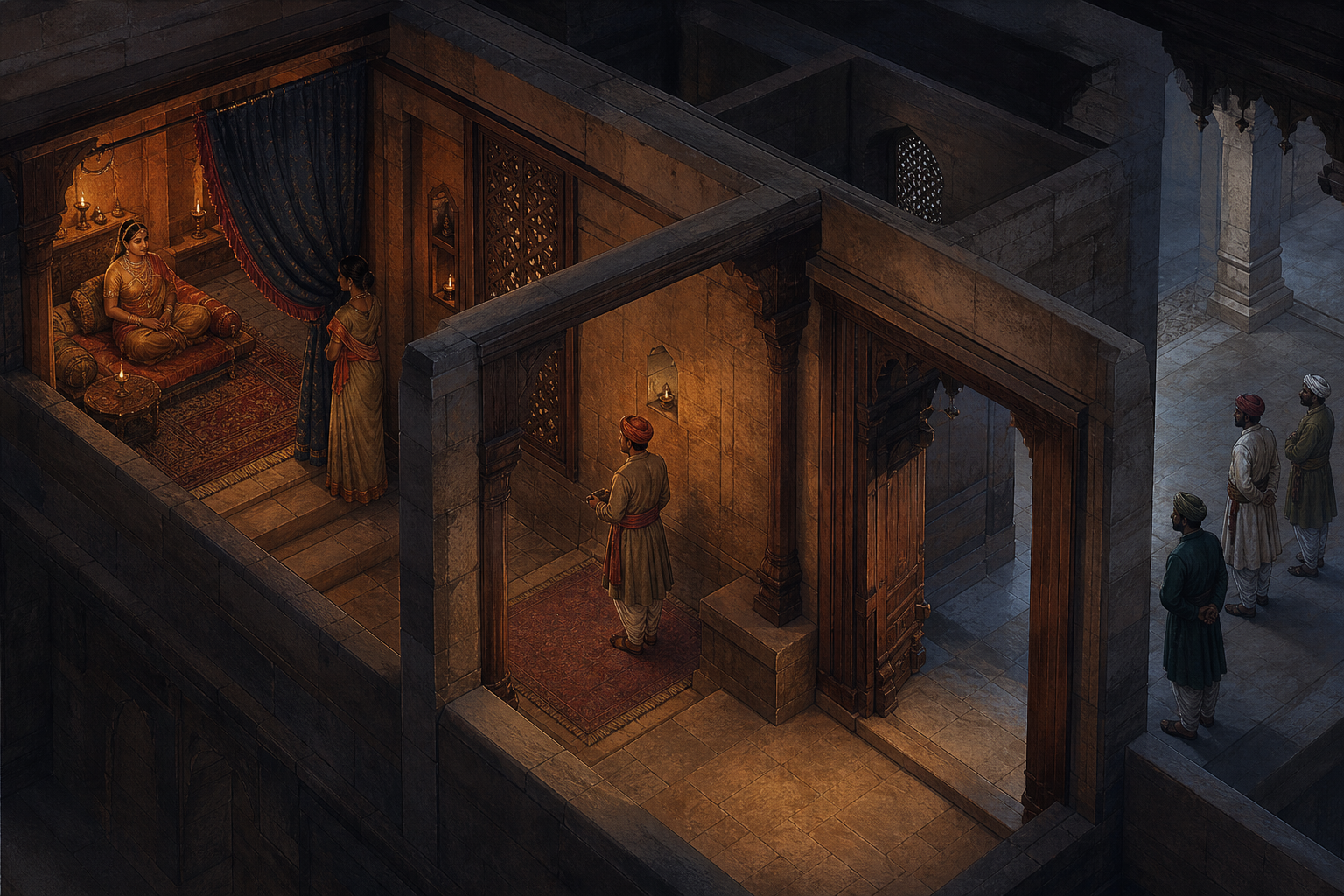
A kopa-bhavana made political sense only in relation to the rest of the palace. It needed sufficient seclusion to interrupt ordinary contact, yet enough proximity to the inner residential quarters for attendants and the ruler to reach it. Its function came from separation with access, not from remoteness alone.
Descriptions and later palace memory associate Kop Bhavan spaces with controlled paths, thresholds, courtyards, subdued light, water, cool stone, and quiet alcoves. These details form a plausible vocabulary of emotional regulation, but they should not be converted into a universal archaeological specification. Many palace spaces could be cool, private, guarded, or dim for reasons unrelated to ritualized dissent.
Use the following functional test when you examine a palace plan, heritage display, or local identification:
| Spatial cue | Possible role in ritualized dissent | What it cannot prove by itself |
|---|---|---|
| Position near the women’s residential quarters | Keeps the queen within her household network while marking separation | That the room was built specifically as a Kop Bhavan |
| Attendant-controlled entrance | Regulates who can approach and protects the gravity of the withdrawal | That access control served a grievance ritual rather than ordinary palace security |
| Passage, threshold, or courtyard | Slows the transition from estrangement to conversation | That movement through the space always followed one fixed ceremony |
| Cool, shaded, subdued interior | May reduce sensory intensity and support composure | That calming design was unique to anger chambers |
| Seclusion combined with royal accessibility | Allows withdrawal to remain visible to the people obliged to respond | That the occupant necessarily controlled the terms of her seclusion |
The threshold is especially important as an interpretive clue. The ruler does not simply summon the queen back into his normal sphere. He must approach the place created by her refusal. That movement can reverse the usual direction of courtly attention: for a limited moment, power goes toward the grievance rather than requiring the grievance to present itself before power.
Architecture still cannot create justice on its own. A beautifully designed chamber could become a place where a woman was ignored. A modest room could carry considerable authority if protocol guaranteed a hearing. The decisive evidence is therefore relational: where the room sits, who controls entry, what action follows withdrawal, and whether the queen returns through negotiation rather than compulsion.
Heritage interpretation should reflect that uncertainty honestly. If only a local name or palace tradition survives, “traditionally identified as a Kop Bhavan” is stronger wording than an unsupported declaration that the room has been conclusively proven. If literary memory, spatial arrangement, vernacular tradition, and architectural investigation converge, the claim becomes more persuasive. Precision does not weaken cultural heritage; it prevents a meaningful tradition from being reduced to a fragile legend.
Carry forward the obligation to listen, not the palace hierarchy

Kopavana is easiest to misunderstand when it is forced into a modern slogan. Calling it proof of complete gender equality romanticizes an elite and limited institution. Calling it an “anger room” where queens sulked strips a legible political act of its protocol. Calling every quiet palace chamber a Kop Bhavan turns symbolism into unsupported archaeology.
The wider Dharmic resonance also needs careful wording. Hindu, Buddhist, Jain, and Sikh traditions all contain ethical languages of restraint, non-harm, compassion, equipoise, and deliberation. Those affinities help explain why disciplined disagreement feels at home within a Dharmic moral frame. They do not prove that every Dharmic court maintained an identical chamber or followed one uniform ritual.
Key takeaways
- Distinguish the metaphorical Kopavana from the architectural kopa-bhavana before evaluating a historical claim.
- Treat withdrawal as political agency only when it is recognizable and creates an obligation for someone in power to respond.
- Separate the right to a hearing from the moral validity of the demand and the wisdom of the final decision.
- Do not generalize from royal women to all women, or from one narrative and later palace memory to every court in Bharat.
- When assessing a claimed Kop Bhavan, look for converging evidence in terminology, spatial relationships, local memory, access patterns, and the protocol attached to the room.
Borrow the structure of the pause
The most useful modern parallel is not a dedicated “anger room.” It is a protected pause that guarantees a return to dialogue. Without that guarantee, asking an upset person to step away can become a polite method of silencing them. Without a pause, however, a dispute can become a contest of speed, volume, and public embarrassment.
If you want to adapt the underlying principle in a family, temple committee, community organization, or workplace, make five parts explicit:
- Name the pause. Say that the conversation is being suspended because the grievance matters and the present conditions are not helping.
- Set a return point. Agree on when or under what condition the discussion will resume. An indefinite withdrawal is avoidance, not a process.
- Protect dignity. Keep the dispute away from spectators who have no role in resolving it, while ensuring that privacy does not become isolation.
- Listen before deciding. The person receiving the grievance should be able to restate it accurately before defending, refusing, or negotiating.
- Separate recognition from agreement. Acknowledge the grievance, then state the decision, the dharmic or institutional reason for it, and any commitment that follows.
This is where the old palace image remains demanding. It asks more of the powerful party than merely allowing anger to exist somewhere out of sight. It requires attention to travel toward the person who has withdrawn and requires the encounter to end with an accountable response.
The next time you encounter a Kop Bhavan, do not stop at the room’s label. Ask who could enter, who had to approach, what duties were activated, and how the occupant returned. In your own institutions, imitate neither the chamber nor the hierarchy. Build the obligation that gave the withdrawal meaning: a recognized pause must lead back to a respectful hearing, a clear answer, and a next step for which someone is responsible.
References
