

If you know Shiva mainly as the formidable ascetic or the power associated with destruction, Bengal’s affection for Bholebaba can seem puzzling. Why does a land so deeply shaped by Kali approach Mahadeva as a serene, forgiving and remarkably accessible presence?
There is no contradiction to resolve. Bholebaba is Bengal’s way of foregrounding the Shiva whom an imperfect person can approach without status, display or fear of rejection. Once you recognize that devotional emphasis, the pairing of Kali and Shiva, the simplicity of Bengali offerings and the practical ethics behind the worship all become easier to understand.
Bholebaba names a relationship, not a different Shiva
Bholebaba means the simple-hearted one. The name draws attention to Shiva’s innocence, openness and readiness to receive the devotee. It does not suggest that Mahadeva is weak, naive or detached from his more formidable dimensions. Bengal is emphasizing one way of meeting the same Shiva: as the divine presence before whom you do not have to pretend that you have never failed.
The affectionate word baba matters as much as bhola. A remote cosmic principle becomes someone to whom grief, error and hope can be brought directly. In Bengali devotional life, many worshippers trust that Bholebaba listens without condemning human frailty. That confidence makes the relationship intimate without making it casual.
You can read this image through three connected lenses:
- Theological: Shiva’s compassion and steadiness are brought to the foreground. His ascetic and fierce dimensions have not been denied; they are simply not the devotee’s first point of approach.
- Devotional: A mistake does not have to become an excuse for hiding from the divine. The appropriate response is honest return, not spiritual performance.
- Ethical: If you ask to be received with patience, the worship places a corresponding demand on you. You must become less eager to humiliate, dismiss or permanently define another person by one failure.
This last point keeps Bholebaba devotion from collapsing into vague reassurance. Forgiveness is not permission to repeat harm without correction. The spiritually useful sequence is acknowledgment, return and better conduct. When you encounter a Bengali image or shrine of gentle Shiva, notice the disposition it invites from the worshipper: candour instead of self-display, humility instead of defensiveness, and correction instead of despair.
Kali’s power and Shiva’s serenity complete the picture

Bengal’s Shakta inheritance does not push Shiva to the margins. Kalighat, Tarapith and the wider devotion to Kali provide the setting in which Bholebaba’s tranquillity becomes especially meaningful. Kali represents transformative power and fierce protection; Shiva offers repose, stability and unconditional availability. The contrast is complementary rather than competitive.
| Devotional emphasis | What it helps you recognize | The question it puts before you |
|---|---|---|
| Kali’s transformative power | Some conditions cannot remain as they are | What must be confronted or changed? |
| Kali’s fierce protection | Compassion may require courage and decisive boundaries | What deserves protection? |
| Bholebaba’s serenity | Change needs an inner ground that is not ruled by panic | Where must you become steady? |
| Bholebaba’s acceptance | An honest return remains possible after failure | What should you admit and repair? |
Do not turn this relationship into a rigid formula in which Kali possesses only fierceness and Shiva only gentleness. These are devotional emphases, not exhaustive definitions of either deity. Their value lies in helping the worshipper hold together truths that are often separated: strength without cruelty, acceptance without passivity, transformation without inner chaos, and stillness without indifference.
This gives you a practical way to read Bengali sacred imagery. Instead of asking which deity is more important, ask what kind of balance the pairing establishes. If you invoke protection but never examine anger, the balance is missing. If you invoke forgiveness but refuse necessary change, the balance is also missing. Kali and Bholebaba together prevent both distortions.
Simple offerings make access central to the worship

In Bengali homes, villages and riverside shrines, Shiva may be approached with bilva leaves, a handful of rice and Ganga jal. Their modesty carries a clear devotional message: Bholebaba is not won by expense or social display. A person with little can still come before him with dignity.
That is why simplicity here should not be confused with incompleteness. The offering is sufficient because sincerity, gratitude and remembrance are central. Adding more objects does not automatically deepen the encounter. When ritual becomes a competition in quantity, ornament or cost, it obscures the very quality expressed by the name Bholebaba.
At the same time, simplicity is not carelessness. Family customs, temple procedures and inherited forms should be treated with respect. If you are participating in a tradition that is new to you, ask the household elder or temple responsible for the practice what is customary. Do not present a personal improvisation as the universal Bengali method.
If anxiety about performing the worship correctly is distracting you, use this sequence:
- Begin with the living custom available to you. Follow the practice of your family or temple rather than assembling an elaborate rite from disconnected instructions.
- Keep the material offering proportionate. Bilva leaves, rice or Ganga jal illustrate the principle that devotion need not depend on wealth. Use what your established practice calls for without turning abundance into a measure of worthiness.
- Name the inner offering. Choose one form of pride, resentment or needless complexity that you are prepared to relinquish. This is personal reflection, not a replacement for the ritual.
- Connect worship to one repair. If you are seeking forgiveness, correct something within your power: admit an error, soften an unnecessarily harsh response or complete a neglected responsibility.
The fourth step is where the meaning becomes visible. A simple ritual followed by more patient conduct expresses Bholebaba more faithfully than an impressive offering followed by contempt. Accessibility before the deity should also make you less willing to create needless barriers of status around devotional life.
Let remembrance mature into steadiness and service
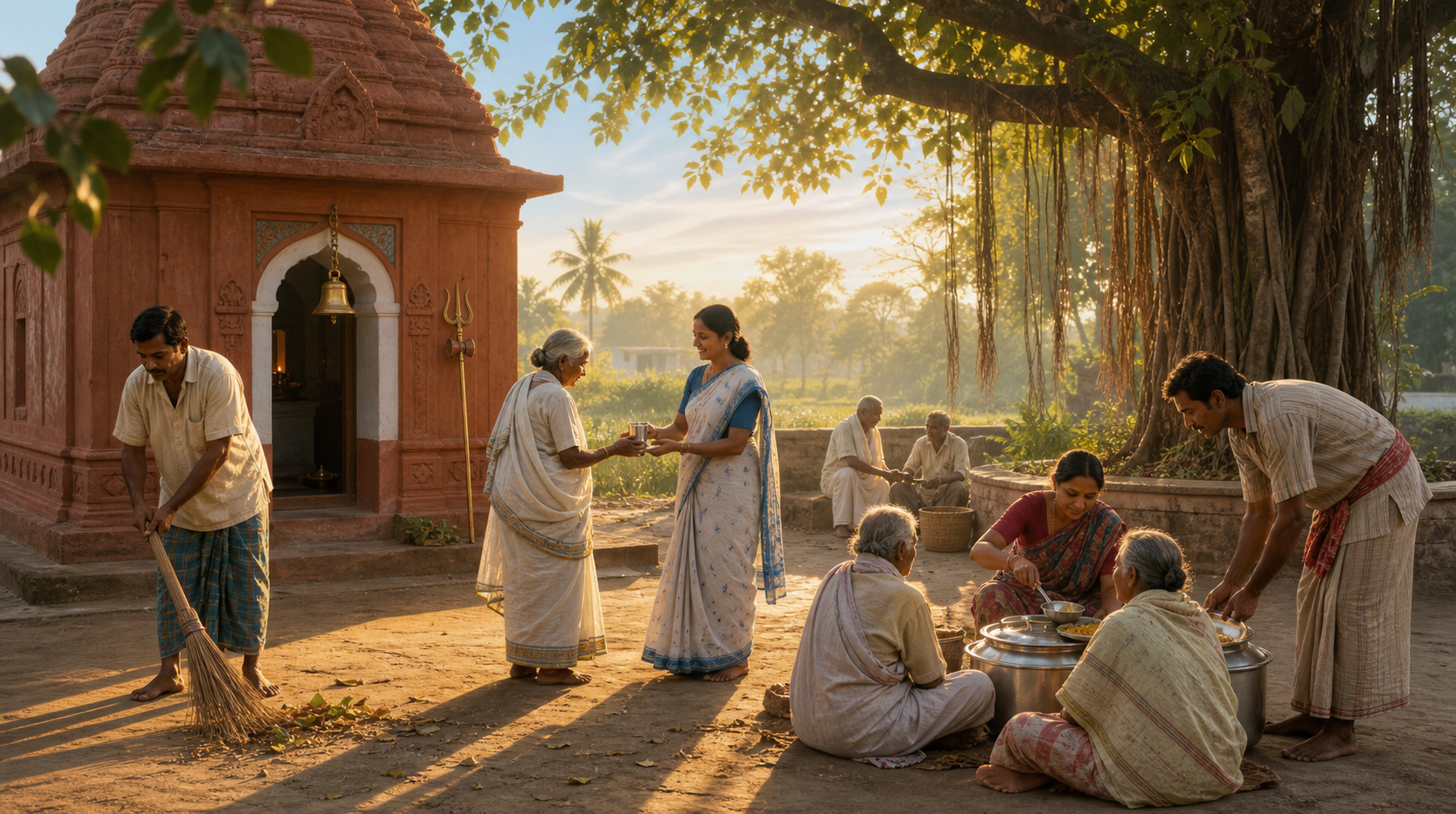
Maha Shivaratri gives Bengal’s serene vision of Shiva a concentrated form through night vigil, japa and simple offerings. The external acts direct attention toward restraint and inner stillness. Weekly observances and seasonal vratas can then keep that orientation from being limited to one festival.
You do not need to make every observance equally elaborate. A sustainable devotional rhythm has several levels:
- On Maha Shivaratri: let vigil, japa and offering interrupt ordinary distraction. Pay attention to what surfaces when noise and routine recede.
- During the year: maintain the weekly or seasonal observance recognized by your family or temple. Regularity trains remembrance more effectively than occasional display.
- Under pressure: recall Bholebaba before answering in anger or judging another person’s mistake. A short pause is where serenity becomes conduct.
- After worship: choose a concrete expression of daya or service. Helpfulness, patience and responsible action are tests of whether devotion has moved beyond mood.
The values associated with Bholebaba also create a careful point of contact across Dharmic traditions. Shiva’s compassion can resonate with Buddhist karuna, Jain ahimsa and Sikh daya. The traditions remain distinct, and their teachings should not be flattened into a claim that they are interchangeable. The useful connection is ethical: each gives serious weight to restraint, compassion and responsibility toward life.
When speaking across these traditions, begin there. Ask how compassion is disciplined, how non-violence shapes conduct, and how forgiveness can coexist with responsibility. That produces a more honest Dharmic conversation than insisting that every vocabulary means exactly the same thing.
Key takeaways
- Bholebaba is not a separate or diminished Shiva. The name foregrounds Mahadeva’s simple-hearted compassion and accessibility.
- Bengal’s devotion to Kali does not compete with devotion to Shiva. Fierce protection and serene acceptance form a complementary spiritual balance.
- Bilva leaves, rice and Ganga jal express the principle that sincere worship does not depend on wealth or spectacle.
- Simple worship should still respect the living customs of a family or temple; accessibility is not a license to dismiss tradition.
- Forgiveness becomes spiritually serious when it leads to acknowledgment, correction and more patient treatment of others.
- Bholebaba’s compassion can support respectful dialogue with Buddhist, Jain and Sikh ethical traditions without erasing their differences.
The next time you stand before Shiva in a Bengali home or shrine, do not ask whether gentleness makes the image incomplete. Ask what Bholebaba is asking you to simplify, admit, forgive or repair. Keep the offering sincere, follow the living custom before you, and leave with one concrete act that makes another person’s path less burdened.
References
