
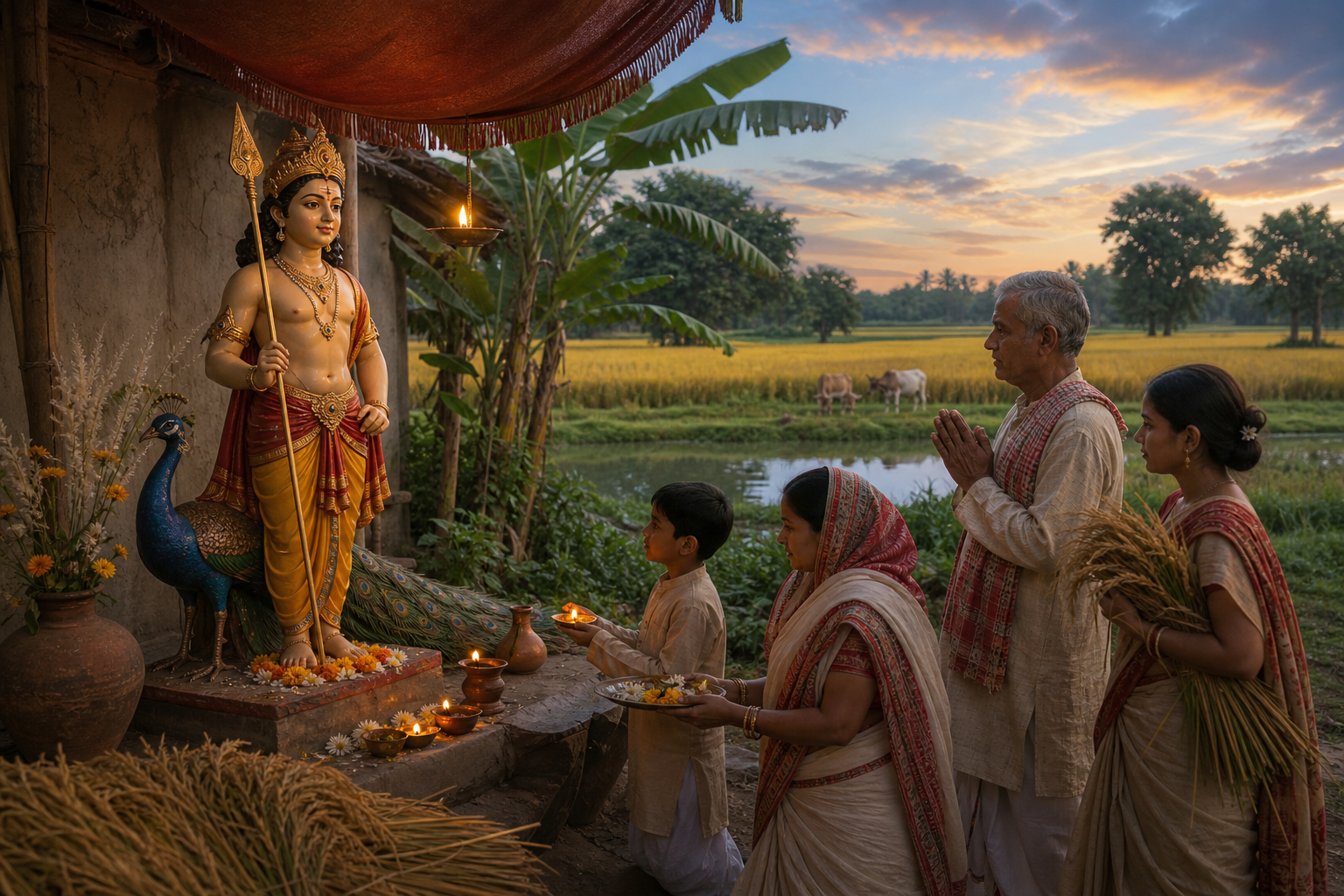
Perhaps you know Kartikeya as Murugan, the spear-bearing commander of the devas. Bengal can then present a puzzle: why is this martial deity invoked for ripening rice, children, marriage, livestock, and household well-being? Bengal has not forgotten Skanda’s power. It has read that power through the needs of the farm and the family.
Read Bengali Kartik as a sequence rather than an isolated puja. The sequence begins while aman paddy is still ripening, passes through lamps, bathing observances, household vows, and community worship, and approaches the gratitude of Nabanna. Once you see that movement, Kartik’s agrarian identity becomes coherent: protection comes before abundance can be received and shared.
Read the calendar before you read the ritual
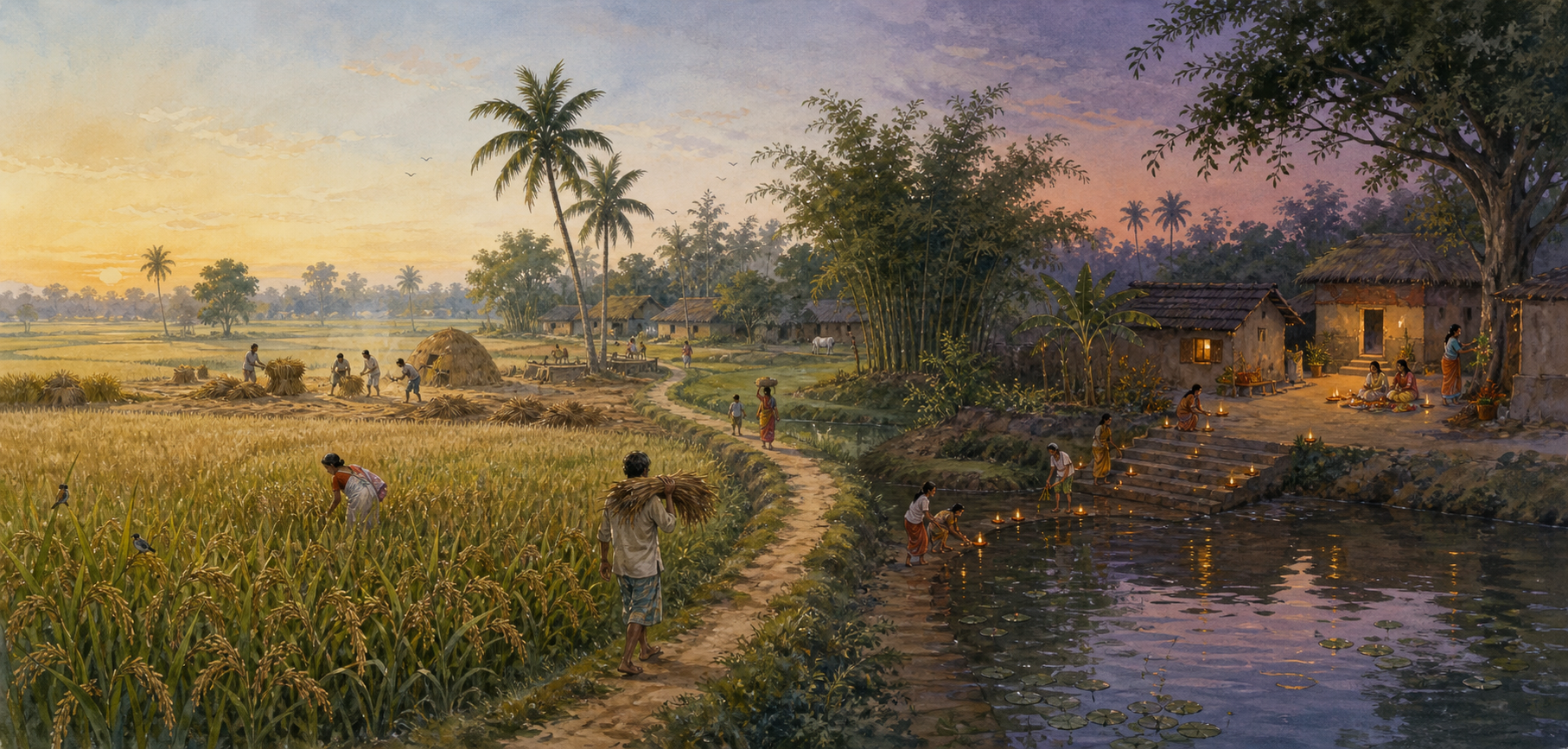
Kartik is a season of expectation, not simply a celebration after the work is over. The Bengali month arrives with cooler skies while aman paddy is in its late-ripening stage. Nabanna, the thanksgiving associated with the new harvest, follows in Agrahayan. The order matters.
A crop that is ripening represents visible promise, but not yet completed abundance. Kartik worship therefore belongs to a threshold. It gives religious form to patience, vigilance, and dependence on forces no household controls by itself: soil, water, livestock, weather, labor, and the continuing strength of the family.
| Seasonal marker | What you should notice | Dharmic meaning |
|---|---|---|
| Bengali month of Kartik | Cooler skies and late-ripening aman paddy | Guard what is growing but not yet complete |
| Kartika Purnima | Kartik Snan, lamps, riverbanks, and shared observance | Place household prayer within a larger community and ecology |
| Agrahayan and Nabanna | Gratitude for the new harvest and shared food | Receive abundance responsibly rather than treating it as private possession |
This is why calling Kartik Puja merely a harvest festival misses its distinctive position. It stands between cultivation and thanksgiving. Its emotional register is protective because the cycle has not yet reached completion. If you are explaining the observance to someone unfamiliar with Bengal, begin with that timing rather than with a list of offerings.
If you are planning an observance, consult the local Bengali calendar and your household or temple tradition. Do not force the festival into a fixed modern date from memory. The agricultural meaning rests on its place within the seasonal sequence.
The celestial commander has not disappeared

Kartik is known across Hindu traditions as Kartikeya, Skanda, Murugan, and Subrahmanya. In strength-centered traditions he is Deva Senapati, commander of the celestial forces. In Bengal, the same protective potency is directed toward the vulnerabilities of domestic and agrarian life.
That is a change of emphasis, not a contradiction. A commander protects an ordered realm. For a cultivating household, that realm includes the field, the animals that support livelihood, the children through whom the family continues, and the relationships that hold labor and care together. Bengal brings these dependencies into the foreground.
Do not pretend that Kartik’s spear stops being a spear. Instead, notice how its meaning expands. The vel can be read as a sign of protection and auspicious continuity, while the peacock, youthful form, and martial inheritance keep Bengali Kartik connected to the wider Kartikeya tradition.
When you encounter a Bengali image of Kartik, use three questions to read it carefully:
- What remains constant? Look for the youthful deity, peacock emblem, spear, and protective power associated with Kartikeya.
- What receives local emphasis? Look for prayers concerning crops, livestock, children, marriage, prosperity, and household continuity.
- What kind of victory is being sought? In this setting, success is measured less by conquest than by a harvest reaching maturity, a household remaining whole, and prosperity becoming shareable.
This way of looking also prevents a common mistake: treating Murugan in Tamil Nadu as the complete or original form and Bengali Kartik as a weakened domestic version. Regional traditions do not need to erase one another to be valid. The heroic commander and the agrarian guardian disclose different applications of the same divine power.
Field, household, and neighborhood form one sacred economy
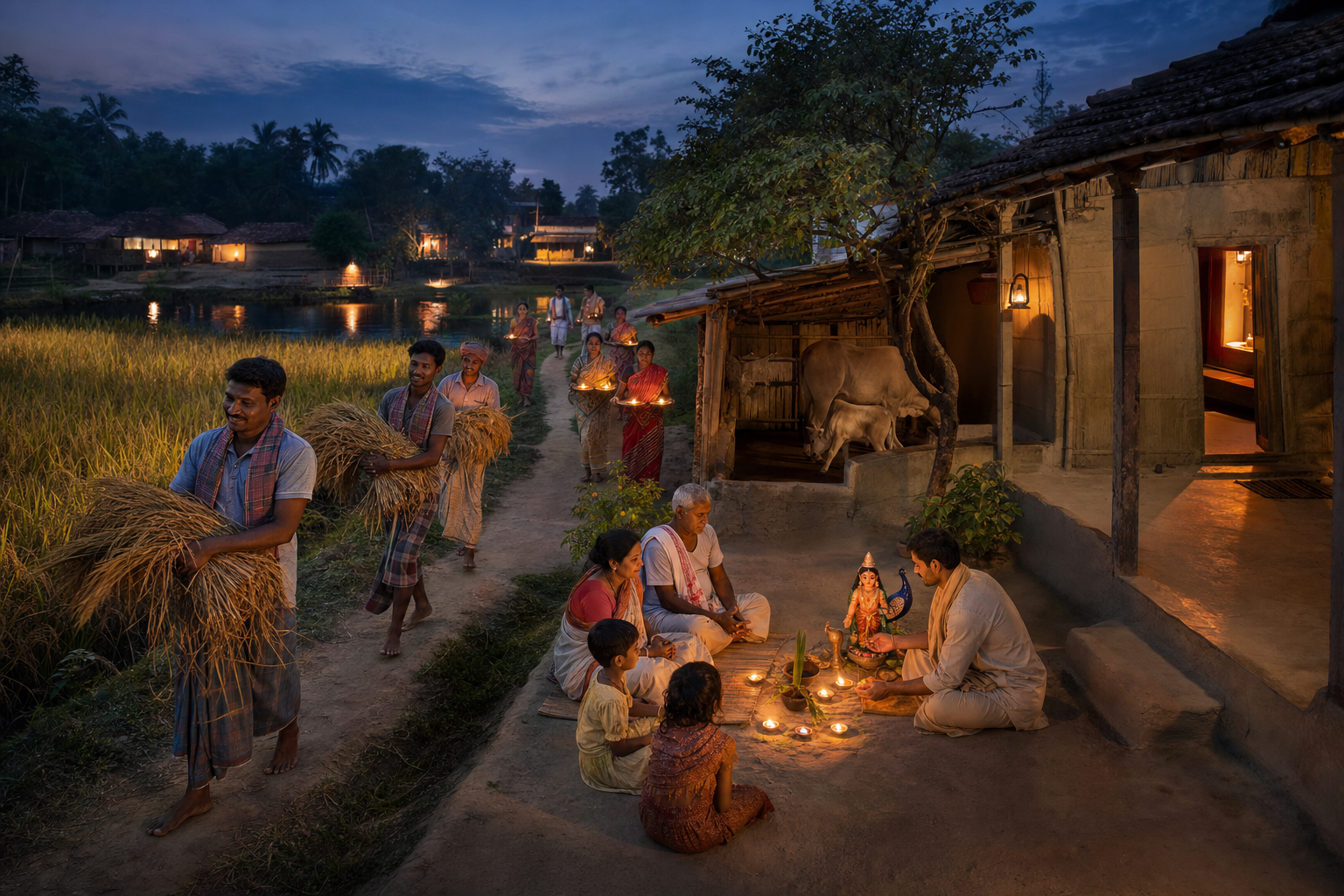
Kartik worship becomes easier to understand when you stop separating agriculture from domestic religion. In an agrarian society, the field, household, artisan quarter, water body, and neighborhood are not independent worlds. Each carries part of the harvest.
The field teaches patience before possession
Prayers for soil fertility, field prosperity, and livestock vitality acknowledge that cultivation is a network of living dependencies. Ritual does not replace agricultural knowledge or labor. It disciplines the cultivator’s relationship to the result: work diligently, protect what sustains the crop, and do not behave as though an unfinished harvest is already yours.
You can recover this meaning even if your family no longer farms. Identify the grain at the center of the season and learn where the rice in your household comes from. When children participate, explain that Kartik is worshipped while the crop is still becoming food. That one distinction connects the lamp in the home to the labor in the field more effectively than a generic statement about prosperity.
The household turns fertility into continuity
Fertility in this tradition is broader than a single request for material wealth. Household vrata observances emphasize child welfare, harmonious marriage, and field prosperity. These concerns belong together because land cannot be cultivated across generations without care, cooperation, health, and the transmission of responsibility.
Before a household observance, make the intention concrete. Ask what needs protection at this point in the family cycle. It may be a ripening crop, the well-being of children, the steadiness of a marriage, the humane care of animals, or the responsible use of food. Naming the responsibility keeps the prayer from collapsing into a vague demand for more.
Shared meals complete part of this logic. Food moves from field to kitchen and then from one person to another. A household demonstrates prosperity not merely by possessing grain, but by feeding kin, guests, and people in need. The movement from prayer to sharing is therefore internal to the agrarian meaning of Kartik worship.
The neighborhood carries worship beyond the home
Seasonal devotion also supports the people whose livelihoods follow the festival calendar. Small clay images made by artisans, including craftspeople in Kumartuli, embody inherited knowledge as well as sacred form. When practical, obtaining an image from a local artisan and learning who made it turns a purchase into an act of cultural continuity.
Riverbank lamps and Kartik Snan on Kartika Purnima bring worship into a shared ecological space. The religious act becomes incoherent if the water is honored during the ritual and left burdened with plastic or discarded materials afterward. Follow local rules, use materials accepted by the community, remove what should not remain in the water, and take part in a cleaning effort where one is organized.
Post-harvest charity carries the same principle into social life. The community that helped sustain cultivation has a claim on its abundance. Support for artisans, care for water bodies, shared food, and charity are not interchangeable with puja, but each can express the duty awakened by puja.
How to honor Bengali Kartik without inventing a generic ritual
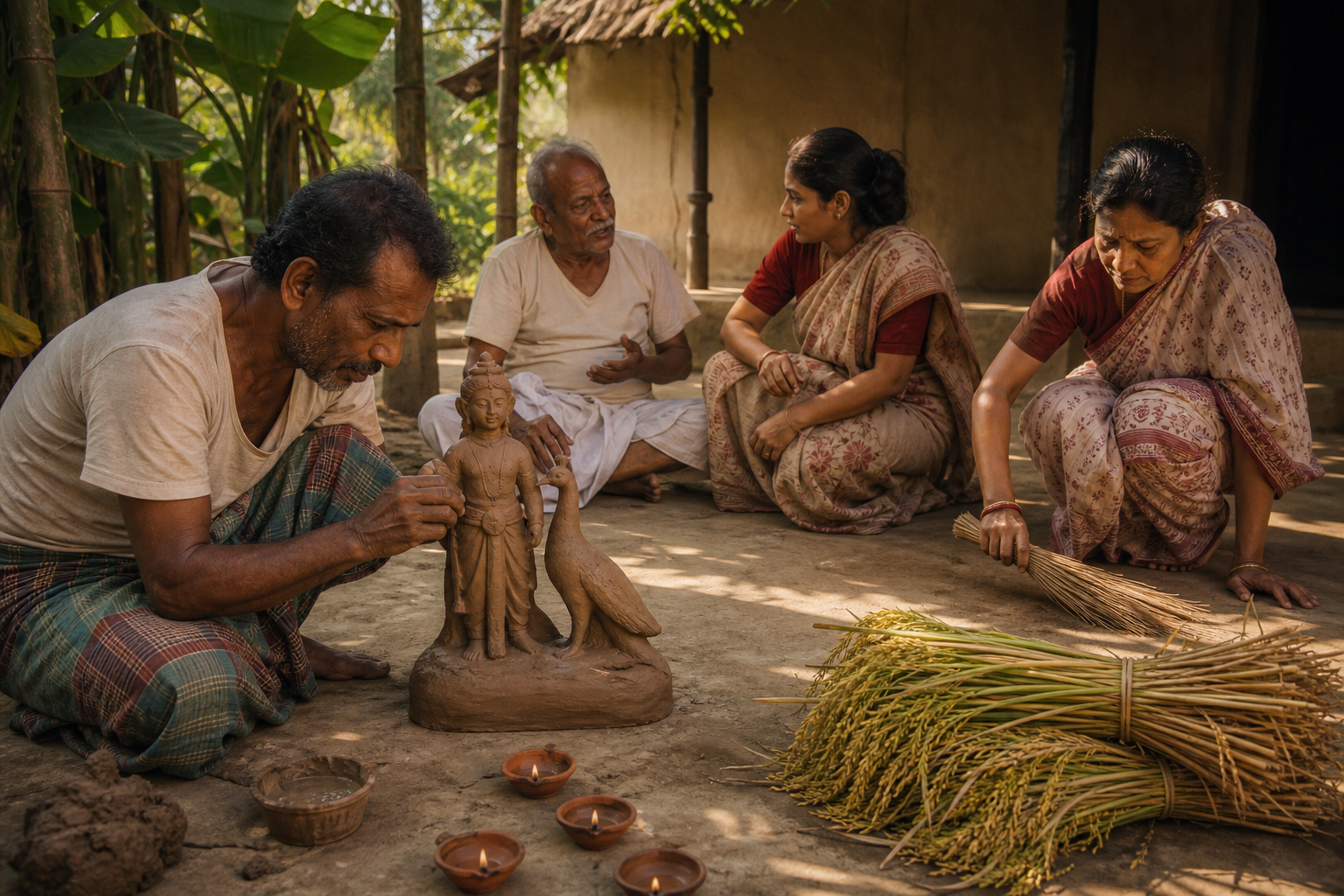
Respectful participation begins with a simple restraint: do not standardize a living regional tradition merely because several names of the deity are familiar. A Murugan practice from Tamil Nadu can illuminate Kartikeya’s wider identity, but it does not automatically supply the procedure for a Bengali household vrata or neighborhood Kartik Puja.
- Start with the inherited form. Ask older relatives, a local priest, or the neighborhood puja committee which practices belong to that household or locality. Record the names, sequence, and purpose before adding anything.
- Place the observance in the agrarian sequence. Note the late ripening of aman paddy, the place of Kartika Purnima, and the approach of Nabanna in Agrahayan. This prevents Kartik Puja from becoming a detached annual event.
- Use recognized practices selectively. Lamps, Kartik Snan, a clay image, a vrata, offerings, and a shared meal all appear within Bengal’s seasonal religious life, but a particular family need not perform every form. Follow the practice actually transmitted in your setting.
- Pair blessing with one defined duty. Support a local image-maker, help care for a water body, reduce avoidable food waste, share a meal, or set aside part of the season’s abundance for charity. Choose something you can complete rather than making a ceremonial promise with no follow-through.
- Explain the symbolism accurately. Tell younger participants that Bengali Kartik is the same Kartikeya known as Skanda, Murugan, or Subrahmanya, with protection expressed through the needs of Bengal’s farms and families.
- Preserve family memory. Note who traditionally keeps the vrata, where the image is obtained, what welfare is prayed for, and how the household connects Kartik to Nabanna. Even a short record can keep the next generation from inheriting only the outer form.
A wider Dharmic comparison can deepen this understanding if you preserve real distinctions. The Buddhist Kathina season around Kattika, the Jain commitment to ahimsa in livelihood, and the Sikh celebration of agrarian labor through Vaisakhi are not versions of Kartik Puja. They have their own teachings and ritual histories. The meaningful parallel lies in an ethical pattern: sustenance calls for restraint, gratitude, community labor, and responsibility toward life.
Use that comparison to notice civilizational kinship, not to claim that every Dharmic community performs the same festival. Unity becomes more credible when difference is allowed to remain visible.
Key takeaways for reading or planning the observance
- Describe Kartik Puja as a threshold before harvest thanksgiving, not merely as a harvest festival.
- Read the spear, peacock, and youthful form as continuities with the wider Kartikeya tradition.
- Understand fertility as the continuity of soil, crops, livestock, household relationships, children, and community life.
- Follow the practice of the household or locality instead of assembling a composite ritual from unrelated regional traditions.
- Let devotion produce a specific responsibility: care for water, respect for food, support for artisans, or sharing with others.
- Draw parallels with Buddhist, Jain, and Sikh agrarian ethics without presenting distinct observances as identical.
When Kartik next arrives, begin before the lamp is lit. Look at the crop’s place in the season, ask how your family or locality has observed the puja, learn who shaped the image, and decide what part of the resulting abundance will be shared. Kartikeya’s protective power then has clear work to do: guard continuity until ripening becomes gratitude.
References
