
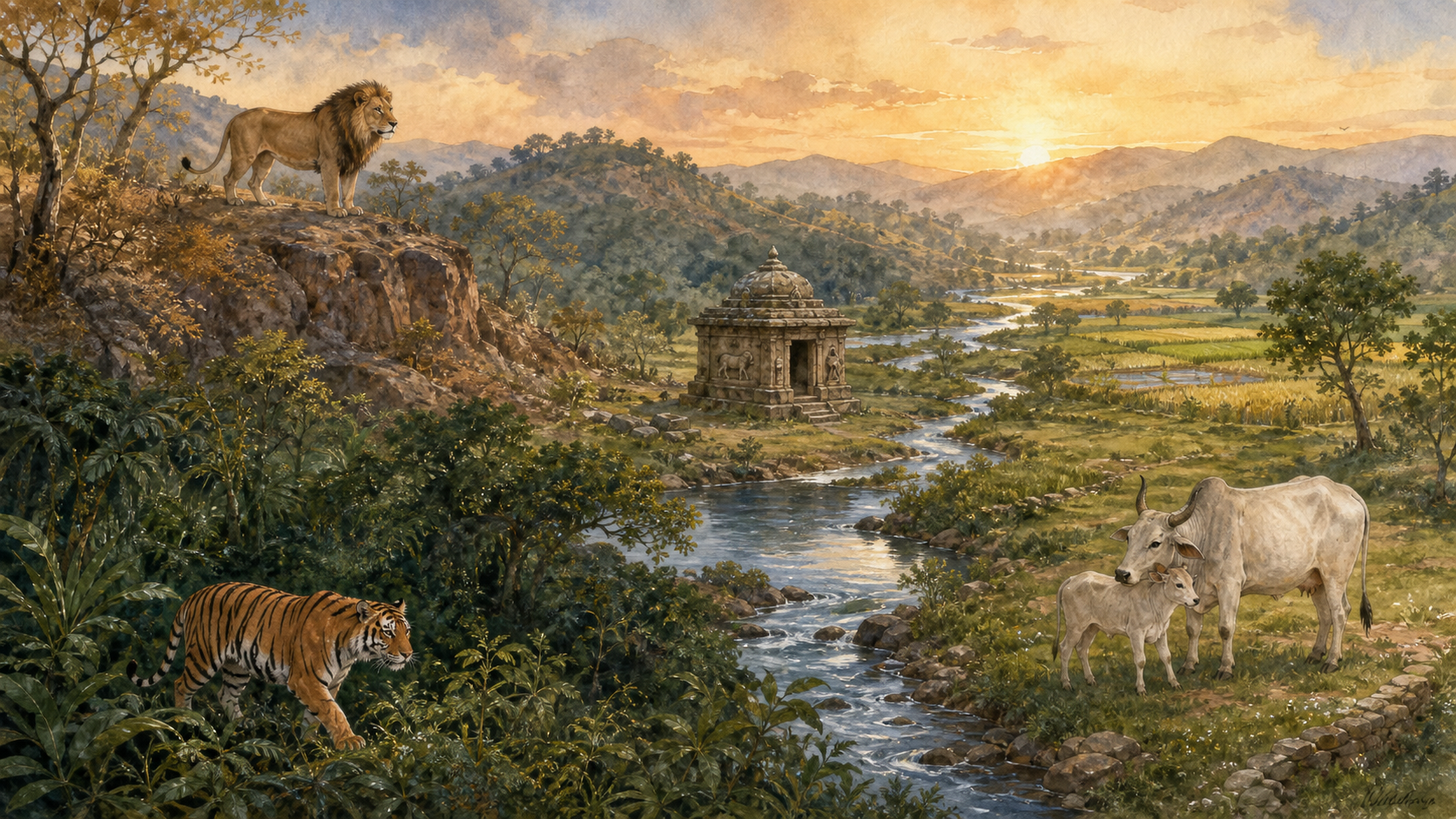
When you stand before Narasimha, Durga, or Shiva, it is easy to read the animal imagery as a code: lion means strength, tiger means power. That reading is not wrong, but it stops too soon. The more useful question is what kind of conduct that strength demands from you.
Dharmic animal symbolism works at three levels at once. It shapes inner discipline, defines a moral relationship with other living beings, and points toward practical care for land, habitat, and shared resources. Keep those levels together, and a sacred animal becomes more than an emblem. It becomes a test of how you live.
Start with the relationship, not a one-word meaning
A lion can represent sovereignty, but Dharmic imagery immediately asks what governs that sovereignty. A tiger can evoke untamed vigor, but the image also asks whether vigor has been disciplined. A cow may be revered, but reverence must be visible in the animal’s treatment and in the responsible use of the resources connected with it.
The relationship between deity and animal supplies the part that a one-word definition misses. Narasimha embodies a union of human and leonine form. Durga sits steadily upon a lion or tiger. Shiva is associated with a tiger skin. These are not interchangeable arrangements. One presents righteous force appearing in an extraordinary form; another shows active divine power governing formidable energy; the third directs attention toward transcendence of instinctual drives. Across them, raw force is neither denied nor allowed to rule by itself.
Use four questions whenever you encounter an animal in a temple image, sacred narrative, festival, or family shrine:
- What capacity does the animal make visible: courage, alertness, sovereignty, restraint, service, or something else?
- Who or what is that capacity meant to protect?
- What keeps the capacity from turning into appetite, vanity, cruelty, or domination?
- What obligation follows toward the living animal, its habitat, or the material resources associated with it?
The fourth question prevents symbolism from becoming decorative. You cannot coherently praise the tiger as a bearer of sacred meaning while treating the survival of actual tigers and their habitats as somebody else’s concern. Nor can ritual reverence for the cow excuse neglect, cruelty, unsafe handling, or waste. Sacred status increases responsibility; it does not cancel it.
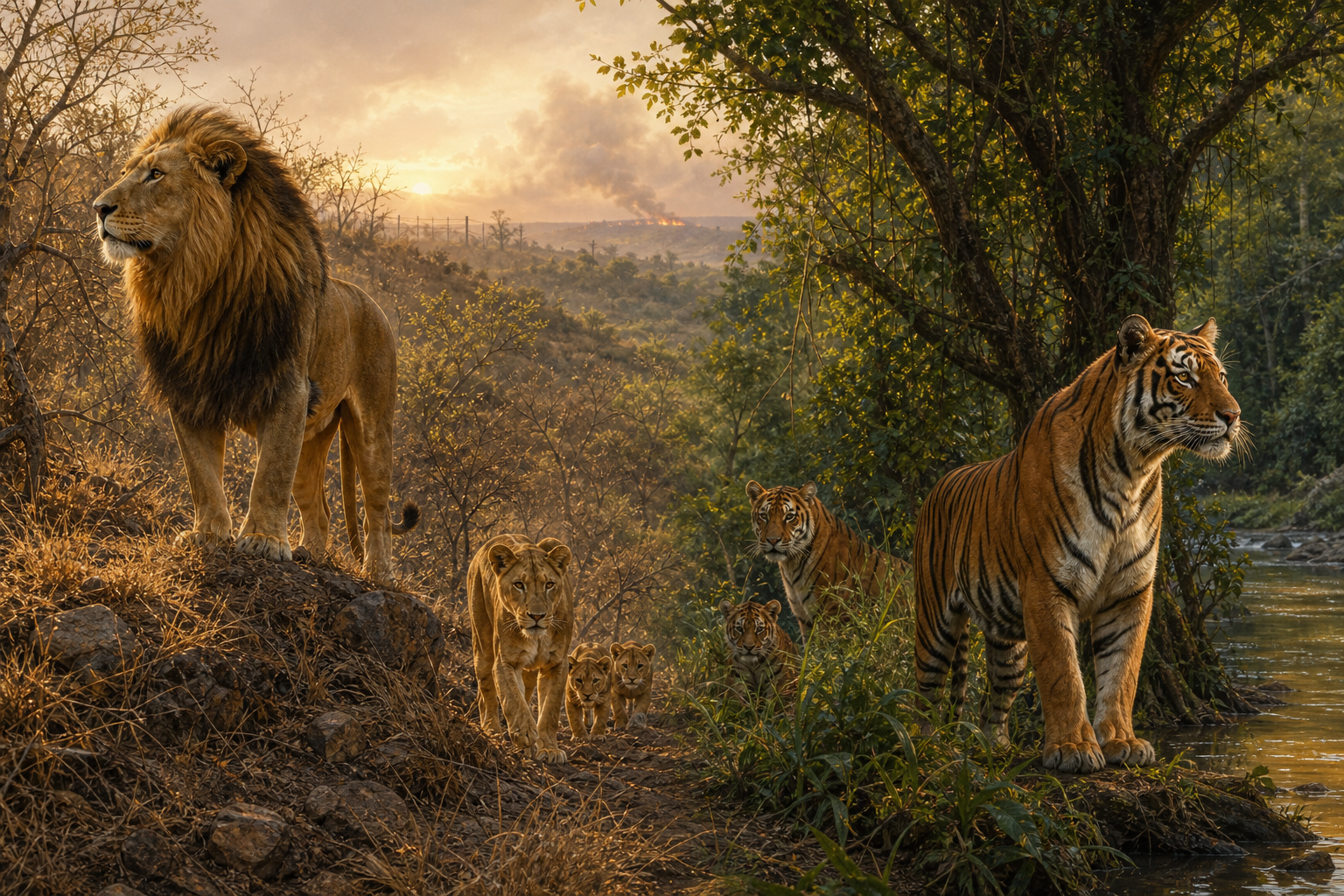
Lions and tigers teach force without the worship of violence
Narasimha’s ferocity has a definite moral direction. The man-lion manifestation of Vishnu protects Prahlada, confronts adharma, and restores order. The point is not rage for its own sake. It is power placed in the service of protection and dharma.
Durga’s lion or tiger develops the lesson differently. Shakti does not flee from primal power, but neither is she thrown about by it. Her steady seat communicates command without panic. Shiva’s tiger skin likewise directs the devotee beyond enslavement to instinct. Alertness, vigor, and tejas remain present, yet they are brought under contemplative and ethical discipline.
This distinction matters whenever you are tempted to call an angry reaction courageous. Intensity alone does not make an action Dharmic. Before you invoke the lion or tiger to justify a hard decision, apply four tests:
- Name what is being protected. A vulnerable person, a legitimate boundary, truth, justice, or ecological balance is clearer than a general desire to win.
- Name the restraint. Decide what you will not do even if anger urges you toward it. Power without a boundary is appetite, not mastery.
- Separate restoration from humiliation. The Dharmic aim is to stop harm and re-establish order, not to prolong conflict for the pleasure of defeating someone.
- Apply the standard inwardly. If you demand discipline from an opponent but exempt your own speech, conduct, or community, the symbol has become a costume.
This is why the predator image can reassure a devotee without glorifying indiscriminate aggression. It says that fear need not command you and that force may sometimes be necessary, but it also insists that force answer to wisdom, compassion, and a defined moral purpose.
The lion reveals a shared Dharmic grammar without erasing differences
The lion travels across the Dharmic family, but it does not carry an identical theological meaning everywhere. The responsible way to compare traditions is to notice their shared moral direction while preserving their distinct teachings.
| Tradition | Lion motif | Practical moral emphasis |
|---|---|---|
| Hindu traditions | Narasimha and the lion associated with Parvati or Durga | Protective strength governed by dharma and Shakti |
| Buddhism | The lion’s roar, or simhanada, and the lion throne, or simhasana | Fearless proclamation of truth, dignity, and wisdom |
| Jainism | The lion emblem of Mahavira, the 24th Tirthankara | Courage expressed through restraint and ahimsa |
| Sikh tradition | The name Singh, meaning lion | Valor, integrity, and stewardship of justice |
These convergences form a shared language of ethically governed courage. They do not prove that every tradition teaches the same doctrine, nor should one community’s symbol be used to speak over another community’s understanding of itself.
If you are teaching children, leading an interfaith discussion, or explaining Dharmic symbolism to someone unfamiliar with it, avoid saying simply, “The lion means power.” Say what kind of power each setting honors. In Narasimha, identify protection and restoration of order. In the Buddhist simhanada, identify fearless truth. In the Jain emblem of Mahavira, identify courage inseparable from non-violence. In Singh, identify valor tied to integrity and justice. Comparison becomes illuminating when the moral verbs remain precise.
That method also gives you a dependable test for claims of Dharmic unity: look for a shared ethical orientation, not forced sameness. Courage, self-command, protection, truth, and responsibility can establish kinship while each path retains its own vocabulary, discipline, and sacred context.
The cow turns reverence into a material ecological practice
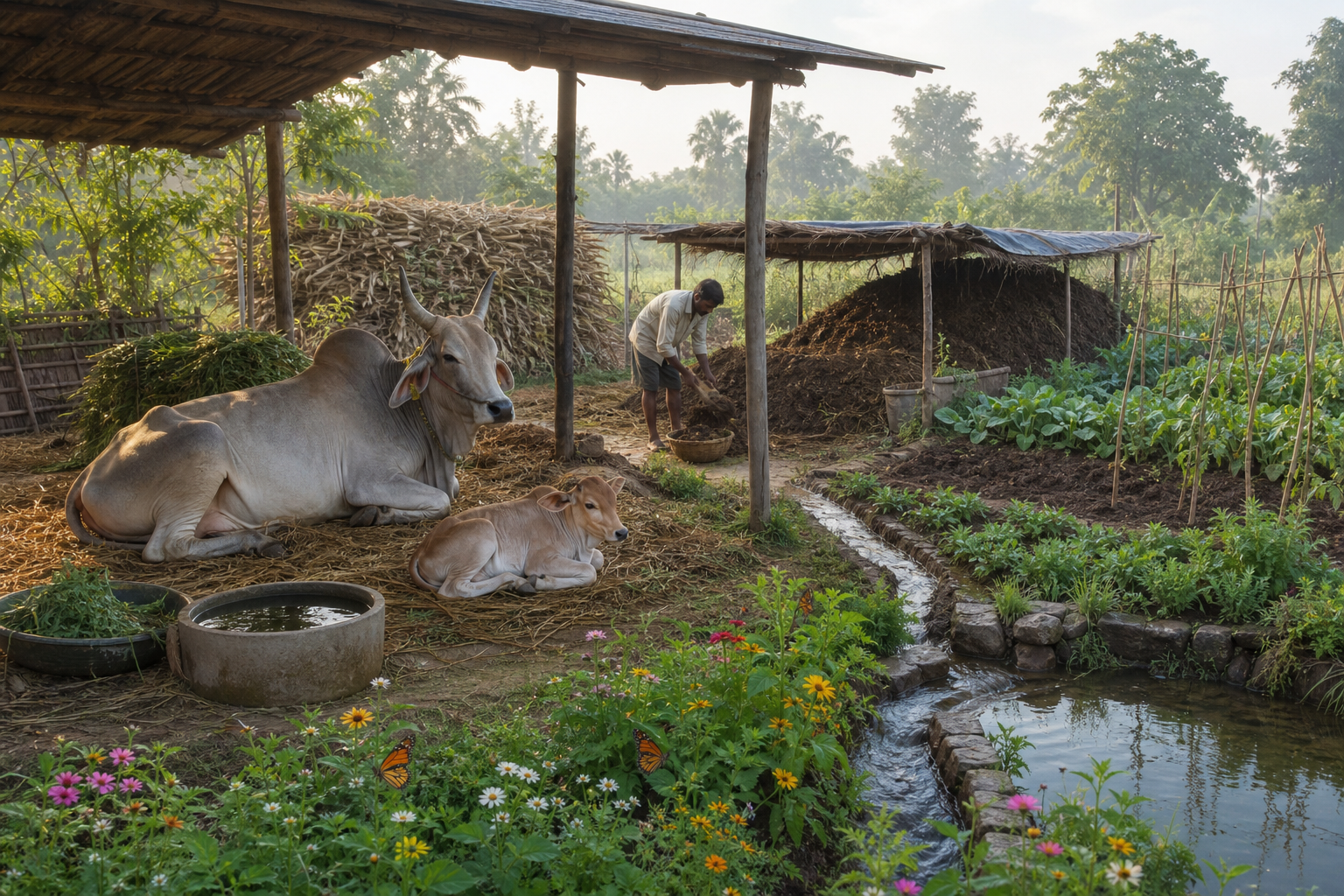
Predator symbolism shows how force should be governed. The cow brings the discussion closer to household life, agriculture, sanitation, energy, and animal care. Here sacred ecology is not merely an attitude toward nature. It is a material loop in which an animal is cared for, useful matter is recovered, soil is replenished, and waste is reduced.
Cow dung, or Gomaya, can be composted or processed as vermicompost, adding organic matter while supporting soil structure, water retention, and nutrient cycling. In a properly managed biogas system, dung can produce fuel, and the remaining nutrient-rich slurry can return to a kitchen garden or farm as fertilizer. This is a practical circular relationship between animal care, energy, and soil regeneration.
Traditional uses also include dried dung cakes for fuel and thin dung-clay plaster on floors or courtyards, particularly in ritual and festival settings. Gomutra has a place in purification rites, Panchagavya preparations, and specific Ayurvedic formulations. Ritual significance, however, is not proof that every informal health claim is reliable or that every method of handling is safe.
If you want to bring this form of sacred ecology into a household, goshala, temple, or community project, begin with one controlled loop:
- Check how the material is obtained. Collection should be compatible with ahimsa and respectful animal care. Sacred use cannot redeem cruel confinement or neglect.
- Compost fresh dung before horticultural use. Combine it with suitable dry biomass, keep the process managed, and use gloves and clean tools. Do not apply reverence as a substitute for hygiene.
- Treat biogas as infrastructure. A digester needs appropriate design and maintenance. Where a sound system is feasible, it can produce useful energy while leaving slurry for fertilizer and reducing dependence on solid fuel.
- Use household applications with ventilation and sanitation. Dung-clay plaster should use adequately dried material. Do not assume that a customary application is a complete modern disinfectant.
- Do not self-prescribe Gomutra. Ritual use and medical use are different categories. Any therapeutic application should follow qualified Ayurvedic guidance and must not replace professional medical care.
The shared ground across Dharmic traditions is clearest at the ethical level. Hindu ritual sanctity, Jain non-violence, Buddhist compassion and interdependence, and Sikh seva can all direct attention toward careful resource use and responsible stewardship. That does not mean every community performs the same cow-related rites. It means ecological care can become a field of cooperation without manufacturing ritual uniformity.
A useful community proposal therefore begins with a defined outcome rather than a large cultural claim. Ask whether the immediate need is cruelty-free animal care, compost for a garden, better waste management, or a maintained biogas system. Choose one, assign responsibility for hygiene and upkeep, and verify that the benefit continues after the ceremonial launch.
Key takeaways: test devotion by what it protects
- An animal symbol is a relationship among power, restraint, and responsibility, not a decorative synonym for a single virtue.
- Narasimha, Durga, and Shiva direct formidable energy toward protection, self-command, and the restoration of balance.
- The lion connects Hindu, Buddhist, Jain, and Sikh moral vocabularies, but shared imagery should never be used to erase distinct doctrines.
- Reverence for living animals should be visible in cruelty-free care, concern for biodiversity, and protection of habitat.
- Cow-based ecological practices are credible when ethical sourcing, composting, ventilation, clean handling, and competent system maintenance accompany ritual respect.
- Ritual sanctity does not turn Gomutra into a universal remedy or make unsafe handling harmless; qualified guidance and ordinary hygiene still apply.
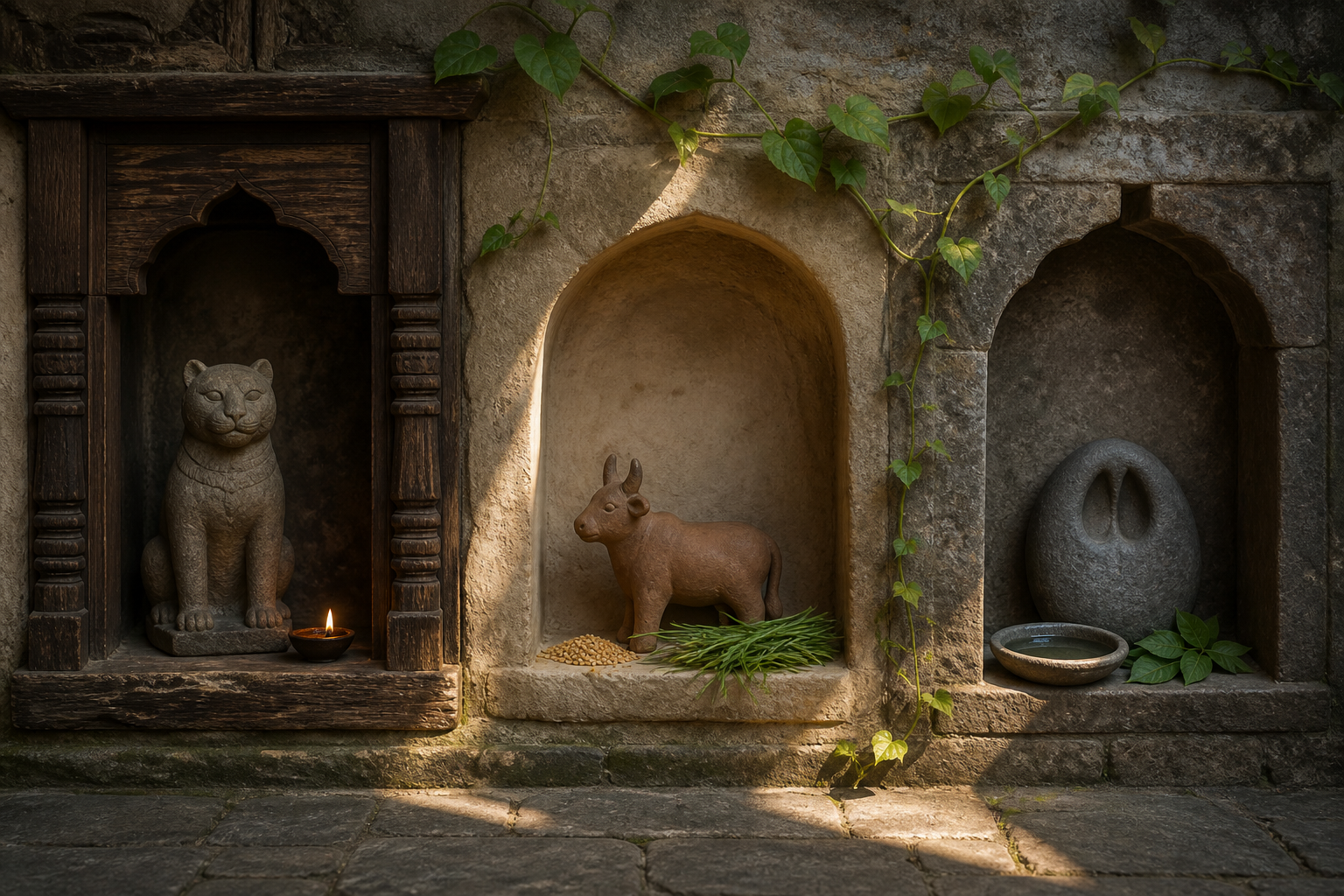
On your next temple visit or at your home shrine, choose one animal image and write down four things: the capacity it represents, the danger within that capacity, the discipline that governs it, and the living being or ecological system it obliges you to protect. Then turn one answer into a traceable action.
That action might be asking how a temple sources animal-derived ritual materials, supporting responsible habitat protection, improving care at a goshala, or starting a safely managed compost loop. Do one thing that can still be observed a month later. When the symbol changes your conduct as well as your mood, sacred ecology has begun to move from the shrine into the world.
References
- DharmaRenaissance Blog — Lions and Tigers in Hindu Scriptures: Powerful Symbols of Dharma, Shakti, and Dharmic Unity
- DharmaRenaissance Blog — Cowdung and Gomutra: Sacred Ecology for Cleaner Homes, Healthier Soil, and Unity in Dharma
