
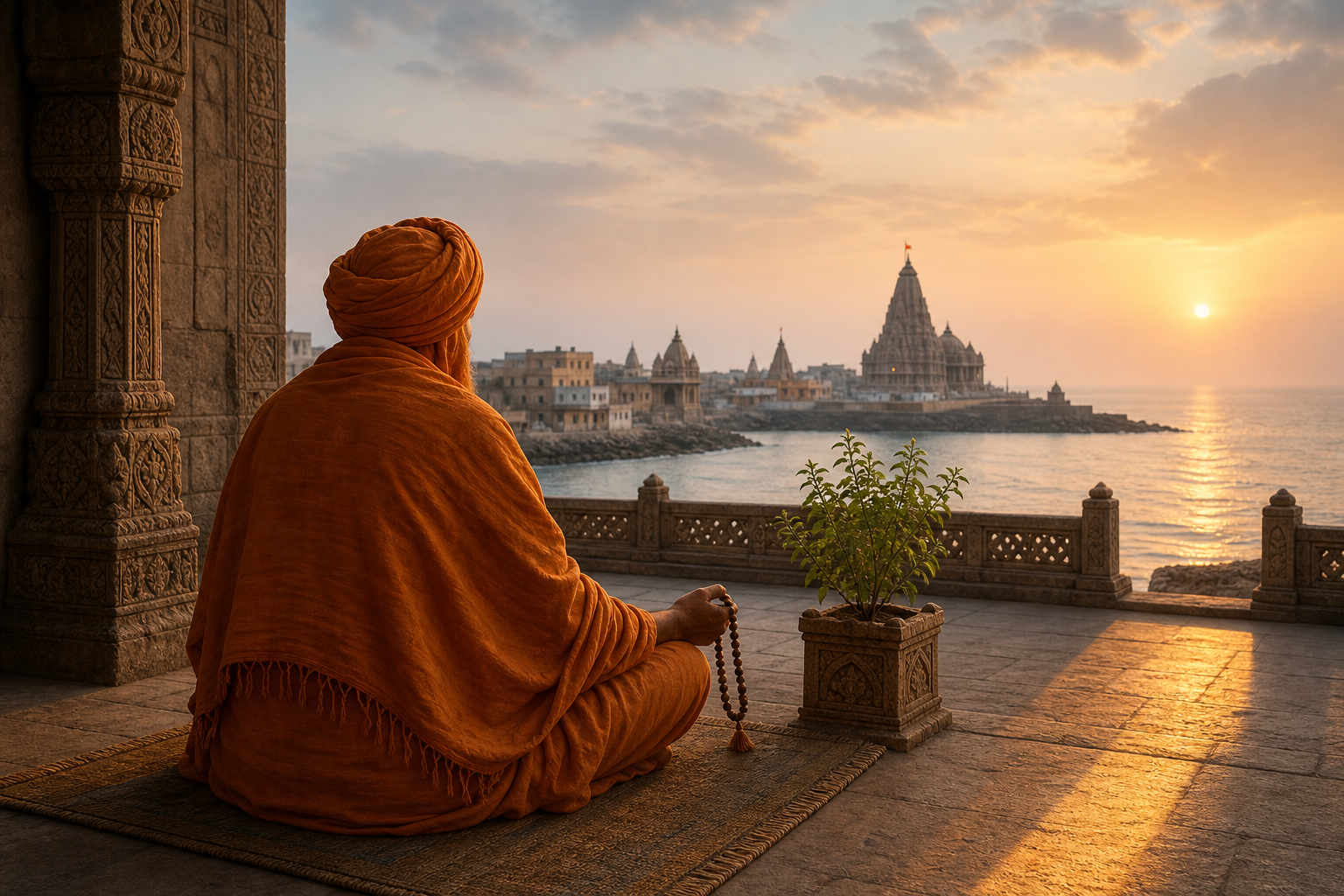
If you came looking for a complete life of Sant Rishidas, the honest answer matters: his remembered identity is clearer than his surviving biography. Gujarat remembers a Krishna devotee shaped by Dwaraka and temple culture, but the record does not support a detailed chronology of his teachings, travels or compositions.
That does not make Rishidas irrelevant. It changes the question you should ask. Instead of filling the gaps with attractive legends, look at what his memory preserves: devotion joined to discipline, temple worship joined to village responsibility, and love of Krishna made credible through compassion, truth and seva.
Key takeaways
- Sant Rishidas is remembered as a 14th-century Gujarati saint devoted to Sri Krishna.
- Tradition places his formation within a Brahmin priestly family connected to the Shree Dwarkadhish Temple through his father.
- The biographical record is sparse. Specific hymns, miracles, journeys or doctrines should not be attributed to him without further evidence.
- His significance lies in a recognisable Gujarati Bhakti pattern: remembrance of the divine name, kirtan, contemplation of Krishna’s leelas, reverence for scripture and seva.
- You can honour that legacy by fixing devotion to a daily anchor and testing it through conduct, especially kind speech, truthful action and useful service.
Separate the remembered saint from an invented biography
The first task is to hold certainty and uncertainty in the right proportions. Rishidas is remembered as having been born into a pious Brahmin family in Gujarat. His father is associated with priestly service at the Shree Dwarkadhish Temple in Dwaraka. These details place him within a Vaishnava environment ordered by worship, recitation, ritual care and service.
Beyond that outline, caution is necessary. Detailed archival information about Rishidas is scarce. A responsible account therefore distinguishes among three things:
- Remembered biography: his Gujarati setting, priestly family background, connection to Dwaraka and Krishna-centred devotion.
- Historical setting: the wider devotional culture of personal piety, congregational worship, sacred remembrance, seva and scriptural reverence.
- Unverified detail: any precise claim about his words, works, miracles, disciples, debates or travels that lacks supporting evidence.
This distinction is especially important when you teach children, lead a satsang or publish material online. Do not turn a plausible feature of medieval saintly life into a fact about Rishidas merely because it sounds appropriate. Say, “Rishidas is remembered for Krishna-bhakti,” when that is what the tradition preserves. Do not place a hymn in his mouth or attach a miracle to his name without a traceable basis.
Oral memory and temple history still matter. They reveal which qualities a community chose to carry forward, even when they cannot establish every event in a modern biographical sense. In Rishidas’s case, the durable image is not that of a ruler, polemicist or institution-builder. It is that of a devotee whose religious life remained close to worship, locality and service.
Gujarati Bhakti joined temple worship to ordinary conduct
Dwaraka gives Rishidas’s memory its spiritual geography. For a Krishna devotee, the sacred city is not merely a location associated with the past. It orders attention toward Dwarkadhish and places daily worship inside a civilizational landscape of pilgrimage, temple service and sacred narrative.
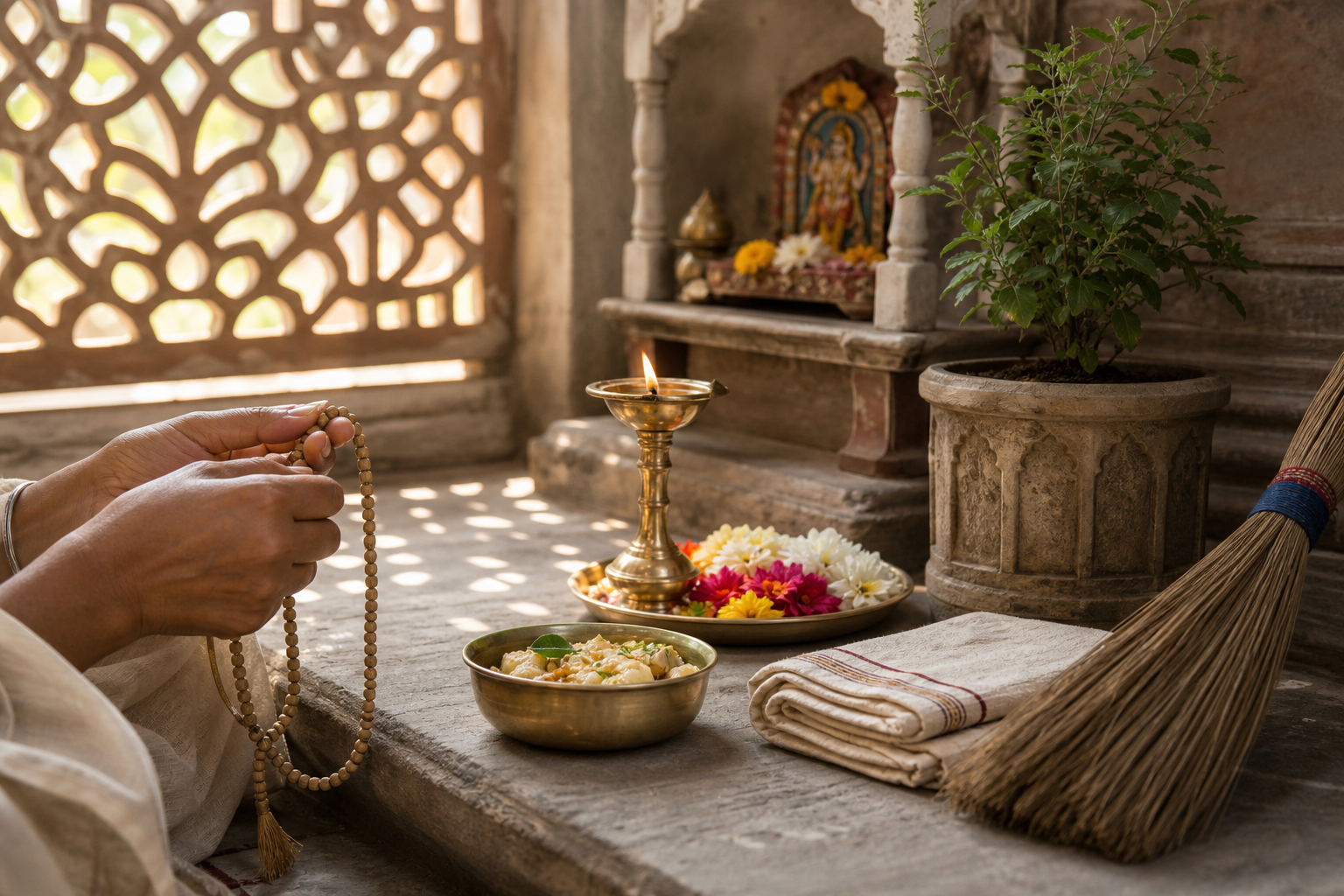
A priestly household would also make devotion tangible. Lamps must be prepared. Sacred recitation requires attention. Offerings are handled with care. The worship space must be maintained. People arrive with needs, questions and vows. Ritual precision and humility meet in these repeated duties. Bhakti, in such a setting, is not a passing devotional mood. It is trained fidelity.
The broader Gujarati Krishna-bhakti environment associated with Rishidas can be recognised through several mutually supporting practices:
- Nama-smarana: returning the mind to the divine name instead of waiting for an ideal emotional state.
- Kirtan: making remembrance congregational, so devotion is reinforced through shared voice and attention.
- Leela-chintana: contemplating Krishna’s divine actions as a way of shaping moral and spiritual perception.
- Scriptural reverence: allowing inherited wisdom to correct impulse rather than using devotion to justify whatever one already prefers.
- Seva: converting reverence into useful work for a temple, family, neighbour or person in need.
This list describes the devotional world in which Rishidas is remembered; it should not be presented as a recovered personal schedule. The distinction protects historical honesty without reducing Bhakti to vague admiration.
You can also use the pattern as a diagnostic. If worship remains confined to the altar while speech becomes cruel, service feels beneath you, or ritual status becomes a reason for contempt, the devotional circuit has broken. The repair is not less devotion. It is a fuller devotion in which worship reforms the person who worships.
Compassion and truth keep devotion from becoming display
Four ethical terms clarify the spiritual meaning carried by Rishidas’s memory: karuna, ahimsa, satya and dharma. Compassion notices suffering and responds. Non-violence restrains injury in deed, speech and intention. Truthfulness aligns words with reality. Dharma asks what right conduct requires within an actual relationship or responsibility.
These values are recognisable across Hinduism, Buddhism, Jainism and Sikhism, although those traditions do not define every doctrine or discipline in the same way. Shared ethical ground should not be used to erase genuine differences. Dharmic unity is strongest when it permits principled distinction while encouraging mutual regard.
For a Krishna bhakta, these virtues are not an alternative to devotion. They are among its visible consequences. Singing before the murti and serving a vulnerable person need not compete. Ritual care trains attention; seva directs that attention outward. Remembrance steadies the mind; satya governs what the steadied mind chooses to say. Ahimsa checks the impulse to turn religious certainty into needless humiliation of another person.
This gives you a sharper measure of spiritual progress than intensity alone. Ask what your practice does to your conduct at the first point of friction. Are you more truthful when a lie would protect your image? Is your speech less injurious when disagreement becomes personal? Do you notice work that needs doing without first asking who will praise you? These are demanding questions because they move Bhakti from identity into character.
Put Rishidas’s legacy into a workable weekly rhythm
You do not need to reconstruct a medieval routine to learn from a medieval saint. Use the following as a modern discipline inspired by the values associated with Rishidas, not as a claim about his personal practice.
- Fix devotion to an existing daily anchor. Choose a moment that already occurs, such as after bathing, before the first meal or before sleep. Consistency is more useful than waiting to feel devotional.
- Remember Krishna by a familiar divine name. Keep the practice simple enough to repeat attentively. If your family follows an established mantra or sampradaya discipline, preserve that form rather than continually changing it.
- Carry remembrance into the first difficult interaction. Before answering in irritation, pause long enough to test the response against satya and ahimsa. Do not use pleasant language to conceal the truth, but do not use truth as permission for cruelty.
- Complete an act of seva that solves a real need. Clean a worship space, help with congregational work, prepare food, assist an elder or remove a burden from someone at home. Prefer necessary work over visible work.
- Make room for shared devotion during the week. Join a kirtan where available, sing with your household or contemplate a Krishna leela from a text respected in your tradition. Congregational practice prevents private devotion from becoming entirely self-designed.
- Review conduct before returning to ritual. Notice where pride, carelessness or harsh speech contradicted worship. Choose a concrete repair: an apology, a corrected statement, a completed duty or renewed service.
Keep the sequence modest enough to sustain. The point is not to manufacture an impressive spiritual programme. It is to close the distance between the name of Krishna on your lips and the quality of attention you bring to people, duties and sacred spaces.
Begin at your next fixed devotional moment. Remember Krishna, then choose the nearest necessary act of seva. That movement from remembrance to responsibility is where the quiet legacy of Sant Rishidas becomes a living practice rather than a name from Gujarat’s past.


References
