
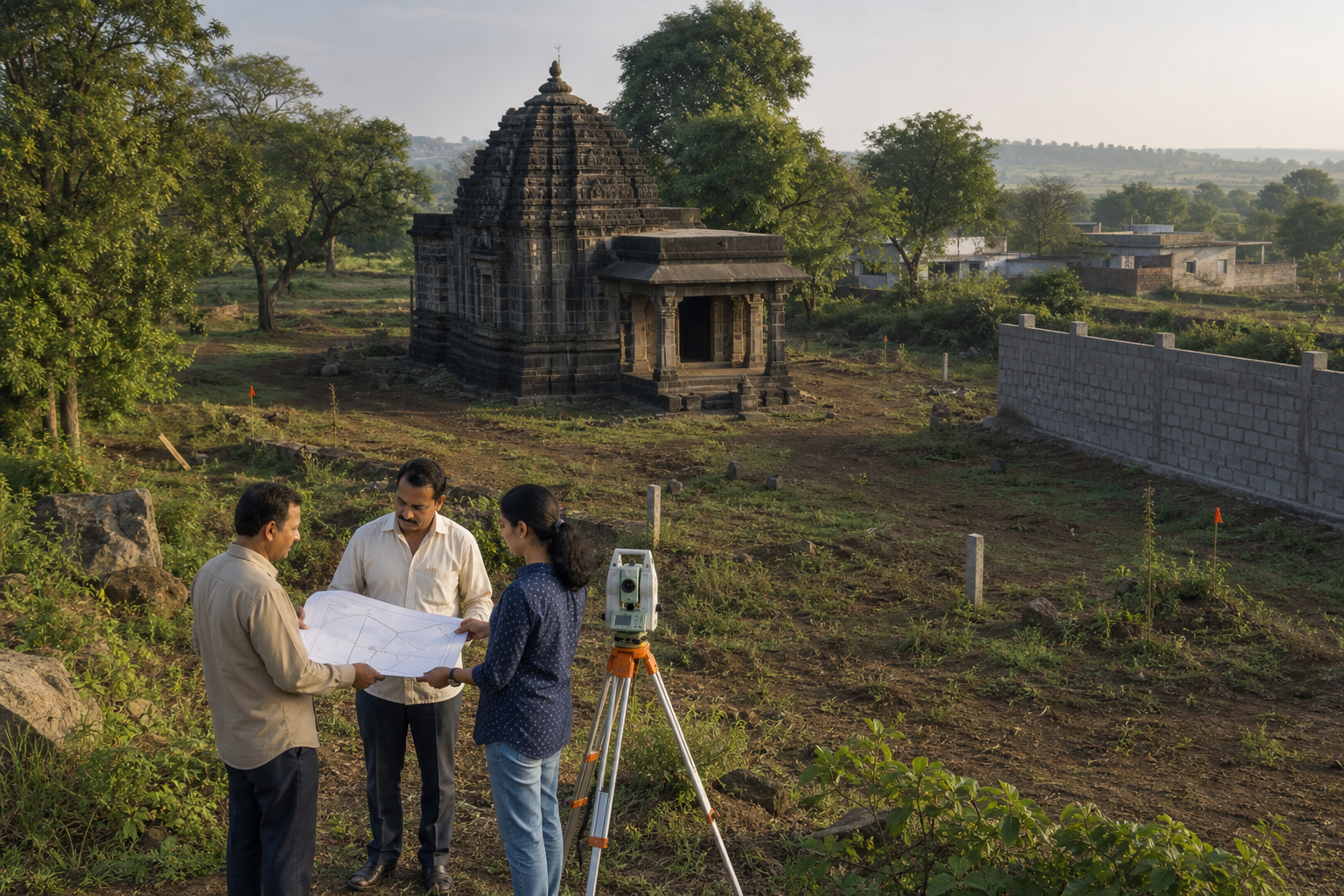
If you help manage a temple and discover a new wall, an unexplained occupant, or a mismatch in the land record, the dispute may already be older than the visible warning sign. Your first task is not confrontation. It is to make the temple’s claim, the condition of the land, and every relevant event clear enough for lawful action.
Maharashtra needs a stronger legal response, but trustees should not wait for a new statute before organizing their holdings. The demand now uniting more than 1,000 temple trustees across 22 districts should therefore be understood as two connected duties: enact an effective Anti-Land Grabbing Act and build records capable of making that law work.
Start with a land register that a stranger can understand
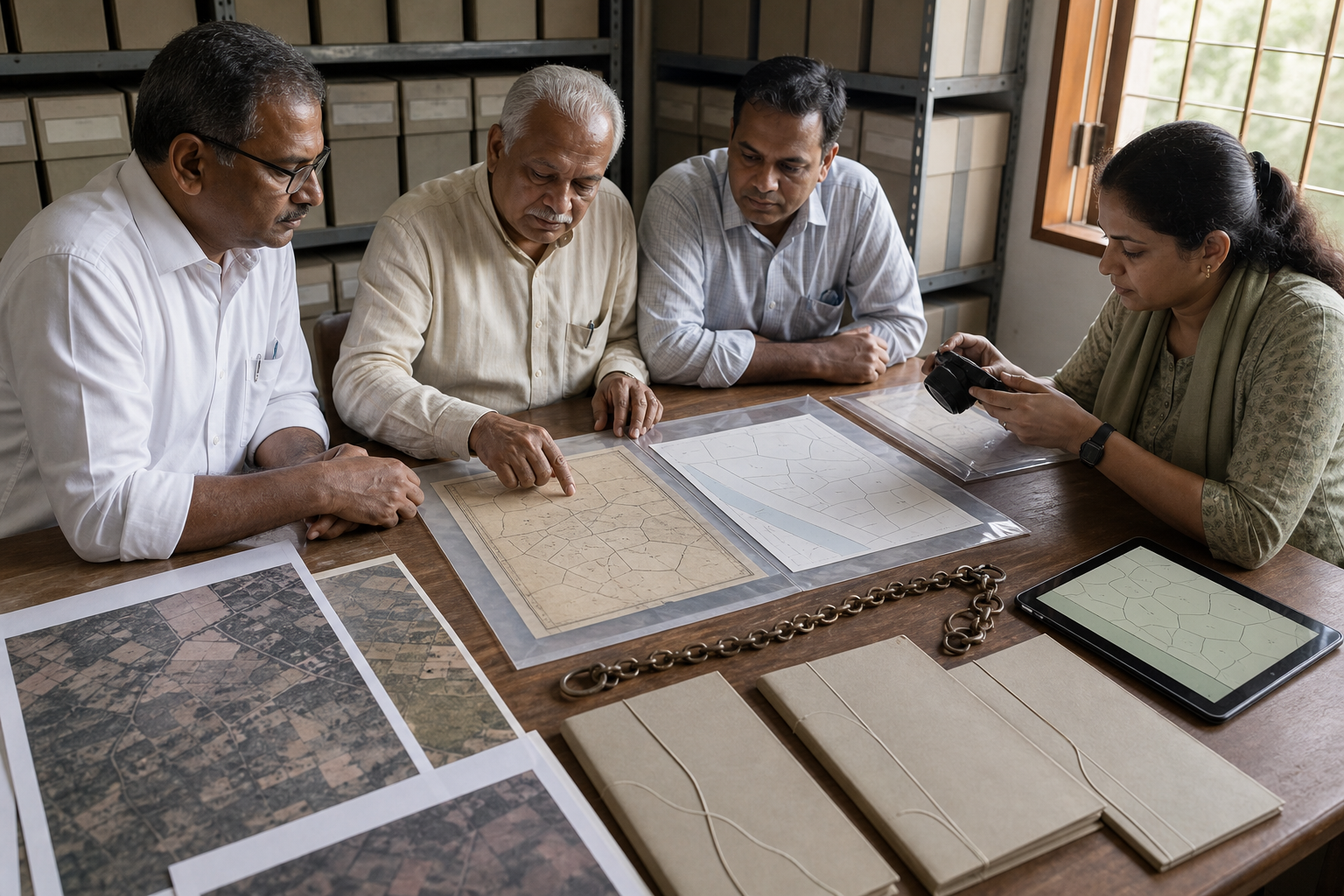
Many temples know what they own through a mixture of deeds, revenue entries, old maps, trustee memory, donor history, court papers, and local recognition. That knowledge may feel convincing inside the community, but it becomes fragile when it is scattered across cupboards and individuals.
The risk rises when urban expansion changes the value of land and old endowment arrangements no longer align neatly with present records. Imperfect land records and complicated inheritance or endowment histories can create openings that an encroacher exploits. A trustee who cannot quickly identify every parcel, document, boundary, occupant, and pending dispute is forced to reconstruct the temple’s case after the problem has begun.
Create one master register, with one row for each parcel. At minimum, record:
- The temple, trust, endowment, or recorded holder associated with the land.
- The parcel identifiers appearing in each available official record. Preserve differences between documents instead of silently choosing the most favourable version.
- The stated area, boundary description, map reference, access route, and present physical condition.
- The documents held by the temple, where the originals are stored, and whether authenticated copies have been obtained.
- The current use of the land, including worship, agriculture, tenancy, charitable activity, vacant land, or occupation by another party.
- Any lease, licence, permission, correspondence, complaint, proceeding, or settlement connected with the parcel.
- The date of the latest physical inspection and the names of the people who conducted it.
- A simple status: documented and clear, requires record reconciliation, under observation, or disputed.
- The trustee or authorized person responsible for the next action and the date on which it must be reviewed.
A spreadsheet is only an index; it is not proof of title. Give every parcel a corresponding dossier containing copies of deeds, maps, official entries, photographs, correspondence, resolutions, and legal papers. Keep originals secure, restrict access, and maintain a list showing when a document was added or removed. If a record appears wrong, preserve the conflicting versions and obtain case-specific advice on the proper correction process. Never alter an old document or annotate its original surface.
A useful register should also capture the land’s dharmic purpose. Temple property may support community kitchens, education, and cultural programmes, even when the parcel itself does not contain a shrine. Recording that function helps trustees explain what the community loses when the property becomes unusable.
Distinguish a record problem from an active encroachment
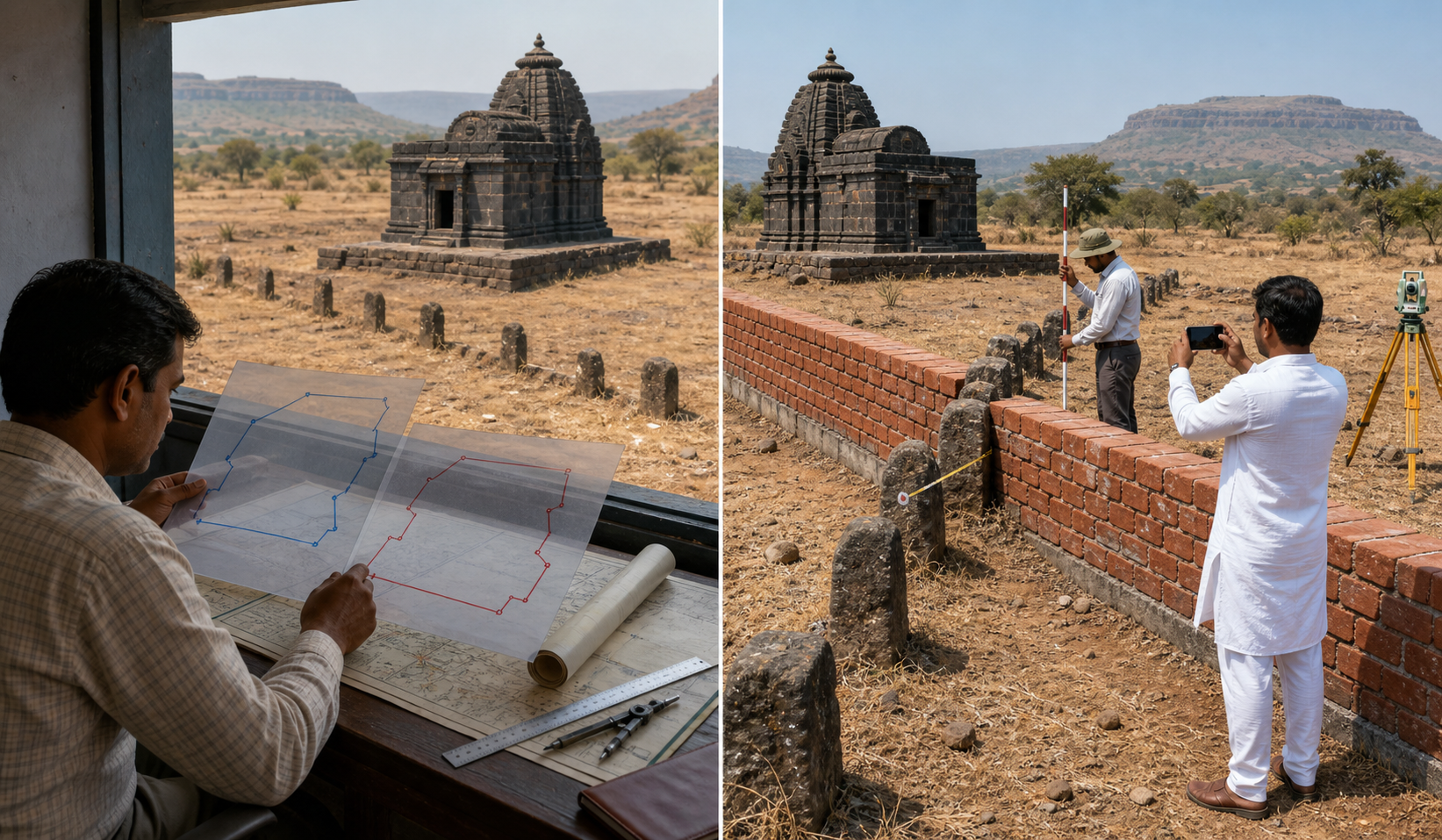
Not every irregularity is the same. Treating a clerical mismatch, a boundary disagreement, an expired permission, and deliberate land grabbing as one category can weaken both the temple’s response and the fairness of the process.
| What you notice | What to do first | What not to assume |
|---|---|---|
| Two records show different areas, names, or parcel identifiers | Secure authoritative copies, list the discrepancy exactly, and ask qualified counsel which record process applies | Do not assume that the version held by the temple automatically controls |
| A fence, wall, excavation, or structure appears near a boundary | Document the location and date from a safe and lawful position, compare it with the parcel file, and escalate promptly | Do not assume that physical possession proves ownership or lawful authority |
| A person uses the land under an old lease, licence, or informal permission | Find the instrument, resolutions, payment records, correspondence, and stated term before deciding on the next step | Do not label the person a land grabber merely because the arrangement is inconvenient or poorly recorded |
| An occupant claims purchase, inheritance, tenancy, or another right | Record the claim without conceding it, preserve the documents offered, and obtain legal advice | Do not try to settle a complex title question through a verbal exchange at the site |
| A case or official complaint is already pending | Create a complete chronology, assign one responsible trustee, and track every instruction and deadline | Do not let several volunteers issue inconsistent statements or negotiate independently |
Do not physically remove occupants, demolish structures, seize materials, or provoke a confrontation. Such action can endanger people and complicate the temple’s legal position. Preserve evidence, secure the site only through lawful means, and let qualified Maharashtra property or endowment counsel identify the appropriate administrative, police, or judicial route. The correct remedy and any applicable deadline depend on the documents and facts of the individual parcel.
What an effective Anti-Land Grabbing Act must contain

“Anti-land-grabbing” cannot remain a slogan. A harsh label without precise definitions can be misused, while severe penalties without workable procedures may still leave a temple waiting through years of fragmented proceedings. The aim should be fast, credible adjudication with protection for both sacred endowments and due process.
Gujarat and Karnataka are being invoked as models because their frameworks combine defined offences, enforcement, penalties, and faster adjudication. Maharashtra does not need to copy another state mechanically. It should examine which mechanisms solve the actual points of failure in Maharashtra’s land administration.
Trustees and devotees evaluating a proposed law should look for these provisions:
- A precise definition of land grabbing that separates fraudulent or unauthorized appropriation from a genuine title, tenancy, inheritance, boundary, or record dispute.
- A clear complaint pathway showing who may file, what initial material is required, which authority verifies it, and where the matter goes next.
- Independent verification before coercive action, with written reasons that the affected parties can examine.
- Transparent investigations and time-bound hearings rather than an undefined promise of “speed.”
- Penalties proportionate to the proven conduct, including meaningful deterrence for organized or fraudulent grabbing.
- A fair opportunity to respond and a defined review or appeal pathway so that urgency does not become arbitrariness.
- Specialized legal cells or fast-track mechanisms with the ability to understand land records, religious endowments, and overlapping proceedings.
- Operational coordination among revenue officials, police, endowment authorities, and adjudicatory bodies, with responsibility assigned at each handoff.
- Digitized, geo-tagged property records and a public endowment registry with a visible correction process and an audit trail.
- Community oversight capable of exposing delay or misuse without turning unresolved legal claims into public verdicts.
Time-bound adjudication matters only when the clock has a starting point, a responsible office, and a consequence for avoidable delay. When lawmakers present a bill, ask practical questions: When does preliminary verification begin? Who must notify the parties? How are conflicting official records handled? Which body hears the matter? What information about pending cases will be public? A statute that cannot answer those questions may create another layer of procedure without protecting another acre.
Build a response protocol before the next incident
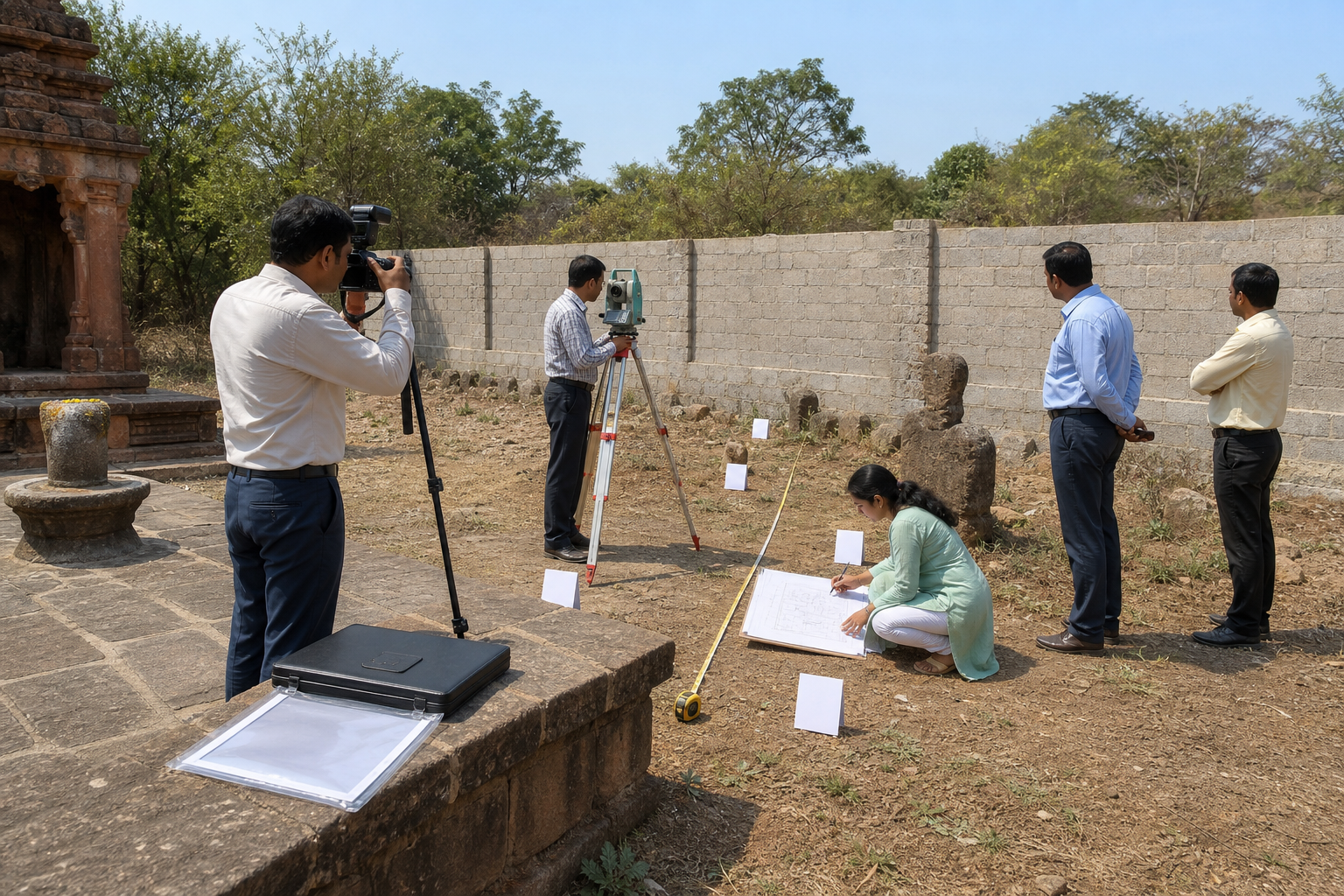
A temple should not invent its response while construction is already occurring on disputed land. Adopt a written protocol through the appropriate trustee or governing process and give every volunteer a short version they can follow.
- Verify the parcel. Match the reported location with the land register, map, and dossier. Record uncertainty rather than forcing a premature conclusion.
- Preserve the scene lawfully. Note the date, time, location, visible activity, and names of witnesses. Take photographs only where it is safe and lawful to do so, and retain the original files.
- Open an incident record. Give it a unique identifier and maintain a chronological log of observations, calls, letters, visits, acknowledgements, and instructions.
- Notify the authorized decision-makers. The temple’s chair, secretary, land custodian, and retained lawyer should know who is responsible for directing the response.
- Review existing rights. Search for leases, licences, permissions, trustee resolutions, payments, prior complaints, court orders, and correspondence before describing the occupation publicly.
- Select the lawful route with counsel. The appropriate revenue, police, endowment, civil, or other process depends on the facts. Record why the chosen route was selected.
- Control communications. Designate one spokesperson, state only verified facts, and avoid publicly identifying someone as a criminal before lawful findings support that description.
- Track the matter to closure. A filed complaint is not an outcome. Record acknowledgements, hearing dates, orders, compliance, restoration steps, and any continuing risk to the parcel.
This protocol should cover internal misconduct as well as outside occupation. If a trustee, employee, tenant, agent, or intermediary may have exceeded authority, preserve the relevant resolutions and communications, manage conflicts of interest, and obtain independent advice. Temple protection loses credibility when accountability applies only to outsiders.
Run a fixed review of the register rather than waiting for a complaint. High-risk parcels deserve more frequent inspection than documented land in stable use. The cadence is less important than assigning it, recording it, and following up on changes. An inspection that produces no dated record will be difficult to distinguish later from an inspection that never occurred.
Public accountability strengthens the temple’s claim
Temple property is not merely real estate held for a private balance sheet. It is an intergenerational resource entrusted for worship, seva, learning, culture, and community continuity. That sacred character calls for better governance, not less scrutiny.
Publish a sensible summary of the temple’s land portfolio: the number of parcels, broad use categories, the number requiring record reconciliation, and the number under dispute. Do not publish original deeds, personal identifiers, legal strategy, access details, or security-sensitive maps. Transparency should make stewardship visible without exposing the temple or legitimate parties to new risk.
Community oversight can be made practical through:
- An annual trustee resolution confirming that the land register and dispute list were reviewed.
- A clear policy for leases, licences, permissions, renewals, and changes in land use.
- Recorded declarations of conflicts of interest before property decisions.
- More than one authorized reviewer for major land documents and transactions.
- A reporting channel through which devotees can flag construction, dumping, fencing, unauthorized use, or record concerns.
- A written acknowledgement for every credible report, followed by a status update that does not compromise legal proceedings.
This is where temple protection becomes a shared dharmic responsibility. Hindu, Buddhist, Jain, and Sikh institutions all preserve places through which service, learning, discipline, and social cohesion pass from one generation to another. Protecting those places does not require abandoning fairness. Precise records, transparent decisions, and lawful enforcement are how civilizational commitment becomes credible public stewardship.
Key takeaways
- Index every parcel and create a separate evidence dossier; institutional memory is not a substitute for an accessible record.
- Classify the problem before escalating it. A record mismatch, boundary dispute, expired permission, and deliberate grabbing require different responses.
- Never use physical confrontation or improvised self-help. Preserve evidence and choose the lawful route with qualified counsel.
- Support an Anti-Land Grabbing Act only if it combines deterrence with precise definitions, independent verification, time-bound hearings, coordination, and review safeguards.
- Use digitized and geo-tagged records, a public endowment registry, and community oversight to prevent disputes rather than merely react to them.
- Apply accountability to trustees and insiders as firmly as it is applied to outside encroachers.
At the next trustee meeting, place three decisions on the agenda: appoint a responsible land-record custodian, set a deadline for completing the parcel register, and approve a written incident protocol. Then carry the same clarity into the public campaign for Maharashtra’s law. Sacred land is protected when devotion is matched by records, vigilance, due process, and consequences.
References
