
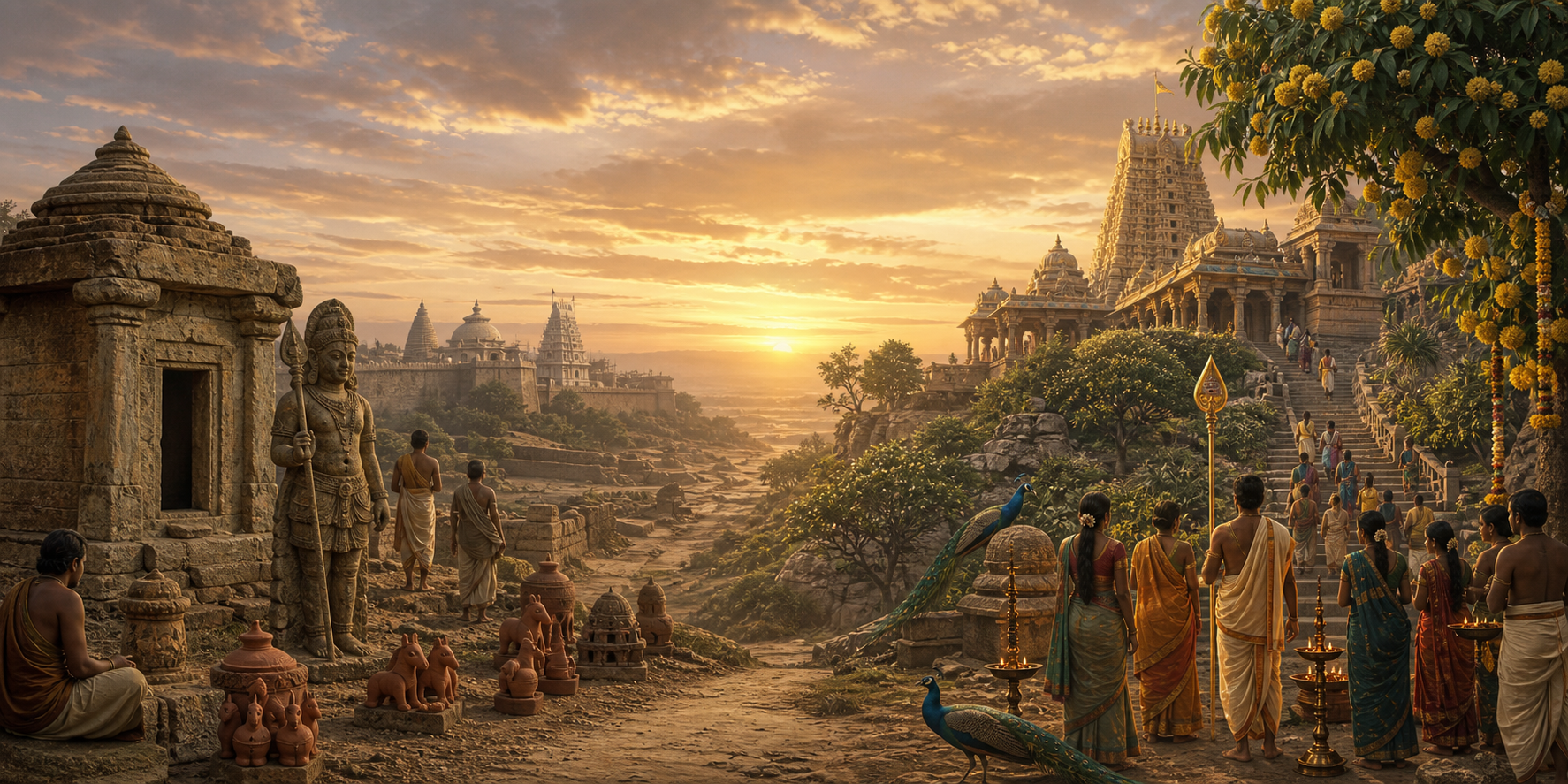
You may have heard Murugan described as a southern or Tamil deity and wondered whether Northern India ever worshipped him. It did. The harder question is why a deity once visible in northern images, names, inscriptions, and sacred sites later became far more prominent in the South.
The most defensible answer is not that Murugan vanished, migrated, or was rejected. His northern public cult appears to have contracted as patronage, devotional priorities, cities, and pilgrimage networks changed. If you keep those processes separate, the history becomes clearer and the surviving evidence becomes much harder to misuse.
The historical question is prominence, not mere presence
Murugan, Kartikeya, Skanda, Subrahmanya, and Shanmukha are names associated with the son of Shiva and Parvati, commander of the celestial forces and embodiment of youthful courage and wisdom. A search limited to the name Murugan will therefore miss much of his northern history. In northern material, Skanda or Kartikeya may be the more relevant identifier.
His presence is visible in Mathura sculpture, inscriptions, temple remains, and the Gupta-era name Skandagupta. These markers are enough to reject the claim that Kartikeya was always foreign to Northern Indian religious life. They are not enough, by themselves, to establish that his cult dominated every northern region or remained equally strong in every period.
This distinction matters. A deity can be known throughout a religious culture without possessing many independent temples. A royal name can show prestige without measuring ordinary household devotion. A sculpture can establish local recognition without telling us how long its shrine remained active. When historians speak of Murugan’s retreat, the careful claim concerns declining public visibility and institutional support, not the erasure of the deity from Hindu memory.
Key takeaways
- Search for Kartikeya and Skanda as well as Murugan; the regional name changes what evidence you will find.
- Northern images and inscriptions establish real presence, but they do not automatically prove continuous mass worship.
- Retreat means a reduced concentration of temples, patronage, and public ritual. It does not necessarily mean rejection or disappearance.
- No single cause explains the change. Patronage, Bhakti priorities, urban change, trade routes, conflict, and Hindu pluralism could operate together.
- Southern flourishing should not be mistaken for the southward migration of an otherwise homeless deity. It reflects the exceptional continuity and intensity of an already rooted Tamil tradition.
Read each kind of evidence for what it can actually prove
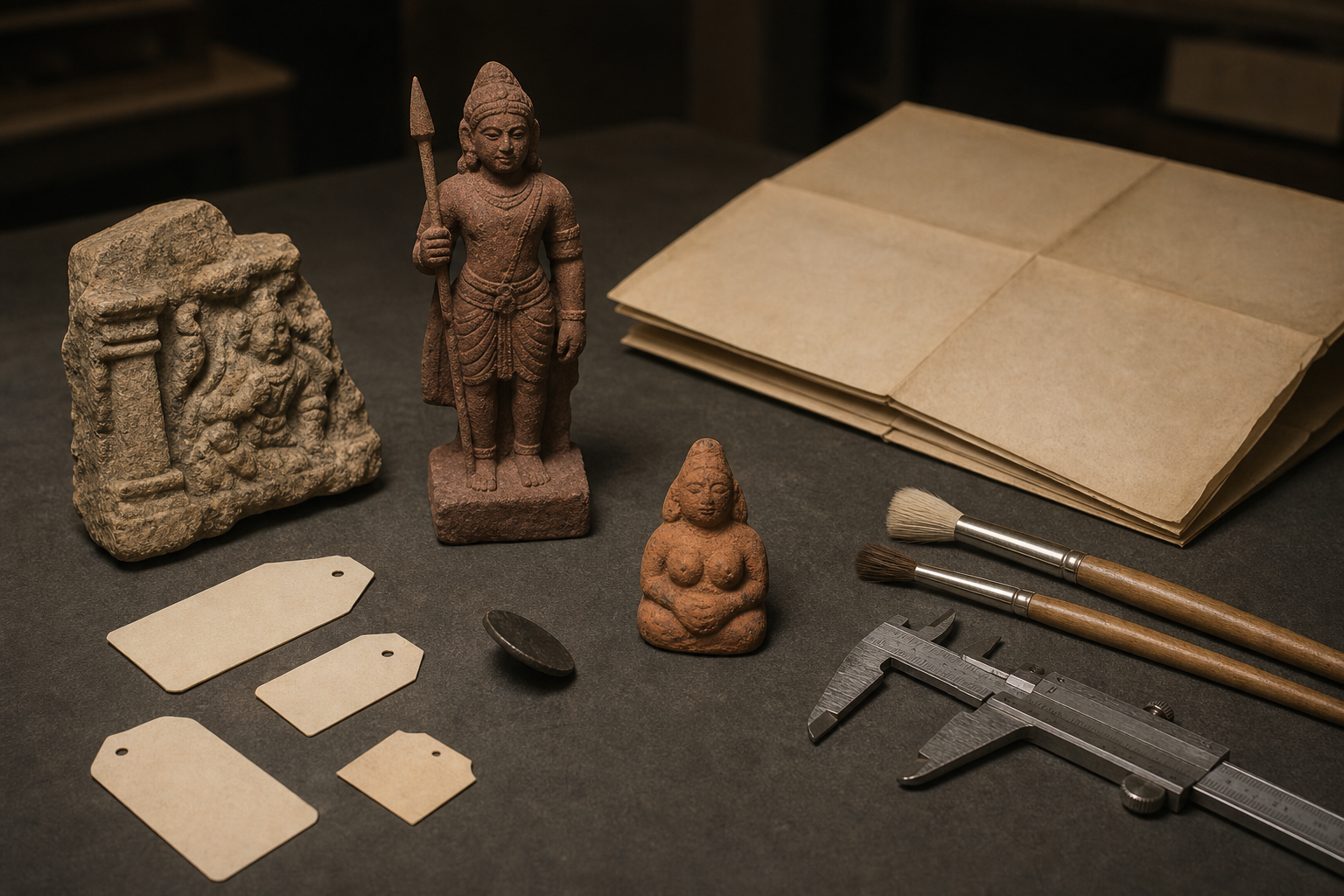
If you are evaluating a claim about a forgotten Murugan shrine, begin by asking what kind of evidence supports it. Archaeological, epigraphic, artistic, literary, and oral materials answer different questions. Combining them can produce a strong case. Treating them as interchangeable produces confident stories that outrun the record.
| Evidence | What it can support | What it cannot establish alone |
|---|---|---|
| Sculpture or iconography | Recognition of Skanda in a place and artistic period | The size, duration, or social reach of his worship |
| Inscription or theophoric name | Prestige, patronage, dedication, or personal devotion | A complete picture of popular practice |
| Temple fragment or reused image | An earlier sacred layer and possible later repurposing | The exact cause or date of the original shrine’s decline |
| Toponym, poem, or family tradition | Persistence of memory after institutions changed | The original form of a temple without material corroboration |
| Later multi-deity shrine | Continued inclusion within the Hindu pantheon | Continuity of an earlier independent Kartikeya cult |
The name Skandagupta is suggestive because it places Skanda within a prestigious political vocabulary of the Gupta period. Yet a ruler’s name is not a census of worshippers. Likewise, distinctive Skanda images from Mathura prove that northern artists and patrons represented him, but one image cannot reveal how many festivals were held, how far pilgrims travelled, or whether the same institution survived into a later century.
Three safeguards will keep your conclusion proportionate to the evidence:
- Separate identification from interpretation. First establish whether the figure or name is plausibly Skanda. Only then ask what its setting says about worship.
- Separate presence from predominance. A deity represented in a temple complex may have been honoured without being the principal deity of the site.
- Separate decline from cause. A damaged image, abandoned structure, or changed dedication does not tell you whether conflict, economic contraction, lost patronage, ritual reorientation, or several forces produced the change.
The same restraint applies to silence. A gap in surviving inscriptions does not prove that families stopped invoking Kartikeya. Perishable shrines, household observances, oral prayers, and secondary positions within larger temples leave uneven traces. The honest conclusion may therefore be narrower than the emotionally satisfying one: public institutions weakened, while the extent of private continuity remains uncertain.
Murugan’s retreat was a change in the devotional centre of gravity
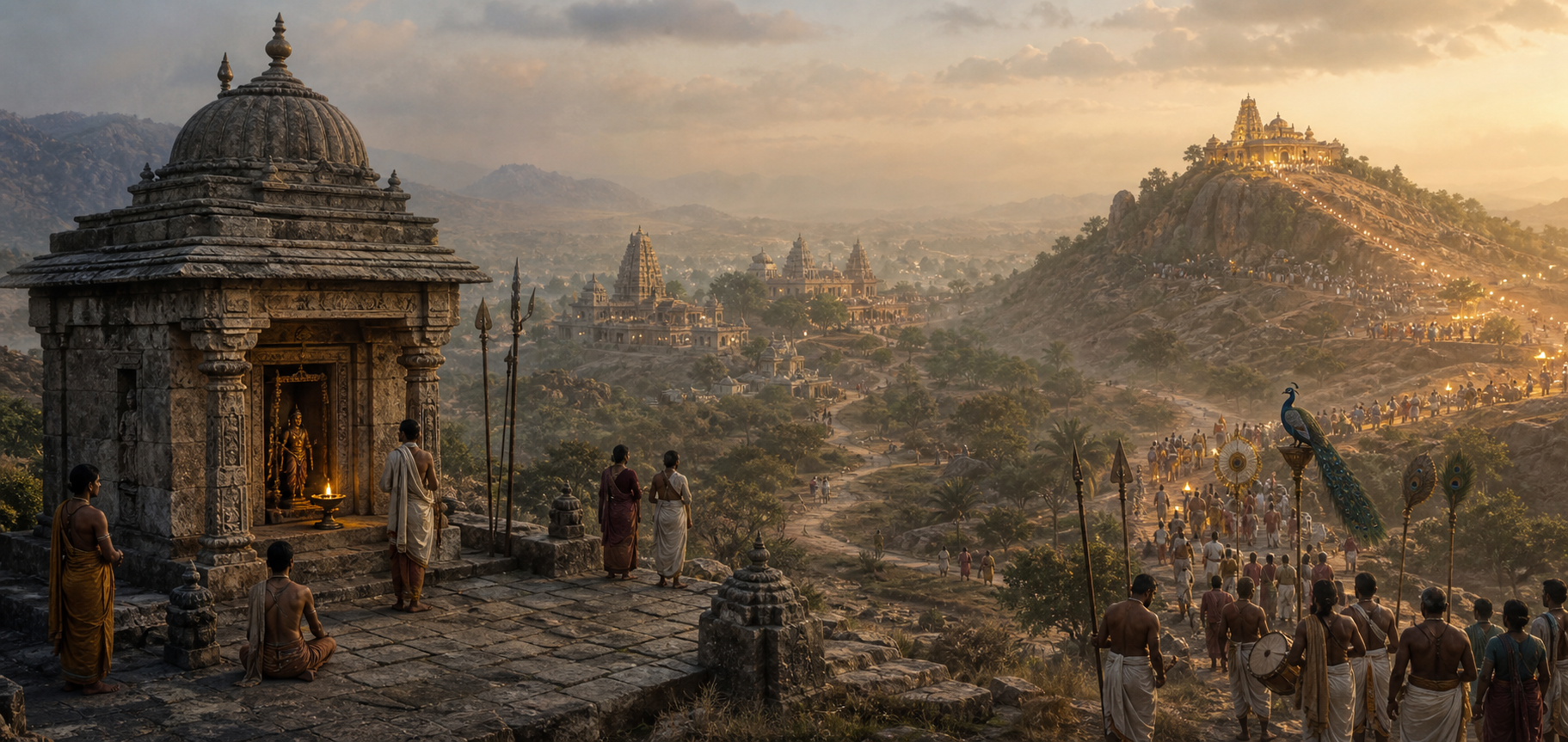
Religious prominence depends on more than theological status. Temples require patrons, ritual specialists, pilgrims, land, functioning settlements, and routes that keep people and resources moving. When those supports shift, a major deity can lose public visibility without being repudiated.
Changing royal patronage was one likely force. A court that endowed a particular form of Shiva, Vishnu, Rama, or Krishna could redirect artistic production and temple building toward that form. This did not require an official prohibition against Kartikeya. Repeated preference is enough: fewer dedicated shrines are built, older institutions receive less support, and the next generation encounters the deity more often as Shiva’s son than as the principal lord of a sanctuary.
The growth of regionally powerful Bhakti traditions reinforced that effect. Communities gathered around particular stories, pilgrimage centres, songs, festivals, and chosen forms of the divine. As these networks became denser, collective devotion could concentrate on Shiva, Vishnu, Rama, or Krishna while Kartikeya remained fully intelligible within the shared pantheon.
Hindu pluralism helps explain why this change could be gradual. The Ishta principle allows a person or community to give special devotion to one form without declaring other forms false. A temple precinct can also accommodate several deities with different ritual weight. Murugan therefore did not need to be doctrinally defeated before his independent northern institutions could diminish. He could move from the centre of public worship to a respected place within a wider Shaiva family and still remain present.
Material conditions also mattered. Urban contraction, altered trade routes, political realignment, episodic conflict, and the reuse or relocation of temples and icons changed the sacred geography of Northern India, especially across the early second millennium. These forces should be treated as interacting pressures, not as a ready-made single-cause explanation.
This is where two popular narratives fail. It is too simple to blame the entire retreat on one invasion or episode of destruction, because the evidence also points to internal changes in patronage and devotion. It is equally weak to describe the shift as an effortless, purely theological evolution, because cities, routes, conflict, and institutional disruption affect which traditions can sustain visible public life. A credible history must leave room for both adaptation and loss.
The Tamil South preserved an unusually dense Murugan world
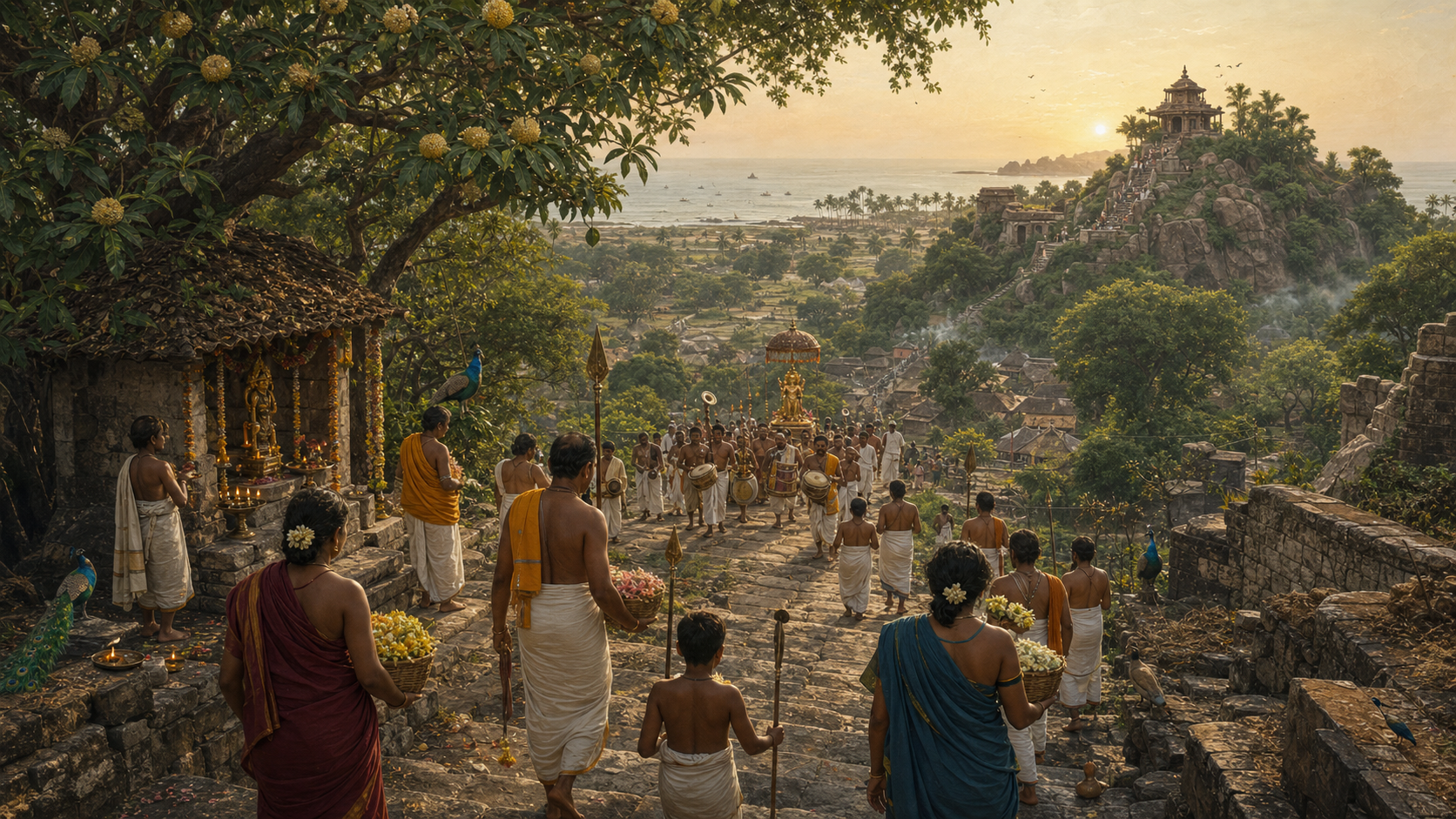
Murugan’s southern strength cannot be explained merely as the destination of a deity retreating from the North. Tamil devotion had its own deep literary, ritual, and geographical roots. The South did not simply receive a displaced northern cult; it sustained a powerful regional relationship with Murugan over a long span.
Devotional literature from the Sangam through medieval eras, hill sanctuaries, and major centres such as Palani, Tiruttani, Swamimalai, and Thiruchendur gave worshippers mutually reinforcing ways to encounter him. Poetry carried theology and memory. Pilgrimage fixed that memory in the landscape. Recurring ritual allowed families and communities to transmit devotion rather than merely preserve information about it.
The vel, peacock, and kavadi became readily recognisable elements of a living devotional language. Their importance is not just visual. A stable set of symbols lets worship travel between household practice, procession, vow, poem, temple, and pilgrimage. That continuity helps explain why Murugan remained publicly central in Tamil regions even while his dedicated northern institutions became thinner.
You should therefore resist turning regional intensity into an argument over ownership. Murugan’s Tamil intimacy and Kartikeya’s pan-Indian identity can both be true. Regional traditions often preserve one dimension of the larger Dharmic inheritance with exceptional depth. Their particularity is a vehicle of continuity, not evidence that the deity has no history elsewhere.
The useful comparison is institutional rather than competitive. In the South, literature, pilgrimage, major shrines, symbols, and recurring observances formed a dense devotional ecosystem. In the North, surviving material points to earlier visibility followed by a less concentrated public presence. The contrast explains different historical trajectories without arranging regions on a ladder of authenticity.
Continuity survives in more than one religious form
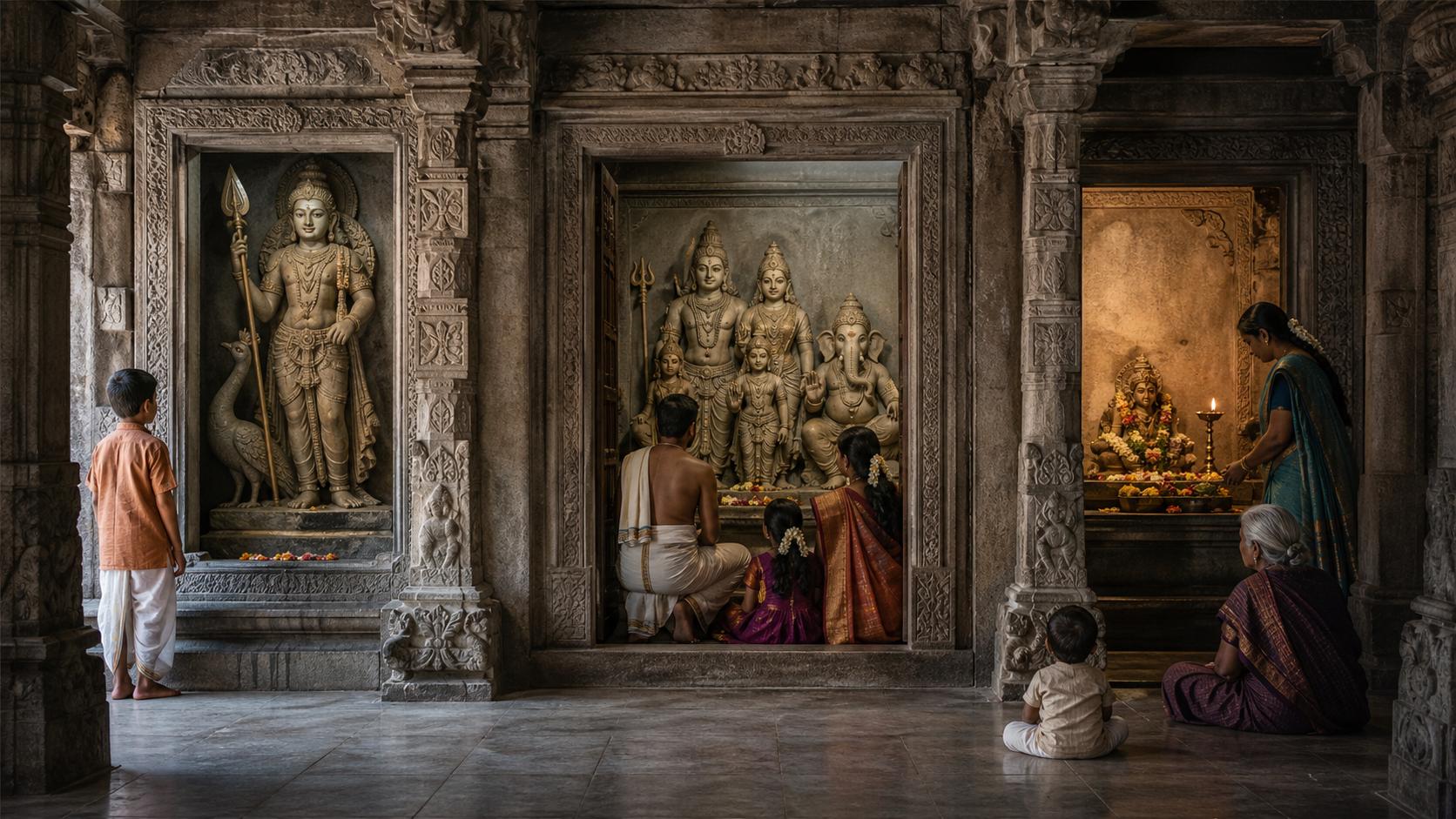
A deity’s history should not be mapped only by counting temples bearing one name. Memory can persist through family relationships in mythology, subsidiary images, place-names, poetry, local customs, and related guardian roles. Each form carries a different strength of evidence, but together they show why disappearance is too absolute a word.
Beyond India, Skanda-Kumara appears in Buddhist Asia as the monastic guardian known in East Asian settings as Wei Tuo. That transformation does not prove that every Buddhist guardian practice descends directly from a particular northern Hindu shrine. It does show that the figure associated with disciplined protection could cross linguistic, geographic, and institutional boundaries.
The wider Dharmic lesson is unity without forced sameness. Hindu, Buddhist, Jain, and Sikh traditions all give serious moral weight to courage, restraint, compassion, disciplined action, and righteous protection, but they do not express those values through identical theology or ritual. Sikh Kshatra, for example, can illuminate the enduring Dharmic concern with righteous defence; it should not be presented as evidence of Sikh worship of Murugan. Shared ethical resonance is not the same thing as a shared cult.
That distinction protects both historical accuracy and Dharmic solidarity. We do not strengthen unity by flattening real differences. We strengthen it by recognising related moral worlds, tracing genuine transmission where evidence permits it, and refusing to manufacture equivalence where it does not.
How to investigate a claim about northern Murugan worship
If a local tradition identifies a damaged image, mound, temple fragment, or place-name with Kartikeya, do not begin by trying to prove a sweeping story. Begin with a small, testable record. The goal is to preserve what is known, distinguish it from community memory, and identify what further expertise is needed.
- Record every relevant name. Note Murugan, Kartikeya, Skanda, Subrahmanya, Shanmukha, and any local form. A regional naming difference can otherwise hide a genuine connection.
- Identify the evidence type. State whether the claim rests on sculpture, inscription, architectural reuse, a place-name, a poem, or oral tradition. Do not merge them into a vague assertion that proof exists.
- Document the setting. Record whether the object stands in an independent shrine, a subsidiary niche, a museum, a reused wall, or a later temple complex. Context changes what the object can tell you.
- Keep observation separate from interpretation. A peacock, spear, youthful warrior, or six-faced form may support identification, but a damaged attribute should be treated as a clue rather than a complete conclusion.
- Build a sequence instead of guessing a cause. Ask what appears earliest, what changed later, and which stages are undated. Only after establishing that sequence should you discuss declining patronage, reconsecration, abandonment, or conflict.
- Grade the conclusion. Label it established, plausible, or speculative. An inscription naming Skanda carries different weight from a place-name whose explanation survives only in recent memory.
- Seek complementary expertise. Epigraphy can test a reading, iconography can assess an identification, archaeology can clarify layers, and oral history can preserve community memory. No one discipline should be made to answer every question.
Do not move a fragment, clean an inscription aggressively, or detach an image to obtain a better view. Such actions can destroy context, damage the object, and erase precisely the evidence needed to understand it. Preserve its location and condition, and involve the responsible temple, heritage, or scholarly authorities before any intervention.
A useful local record can be modest: the present name of the place, alternate names, the object’s exact setting, visible attributes, associated oral accounts, and which claims remain unverified. This creates something later researchers can check. It is more valuable than announcing a lost Kartikeya temple on the basis of one ambiguous feature.
The next time you encounter the claim that Murugan was only southern or that he completely vanished from the North, ask for the name variant, evidence type, location, and historical layer. Those four questions turn a cultural argument into a serious investigation and give Northern India’s Skanda heritage its best chance of being recovered without being romanticised.
References
