
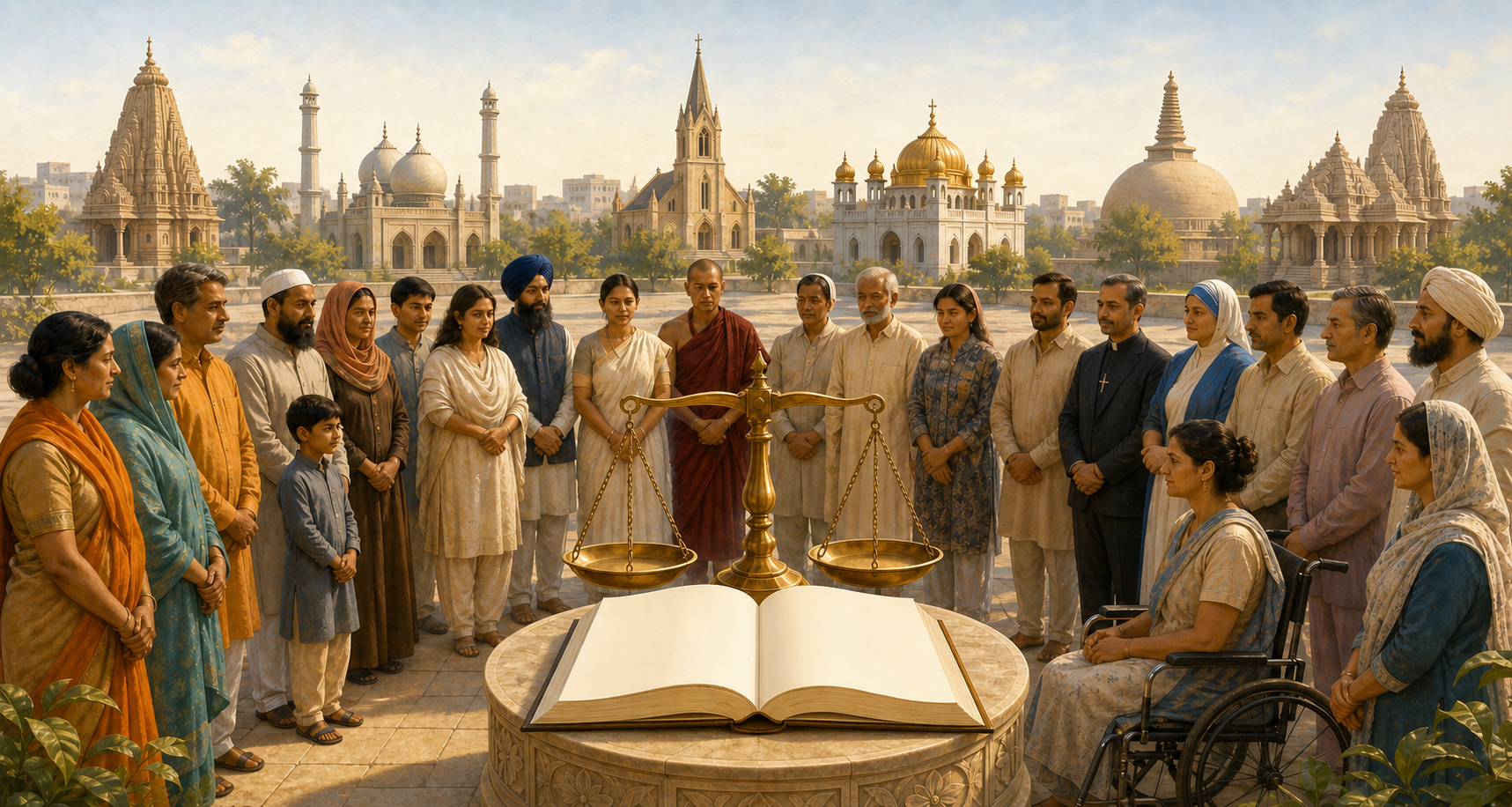
Perhaps you have just seen India described as either a persecutor of minorities or an unmatched haven of pluralism. If you want to know what is true, neither slogan is enough. You need a way to test the claim before you repeat it, defend India against it, or use it to demand reform.
The useful method is to separate constitutional protection, official conduct, social conflict, political rhetoric, and the working of remedies. That lets you defend Bharat when criticism is careless while still confronting a failure when someone’s freedom is actually denied.
Start with the constitutional right, then examine whether it worked
Any claim that India lacks a serious legal foundation for religious freedom begins from the wrong baseline. Articles 25-30 protect freedom of conscience, the free profession and practice of religion, and the rights of religious and linguistic minorities; Article 30 specifically protects minority educational institutions.
That baseline matters, but it answers only the first question. A constitutional guarantee proves that a right is recognized. It does not prove that every official observes it, every victim can readily enforce it, or every dispute is resolved fairly. The reverse error is just as serious: misconduct in one case does not, by itself, prove that the Constitution is empty or that discrimination is national policy.
The National Commission for Minorities and the higher judiciary form part of India’s oversight architecture. Their existence is relevant because religious liberty includes access to correction when power is abused. Yet an institution’s name on an organizational chart cannot settle whether redress was accessible, timely, consistent, or effective in a particular case.
When you assess an alleged violation, ask five concrete questions:
- What exact freedom was allegedly restricted: conscience, worship, religious practice, association, or the operation of a minority educational institution?
- Who acted: a legislature, an administrator, law enforcement, a political organization, a private group, or an individual?
- What evidence identifies the act: a legal text, official order, complaint, recorded incident, judgment, or attributed statement?
- What remedy was sought, and what did the responsible institution do?
- Does the evidence establish one serious event, a recurring local pattern, or a broader institutional practice?
If you are dealing with a live dispute rather than a public argument, preserve the exact notice, order, complaint, and chronology. Obtain advice from a qualified Indian lawyer before choosing a forum or acting against a deadline. A general framework cannot determine the correct legal remedy for an individual case.
Separate the four layers that public debate collapses
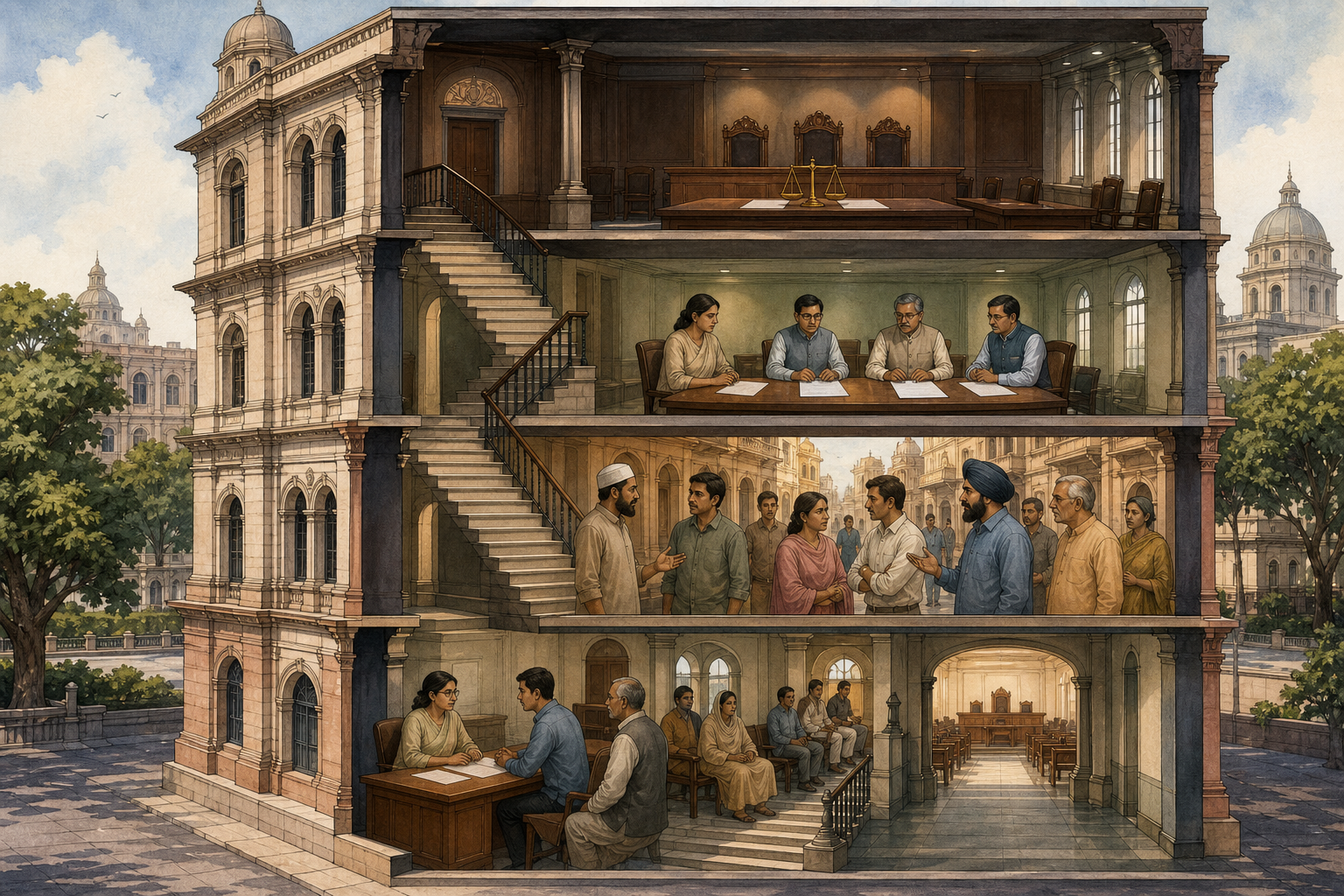
The same controversy can touch law, administration, society, and politics. Evidence from one layer may help explain another, but it cannot simply replace it.
| Layer | The question it answers | The common misreading |
|---|---|---|
| Constitutional rule | What freedom does India formally protect? | A strong guarantee does not prove perfect enforcement. |
| Official conduct | What did lawmakers, administrators, law enforcement, or courts actually do? | One official’s failure is not automatically a national design, but state action cannot be dismissed merely as private hostility. |
| Societal conduct | Did individuals or organized groups obstruct another community’s freedom? | Social hostility is not identical to government restriction, although the government’s response remains relevant. |
| Political rhetoric | What position, demand, or sentiment did a political actor express? | A harsh statement may be consequential without proving a nationwide legal condition. |
A judicial remedy may demonstrate that the system can correct an abuse, but it does not erase the original injury. Failure to obtain a remedy may expose an institutional weakness, but one failed case still cannot establish a nationwide pattern without evidence about comparable cases. Precision prevents both whitewashing and exaggeration.
One particularly important distinction is between political contestation and societal intolerance. A speech, campaign demand, local confrontation, discriminatory order, violent act, and judicial ruling are not interchangeable evidence. Record what happened before assigning it to a category. Then examine whether one layer caused or enabled another.
Systemic discrimination is not merely a synonym for a disturbing incident. The term implies a recurring disadvantage produced, enforced, or knowingly tolerated through rules or institutions. A serious systemic claim therefore needs both a pattern and a mechanism. But calling every event isolated is not a rebuttal either. Anyone using that word should show that recurrence, institutional involvement, and comparable cases were actually checked.
Make every national verdict earn its national scope

India’s religious life cannot be understood by treating the country as one undifferentiated neighborhood. Regional histories, jurisprudence, and community relationships differ, making disaggregated evidence essential. The lived position of a community can vary substantially by state and district even when the same Constitution applies.
Before accepting a claim about minorities in India, look for six fields that should be visible in the supporting evidence:
- Place: the state, district, or locality in which the event or pattern occurred.
- Community and right: who was affected and which protected freedom was implicated.
- Period: the interval covered, rather than a collection of events with no clear boundary.
- Actor and action: who did what, under which rule or asserted authority.
- Status: whether the matter remains an allegation, has been investigated, or has received an institutional or judicial determination.
- Response: whether law enforcement, a commission, administrators, or courts provided, denied, or delayed redress.
If figures are offered, ask what counted as an incident, how cases were selected, whether repeated entries were separated, and what comparison supports the conclusion. A national label drawn from a geographically concentrated set of cases may hide its own limits. A national average can commit the opposite error by concealing a severe local pattern.
Do not let methodological caution become a device for making a victim disappear. One violation can require investigation, protection, prosecution, or institutional reform even when it cannot characterize the whole country. Nor should a record of everyday harmony be used to disprove a documented local abuse. Scale determines the conclusion; it does not determine whether an injured person matters.
VHP contends that selected incidents have been expanded into sweeping conclusions while constitutional protections and domestic checks receive insufficient weight. That allegation creates a testable methodological demand; it is not a self-proving answer. Case-selection rules, definitions, geographic distribution, contrary evidence, and the handling of resolved and unresolved grievances should all be open to scrutiny.
Defenders of India should accept the same burden. If an event is said to be exceptional, show the basis for that judgment. Explain what remedy followed, whether similar complaints recur, and what institutional change was made where needed. An appeal to India’s size can explain complexity; it cannot excuse avoidable injustice.
Use dharmic pluralism as a duty, not an alibi
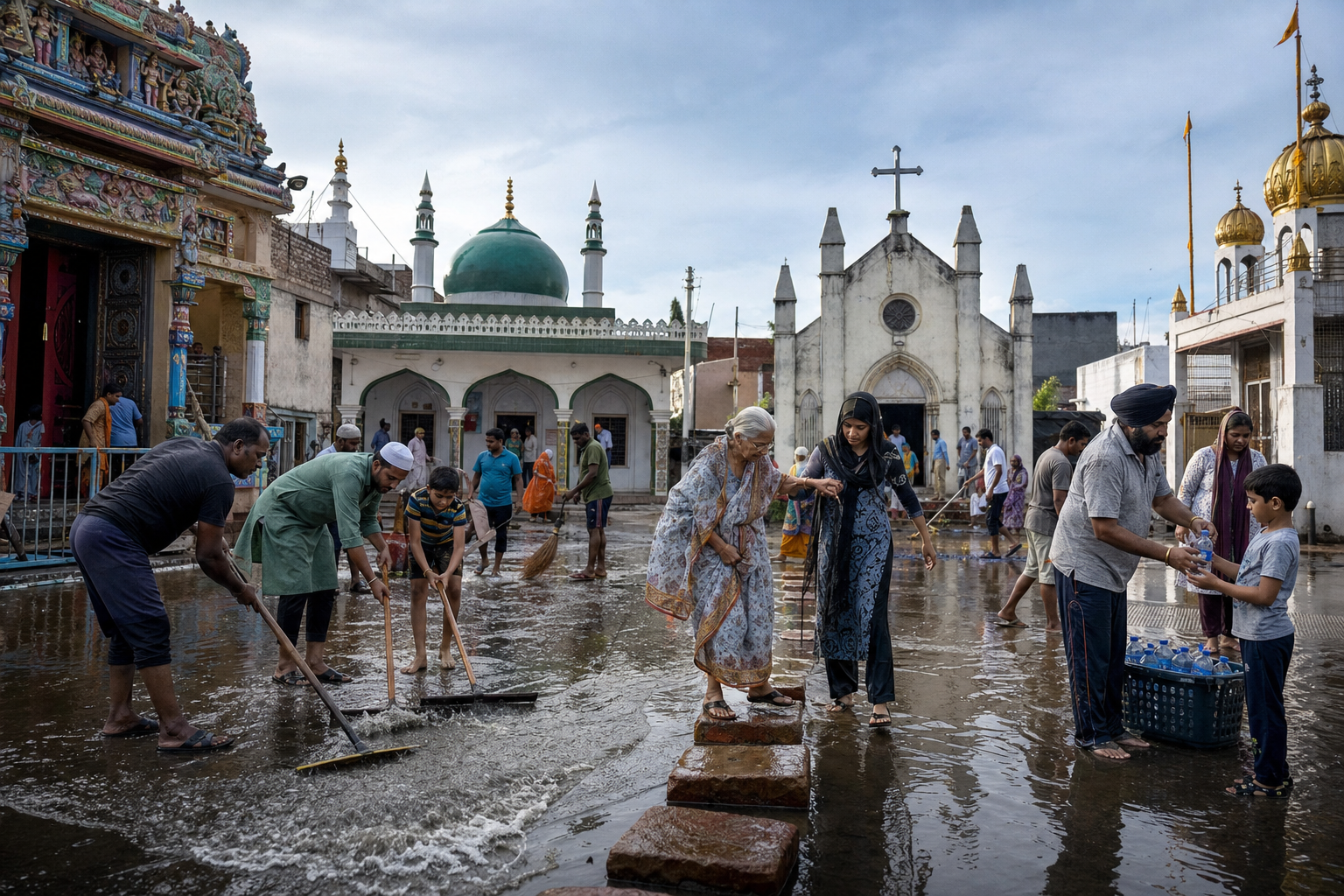
Bharat’s dharmic inheritance matters because it gives pluralism a social life beyond legal clauses. Hindu, Buddhist, Jain, and Sikh traditions have shared cultural space while preserving distinct paths, institutions, disciplines, and forms of worship. Debate and difference need not end in coercion.
You can still see that inheritance in gurdwaras serving langar without distinction, Buddhist viharas welcoming contemplation, Jain institutions supporting compassionate service, and Hindu festivals drawing participation from neighbors of different faiths. Schools, local committees, and neighborhoods can also create ordinary habits of cooperation that rarely enter international controversy.
These practices are evidence of social capacity. They show that coexistence is not merely an imported policy vocabulary. They also reveal institutions and habits that communities can strengthen when tension rises. But cultural hospitality is not a substitute for enforceable rights. A meal open to everyone cannot answer an allegation that an official order denied someone equal freedom.
A confident pro-Hindu position does not require denial. It can insist that Bharat’s civilizational record be represented accurately while insisting just as firmly that an abuse of power be corrected. Equal dignity does not require the Hindu majority to apologize for its civilization, and civilizational confidence does not permit a minority grievance to be ignored.
The sound governing standard is accommodation without religious favoritism or religious penalty. That leaves room for a publicly visible religious culture while asking a decisive civic question: did the state protect each person’s conscience and apply its institutions fairly?
Interfaith dialogue is most useful when it is tied to responsibility. A district or state forum should identify whether a dispute is legal, administrative, or social; record agreed follow-up; and communicate non-sensitive outcomes. Dialogue must not replace law-enforcement or judicial action where a legal violation is alleged. Its role is to prevent needless escalation, keep communication open, and expose recurring problems before they harden.
Key takeaways: five tests to apply before accepting a verdict
- Check the right: begin with Articles 25-30 and identify the particular freedom at issue.
- Classify the evidence: distinguish constitutional law, official conduct, social behavior, political rhetoric, and remedial action.
- Match scope to proof: do not turn one locality into all of India, or use a national average to conceal a local pattern.
- Audit the remedy: ask what the responsible institution did after the grievance arose, not merely whether an institution exists.
- Use one standard: demand transparent methods from international evaluators, Indian governments, advocacy groups, media organizations, and defenders of every community.
India can make that standard easier to apply. Periodic public white papers on religious-freedom indicators, community-led audits of grievance redress, non-discrimination training for law enforcement, and structured district- and state-level interfaith platforms would turn broad assurances into evidence that citizens can inspect.
Credible evaluation also requires replicable definitions, disaggregated datasets, and engagement with Indian scholars, dharmic leaders, civil-society monitors, and minority representatives. No one constituency can stand in for India’s entire social fabric. Wider participation is not a request for favorable treatment; it is a safeguard against selective vision.
The next time you encounter a sweeping verdict about religious freedom in India, write down the right, actor, place, evidence, and remedy. If those elements support the conclusion, take it seriously and demand correction. If they are missing, ask for them before you forward the claim. That discipline serves Bharat better than reflexive outrage or reflexive shame.
References
