

Your child tells you that a class discussion made a family practice sound primitive. Your first impulse may be to correct the teacher, correct the textbook, and deliver a civilizational rebuttal before dinner. Slow the sequence down. If you react before you know what happened, your child may learn that identity questions are too dangerous to discuss honestly.
Your aim is larger than winning a classroom dispute. You want a child who understands the family tradition, tests claims carefully, speaks without shame, treats other traditions fairly, and remains academically capable. That kind of Dharmic confidence grows through school choice, teacher engagement, home learning, intellectual discipline, and repeated family practice.
When a lesson unsettles your child, diagnose before reacting
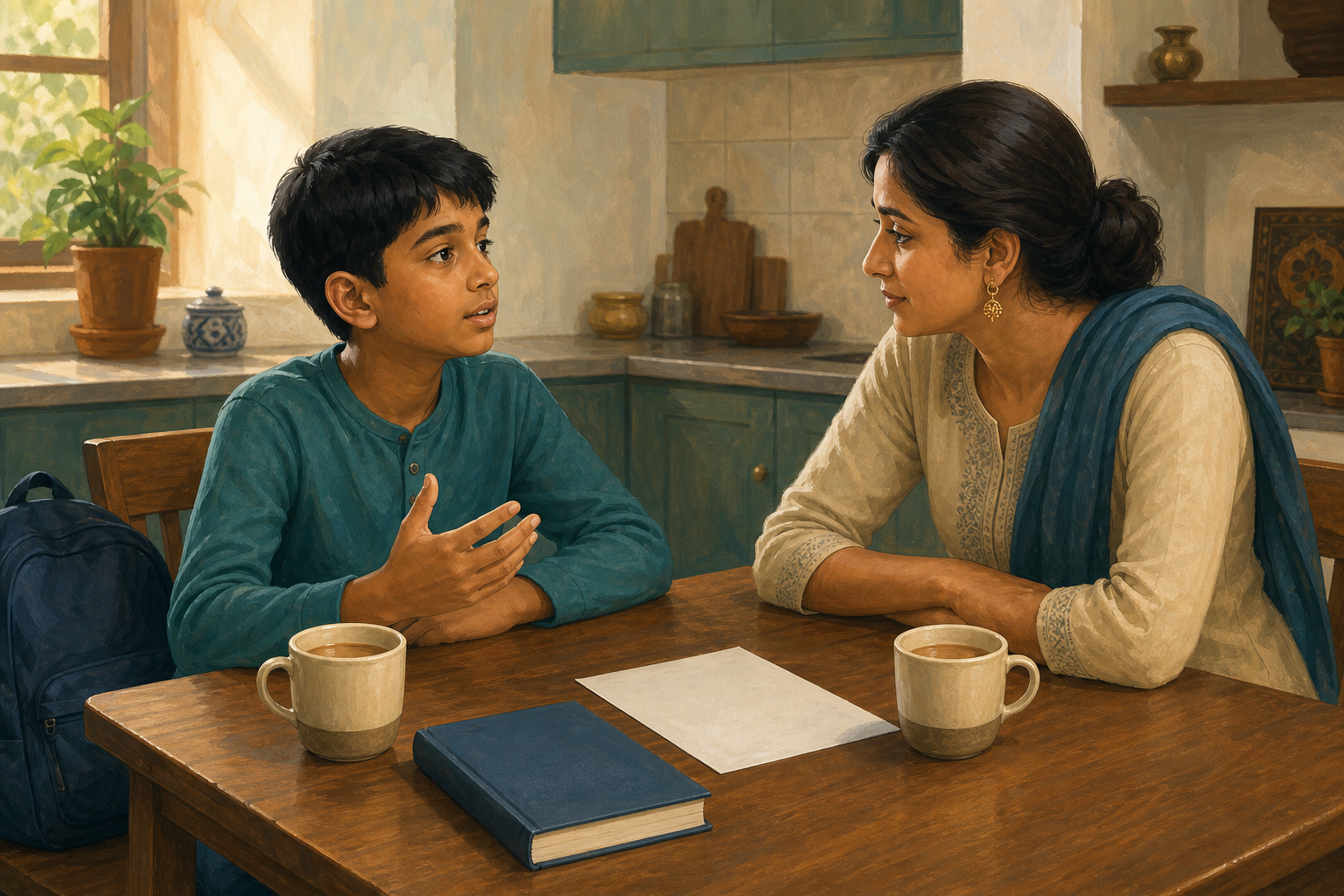
Begin with the exact classroom event, not the larger political argument it reminds you of. Children often report the emotional meaning of an exchange before they can reconstruct its words. That does not make the feeling unimportant. It means you need to separate what was taught, how it was framed, how other students responded, and what your child concluded.
Ask calmly:
- What exact claim do you remember?
- Was it in a textbook, an assignment, a teacher’s explanation, or a classmate’s comment?
- Was the claim presented as a fact, an interpretation, or a personal opinion?
- What did you think it meant about our family or tradition?
- What would you like to happen next?
Do not interrupt each answer with a correction. You are trying to recover the event and keep your child talking. Once you understand it, decide which problem you actually have.
- Omission: Important context was absent, but nobody was demeaned. Supply the missing context at home and, if it affects the lesson substantially, offer the teacher a relevant question or resource.
- Oversimplification: A complex tradition was reduced to a slogan or a single social practice. Help your child identify what the simplification leaves out, then ask the teacher how the topic will be developed.
- Legitimate disagreement: The class examined a criticism your family rejects. Teach your child to answer the criticism with evidence rather than treating its existence as an insult.
- Disrespect or targeting: A practice, community, or student was mocked or singled out. Record the wording, material, date, and response. Address it through the school’s written concern process instead of making your child fight the matter alone.
A useful first message to a teacher is brief and factual: My child understood the lesson to mean that this tradition is being described in this particular way. Could you share the learning objective and the material used? I would appreciate a conversation about the context and how students are expected to evaluate competing interpretations.
This wording does three things. It checks whether your child’s account is complete, asks for evidence, and gives the teacher room to respond without public defensiveness. If the explanation resolves the concern, say so. If the same problem continues, preserve the correspondence and move through the school’s established process. If your child is personally targeted, use the school’s safeguarding or discipline route rather than treating it as an ordinary debate over curriculum.
Do not send a young child back as the family’s spokesperson. A child may ask a respectful question, but responsibility for the adult conversation belongs to you. The lesson you want to teach is that unfairness can be addressed with precision and self-command.
Build academic competence and civilizational continuity together
Dharmic identity cannot rest on grievance. A child who knows that something important was omitted but cannot read closely, calculate reliably, write a coherent explanation, or distinguish evidence from assertion remains vulnerable to every confident voice. Academic competence is therefore part of cultural self-respect, not a rival to it.
Keep the foundations non-negotiable
Use schoolwork to notice the actual skill beneath a grade. Can your child explain a paragraph in their own words? Can they show the reasoning behind an arithmetic answer? Can they organize a written response so another person can follow it? Can they place a historical claim in context instead of merely repeating a conclusion?
A durable home routine can include daily reading in the mother tongue and English, arithmetic fluency, clear handwriting or presentation, biographies, epics, historical materials, and visits to libraries, archives, or museums. The point is not to duplicate school. It is to make the child capable of examining what school presents.
Ask for explanation rather than recitation. After a reading, invite your child to state the main claim, identify the strongest evidence, and name what remains uncertain. This works for a history chapter, a scientific explanation, a newspaper item, and a passage from a traditional text. Using the same intellectual standard across subjects prevents critical thinking from becoming a weapon used only against disfavored ideas.
Give belonging a regular place in family life
Continuity is built through repetition. Shared meals, recitation, reflection, simple ritual, and conversation make the tradition part of ordinary life. Weekend learning can include Samskritam, Pali, Prakrit, Gurmukhi, another family language or script, temple and heritage visits, classical arts, nature study, or seva. Choose practices that belong naturally to your lineage and household rather than collecting disconnected cultural activities.
Do not turn Dharmic learning into a second examination system. If every story ends in a test and every ritual becomes an obligation enforced by anger, the child may associate heritage with performance for parental approval. Let participation deepen gradually. Explain what a practice means, demonstrate how it is done, and allow sincere questions.
Hindu, Buddhist, Jain, and Sikh traditions are not interchangeable. A shared Dharmic vocabulary can still emphasize inner discipline, compassion, truth-seeking, non-harm, responsibility, and room for more than one perspective. Pair that common ground with knowledge of your family’s particular sampradaya, teachers, texts, practices, and history. Pluralism becomes meaningful when a child has a place from which to meet others.
Teach a repeatable method for contested claims
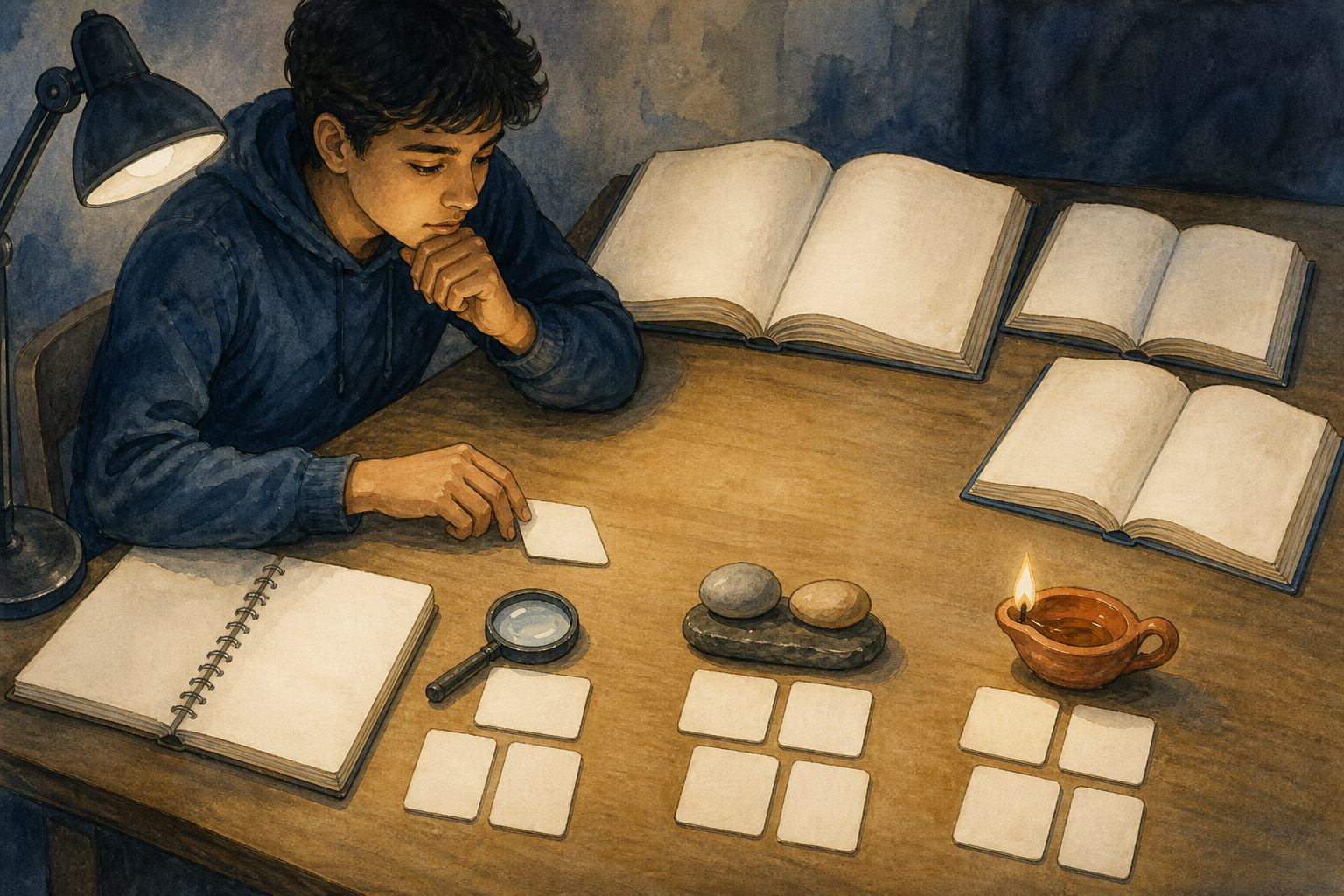
A child does not need a memorized rebuttal for every possible criticism of Bharat or a Dharmic tradition. Such lists age badly and can produce brittle confidence. Give the child a method that works even when neither of you knows the answer yet.
- Capture the claim precisely. Replace a vague complaint about what everyone thinks with the actual sentence, image, assignment, or proposition under discussion.
- Classify it. Is it a verifiable fact, an interpretation of facts, a moral judgment, a definition, or a prediction? Different kinds of claims require different kinds of support.
- Inspect the evidence. Ask what material supports the claim and whether the class has seen it. A citation is a starting point, not a substitute for understanding.
- Move toward primary material. When possible, examine the text, record, image, data, or testimony being interpreted. Then ask what context, translation choices, or selection decisions may affect its meaning.
- Compare serious alternatives. Look for more than a mirror image of the first position. A credible alternative should explain the evidence, acknowledge inconvenient facts, and be open to correction.
- Form a proportionate conclusion. Say what appears well supported, what remains interpretive, and what you still need to know. Not every inquiry ends with certainty.
Apply this method symmetrically. A flattering claim about ancient Bharat does not become true merely because it restores pride. An unflattering claim does not become false merely because it causes discomfort. Intellectual integrity protects Dharmic confidence from both fashionable contempt and careless exaggeration.
Teach your child to work within the academic task as well. Read the prompt. Answer the question. Meet the stated criteria. Distinguish between describing a position and endorsing it. If relevant evidence or another interpretation belongs in the response, introduce it clearly and support it. Turning every assignment into a manifesto usually obscures the strongest point and can leave the underlying academic skill undeveloped.
Treat social media as an attention system, not an authority
Online identity debates intensify the classroom problem because sensational content, grievance, outrage, and compressed slogans attract attention while nuance disappears. A label, hashtag, screenshot, or viral clip may tell your child what to feel before it provides enough material to know what happened.
When a disputed item enters the family conversation, use a simple media check:
- State the exact claim without the inflammatory caption.
- Locate the original material when it is available rather than relying on a cropped screenshot.
- Separate what is visible from what the caption infers.
- Ask what evidence would weaken the claim as well as what would support it.
- Delay sharing until the claim has been checked.
Support that method with digital hygiene: defined time boundaries, deliberately chosen accounts, shared discussions, and a scheduled media sabbath. Explain the reason. The aim is to reclaim attention and judgment, not to hide competing views. A teenager who understands how an outrage cycle captures attention is better prepared than one who merely loses access to a device and waits to regain it.
Change your intervention as your child grows
The same parental response will not work from primary school through university. Younger children need security and concrete explanations. Adolescents need methods, boundaries, and room to test ideas. Older students need intellectual peers, meaningful work, and responsibility for their own practice.
Primary years: protect confidence without creating fear
At this stage, a textbook, assignment, or teacher may become the child’s default authority. When India or a family practice is presented without depth, correct the impression at home in language the child can understand. Add a story, image, biography, visit, or short passage that supplies the missing context. Then handle any necessary teacher conversation yourself.
Avoid teaching that school is hostile by definition. That can make a child afraid to ask honest questions or eager to detect insults everywhere. A steadier message is: teachers and books can be incomplete; we listen carefully, check what is true, and respond respectfully.
Adolescence: combine argument skills with self-mastery
Teenagers encounter stronger peer pressure, ideological labels, and online identity contests. Let them examine difficult positions without treating every disagreement as disloyalty. Ask them to present the strongest version of a view before criticizing it. Also ask them to identify where their preferred side may be overstating its case.
Peer circles matter here. A group organized around serious reading, language learning, classical arts, seva, or reflective practice offers belonging without requiring constant outrage. It gives the adolescent something to build, not only something to oppose.
Sensitive life education requires the same combination of accuracy and cultural grounding. Ask what will be taught, at what developmental stage, with what learning objective, and through which materials. Continue the conversation at home using clear language about dignity, consent, health, responsibility, self-mastery or samyama, non-harm or ahimsa, and mutual respect. Silence leaves the child’s framework to peers and media; panic makes truthful questions harder to ask.
Senior secondary years: connect study with purpose
Do not rank science, commerce, and humanities as if only one path can express intelligence or serve Dharma. Judge a stream by the student’s aptitude, the competence it can develop, the ethical responsibilities of the field, and the contribution the student hopes to make.
Connect coursework with India’s knowledge traditions where the connection is genuine. Mathematics, astronomy, linguistics, aesthetics, and philosophy can open paths into civilizational history without replacing the modern discipline being studied. Encourage projects that require academic skill and produce some real benefit for a community. The student should learn that heritage can generate questions and standards of conduct, not merely decorative references.
University years: look for disciplined independence
University can deepen inquiry or turn identity into a permanent adversarial performance. Warning signs are not simply changed opinions. Notice whether online outrage is replacing reading, whether activism produces neither scholarship nor service, whether contempt has replaced curiosity, or whether core skills and responsibilities are being neglected.
Do not answer every ideological shift by trying to control an adult student’s conclusions. Ask better questions: What have you read in full? What is the strongest counterargument? Which evidence changed your mind? What work have you produced? Whom has your activity served? These questions make intellectual responsibility visible.
Useful supports include mentors, guided reading groups on Indian intellectual traditions, internships, community seva, Yoga, meditation, mindfulness, and reflective practice. The combination matters. Study without inner discipline can become vanity; practice without study can become credulity; activism without useful work can become performance.
Make school choice and family habits part of one system

No school will transmit your family’s whole civilizational inheritance. A school can, however, make careful inquiry easier or harder. When selecting a school or reconsidering an existing one, look beyond branding and examination results.
- Ask how parents can inspect curriculum materials and raise a concern.
- Ask how teachers handle respectful disagreement over history, religion, culture, or ethics.
- Look for evidence that reading, numeracy, writing, presentation, and historical understanding receive sustained attention.
- Find out whether family religious and cultural practices are treated with ordinary respect.
- Ask how digital citizenship and sensitive life education are made transparent and developmentally appropriate.
- Notice whether the school’s actual response to a difficult question matches its public language about inclusion and inquiry.
School selection is only one part of the system. Home provides continuity. Teachers provide instruction and feedback. Mentors and peers widen the circle of serious learning. Community service turns values into responsibility. Digital boundaries protect attention. When one part is weak, strengthen the others instead of expecting a single institution to do everything.
Measure progress through behavior rather than slogans. Can your child explain a practice in their own words? Ask for evidence without becoming aggressive? Admit when a favorable claim is weak? Complete demanding academic work? Treat another tradition with the fairness they expect for their own? Return from a disagreement without either shame or contempt? These are signs that identity is becoming durable.
Key takeaways
- Recover the exact classroom claim before deciding whether you face omission, oversimplification, disagreement, or disrespect.
- Pair Dharmic continuity with strong reading, numeracy, writing, historical awareness, and evidence-testing.
- Teach a method for examining claims instead of handing your child a catalog of predetermined rebuttals.
- Use daily family practices, weekend learning, serious peers, and seva to make belonging concrete.
- Change your role with age: guide younger children, coach adolescents, and expect disciplined independence from university students.
- Work with teachers calmly, but use formal school processes when a pattern continues or a child is personally targeted.
Begin with the next ordinary school conversation. Ask your child to show you what was taught, listen without supplying the answer, and decide on the smallest honest response: add context at home, ask the teacher for clarification, challenge a supported concern, or accept that a legitimate disagreement occurred. Repeated calmly, that habit prepares a child to carry Dharma into modern institutions without surrendering either discernment or dignity.
References
