
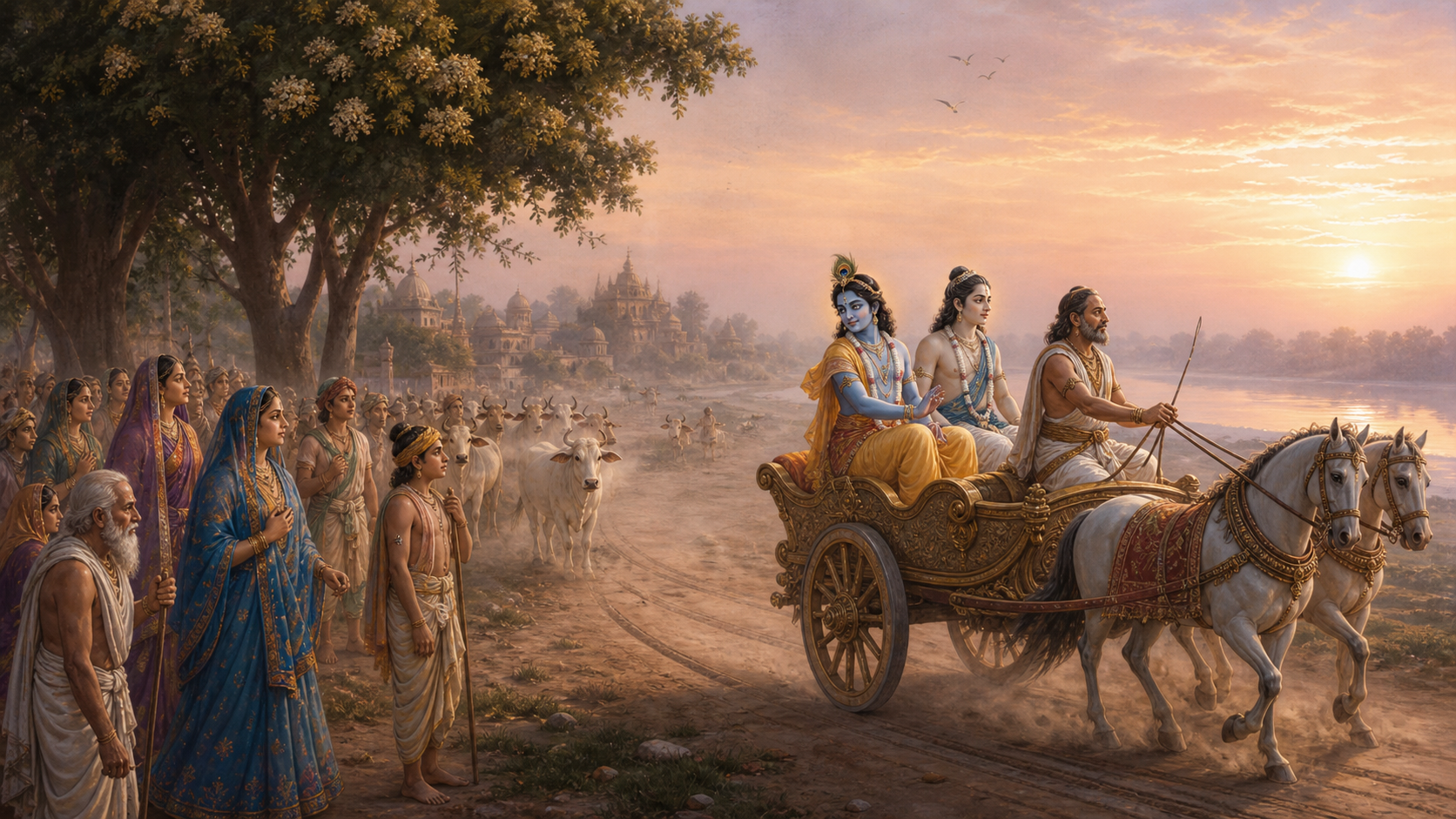
If Krishna loved Vrindavan so completely, why did he leave? That question troubles many devotees because the departure can look like abandonment: the one at the centre of Braja’s life goes away, while those who love him remain behind in unbearable separation.
The scene becomes clearer when you stop treating love and duty as opposites. Krishna’s movement from Vrindavan to Mathura does not declare Vrindavan unimportant. It shows that genuine love cannot become an excuse to avoid a wider dharma. At the same time, the grief of those left behind is not dismissed as weakness. Their separation reveals what their love had always been made of.
Krishna leaves a place, not the love formed there
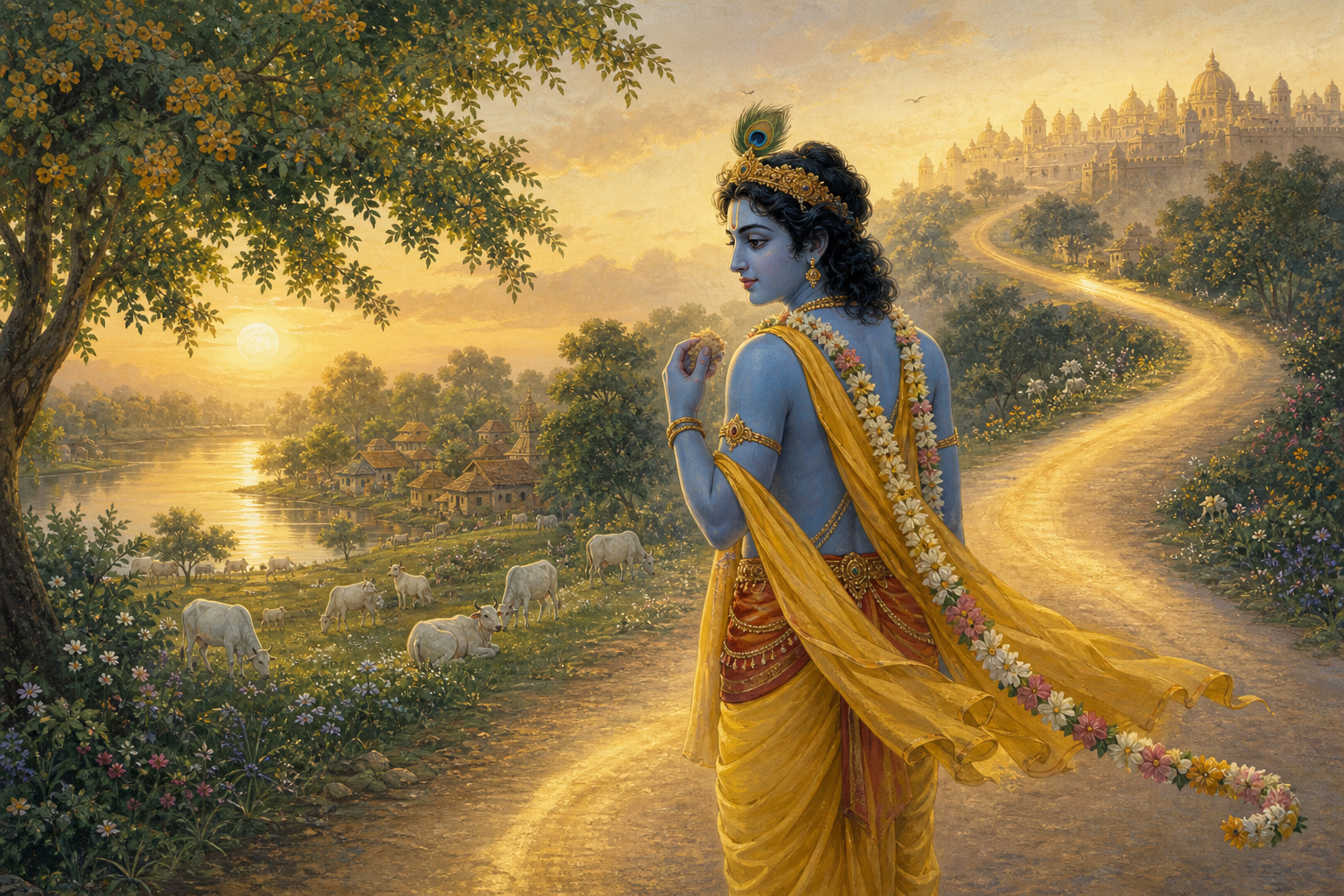
Vrindavan is the world of intimate relationship. Krishna is known there through affection rather than status: as Yashoda’s child, Nanda’s son, the companion of the cowherds, the beloved of the gopis and the joy of the cows and calves. Mathura represents a different field of action. The movement between them is therefore more than a change of location. It is a passage from protected intimacy into public responsibility.
That does not make Vrindavan a childish stage that Krishna must outgrow. Such a reading misses the sacred force of the departure. The love of Braja is not discarded when public duty appears. It is what gives the departure its moral and emotional cost. If Krishna felt nothing for those he left, going would require no sacrifice and teach nothing about dharma.
The anguish is deliberately shown through the whole community: Yashoda weeps, Nanda is unable to speak, the cows and calves abandon their fodder, and even the Kadamba trees seem to wither. Braja does not respond as a backdrop from which a hero conveniently departs. Its people, animals and trees participate in the separation because Krishna’s presence had bound the entire place together.
When you contemplate this moment, notice what the pain proves. It proves the reality of attachment, not the failure of love. Departure changes the form of the relationship; it does not erase the relationship or make the years in Vrindavan disposable.
Why dharma may require leaving what is most beloved
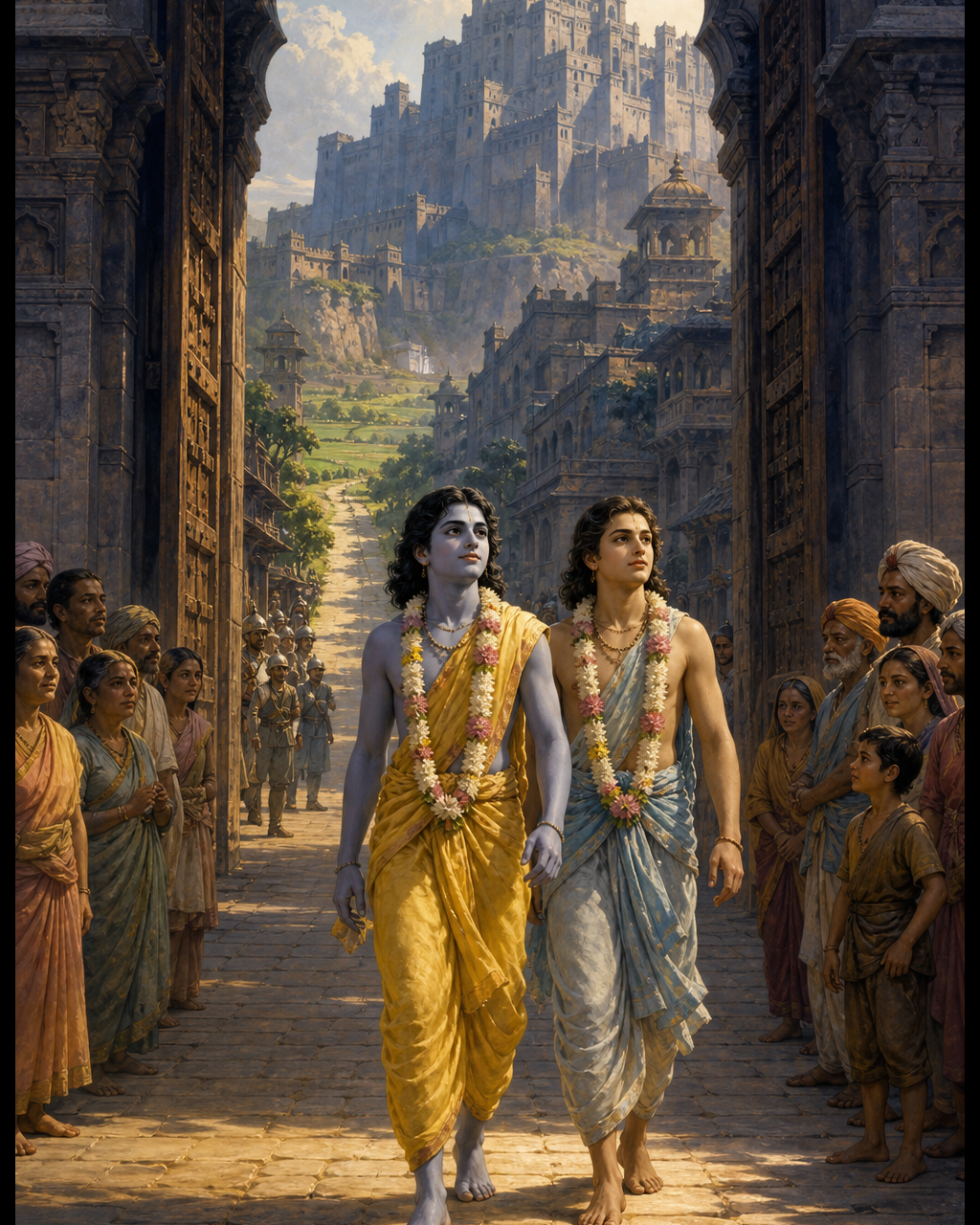
The easy interpretation is that Krishna leaves comfort for responsibility. That is broadly right, but the word “comfort” needs care. Vrindavan is not merely pleasant or safe. It is his home within a web of real obligations and affections. The lesson is not that spiritual maturity requires contempt for home. It is that even a sacred home cannot become the boundary of one’s concern when dharma calls beyond it.
This distinction matters in your own decisions. A desire to escape discomfort is not automatically dharma. Neither is ambition made holy by calling it a mission. Before using Krishna’s departure as a model for a major choice, ask four exact questions:
- What responsibility cannot be fulfilled if you remain where you are?
- Who will bear the cost of your departure, and which part of that cost can you reduce?
- Are you moving toward a defined duty, or merely away from an uncomfortable relationship?
- Which existing obligations continue after you leave, even if their form must change?
These questions protect the teaching from a common misuse. Krishna’s departure cannot serve as a spiritual licence for ordinary people to neglect dependants, break promises or romanticise avoidable harm. Human beings do not possess divine knowledge of every consequence. Our dharma must therefore include accountability, honest communication and care for those affected by our choices.
Sometimes the right decision still hurts. In that case, pain is not by itself proof that the decision is wrong. But pain does impose duties: acknowledge it, avoid false promises, provide what support you reasonably can and do not demand that others celebrate your departure simply because you believe it is necessary.
Separation turns affection into viraha bhakti
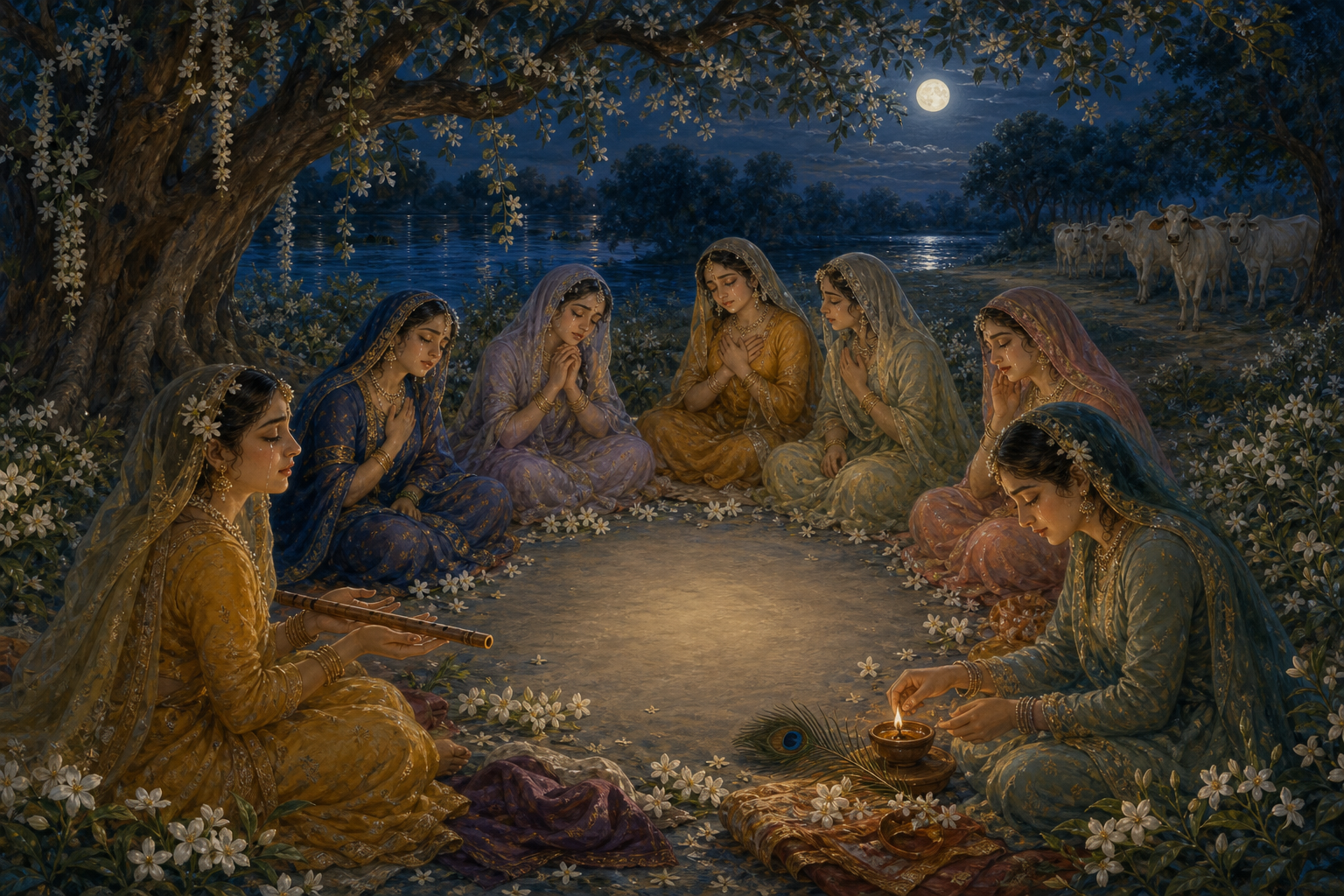
Viraha means separation from the beloved. In bhakti, it is not simple absence or emotional deprivation. The beloved who can no longer be encountered in the familiar way becomes continuously present in remembrance. Ordinary attention moves from one object to another; longing gathers attention around one centre.
This is why the sorrow of Braja should not be read as a pause in devotion until Krishna returns. The separation itself becomes a mode of devotion. The residents can no longer depend upon an immediately visible Krishna walking among them. They must live by memory, longing and unwavering relation. Love ceases to depend on convenient access.
That insight gives you a practical way to work with spiritual dryness. When prayer no longer produces the feeling it once did, do not immediately assume that devotion has failed. Test whether your practice depended on receiving a particular emotion. Then shift from chasing the former experience to keeping a deliberate relationship:
- Name what feels absent instead of hiding the loss behind religious language.
- Choose one stable daily act of remembrance, such as a fixed period of nama-japa, prayer or reading.
- Connect remembrance to seva so that longing produces care rather than self-absorption.
- Judge the practice by steadiness and conduct, not only by emotional intensity.
This does not mean manufacturing sorrow. Viraha is not theatrical sadness, nor is every painful attachment automatically sacred. Its test is transformation. If longing makes attention more faithful, conduct more compassionate and the ego less demanding, it is functioning as devotion. If it becomes an excuse to neglect life, manipulate others or cultivate despair, it has lost that direction.
Four misreadings that obscure the departure
You can read the episode more carefully by refusing four tempting shortcuts.
- “If Krishna left, the love of Vrindavan was temporary.” Physical departure does not make the earlier relationship false. The intensity of separation shows the opposite: love remains active when proximity ends.
- “Dharma requires emotional detachment from everyone.” Krishna’s movement toward duty does not make the sorrow of Yashoda, Nanda or Braja irrelevant. Dharma can require action without requiring emotional coldness.
- “The residents of Braja should simply accept the divine plan.” Their grief is not corrected out of the story. Bhakti has room for tears, protest, longing and remembrance. Acceptance need not mean emotional numbness.
- “Leaving a familiar life is automatically courageous.” A departure becomes dharmic through the responsibility it serves, not through its dramatic appearance. Running away and answering a duty can look similar from a distance; their moral direction is different.
These corrections keep the scene from becoming either sentimental or severe. Sentimentality sees only the tears and forgets the duty. Severity sees only the duty and treats the tears as an obstacle. The departure holds both together. Krishna goes, and Braja grieves. Neither truth cancels the other.
Key takeaways
- Krishna’s departure from Vrindavan is best understood as an expansion of responsibility, not a rejection of love.
- Vrindavan is not demeaned as mere comfort; its sacred intimacy makes the cost of leaving meaningful.
- The grief of Braja reveals enduring devotion rather than spiritual failure.
- Viraha bhakti turns separation into disciplined remembrance, but it should deepen seva and conduct rather than encourage despair.
- In your own life, do not call a departure dharmic until you can name the duty it serves and the obligations that remain.
If you are standing before a necessary departure, do not ask only whether staying feels loving or leaving feels brave. Name the duty, name the cost and decide how you will continue to honour the people and commitments that formed you. That is the practical discipline within Krishna’s journey: carry the truth of Vrindavan into the work that waits beyond it.
References
