
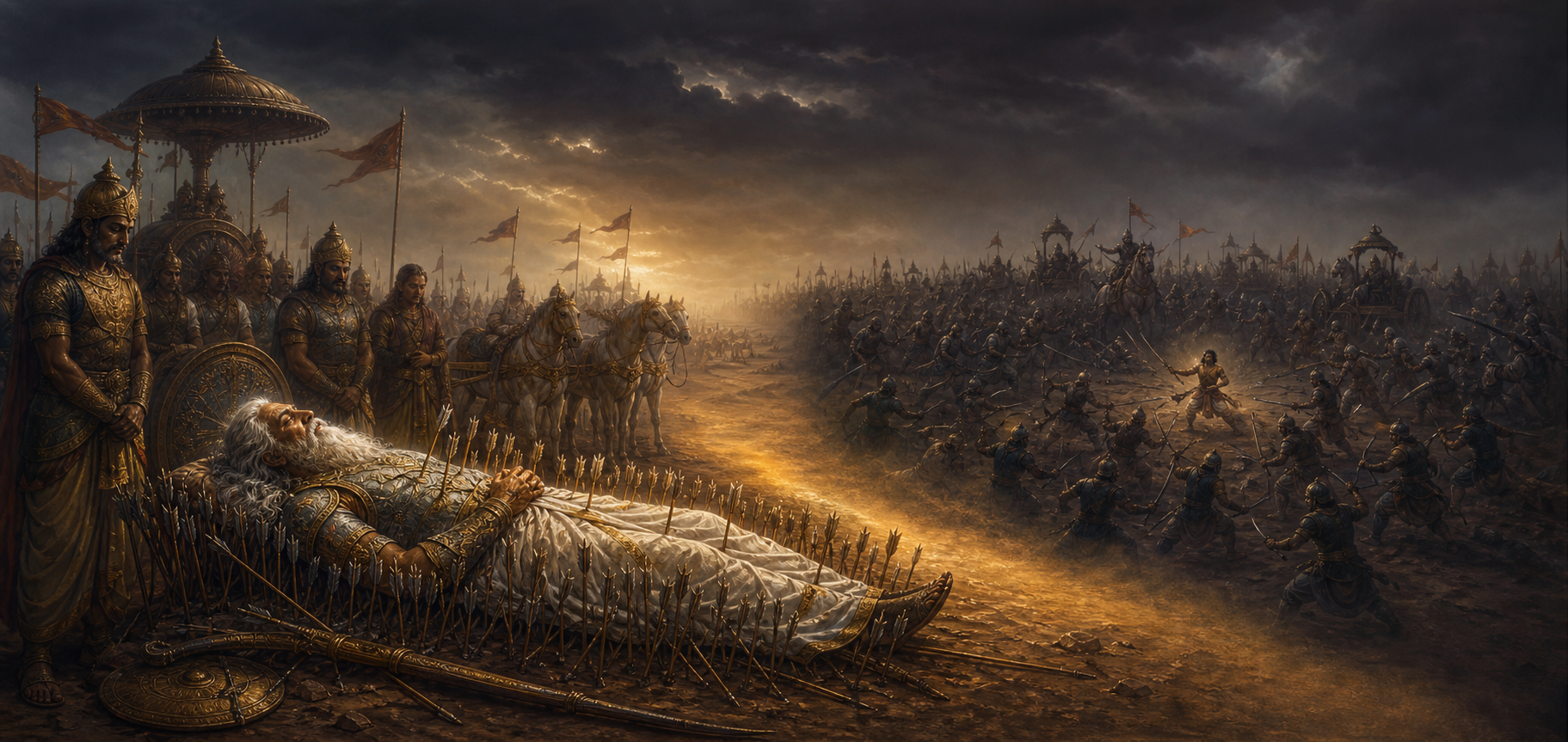
If you are trying to understand why Abhimanyu was killed only after Bhishma fell, the sequence matters. But it does not prove that Bhishma was secretly guarding him at every moment, or that one man’s removal mechanically caused the crime.
The stronger reading is about moral authority. Bhishma’s presence imposed a limit on what the army under his command could treat as acceptable. Once that limit disappeared, Abhimanyu’s killing exposed how quickly a war conducted under imperfect restraints could descend into collective adharma.
The timing is evidence, but not a complete explanation
Abhimanyu was Arjuna’s son and Sri Krishna’s nephew, but his celebrated lineage does not explain the timing of his death. Nor can we say that he faced no danger while Bhishma commanded. The fighting was already intense, and the consequences were already grave.
The essential fact is narrower: Abhimanyu survived the first ten days of the Kurukshetra War and was killed only after Bhishma’s fall. That contrast gives you the right question: what changed in the army’s conduct when its commanding elder was removed?
Chronology alone cannot establish a private conspiracy or a single motive. It does, however, reveal a change in the conditions under which decisions were made. Before Bhishma fell, the army fought beneath the gaze and authority of a man whose understanding of warrior conduct still mattered. Afterward, commanders and fighters encountered fewer effective restraints when military desperation pressed against dharma.
This distinction protects you from two opposite errors. The first is to romanticise the opening days as clean or harmless. They were neither. The second is to treat Abhimanyu’s death as just another casualty in an unchanged war. Its timing and manner show that something more than command personnel had shifted.
Bhishma’s real protection was a boundary around conduct
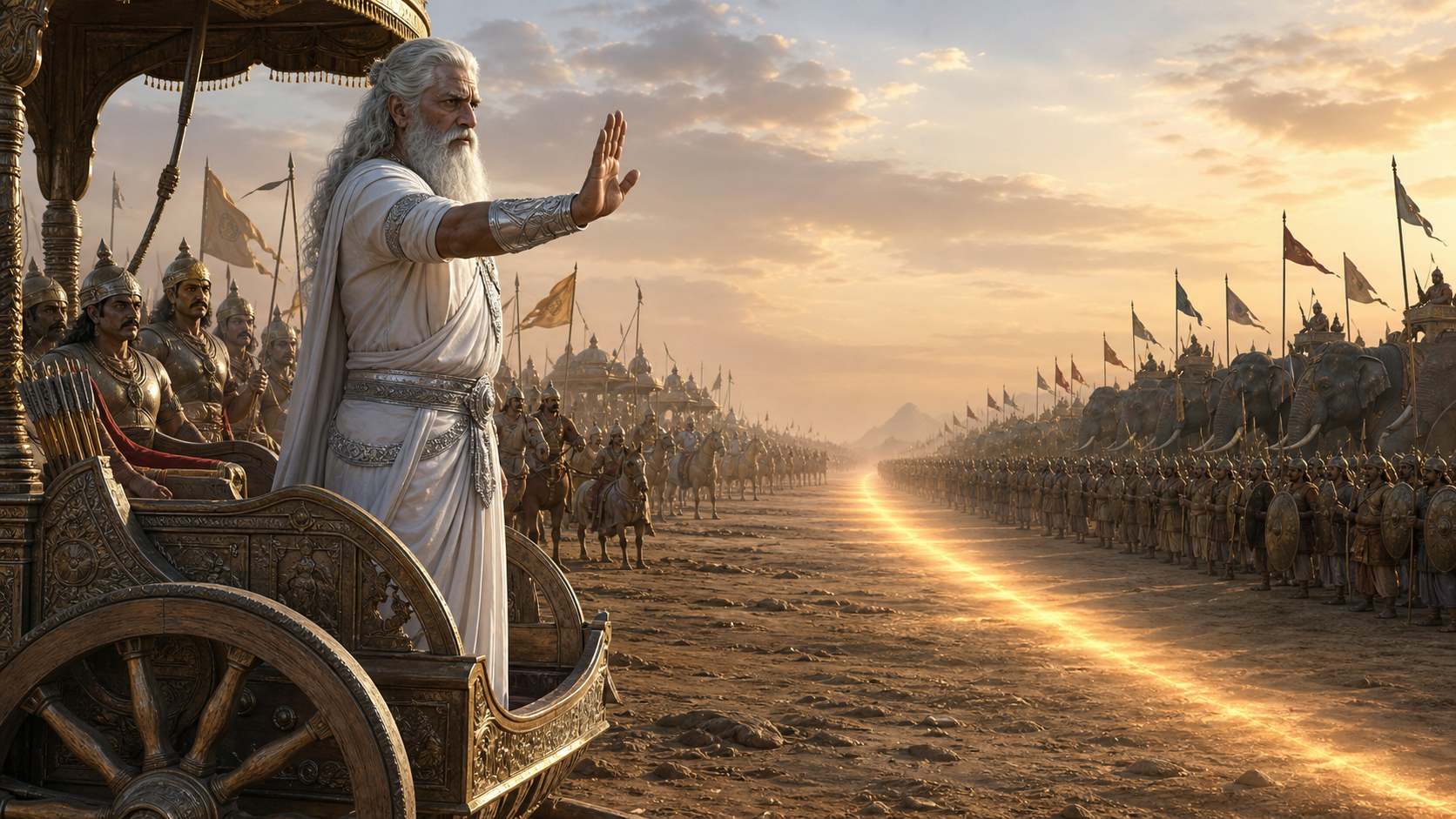
Bhishma did not need to stand beside Abhimanyu or intercept every weapon to function as a shield. A commander’s influence is often structural. He helps determine which tactics subordinates will propose, which violations they will fear, and which acts they believe can be defended before their peers.
That is the useful meaning of calling Bhishma a protection. His presence represented continuity with an older warrior ethic. He was not outside the war, and his participation did not make the battlefield righteous in every respect. Yet his authority made certain excesses more difficult to normalise.
Think of the difference between a rule written down and a rule embodied by a respected elder. The written rule can remain after the elder leaves, but its practical force may collapse. People who had obeyed because they respected the person may begin interpreting the rule according to immediate advantage. Conduct that was once unthinkable becomes debatable; what becomes debatable soon becomes possible.
Bhishma’s fall therefore did not create greed, fear, anger or desperation. Those forces were already present. It removed an important obstacle to their expression. When you read the transition this way, you can see why the next commander could inherit the army without inheriting Bhishma’s full moral authority. A title can be transferred in a moment. Reverence, legitimacy and restraint cannot.
Abhimanyu’s killing was a change in kind, not only degree
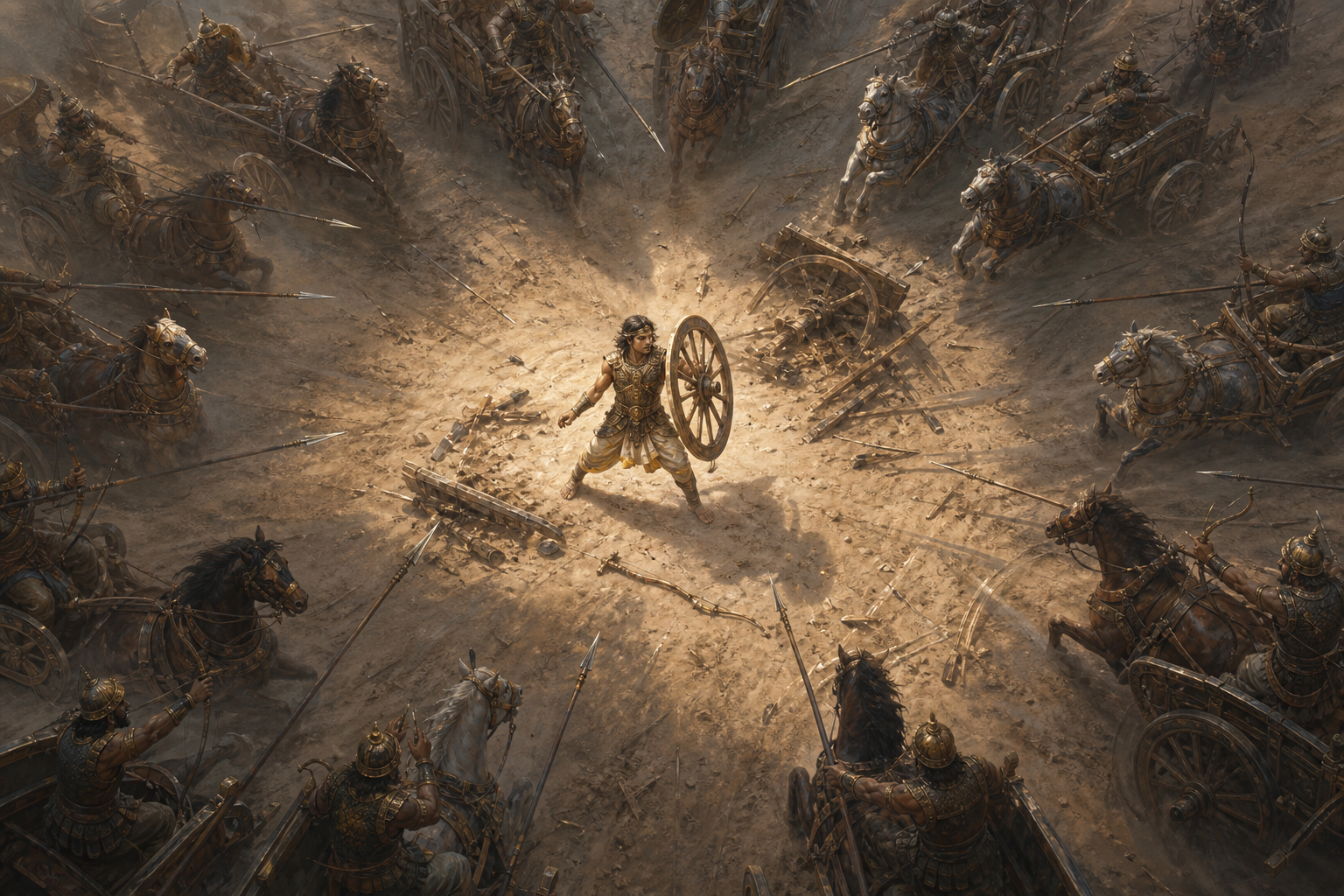
Death in battle is not automatically evidence of adharma. Abhimanyu entered the war as a warrior and accepted its mortal danger. If we object only because he was young, beloved or related to great figures, we weaken the ethical case. The decisive question is not whether he could legitimately be opposed. It is how he was opposed once he became isolated and vulnerable.
His opponents did not merely defeat a capable combatant in a fair contest. They used collective advantage against an isolated warrior after the protections associated with an honourable encounter had broken down. The wrong lies in that convergence: numerical power, vulnerability and the abandonment of restraint.
This is why Abhimanyu’s death carries a moral weight greater than an ordinary battlefield loss. The killing shows what happens when warriors stop asking, “Is this act worthy of us?” and ask only, “Will this remove the obstacle before us?” Strategy then ceases to operate inside dharma and begins treating dharma as an inconvenience.
You should also notice the role of collective action. A deed can become easier to commit when responsibility is dispersed. Each participant can imagine that another person initiated it, that command necessity required it, or that individual refusal would have changed nothing. Yet many people sharing an offence does not divide its moral seriousness into harmless portions. It multiplies the number of agents who chose expediency over restraint.
Abhimanyu’s killing thus becomes a diagnostic event in the Mahabharata. It tells you not merely that the war was becoming more violent, but that its participants were becoming willing to redefine permissible violence when victory seemed to demand it.
Read responsibility without turning Bhishma into an excuse

There is a temptation to tell the episode as a simple contrast: Bhishma was present and Abhimanyu was safe; Bhishma fell and wickedness took over. That version is memorable, but too neat. It can accidentally absolve everyone who acted afterward, as though they were helpless once the elder disappeared.
Bhishma’s absence explains a weakened restraint. It does not excuse the people who exploited that weakness. The distinction is crucial. Conditions influence conduct, while persons remain responsible for their choices within those conditions.
Nor should Bhishma’s restraining role erase the tragedy of his own position. An honourable person can lend legitimacy to a compromised institution simply by continuing to lead it. His personal limits may reduce immediate harm, but they may also conceal how dependent the institution has become on one exceptional conscience. When that conscience is removed, the underlying disorder becomes visible.
This gives you a more demanding way to read the epic. Do not sort its figures into flawless embodiments of dharma and permanent embodiments of adharma. Ask instead which duty each person recognised, which competing loyalty distorted that duty, and what boundary the person refused—or failed—to cross. The Mahabharata’s moral force lies precisely in these collisions between allegiance, authority, necessity and righteous conduct.
Military necessity is not a final moral answer in this framework. Calling an act necessary tells you why someone wanted it done; it does not establish that the act was dharmic. Whenever a character defends the method solely by pointing to the desired result, you should examine the method more closely.
Key takeaways for reading the episode—and recognising its lesson
- Start with the sequence. Abhimanyu survived the first ten days under Bhishma’s command and died after Bhishma fell. Treat that timing as evidence of a changed command climate, not as proof of an undocumented personal promise.
- Separate danger from wrongdoing. Abhimanyu’s presence in battle exposed him to legitimate danger. The moral breach concerns the collective exploitation of an isolated warrior and the collapse of limits on how victory could be pursued.
- Distinguish explanation from excuse. Bhishma’s absence helps explain why restraint weakened. It does not remove agency or culpability from those who chose the ensuing conduct.
- Look for embodied safeguards. A rule may appear stable when one respected person is enforcing it. To test whether the rule is real, ask what becomes permissible when that person leaves.
- Judge means as well as ends. A desirable victory cannot purify every method used to obtain it. Dharma is most revealing when obedience to it carries a cost.
The episode remains practical because the same pattern appears wherever authority and ethics meet. In a family, institution or public movement, identify the restraints that depend on one elder, leader or conscientious member. Then ask what would happen if that person were absent: who would still object, which procedures would still hold, and whether anyone could halt a collective wrong before shared participation made it seem normal.
That is the action Bhishma’s fall asks of you. Do not wait for the protector to disappear before discovering that the principle was never rooted in everyone else. Build the boundary into conduct while moral authority is still present, so that dharma survives the person who first gave it force.
References
