

You may be looking at footage of a vast scripture recitation, a temple announcement, or a mosque claim and wondering what it means at the ballot box. The quickest answer – religion has entered politics – is also the least useful. Your real task is to identify when devotion becomes organized political leverage, who is directing it, and what participants are being asked to do.
That distinction matters in Bengal because three highly visible developments have occupied the same political field: a Babri mosque foundation claim in Beldanga, a proposed Ram Temple initiative in Berhampore, and a Kolkata Bhagavad Gita recitation whose organizers put attendance as high as five lakh. They involve religion, but they are not politically equivalent. Treating them as a single wave conceals the differences a voter most needs to examine.
First separate worship, civic organization and electoral work
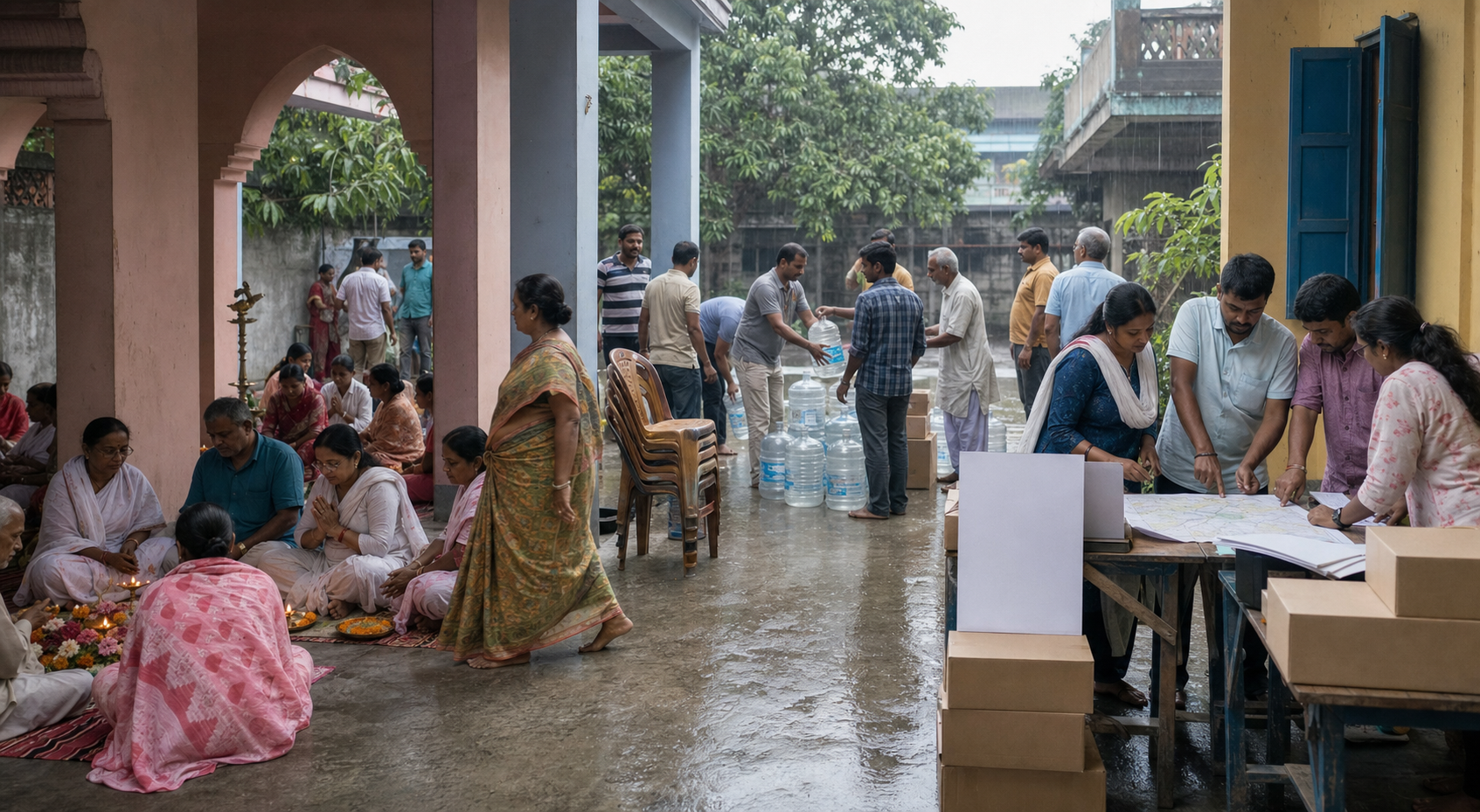
Religious mobilization is not simply religion conducted in public. A procession, recitation, temple campaign, pilgrimage, or community observance can remain devotional even when it attracts a large crowd. Political mobilization begins when religious identity is systematically converted into support for a party, candidate, policy, or adversarial bloc.
- Religious expression asks people to worship, study, commemorate, or sustain a sacred tradition.
- Civic organization uses religious association to build an institution, recruit volunteers, provide service, teach heritage, or care for a community.
- Electoral mobilization directs a religiously identified public toward votes, endorsements, party recruitment, campaign activity, or opposition to another community framed as a political unit.
Real events can contain all three layers. The practical question is which layer controls the stage, the money, the message, and the follow-up. If a gathering begins with prayer but ends with candidate endorsements and voter registration for one party, its devotional form does not erase its electoral function. Conversely, the presence of politicians in an audience does not automatically turn worshippers into a party cadre.
Use the event’s dominant ask as your first test. Were people asked to recite, donate, volunteer, build, vote, punish, boycott, or fear? A crowd’s size tells you how many people appeared. The ask tells you what the gathering was trying to make them become.
This distinction also protects legitimate Hindu public life. A democratic society does not have to make dharma invisible in order to resist cynical politics. It has to distinguish free religious association from attempts to exploit sacred loyalty without accountability.
The three flashpoints require three different judgments
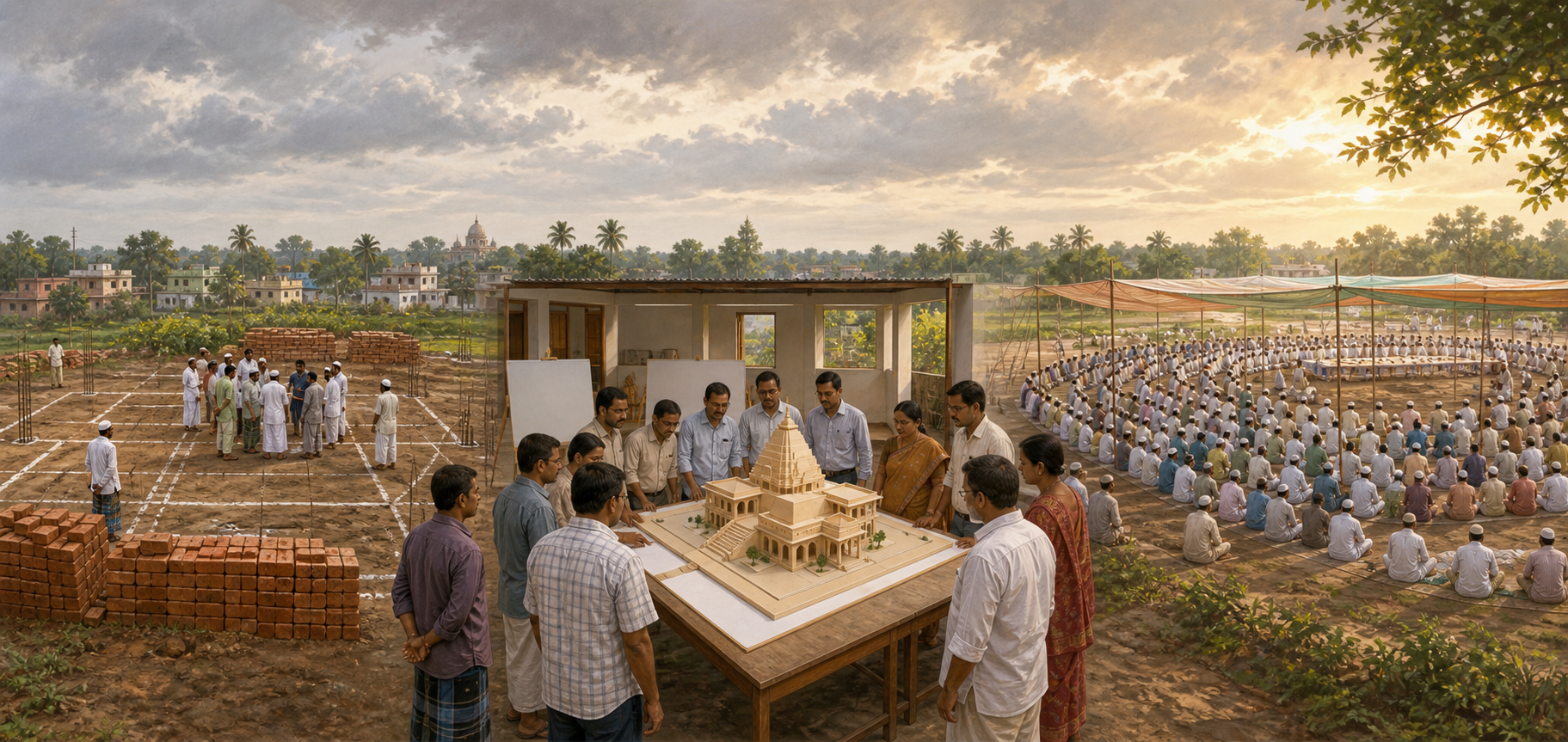
Beldanga: examine the office-holder, the date and the legal facts
The Beldanga controversy centered on TMC MLA Humayun Kabir’s claim about laying a Babri mosque foundation on 6 December, the anniversary of the Babri demolition. The political signal therefore came from a combination of elements: an elected office-holder, a proposed religious act, a historically charged name, and a deliberately resonant date.
That combination can generate political attention before a foundation is laid or a legal file is completed. Attention may itself be the immediate objective. The disciplined response is not to turn a provocative declaration into a claim that construction has already occurred, that every approval exists, or that an entire party has formally adopted the speaker’s position.
Before sharing a verdict, establish four separate facts: the speaker’s exact words in full context; the identity of the organization proposing the project; the status of the land and applicable approvals; and whether the statement represents personal positioning or official party policy. If one of those facts is unavailable, label it unknown. Do not fill the gap with inference.
Rhetorical judgment and legal judgment must also remain separate. A statement can be needlessly provocative without proving that a project is unlawful. A sacred purpose, meanwhile, does not exempt any project from lawful procedure. Keeping those tests separate prevents outrage from replacing evidence.
Berhampore: judge the Ram Temple drive by institutional design
The Berhampore initiative has been presented by supporters as a major Ram Temple project connected with heritage and community service. The word proposed matters. A proposal is an intention, not yet a completed institution, and an ambitious announcement should be assessed through the structure intended to carry it.
If you support the project, ask harder questions, not softer ones. Who holds responsibility for the land and construction? How will donations be recorded? Which body will govern the temple after the campaign moment passes? What urban, environmental, access, and safety requirements apply? Which promised community services have budgets, responsible officers, and timelines?
Those questions are not hostility to a temple. They are part of protecting it. A Ram Temple gains durable Hindu legitimacy when devotees can see that funds, procedures, architecture, worship, and seva are being handled competently. If the project survives only as a rallying slogan, politicians may receive the immediate benefit while the community inherits the unfinished obligation.
Watch the sequence. A serious institution normally moves from a defined promoter to lawful approvals, transparent finance, construction, a stable governing body, and sustained religious or social work. Electoral theatre reverses the priority: the dramatic announcement comes first, while the durable institution remains vague. Support the sacred purpose, but verify the civic machinery.
Kolkata: do not mistake devotional scale for transferred votes
The Kolkata Bhagavad Gita recitation offered a powerful public image, with organizers reporting attendance of up to five lakh people. That figure should remain identified as an organizer-reported estimate. More importantly, even a very large devotional assembly is not a vote count.
A participant may attend as a devotee, a student of the Gita, a member of a family or local association, a cultural Hindu, or a citizen affirming visible Hindu presence. Those motives can overlap without producing identical party preferences. Crowd arithmetic becomes electoral evidence only when there is a demonstrated conversion mechanism: endorsements from the stage, campaign recruitment, a voting appeal, collection of political contact data, or organized follow-up on behalf of a party or candidate.
Ask three questions. Who convened the gathering? What was said from the principal platform? What were participants asked to do after they went home? The first identifies organizational capacity, the second reveals the message, and the third shows whether the event was designed to endure as spiritual fellowship, civic service, or campaign infrastructure.
The ethical vocabulary highlighted around the recitation – seva, satya and dharma – gives organizers a standard by which to be judged. Did the gathering lead to service, education, disciplined conduct, and heritage literacy? Or did political actors merely reuse the crowd image as proof of support the participants never explicitly gave? The answer becomes clearer after the spectacle than during it.
Use seven tests before calling an event electoral
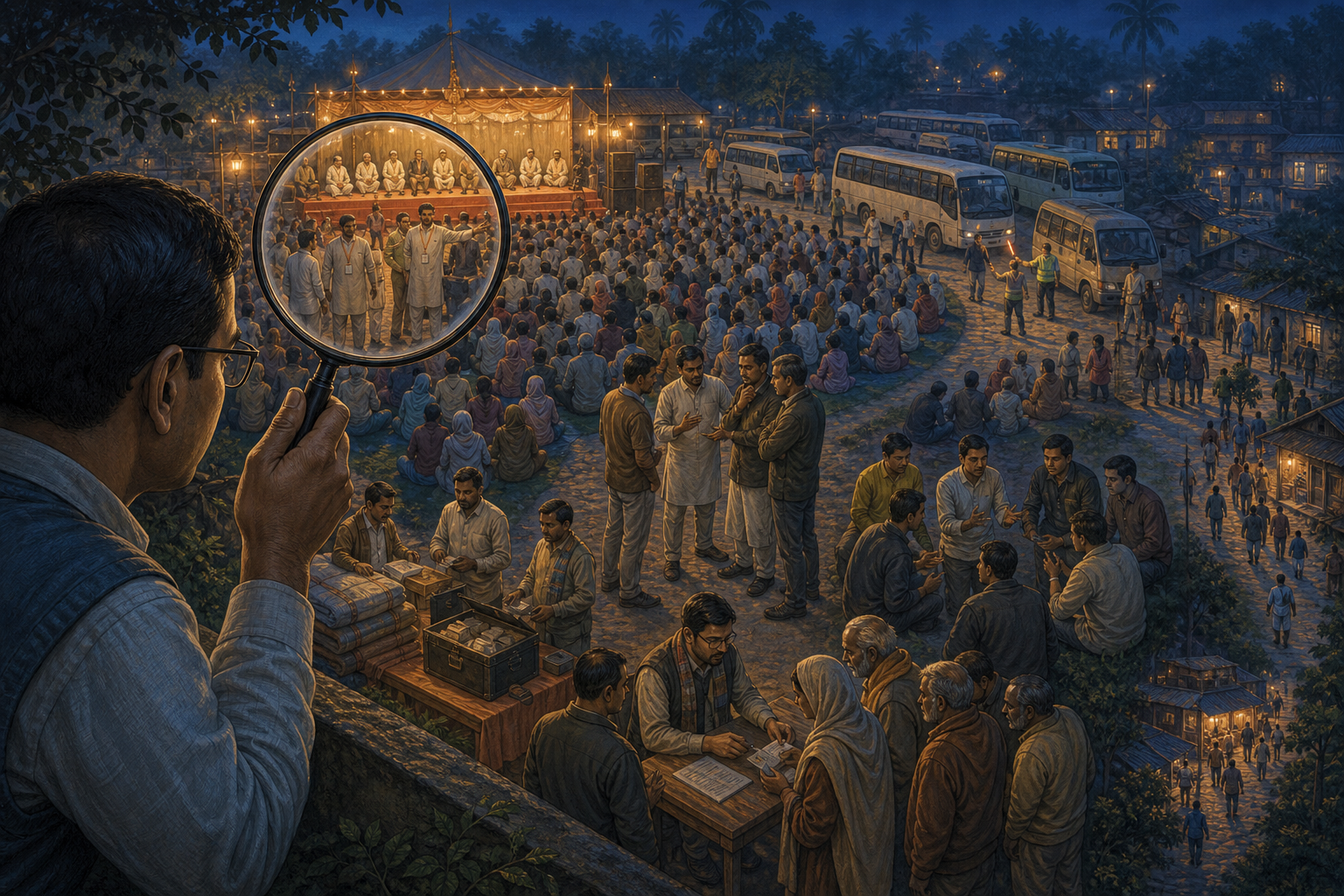
You do not need private polling or insider access to make a better initial judgment. Apply the same seven questions to a temple campaign, mosque declaration, scripture gathering, or inter-community observance.
- Who initiated it? Distinguish a religious trust, neighborhood committee, cultural association, elected representative, party organization, and temporary front. The formal organizer may not be the person exercising practical control.
- Why this date? A recurring sacred calendar date has a different logic from a date chosen for an electoral milestone, a disputed anniversary, or maximum confrontation. Timing does not prove intent, but it identifies the intent that needs examination.
- What was the primary ask? Prayer, study, donation, construction, volunteering, voting, and retaliation are different actions. Record the actual appeal instead of inferring it from the religious symbols around it.
- Who controlled the platform? Examine the principal speakers, banners, introductions, slogans, and closing instructions. A devotional program with an incidental political guest is different from a party event wrapped in religious imagery.
- How were rules and money handled? Permission status, funding records, land arrangements, crowd management, environmental safeguards, and a named grievance contact reveal whether public accountability is present.
- How were outsiders described? Affirming one’s own tradition is not the same as assigning collective guilt to another community. The move from cultural confidence to threats, humiliation, or collective punishment is a decisive warning sign.
- What remained afterward? Look thirty days beyond the event. A functioning service project, educational program, accountable institution, continuing worship community, voter-contact operation, or nothing at all will tell you more than the opening-day photograph.
This is not a mathematical score. It is a classification tool. An event centered on worship, lawful administration, transparent support, and continuing service is primarily religious or civic even if politicians try to associate themselves with it. An event controlled by a party, timed to activate conflict, and followed by voting instructions is electoral mobilization even if every banner carries sacred language. Where the evidence is mixed, call it mixed.
Also distinguish mobilization from polarization. Citizens may legitimately organize around religious identity in a democracy. Polarization occurs when leaders make political cohesion depend on hostility, fear, or permanent suspicion of another group. The first can deepen representation. The second makes every sacred occasion available for political escalation.
Apply one reciprocal standard to every party and project

For voters: keep three separate scorecards
Religious sympathy can make three judgments collapse into one. Do not let that happen. Keep a separate scorecard for the right to organize, the competence of the organization, and the electoral worth of the politicians seeking credit.
- Religious legitimacy: Is the activity faithful to its stated sacred or cultural purpose?
- Civic competence: Are permissions, funds, safety, governance, and promised services handled responsibly?
- Political performance: Has the party or office-holder demonstrated lawful administration, public order, service delivery, and accountability beyond the religious event?
Success on one scorecard does not answer the others. A moving Gita recitation does not prove that a party governs well. A lawful temple project does not require devotees to surrender their political judgment. An objectionable speech does not establish every unverified allegation surrounding a proposed mosque. This discipline denies politicians the easiest conversion of all: turning your reverence into an unexamined vote.
Both the TMC and BJP have incentives to frame visible religious activity in ways favorable to their electoral narratives. Your protection is reciprocity. Ask the same procedural questions when the project serves a tradition you cherish and when it serves one you distrust. Reciprocity does not declare all rhetoric morally equivalent. It ensures that your judgment rests on evidence rather than partisan exemption.
For organizers: make sacred legitimacy auditable
If you organize a religious event, publish a short factual note before speculation fills the gap. Name the responsible body, the event’s purpose, its funding method, its permission status, the rules for speakers, and a contact for grievances. For construction, add the governance structure and relevant land, planning, and environmental status. For a mass gathering, add the crowd plan, emergency access arrangements, and the method used for any attendance estimate.
If the event is nonpartisan, define what that means operationally. Decide whether party banners, campaign appeals, candidate endorsements, or political data collection are prohibited. Put the rule in writing and apply it to every party. A label such as cultural or spiritual will not protect the gathering if the platform behaves like a campaign rally.
Give participants a constructive next action. Volunteer service, education, youth dialogue and heritage literacy turn momentary visibility into social capital. They also make it harder for outside actors to reduce an observance to a communal headcount.
Ahimsa, karuna and satya resonate across Dharmic traditions without erasing their theological differences. In public life, they impose concrete disciplines: do not incite harm, do not dehumanize neighbors, and do not circulate a convenient falsehood for the sake of one’s side. Hindu confidence does not become stronger by borrowing the methods of provocation. It becomes credible through self-command, truthful speech, capable institutions, and seva.
For readers and publishers: preserve the status of every claim
Use small words that prevent large errors. Say proposed when a project has been announced but not completed. Say claimed when the evidence available is a politician’s declaration. Say organizer-reported when the crowd estimate comes from organizers. Say individual statement unless a party has formally adopted it. These labels are not evasions; they are the boundary between reporting a political event and enlarging it.
Before forwarding a provocative clip, find the full statement, date, location, and original uploader. Then ask whether the caption accurately distinguishes a plan from an accomplished act. If you cannot establish those basics, share your uncertainty rather than the allegation. Political entrepreneurs benefit when outrage travels faster than verification.
When speech moves from religious pride to a credible threat against people or sacred sites, do not seek a confrontation in a crowd. Preserve the full context and use appropriate lawful local channels. Public safety is not served by adding another unverified clip, rumor, or retaliatory gathering to an already charged situation.
Key takeaways
- Public religion becomes electoral mobilization when devotion is deliberately converted into votes, endorsements, campaign labor, or an adversarial political bloc.
- The Beldanga claim, Berhampore temple initiative, and Kolkata Gita recitation should not be treated as interchangeable merely because all three use religious language.
- An elected speaker, a charged anniversary, and an unfinished legal process require separate factual checks; one does not prove the others.
- A proposed Ram Temple deserves transparent finance, lawful compliance, durable governance, and a credible seva plan precisely because the project is sacred to its supporters.
- An organizer-reported crowd of up to five lakh demonstrates claimed scale, not automatic transfer of every participant’s vote to a party.
- The most revealing evidence often appears after the event: a lasting institution, service work, educational activity, electoral follow-up, or no follow-through at all.
When the next religious-political headline reaches you, make three columns: verified fact, political inference, and unanswered question. Do not allow a claim to cross from the third column into the first merely because it flatters your side. That one habit will help you defend both dharma and democratic judgment in Bengal’s increasingly charged public life.
References
