
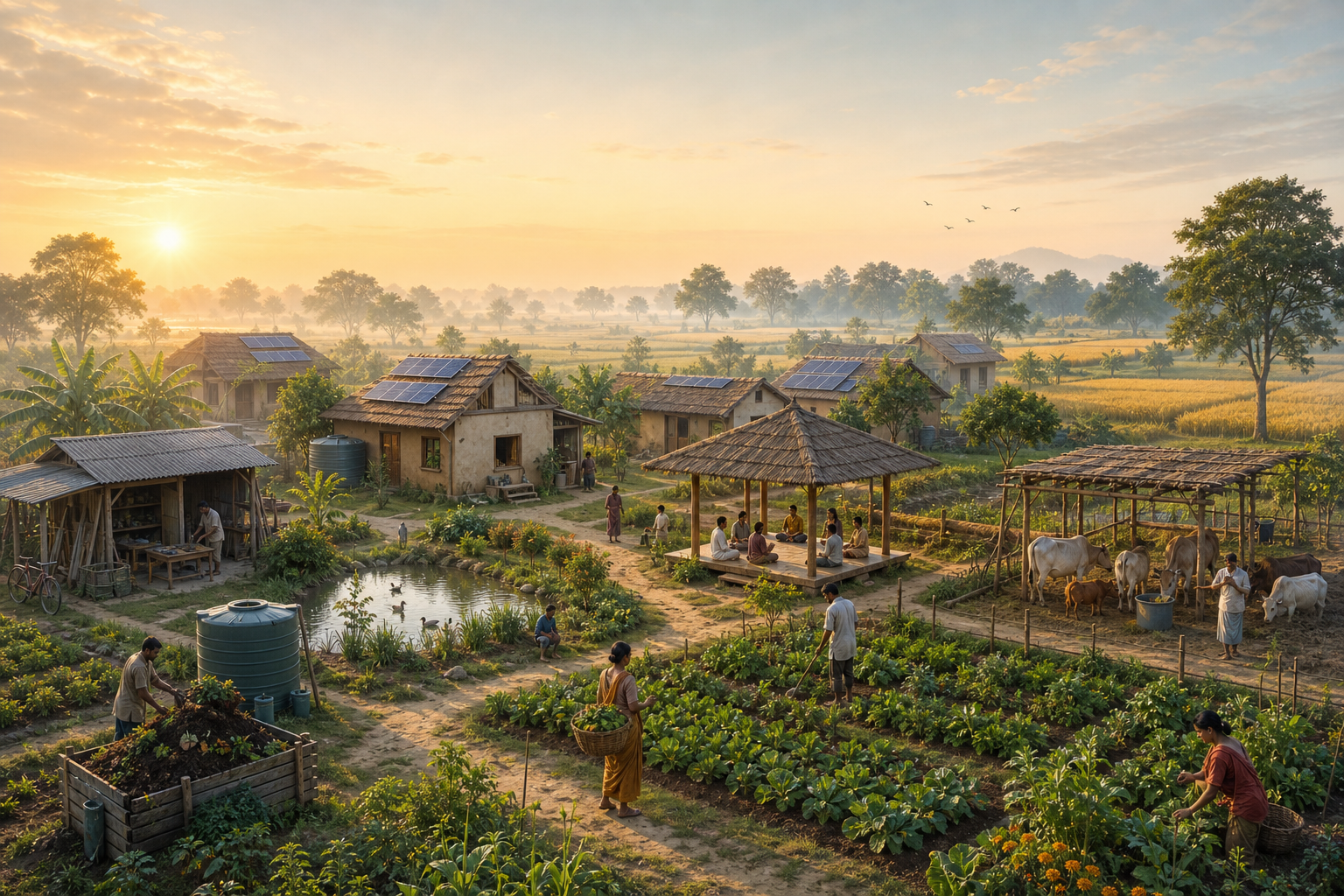
You may be considering a dharmic farm because urban life feels increasingly dependent, expensive or spiritually thin. The difficult question is not whether village life sounds better. It is whether a group can turn dharmic ideals into working arrangements that endure income pressure, demanding farm labour, animal care and disagreement.
A resilient community treats ecology, livelihood, governance and sadhana as one system. If any part rests on wishful thinking, strain will eventually expose it. If the parts support one another, the farm can provide more than food: it can protect life, preserve practical knowledge and give spiritual practice a stable place in daily life.
Resilience begins with a dependency map
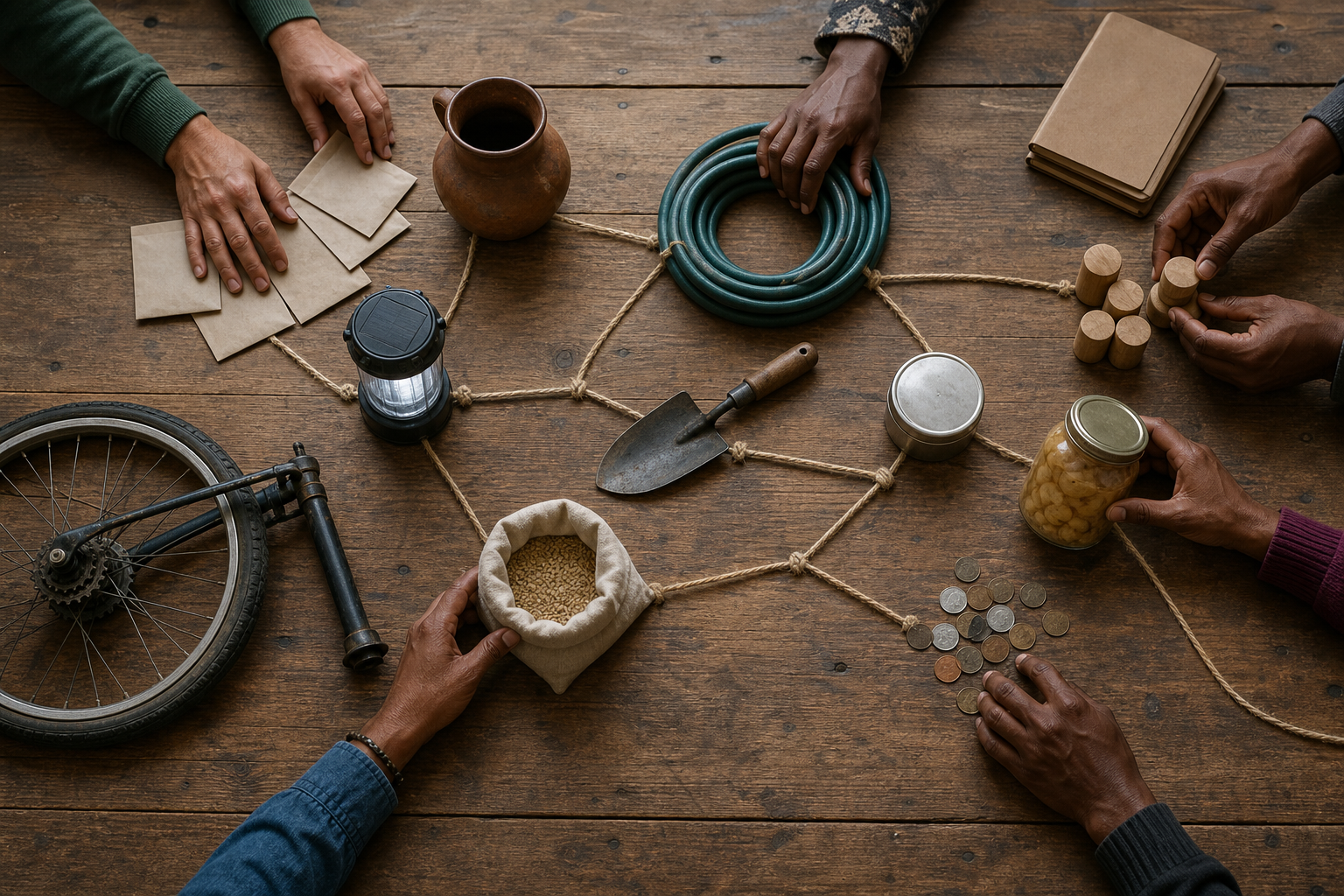
Remoteness is not the same as self-reliance. A rural community can remain completely dependent on purchased seed, distant fodder, outside income, one donor or one person who knows how everything works. Its location has changed, but its vulnerability has not.
Begin by mapping the chains that keep the community alive. The aim is not absolute independence. No sensible village needs to manufacture every tool or refuse all trade. The aim is to discover which dependencies could stop food production, animal care or community decision-making if they failed at the same time.
- Food: Which everyday foods can the land realistically produce, and which will still be purchased? Distinguish staples from occasional foods so that a long crop list does not disguise dependence on bought essentials.
- Water: Where does water come from, when is it least available, who maintains access and what activity receives priority during scarcity?
- Seed: Which seed can be saved locally, which must be bought again and who is responsible for storage, records and renewal?
- Cows and other animals: Where will fodder, water, shelter and continuing care come from when milk or income is low?
- Livelihood: Which expenses require cash, and which relationships provide recurring rather than occasional income?
- Skills: What happens if the only experienced grower, animal caretaker, mechanic, teacher or bookkeeper becomes unavailable?
- Authority: Who can make an urgent decision, and what prevents temporary authority from becoming permanent personal control?
This exercise converts a large aspiration into visible work. It also reveals where cooperation matters more than ownership. A community may not need its own dairy, seed bank or learning centre if a trustworthy regional network can provide one. Dharmic resilience grows through cultivating land, protecting cows and organizing local economies, but local does not have to mean isolated.
Urban partners can remain part of the design. A recurring group of households may support farm produce, crafts, education or animal care. In return, the farm gives those households a reliable relationship with land, food and dharmic service. Measure resilience by the strength and transparency of these relationships, not by the distance from the nearest city.
Turn dharmic values into operating rules
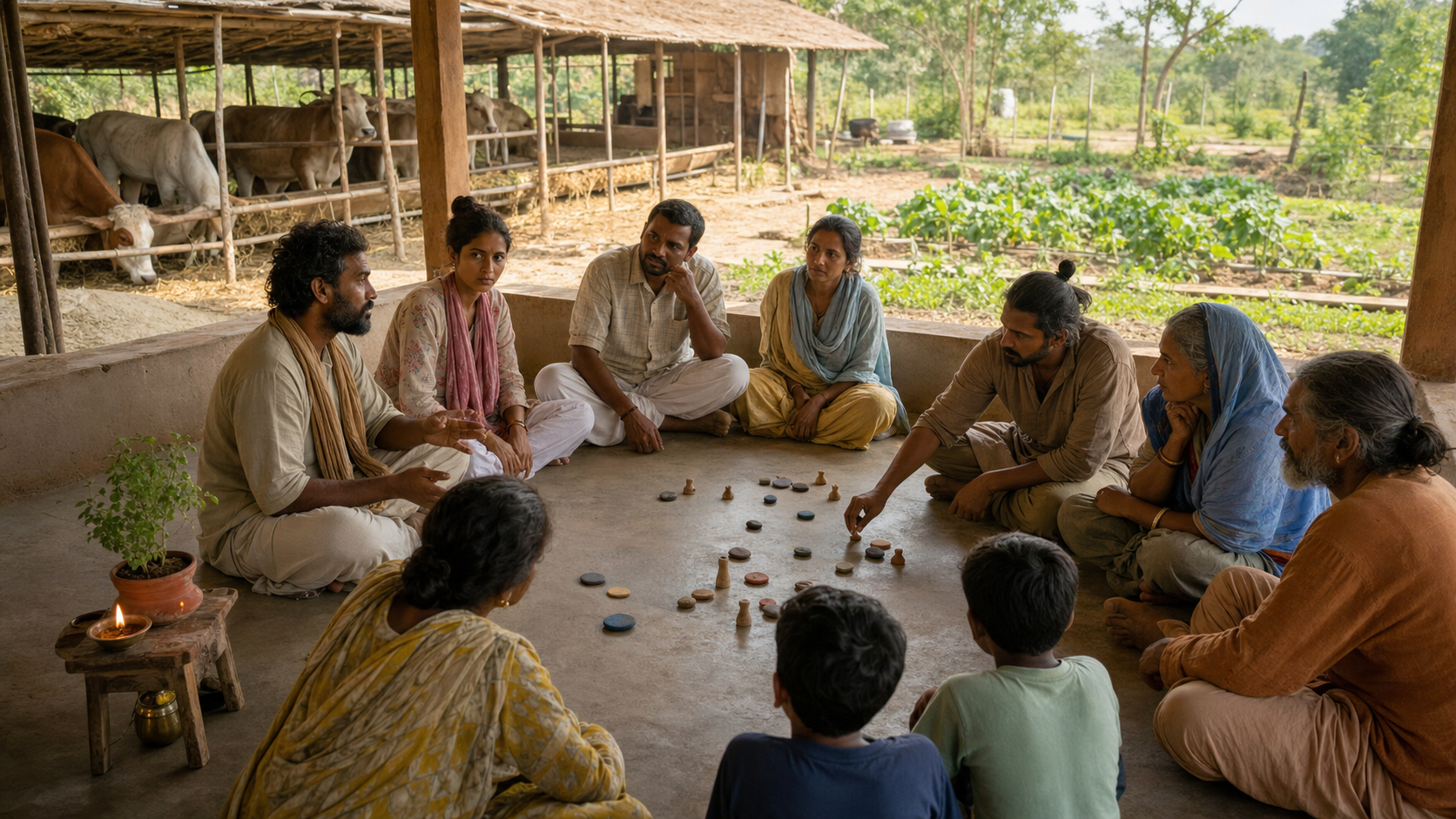
A value that appears only in the community name cannot guide a difficult decision. Ahimsa becomes real when milk production falls. Aparigraha matters when land values rise. Seva is tested when unpleasant work has to be done. Mindfulness matters when the agricultural calendar becomes crowded. Langar matters when food is scarce enough that sharing carries a cost.
Hindu, Buddhist, Jain and Sikh communities do not follow identical disciplines, and an inter-Dharmic project should not flatten their differences. Yet ahimsa, aparigraha, seva, mindfulness and community food traditions provide a strong ethical direction: reduce avoidable harm, restrain excess, dignify service and treat nourishment as a shared responsibility.
- For ahimsa, write down how animals will be treated throughout their lives, how crop protection will minimise harm and which practices the community will refuse even when they promise higher output.
- For aparigraha, decide how much private accumulation is compatible with common land, shared infrastructure and the community’s purpose. Clarify whether members are owners, tenants, trustees, workers or some carefully defined combination.
- For seva, identify essential work and distribute it visibly. Voluntary service can be sacred; an undisclosed expectation that a few people will carry the hardest labour is simply weak planning.
- For mindfulness, protect time for reflection and worship before work expands to fill the whole day. A schedule that mentions sadhana but cancels it whenever the farm is busy has stated its real priority.
- For shared nourishment, decide how food reaches members, guests and people in need. Generosity needs a harvesting, storage and distribution plan if it is to last.
Srila Prabhupada’s formula of “simple living, high thinking” is often admired as a slogan. It is more useful as a design test. Does the community reduce needless consumption without making families insecure? Does its way of working leave attention for japa, kirtan, meditation, study and satsang? Does it avoid transferring hardship to labourers, animals or the surrounding ecosystem?
Simple living does not mean romanticising deprivation. High thinking does not mean leaving practical work to somebody else. The two belong together: restrained needs make ethical provision easier, while meaningful work supports a life not dominated by consumption.
Build the ecological base before building the settlement
A beautiful property can still be the wrong property. Buying land is costly and difficult to reverse, so do not commit because a site looks peaceful or carries an attractive price. Confirm title, permitted land use, dependable access, water rights and livestock rules with qualified local professionals before paying a deposit. Spiritual intent does not remove legal or financial exposure.
Then examine the farm in the order that life depends on it:
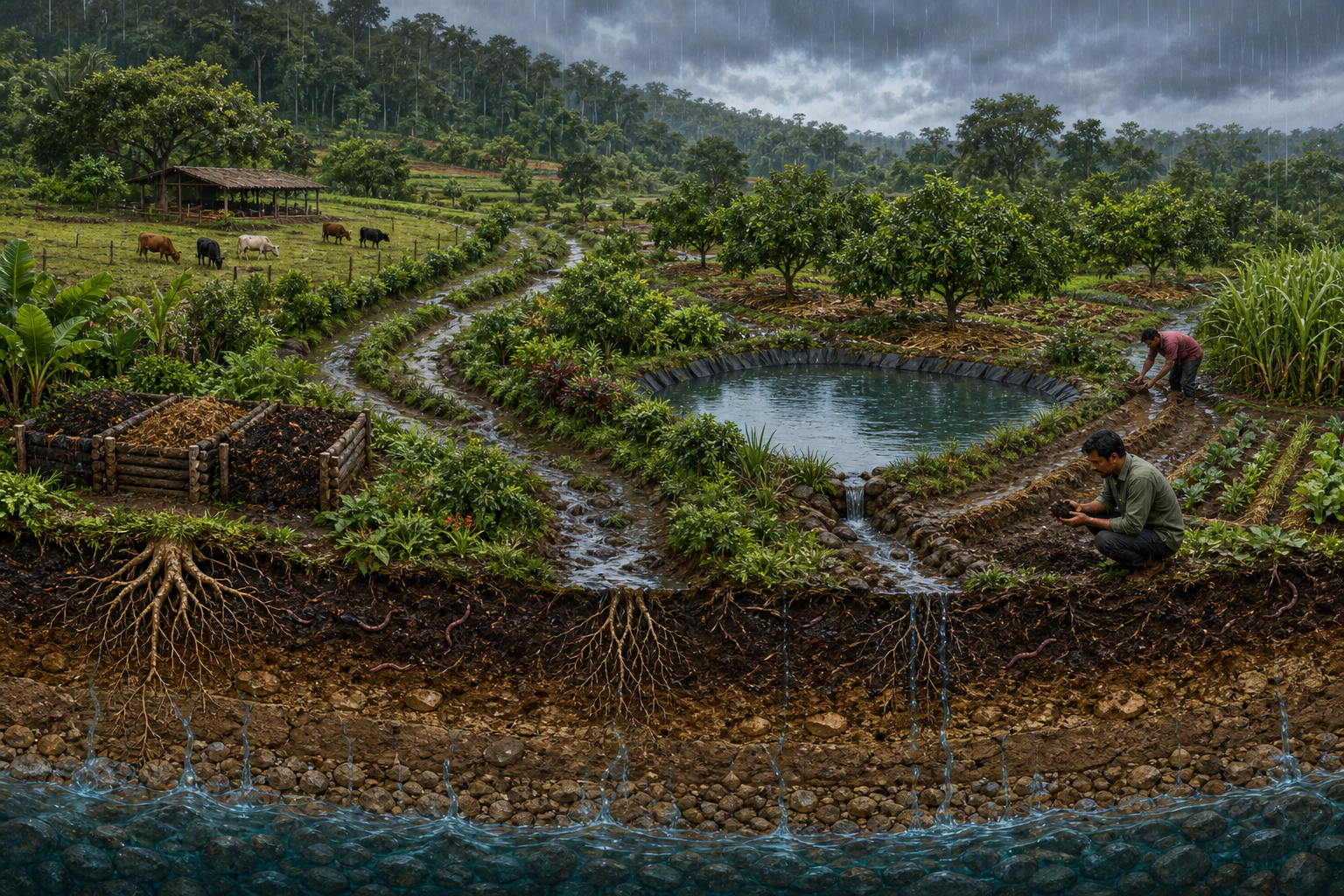
- Map water. Identify its sources, seasonal limits, storage possibilities, competing uses and maintenance responsibilities. A plan for crops, residents or cows is premature until the water plan can support them.
- Map soil. Determine what kinds of cultivation the land can sustain and where restoration is needed. Choose crops for the actual soil and water rather than forcing the property to serve a preconceived image of a farm.
- Plan for regeneration. Use agroecological thinking to connect food production with soil renewal, water conservation and biodiversity. The test is not merely what can be harvested now, but whether the land’s capacity is being preserved.
- Create a seed system. A seed bank needs more than containers. Record each variety, its origin, its cultivation history, the conditions in which it is stored and the person responsible for maintaining it. Seed without knowledge is inventory, not resilience.
- Close useful loops. Plan how crop residues, manure and compostable material can return safely to soil fertility. Also identify what cannot be reused safely instead of treating “circular” as a promise that all waste disappears.
- Add cows only after care capacity exists. Secure fodder, water, shelter, skilled daily attention, veterinary support and a durable care budget before bringing animals onto the land.
Cow protection deserves special honesty. A cow is not a symbol to be installed beside a temple, and an ahimsa dairy cannot be judged only by how milk is obtained. Ask what happens to calves, bulls, ageing cows and animals that require treatment but produce no income. Put those answers in the operating plan before the first animal arrives.
If the community cannot yet provide lifelong care, the dharmic response is not to lower the standard. Support a competent cow-protection effort, develop fodder capacity or train caretakers first. An animal should not bear the cost of a group’s desire to look established.
The same realism applies to biodiversity and soil regeneration. They are not decorations around a production system. They are part of food security and climate resilience. Track whether soil, water, seed and habitat are becoming stronger or weaker under the community’s management. A profitable harvest accompanied by a declining ecological base is deferred loss.
Create an economy and culture people can remain in
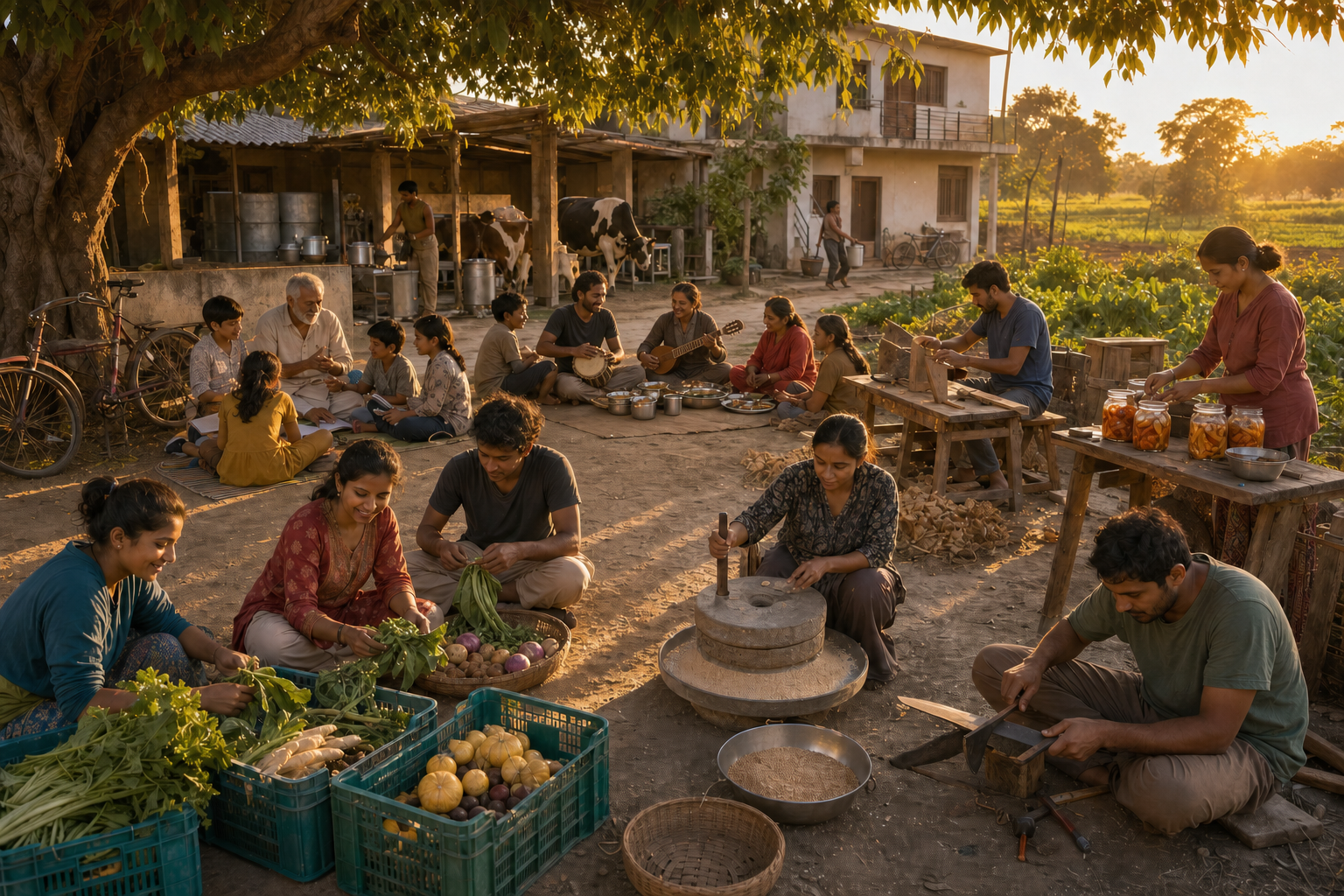
A farm community cannot depend indefinitely on enthusiasm. People need clarity about work, housing, food, personal income, family responsibilities and what happens if they leave. Avoiding these questions does not make a project spiritual; it places the greatest risk on whoever has the least power.
Keep three kinds of accounts. The financial account records recurring costs, income, obligations and reserves. The ecological account follows soil, water, seed, biodiversity and animal-care capacity. The dharmic account asks whether workers are treated with dignity, animals receive promised care, food is shared fairly and spiritual practice still has protected time. A project can look successful in one account while quietly failing in the others.
A written community charter should answer questions that personal goodwill cannot settle consistently:
- Who owns or holds the land, buildings, animals, tools and common funds?
- How are work, food, housing and cash compensation related?
- Which decisions belong to specialists, which belong to community leaders and which require wider consent?
- How are surpluses used, and who carries losses?
- How may a member join, take on responsibility, step back or leave?
- How are complaints heard when they concern a respected leader?
- Who safeguards records and continuity when officeholders change?
Clear governance protects devotion from avoidable resentment. It also lets the community cooperate with urban households, buyers and donors without concealing how money or authority moves. Community-supported agriculture, farm ashramas and village cooperatives linked with urban partners offer useful patterns: production remains rooted in the land while support and exchange extend beyond it.
The social rhythm matters just as much as the legal structure. Put japa, kirtan, meditation or tradition-specific worship into the real calendar. Make satsang and shared meals dependable. Give children and young people meaningful education, craft and service rather than treating them as either free labour or passive spectators. Create roles through which elders can transmit skills and memory without requiring them to perform work beyond their capacity.
In an inter-Dharmic community, unity should rest on shared responsibilities rather than forced sameness. A Vaishnava household, a Buddhist practitioner, a Jain family and a Sikh family may organise spiritual discipline differently. The common charter can still protect nonviolence, honest labour, restraint, care for land, animal welfare and service. Shared ethics become stronger when distinct traditions are respected rather than blurred.
Watch for structural warning signs before committing your money or labour: land and authority concentrated in one person without accountability; animals acquired before a care budget exists; all income dependent on one donor or buyer; spiritual practice disappearing during demanding work periods; members contributing substantial labour without written rights; or claims of self-sufficiency that omit purchased seed, fodder and other essential inputs. None of these questions needs to be asked aggressively. They do need clear answers.
Key takeaways: test readiness before you relocate
- Map dependencies first. List what the community needs for food, water, seed, animals, income, skills and decisions, then identify where one failure could disable several functions.
- Verify land rather than falling in love with it. Examine soil and water, and obtain professional confirmation of title, access, permitted uses and relevant rules before making an irreversible commitment.
- Make ahimsa operational. Define animal care, crop-protection boundaries, labour standards and food-sharing responsibilities before pressure tests them.
- Do not treat cows as infrastructure. Fodder, water, trained care, treatment and lifelong responsibility must precede acquisition.
- Write the governance charter early. Ownership, compensation, authority, accountability and exit arrangements are easier to settle before land and labour create unequal stakes.
- Protect the reason for building the community. Put sadhana, satsang, education and intergenerational learning into the working calendar rather than whatever time remains.
- Keep urban relationships. Recurring partnerships for food, crafts, learning and service can strengthen local production without pretending that resilience requires isolation.
- Start at the scale you can care for. Agroecology training, regional soil and water mapping, a seed-saving effort, support for an ethical dairy or a farm-to-household partnership can begin before relocation.
If your group cannot yet answer the hard questions, shrink the first commitment instead of abandoning the vision. Learn the land, practise cooperation, build a dependable food relationship and prove that your ethical rules survive ordinary pressure. Expansion should follow demonstrated care, not precede it.
A dharmic farm becomes a place of refuge only after it becomes a field of responsibility. Choose one dependency your household or sangha can shorten now, and begin there.
References
