
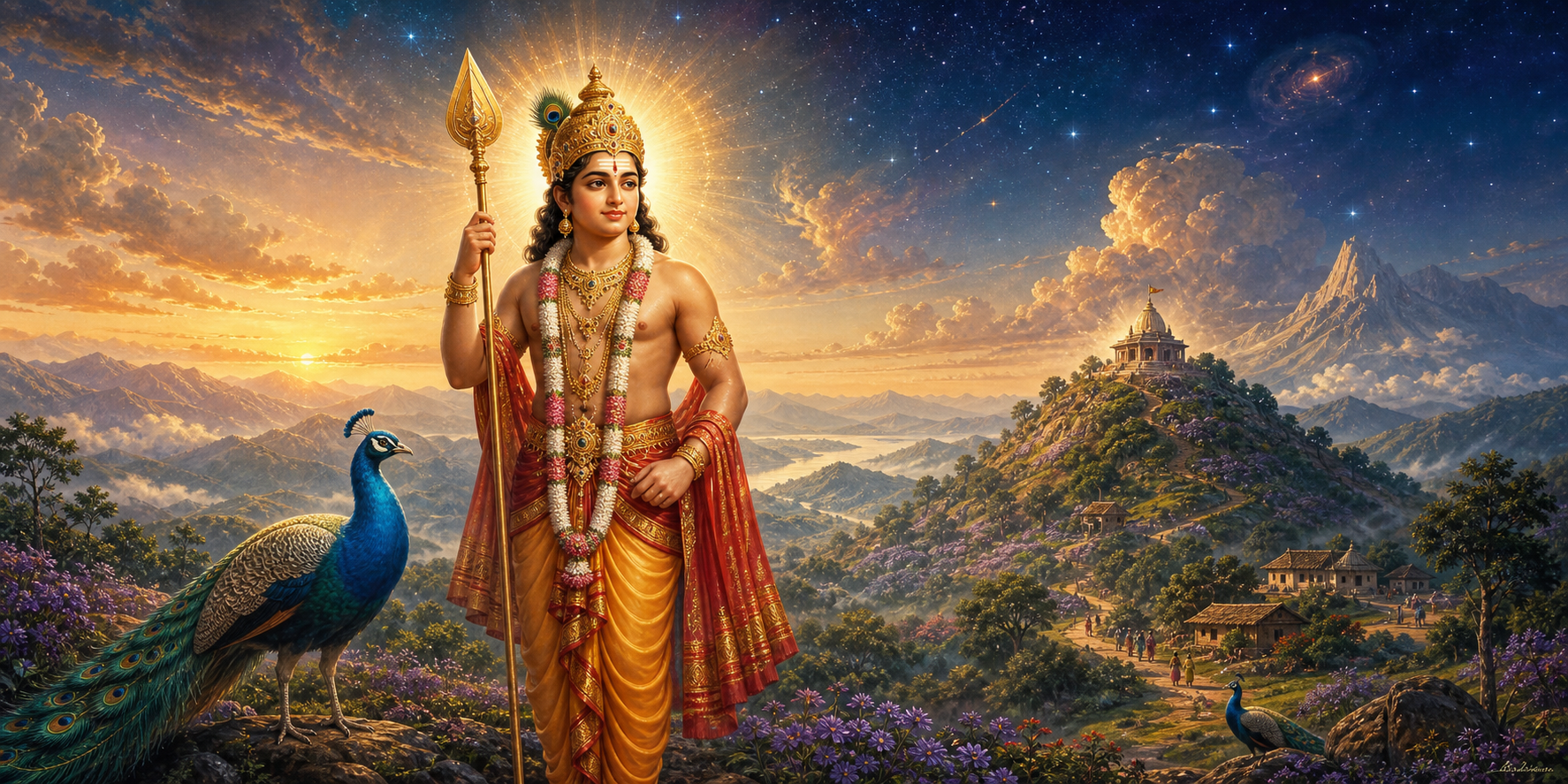
If you are trying to decide whether Murugan belongs primarily to Sanskrit Puranic religion or to Tamil sacred culture, the question is already too narrow. You do not have to choose between Skanda, the commander who restores dharma, and Murugan, the youthful lord of the hills. The two traditions approach one deity at different scales.
The useful distinction is not universal versus local, or authentic versus adapted. One register asks how divine courage restores cosmic order. The other asks how the sacred inhabits a landscape, protects human bonds, and remains close to particular communities. Once you recognize that shift, Murugan’s names, symbols, consorts, and pilgrimage places stop looking like evidence in a rivalry.
Begin with scale, not a contest over authenticity
Within the Puranic register represented by the Skanda Purana, Murugan appears as Skanda, Kartikeya, Shanmukha, and Subrahmanya. He is the son of Shiva and Parvati, the deva-senapati or commander of the devas, and the divine warrior born to restore dharma. Courage matters here because cosmic order must be defended; wisdom matters because force without discernment cannot serve dharma.
Within the Tamil Sangam register, Murugan inhabits the kurinji landscape of hills, honey, love, and valor. In Akananuru and Paripadal, he is youthful, approachable, and close to pastoral and tribal communities. He guards lovers and warriors as a presence belonging to the lived world rather than a remote abstraction.
This movement between cosmic commander and intimate hill deity gives you the central reading key:
| Register | Primary setting | Murugan’s emphasis | What to notice |
|---|---|---|---|
| Puranic | Cosmic order and conflict with adharma | Commander, protector, and son of Shiva and Parvati | How disciplined power restores order |
| Tamil Sangam | Kurinji hills and community life | Youthful guardian of lovers and warriors | How divine presence belongs to land, emotion, and relationship |
| Living synthesis | Shrine, pilgrimage, festival, and vow | Bearer of the vel, peacock rider, and lord associated with Valli and Deivayanai | How cosmic meaning becomes embodied devotion |
This is a reading map, not a chart of separate gods. When a hymn, story, sculpture, or festival foregrounds asuras, divine command, and the restoration of order, read it at the Puranic scale. When it foregrounds hills, lovers, warriors, and local communities, read it through kurinji intimacy. A single devotional setting can contain both.
One caution matters: a contrast between portrayals is not automatically a timeline. It does not prove that one community simply copied, replaced, or absorbed another. The responsible conclusion is narrower. Murugan’s meanings travelled across languages, regions, and pilgrimage routes while distinct local forms remained spiritually productive.
Let Murugan’s symbols carry more than one meaning
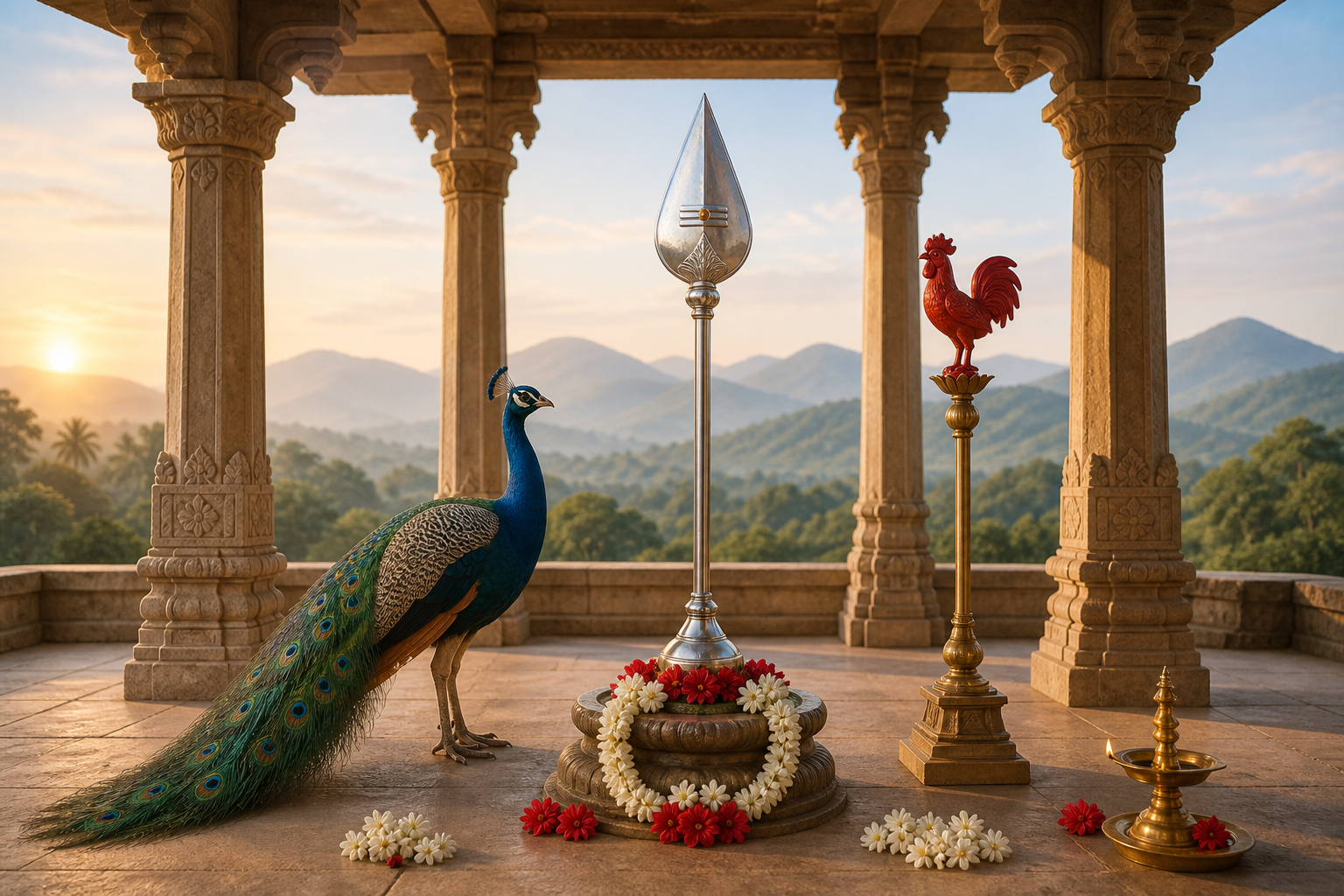
Sacred symbols become thin when they are reduced either to physical objects or to modern psychological metaphors. Murugan’s symbols work in worship, sacred narrative, cultural memory, and ethical reflection at the same time. You understand them better when you retain those layers instead of selecting only the one most familiar to you.
The vel: weapon, sacred emblem, and disciplined clarity
The vel is Murugan’s spear. In the warrior frame, it defeats the forces that obstruct dharma. In an ethical reading, its sharpness becomes the clarity that penetrates tamas and avidya: dull inertia and the ignorance that prevents reality from being seen correctly. In festivals, it remains a beloved, visible emblem rather than merely an abstract idea.
Use both levels when you reflect on the vel. First acknowledge it as Murugan’s divine weapon and an object within living devotion. Then apply its demand to your own conduct. Name the decision before you, the dharmic duty involved, and the attachment or confusion clouding your judgment. The point is not to turn the vel into a self-help metaphor. It is to let a sacred image discipline the way you decide and act.
The peacock: dignity placed under mastery
The peacock is Murugan’s vahana and an emblem of disciplined majesty. It can also be read as pride brought under control. That does not require contempt for beauty, confidence, or strength. The sharper question is whether those qualities serve dharma or demand admiration for themselves.
When this image confronts you, examine the relationship between competence and display. Strength becomes worthy of Murugan when it accepts direction. Pride becomes dangerous when it makes recognition more important than duty. The peacock therefore complements the vel: clear judgment must be joined to mastery over the ego that wants to claim the victory.
Shanmukha: wisdom that sees beyond one angle
As Shanmukha, Murugan bears six faces. They can signify all-seeing wisdom: the capacity to perceive more than the first angle presented by fear, desire, or group loyalty. You do not need to invent a rigid list of six modern qualities to make the image useful.
Instead, let the six-faced form slow premature judgment. Before acting, look separately at the facts, the duty involved, the motive driving you, and the likely consequences for others. The image does not command indecision. Murugan remains a warrior. It joins breadth of vision to the courage to act once the right course becomes clear.
Kurinji makes landscape part of theology

The hills surrounding the Tamil Murugan are not decorative scenery. Kurinji establishes a mode of divine nearness. Love and valor, human vulnerability and martial strength, can occupy the same sacred terrain. Murugan is known not only through a cosmic genealogy but also through the land, emotions, livelihoods, and dangers of a community.
This is why local must never be used to mean lesser. A deity encountered through a hill shrine is not less universal than one described through cosmic conflict. The particular place gives worshippers a way to approach the universal. Tamil culture does not merely add regional color to an otherwise complete abstraction; it reveals what divine guardianship feels like when it enters ordinary relationships and a recognizable landscape.
That closeness also explains why Murugan can guard lovers and warriors without contradiction. Love requires fidelity and courage. Valor becomes dharmic only when it protects something beyond the warrior’s own status. The Sangam setting places these truths beside each other rather than isolating devotion from the emotional life of the devotee.
Valli and Deivayanai hold intimacy and duty together
Valli and Deivayanai, also known as Devasena, provide another way to understand Murugan’s double scale. Valli can be read through earthbound intimacy and closeness to the land. Deivayanai can be read through celestial order and duty. Around Murugan, personal belonging and public responsibility do not have to become enemies.
Use this pairing as a lens, not as an exhaustive code that reduces two sacred figures to concepts. When Valli is foregrounded, notice land, immediacy, and personal relationship. When Deivayanai is foregrounded, notice celestial responsibility and ordered duty. When both are present, notice that Murugan’s fullness includes closeness without abandoning command, and authority without losing tenderness.
Pilgrimage turns literary harmony into lived devotion
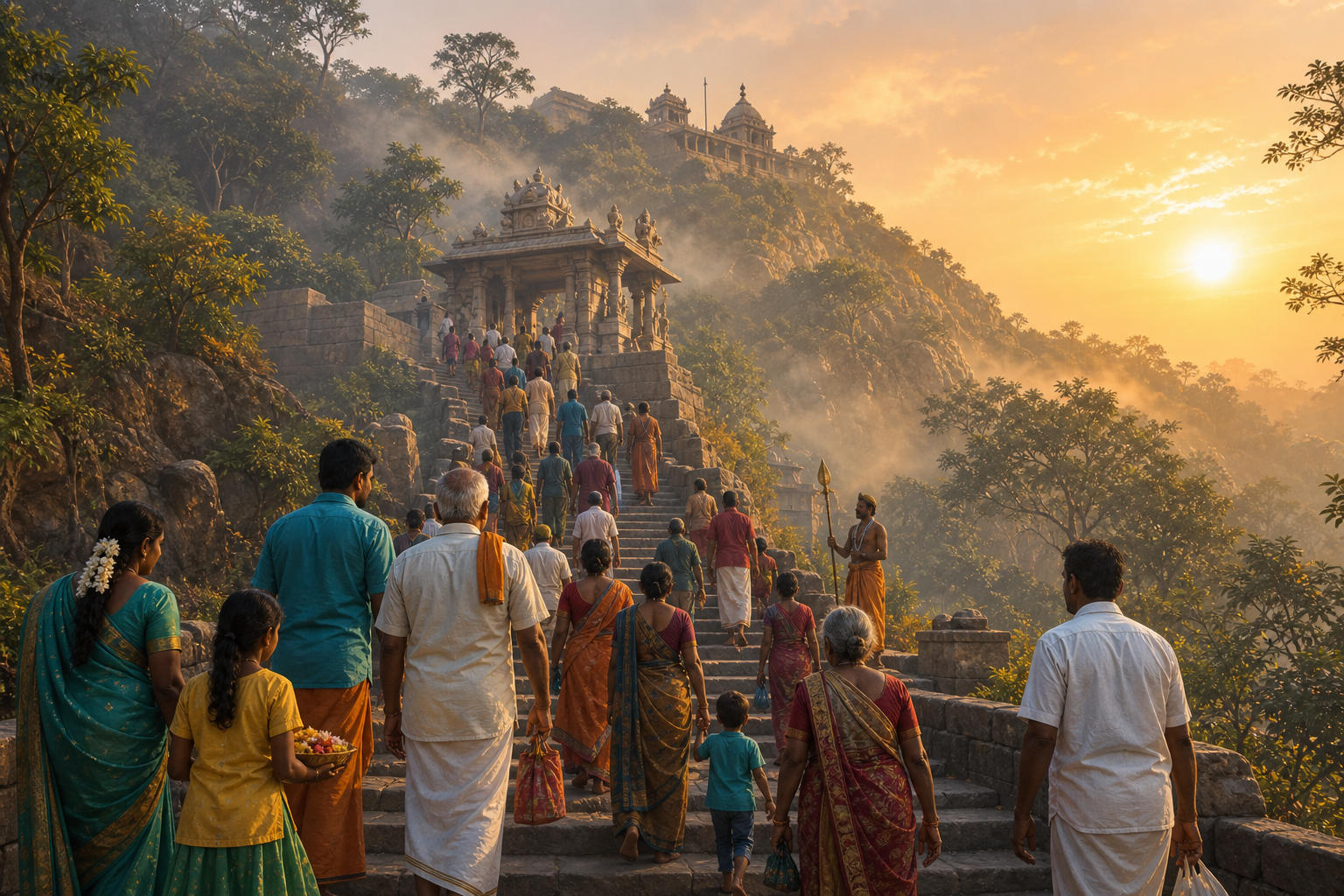
Pilgrim routes connecting shrines such as Palani, Thiruchendur, and Thiruttani allowed narratives and symbols to meet without requiring every place to become identical. This is a characteristic strength of Sanatana Dharma: unity grows through relationship among forms, not through the erasure of local genius.
At Palani, the hill and the act of ascent make landscape part of devotion. At Thiruchendur, the sea and coastal setting give the encounter a different texture. During Thaipusam, kavadi brings vow, bodily discipline, rhythm, and the vel into one public act. The Puranic warrior and the Tamil lord close to the land are no longer separate interpretive categories. They meet in what devotees undertake.
If you visit a shrine or attend a festival, observe in four passes. First, notice the landscape rather than treating it as a backdrop. Next, listen for the name of the deity being emphasized: Murugan, Skanda, Kartikeya, Shanmukha, or Subrahmanya. Then watch how the vel, peacock, vows, and processional acts function within worship. Finally, ask which ethical quality the setting calls forth: courage, clarity, self-mastery, compassion, or responsible strength.
This approach keeps interpretation accountable to practice. It prevents two common errors: treating Tamil devotion as folklore detached from Hindu metaphysics, and treating Puranic theology as an imported framework detached from Tamil life. The living tradition does not require either reduction.
Key takeaways for reading Murugan without flattening him
- Skanda, Kartikeya, Shanmukha, Subrahmanya, and Tamil Murugan belong to one sacred identity, although each name can foreground a different register.
- The Puranic scale emphasizes Murugan as son of Shiva and Parvati, commander of the devas, and restorer of dharma.
- The Tamil Sangam scale emphasizes his youthful nearness within kurinji hills, human relationships, valor, and community life.
- The vel, peacock, and six faces retain ritual and narrative meanings while also inviting reflection on clarity, disciplined pride, and many-sided wisdom.
- Valli and Deivayanai can help you notice how earthbound intimacy and celestial duty coexist around Murugan.
- Literary differences do not by themselves prove a one-way historical sequence. Read them as distinct expressions connected through language, pilgrimage, symbol, and worship.
The next time you hear Tamil Murugan placed against Puranic Skanda, change the question. Ask which scale of Murugan is being revealed, which symbol carries that revelation, and what form of dharmic courage it asks from you. That question can guide your reading, temple visit, or conversation without erasing real differences or manufacturing a division.
References
