
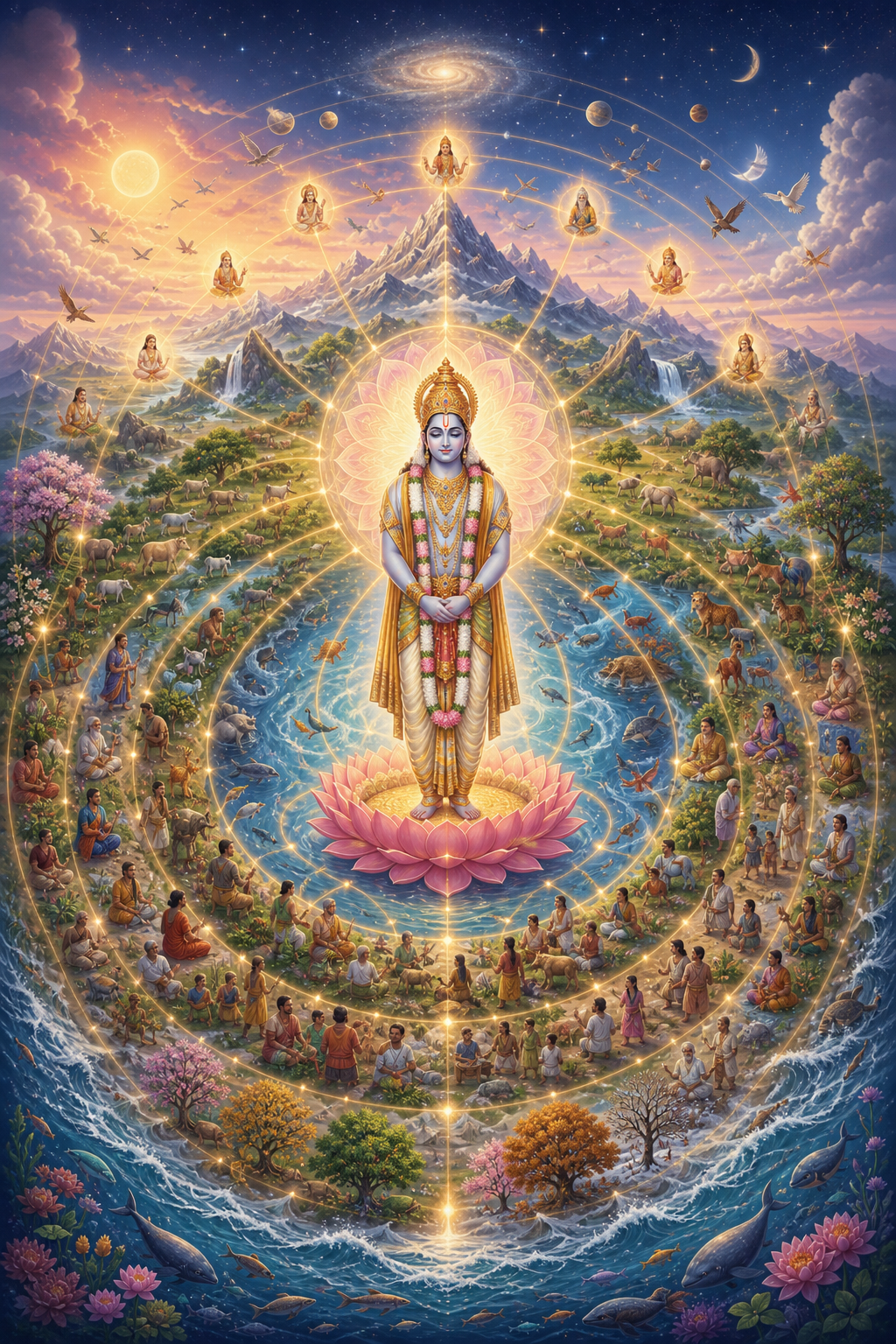
If you have been told that Brahman is changeless and that the world is real, the combination may sound incoherent. A real world changes. If that world belongs to Brahman, must Brahman also change, acquire new conditions, or lose divine perfection?
Ramanuja answers without weakening either side. Brahman remains perfect and immutable, while the sentient and insentient realities inseparably related to Brahman pass through real changes. The crucial task is to identify what changes, what does not, and how both belong within one relational reality. Once you make those distinctions, creation, bhakti, seva, and moral responsibility fit together with unusual clarity.
Key takeaways
- For Ramanuja, Brahman is Śrīman Nārāyaṇa, eternally endowed with auspicious qualities rather than an attribute-less abstraction.
- Brahman’s essential nature does not change. The changing states belong to cit, sentient beings, and acit, insentient matter.
- Cit and acit are neither independent realities outside Brahman nor unreal appearances. They are real, inseparable modes of Brahman.
- The universe is related to Brahman as body to indwelling Self. This expresses dependence, divine presence, and real distinction at the same time.
- Creation is a real transformation of Brahman’s modes, not a gain, loss, or alteration in divine perfection.
- Bhakti is therefore a genuine relationship, and seva matters because the beings and world you serve are real constituents of the divine body.
The shortest accurate formulation is this: Brahman does not change in essential nature, but Brahman’s inseparable modes undergo real change. Leaving out either half produces a caricature.
The distinction between Brahman’s nature and Brahman’s modes

The phrase Brahman changes can carry two very different meanings. It might mean that Brahman’s knowledge, perfection, or identity is altered. Ramanuja rejects that claim. It might instead mean that realities wholly dependent on Brahman, and inseparably related to Brahman, enter new states. Ramanuja accepts that claim.
Viśiṣṭādvaita calls these dependent realities modes, or prakāras. Cit comprises sentient beings. Acit is insentient reality, including the material order. Both are real. Both qualify Brahman. Their changing conditions do not turn Brahman into an imperfect being any more than the reality of relation requires the Lord to acquire a quality that was previously absent.
This is qualified non-duality. Reality is one, but it is not an empty sameness in which all distinctions disappear. Brahman is the one comprehensive reality, eternally qualified by real plurality. Souls and matter cannot stand as rival absolutes, yet their dependence does not make them fictitious.
That gives you a precise way to test any claim about a changing Brahman. Complete the grammar before accepting or rejecting it: What is changing? If the answer is Brahman’s essential perfection, the claim is not Ramanuja’s. If the answer is the real states of cit and acit, the claim belongs at the heart of his account.
You should also ask whether the changing thing is merely near Brahman or belongs inseparably to Brahman. Ramanuja is not describing an untouched deity watching an unrelated universe from outside. Change occurs within a reality whose dependence on the Supreme is complete. Divine immutability therefore does not mean divine absence.
Why the body-and-Self relation is the key
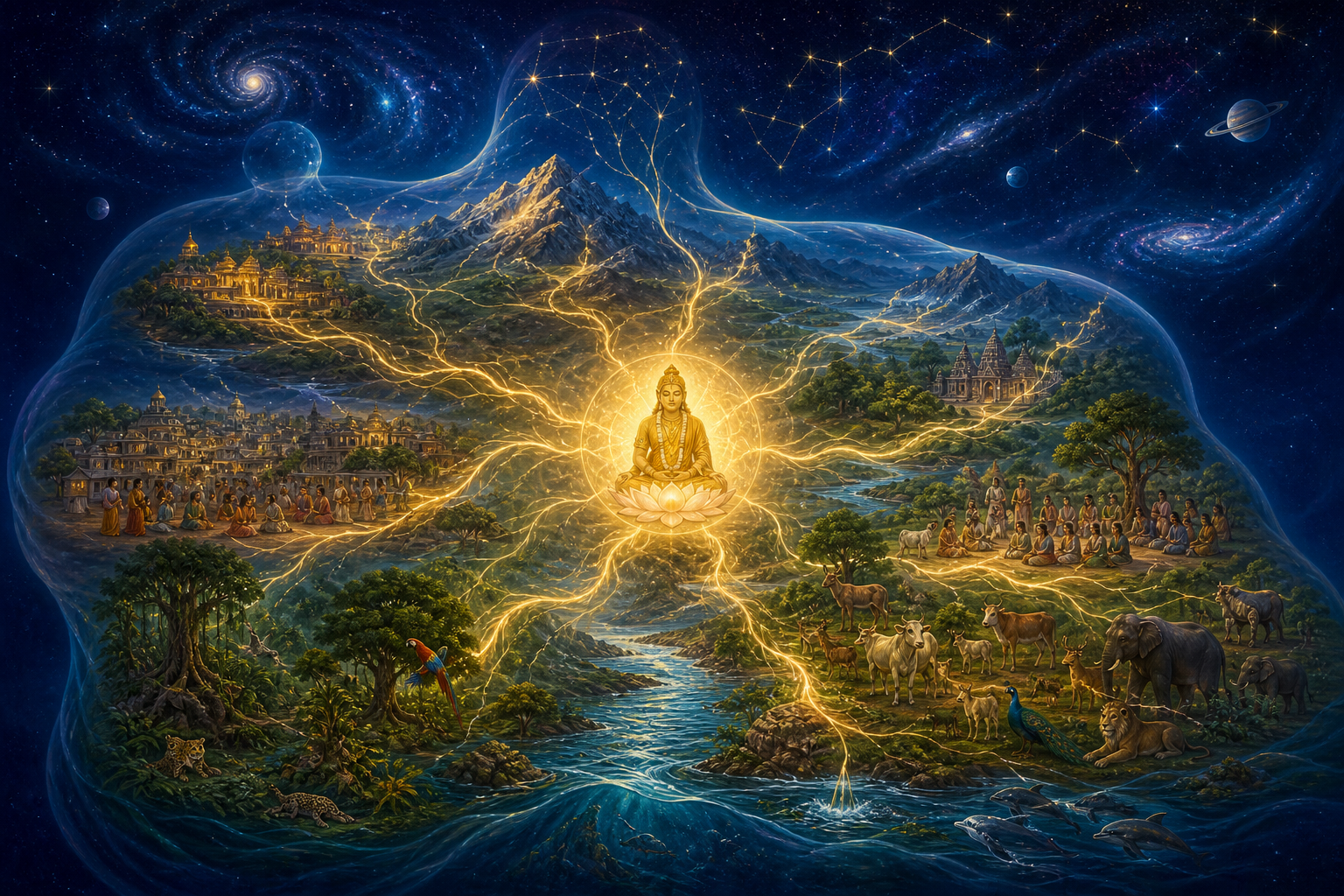
Ramanuja expresses the relation through śarīra–śarīrī-bhāva: the universe and souls are the body, while Brahman is their indwelling Self. The relation carries three ideas that must be held together.
- Dependence: cit and acit do not possess ultimate independence. Their existence, order, and intelligibility rest in Brahman.
- Distinction: a body is not simply interchangeable with its self. Souls and matter remain genuinely distinguishable realities even while belonging to Brahman.
- Indwelling sovereignty: Brahman is present as the inner ruler of the whole, not as one object located beside other objects.
Do not press the word body into a crude physical picture. It does not mean that Nārāyaṇa is a very large material organism or that every property of an embodied creature transfers to Brahman. The relation identifies dependence and indwelling. It explains how plurality can be real without becoming a collection of self-sufficient substances.
This also prevents a careless use of divine immanence. A person is not disposable because only Brahman is real. Nor should a person be flattened into a simplistic statement that the individual is identical to God in every respect. The person is a real sentient being, distinct yet inseparably held within the order that constitutes Brahman’s body.
Use the same discipline when thinking about the material world. Matter is not an independent possession that happens to sit outside sacred reality. Neither is it unreal debris that spiritual life may ignore. Its status as acit differs from that of a conscious soul, but both belong within the divine whole. That is why reverence for life and responsible treatment of the material world follow from the metaphysics rather than being optional moral decorations.
How creation can be real without compromising the Creator

Ordinary causal language separates the maker from the material: one asks who fashioned a thing and what it was fashioned from. Ramanuja identifies Brahman as both the efficient cause, or nimitta-kāraṇa, and the material cause, or upādāna-kāraṇa, of the universe. Nothing external has to supply a second, independent foundation for creation.
Creation is consequently real. Satkāryavāda means that an effect does not emerge from sheer non-being; it is grounded in its cause and appears through a real change of condition. During creation and dissolution, Brahman’s cosmic body changes state. Brahman remains the same perfect substantive reality and indwelling ruler throughout those changes.
The Chāndogya Upaniṣad presents Being alone as prior to manifestation, while the Taittirīya Upaniṣad speaks of the resolve to become many. Ramanuja reads such language neither as the production of a universe from something outside Brahman nor as a merely deceptive event. The Śrī-bhāṣya preserves both sides: the cause remains, and the manifestation is real.
A three-question check will keep this account straight when you encounter competing explanations:
- Where is the change located? In the states of cit and acit, not in Brahman’s essential perfection.
- Is the change real? Yes. Ramanuja does not reduce creation to absolute non-existence or a fiction with no ontological standing.
- Is the changing world outside Brahman? No. It is inseparably related to Brahman as body to indwelling Self.
If an explanation answers only one or two of these questions, it is incomplete. Saying only that Brahman is changeless can make the Supreme sound detached from creation. Saying only that Brahman changes can suggest that divine perfection is unstable. Ramanuja’s position depends on stating the locus, reality, and relation of change together.
What relational reality changes in bhakti and daily dharma
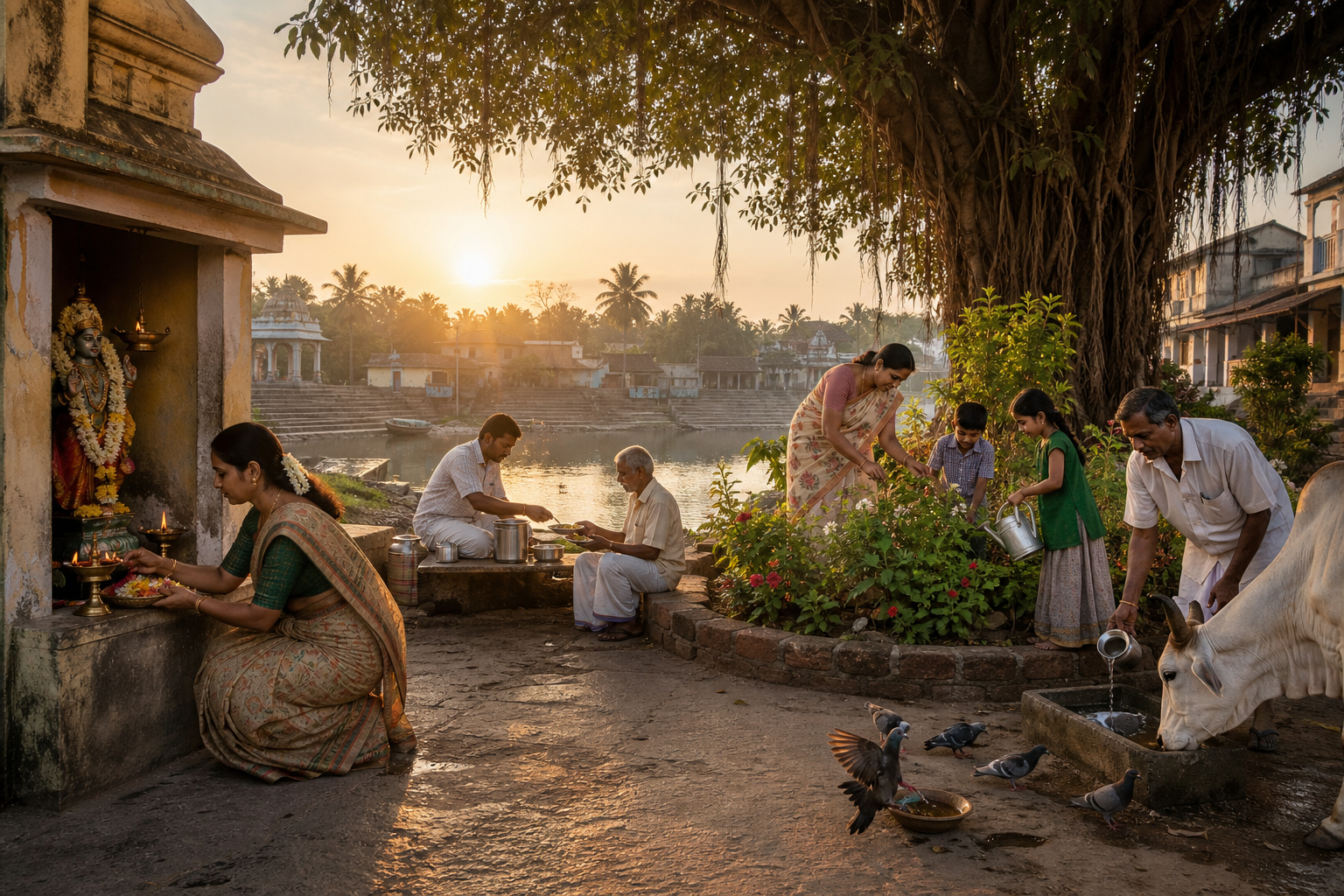
Pray as someone entering a real relationship
If Brahman possesses eternal knowledge, compassion, lordship, and other kalyāṇa-guṇas, devotion is not directed toward a temporary appearance adopted for less advanced worshippers. You are addressing the real Supreme. The Lord’s capacity for relationship expresses divine fullness; it does not repair a deficiency in Brahman.
This makes prayer concrete without turning it into a guarantee that every preferred outcome will occur. A responsive Lord need not be a changeable wish-fulfiller. Bring your actual condition into worship as something real, address Śrīman Nārāyaṇa rather than an undefined cosmic force, and let the act end in a duty you are prepared to perform. Bhakti becomes evasive when prayer replaces responsibility. In relational Vedānta, prayer and responsible action belong together.
Use seva to test whether your metaphysics reaches your conduct
A real divine body gives ethical life ontological weight. Harm, neglect, care, and service occur within a world that truly belongs to Brahman. You cannot affirm śarīra–śarīrī-bhāva in worship and then treat other beings as spiritually irrelevant once worship ends.
Before a consequential choice, apply a simple cit-acit test:
- Cit: Which conscious beings will bear the effect of this decision?
- Acit: Which material conditions, resources, or places will be altered?
- Relation: Does the choice honour their place within a reality belonging to Brahman, or treat them as though they were outside sacred concern?
This test does not produce an automatic answer to every moral dispute. It does expose a common inconsistency: speaking of the universe as the Lord’s body while behaving as though people and the material order were disposable.
Compare Vedānta schools without caricaturing either one
Advaita Vedānta does not simply say that the world is nonexistent. Mithyā indicates dependent reality: the empirical world is neither absolutely independent nor sheer nothingness. Its emphasis falls on the changeless Absolute and the limits of the distinctions encountered in ordinary experience.
Viśiṣṭādvaita does not simply say that God evolves along with the cosmos. It affirms real diversity and real transformation while preserving Brahman’s immutable nature. Its emphasis falls on a unity eternally qualified by souls and matter.
The clean contrast is therefore not real world versus no world, or changing God versus changeless God. Advaita locates empirical change differently from ultimate Brahman. Ramanuja locates real change in Brahman’s dependent modes while denying change in the divine essence. State which account you are using before drawing conclusions about worship, liberation, or the status of the world.
The same precision helps in wider Dharmic dialogue. Buddhist dependent arising, Jain anekāntavāda, and the Sikh affirmation of nirguṇa and saguṇa each challenge simple oppositions in a distinct way. None is merely another name for Ramanuja’s body-and-Self relation. Use such parallels to ask better questions about dependence, plurality, and transcendence, not to erase the differences among traditions.
When the apparent contradiction returns, do not ask whether Brahman changes in one undifferentiated sense. Ask what changes, whether that change is real, and how the changing reality belongs to Brahman. Then let the answer shape your next act: pray as though relationship is real, serve as though the world truly belongs to the Lord, and refuse the easy habit of calling suffering or duty metaphysically negligible.
That is the practical force of Ramanuja’s relational reality. Divine perfection remains secure, but it no longer becomes an excuse for distance from the world in which your dharma must be lived.
References
