
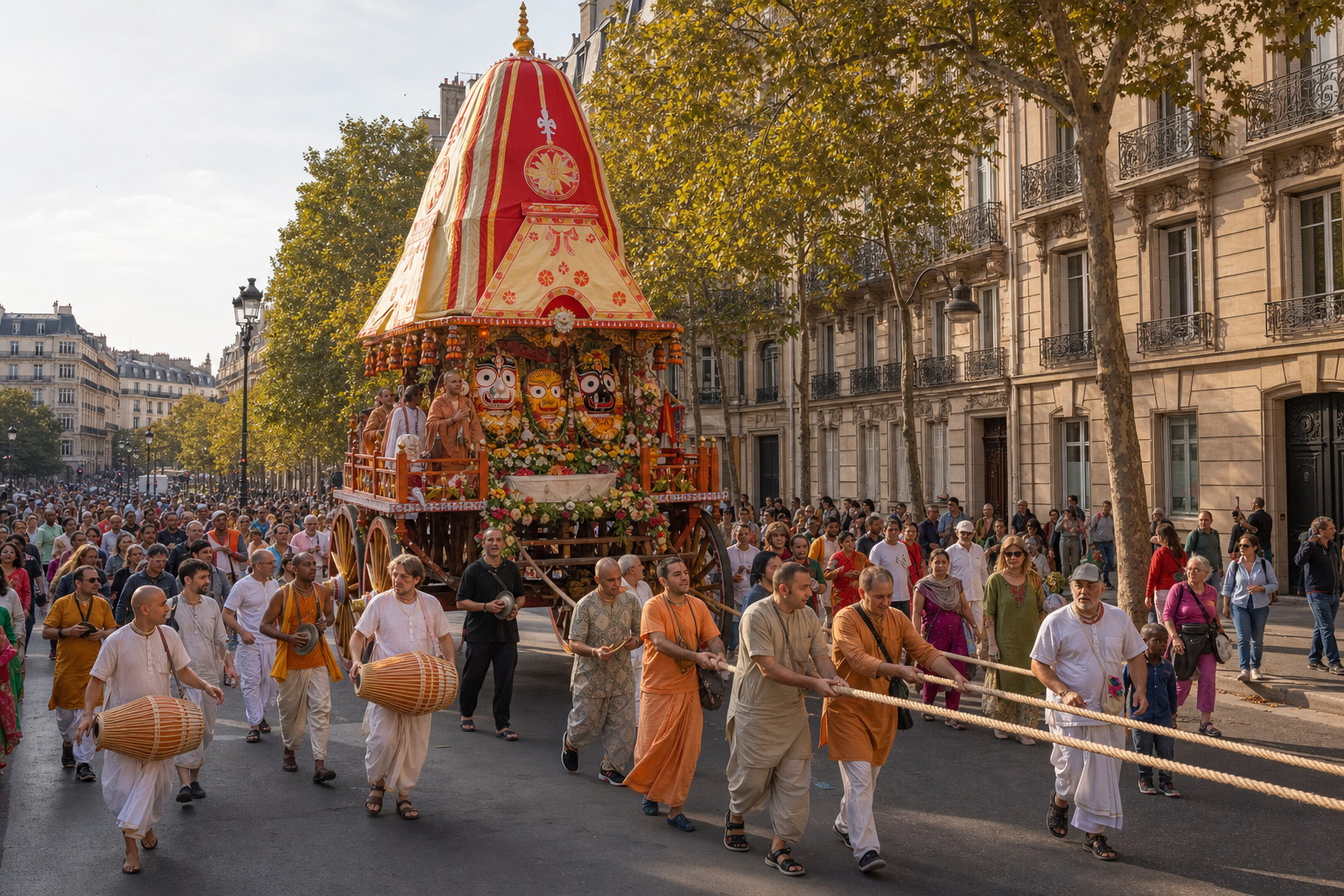
If Paris Ratha Yatra catches your attention, you may wonder whether you are meant to watch from the pavement or join the people singing and walking. You do not need prior knowledge to enter respectfully, but you do need to recognize that this is worship in public, not simply a colorful street performance.
The best approach is to locate the devotional center first, participate at the level you understand, and let curiosity follow reverence. That allows you to experience public bhakti without either keeping it at a safe cultural distance or pretending to know practices that are new to you.
Key takeaways
- Begin with Lord Jagannath and the chariot. The music, movement, garlands, and gathering take their meaning from that devotional center.
- Join gradually. Listen for the recurring kirtan response, follow the procession’s flow, and take direction from volunteers.
- Keep photography secondary to worship. Record without blocking the procession, interrupting participants, or treating people as scenery.
- Recognize shared dharmic values without claiming that Hinduism, Buddhism, Jainism, and Sikhism are interchangeable traditions.
- Before travelling, verify the current route, assembly point, timing, and accessibility arrangements through the organizers’ current channels.
The chariot tells you what kind of gathering this is
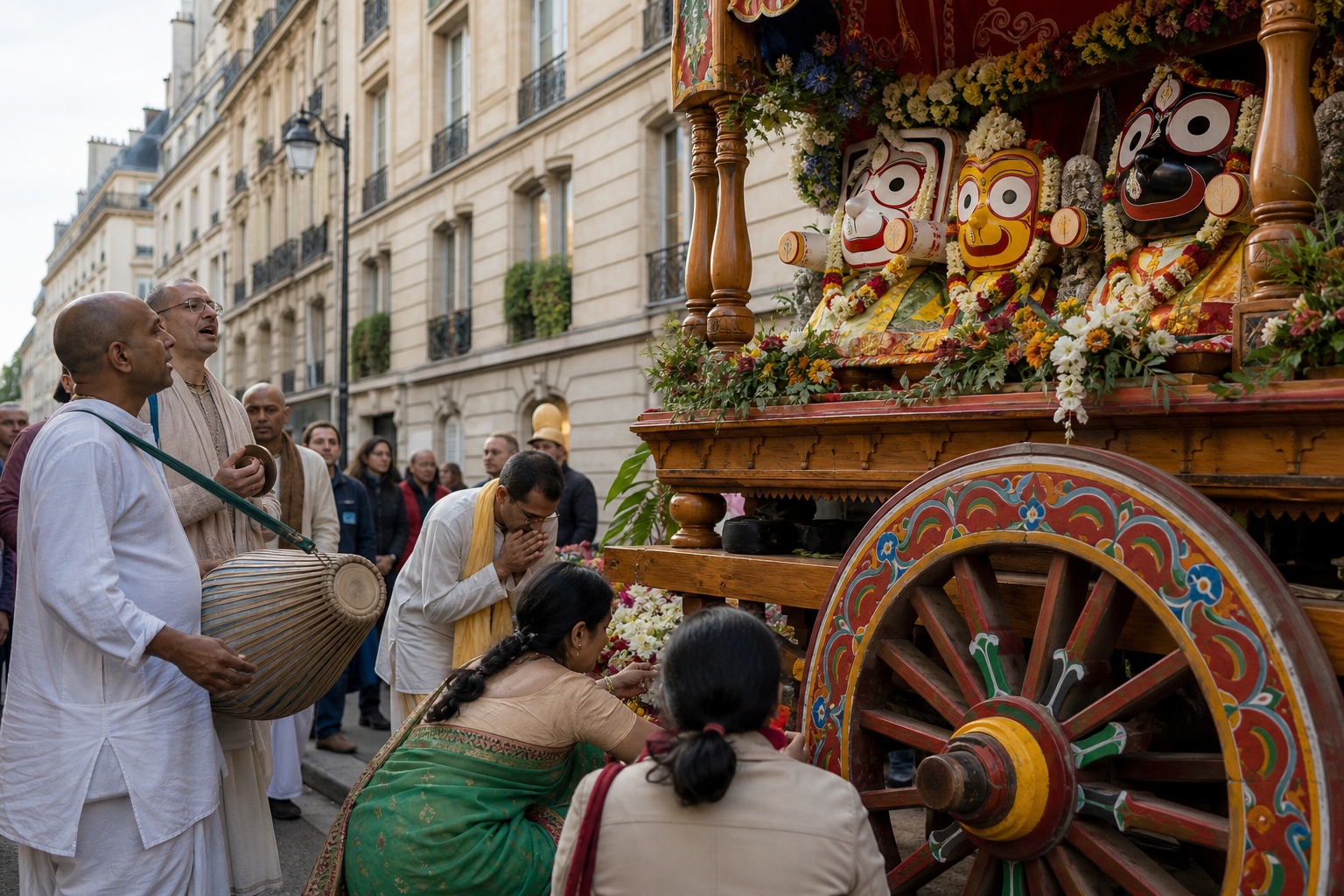
The annual Paris procession centers on the chariot of Lord Jagannath, accompanied by kirtan, rhythmic percussion, garlands, and a moving community of participants. Start there when you interpret what you see. The chariot is not decoration added to a music festival; it is the sacred focus around which the procession is organized.
Public bhakti is more than a private belief displayed outdoors. Chanting, walking, coordinated service, and shared attention make devotion accessible through actions a newcomer can observe and, where appropriate, join. You may not know the theology behind every gesture, but you can still recognize who is being honored, what practice the community is sharing, and which conduct protects the devotional atmosphere.
This distinction prevents two common mistakes. The first is assuming that unfamiliar worship is closed to you, even when the responsive kirtan and moving procession offer a clear point of entry. The second is reducing the occasion to ethnic entertainment because it is musical, visual, and joyful. Openness does not remove sacred meaning. It makes that meaning encounterable.
As the chariot and chanting move through an ordinary city street, attention is temporarily reordered. Traffic, tourism, and hurried movement no longer define the entire space. Sacred sound and collective movement create a temporary devotional environment within the city rather than apart from it. Notice that change before reaching for a label such as parade, concert, or spectacle.
How to join without pretending to know more than you do
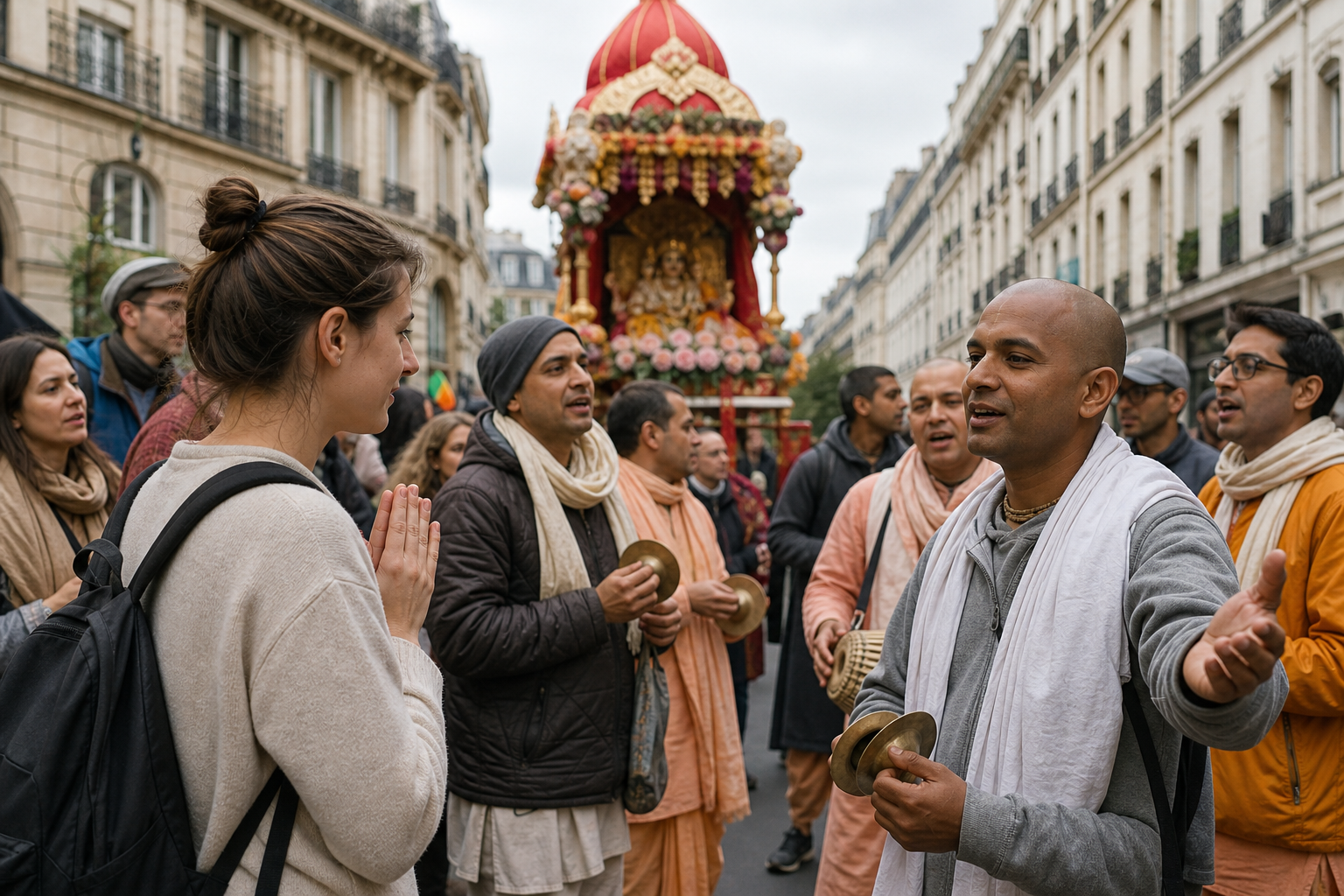
A newcomer does not need to imitate experienced devotees. Respectful participation begins with attention and becomes more active only as the structure of the procession becomes clear. Use this sequence when you attend:
- Confirm the practical details. Check the current date, assembly point, route, expected finish, and accessibility conditions before leaving. A moving procession requires different planning from a program held at a fixed venue, and a remembered itinerary may no longer be current.
- Read the flow from the edge. Locate the chariot, the kirtan group, and the volunteers guiding movement. Give yourself enough time to see where participants are walking and which areas need to remain clear.
- Enter through listening. Kirtan commonly offers a repeated response that you can hear before attempting to sing. Listen for its cadence, respond when you are comfortable, and do not worry about displaying fluency. Attentive walking and listening are more respectful than loudly guessing at unfamiliar words.
- Follow the people carrying responsibility. Volunteers help coordinate the chariot, procession, and participants. Respond promptly to their directions, keep the moving path open, and ask before handling instruments, garlands, or other devotional objects.
- Photograph from a position that does not take over the event. Visual documentation can preserve the procession’s intangible heritage, including its sound, coordinated movement, and communal character. That value does not excuse blocking the route or intruding on individual worship. Step aside for images and seek permission before making a close portrait the focus of your recording.
- Plan for the fact that the crowd moves. If you attend with family or friends, agree on a meeting point before entering the procession. Do not assume everyone will remain together once chanting, onlookers, and volunteers begin moving at different paces.
Public accessibility is an invitation, not an entitlement to every role or object. You can sing, walk, listen, or observe quietly while still honoring the boundaries maintained by devotees and volunteers. When you are uncertain, asking a simple question is better than copying an action whose meaning you do not understand.
Notice how a city street becomes devotional space
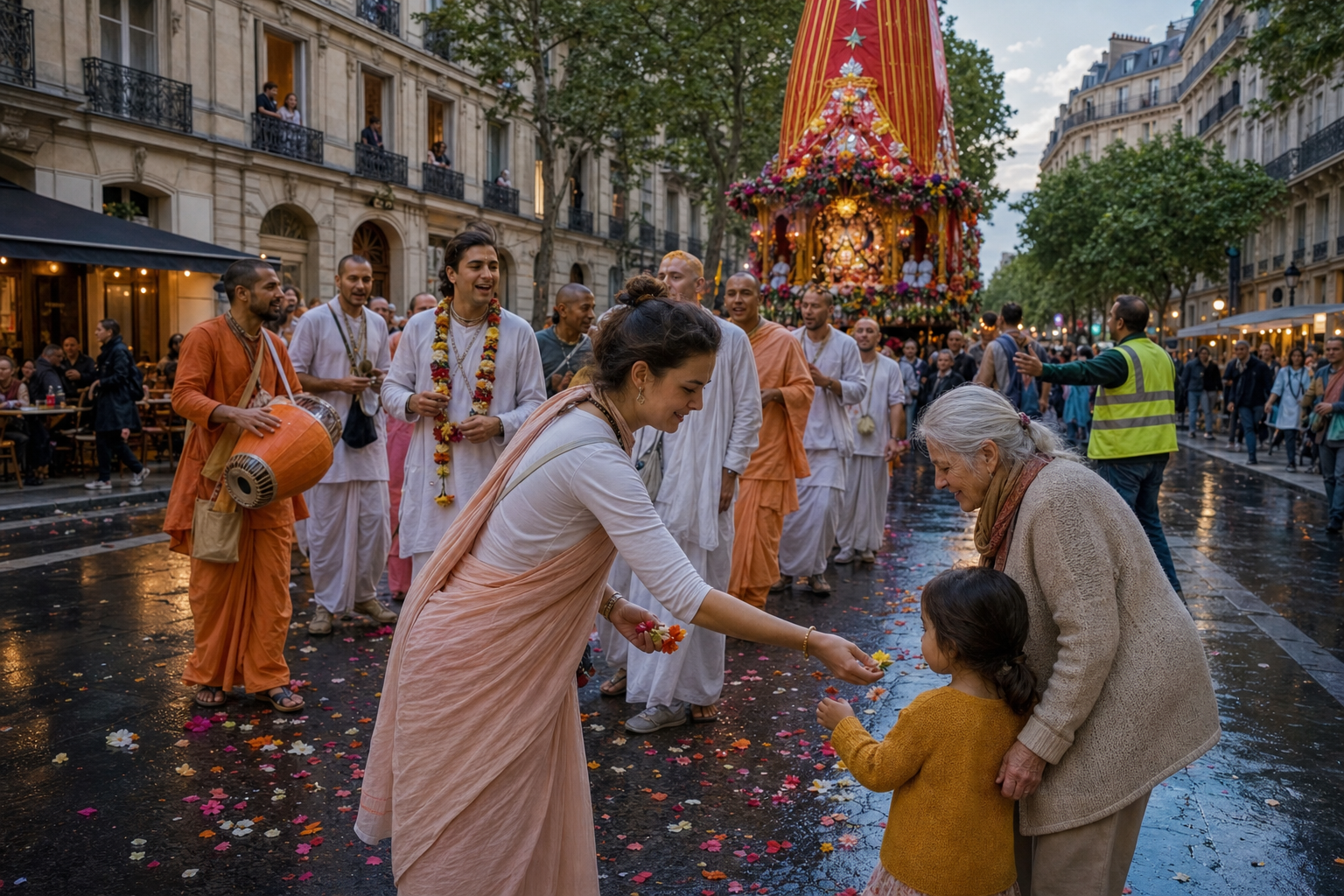
The most revealing part of Ratha Yatra is not any isolated visual element. It is the way several practices work together. Put your phone away for part of the procession and watch for these shifts:
- Sound changes the role of the crowd. A responsive chorus gives a passer-by a way to move from overhearing to participating. Listen for the exchange between a leading voice and the returning response rather than judging the kirtan as if it were a staged concert.
- Movement makes entry gradual. You can walk with the procession, pause, or return to the pavement without needing to master a formal sequence. That permeability is one reason devotion can meet people who did not arrive expecting a religious encounter.
- Seva makes welcome possible. Watch the coordinated steps of volunteers and the practical attention required to sustain a moving gathering. Public joy depends on disciplined service that may be less visually striking than the chariot but is essential to the experience.
- The chariot keeps attention anchored. Music and dancing can attract people from a distance, but Lord Jagannath’s chariot keeps the gathering from becoming a free-floating street celebration. Return your attention to that center whenever the surrounding activity feels overwhelming.
- Participation changes by degrees. One person may sing, another may walk silently, and another may remain at the edge and listen. Do not measure sincerity by outward exuberance alone.
These details help you see why public bhakti is neither a private ceremony that happens to be visible nor a performance designed only for spectators. It preserves differentiated responsibilities while allowing a stranger to approach. The devotee, volunteer, curious traveler, family, and passer-by do not have identical roles, yet they can share the same space without the devotional center disappearing.
If you help organize a future public celebration, the same observations become useful design tests. A newcomer should be able to identify the sacred focus, hear how to enter the chant, find someone who can answer a question, and participate without being pressured to simulate expertise. Hospitality becomes credible when the invitation is easy to understand and the ritual boundaries are equally clear.
Dharmic harmony requires clarity, not dilution
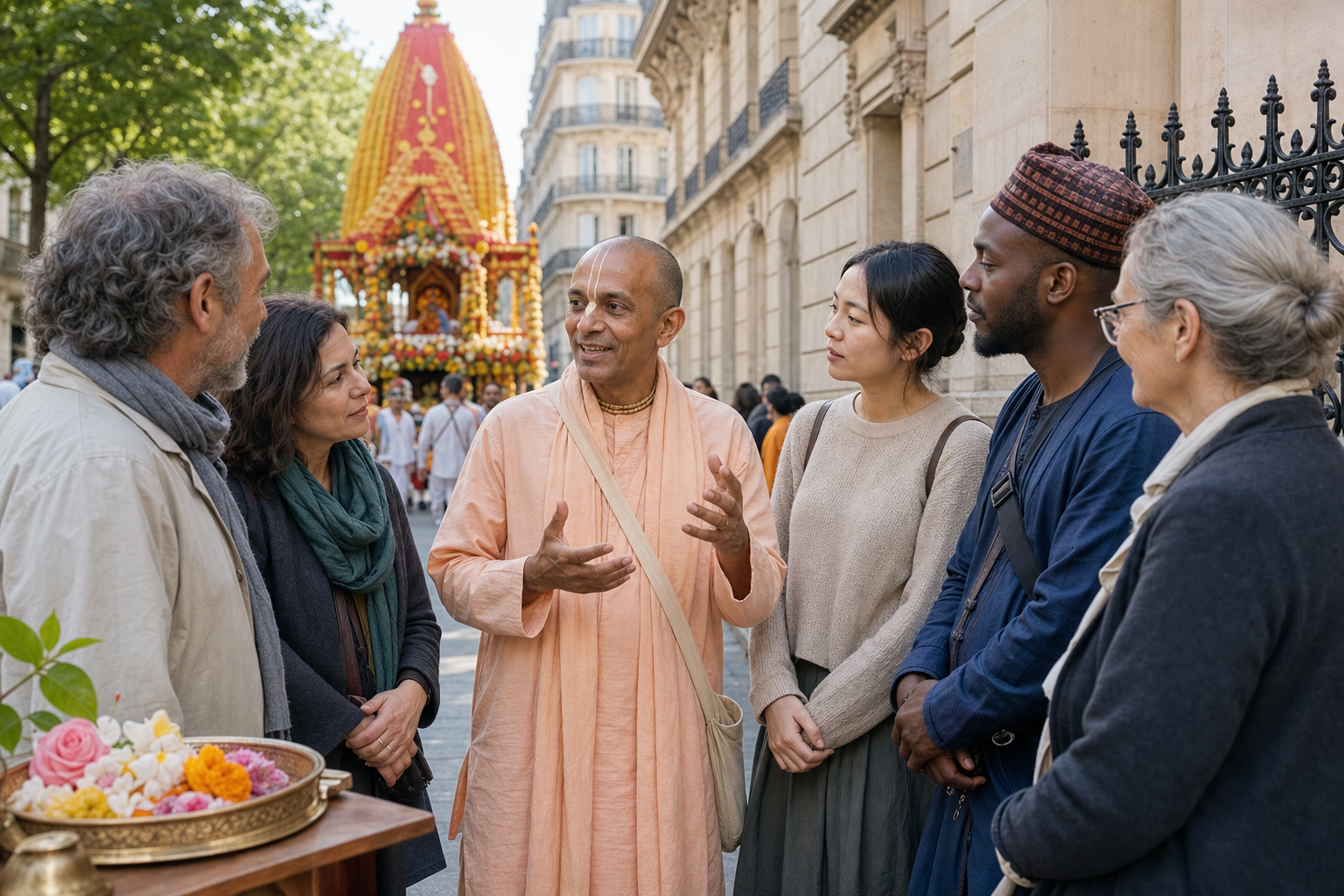
Paris Ratha Yatra can create genuine interfaith recognition because compassion, seva, inner reflection, and ahimsa resonate across Hindu, Buddhist, Jain, and Sikh traditions. These points of contact give people from different backgrounds a meaningful way to understand the ethical character of the gathering.
Resonance is not equivalence. The responsible way to explain the event is to name its particularity before describing its wider connections: this is Ratha Yatra centered on Lord Jagannath, expressed through chariot procession and kirtan within a bhakti tradition. Once that is clear, you can discuss how selfless service, compassion, and community care speak to a wider dharmic moral world.
Avoid the convenient claim that all dharmic paths teach exactly the same thing. Hinduism, Buddhism, Jainism, and Sikhism retain distinct practices, sacred histories, vocabularies, and understandings of liberation. Harmony becomes stronger when those differences can remain visible. Nor should public acceptance depend on removing Jagannath, Krishna, kirtan, or other recognizably Hindu elements until only generic spirituality remains.
This balance also helps different visitors respond honestly. A Hindu participant can welcome others without apologizing for the tradition’s particular form. A Buddhist, Jain, or Sikh visitor can recognize ethical kinship without claiming identical doctrine. A visitor with no dharmic background can participate respectfully without treating sacred symbols as detachable cultural props.
The Paris setting carries a continuing devotional history. Srila Prabhupada visited Paris on several occasions and encouraged sustained bhakti outreach, while ISKCON Paris continues to cultivate kirtan, study, and service. The procession is therefore an open door into an ongoing practice, not an isolated annual display.
Before you attend, decide how you are prepared to participate: through singing, attentive walking, quiet observation, or seva offered under guidance. After the procession, choose one continuation that matches your interest: return to kirtan, enter a setting of study, or ask how to serve. That next step turns a striking moment on a Paris street into an honest encounter with living bhakti.
References
