

You may have encountered a startling claim: in a Kerala Ramayana story, Surpanakha kills her own husband. Is that simply what the Ramayana says? The responsible answer is narrower and more interesting. Some Kerala oral tellings make Surpanakha directly responsible for her husband’s death, but that episode should not be projected onto every Ramayana tradition.
The distinction matters because the variant changes how you read Surpanakha. She is no longer only the woman whose rejected desire precipitates the Panchavati conflict. She becomes an agent carrying an earlier history of anger, injury, power and moral responsibility. Read carefully, the tale is neither a licence to condemn her without reflection nor an excuse to erase the violence attributed to her.
The short answer: a regional variant, not a replacement
There is no contradiction in saying that a story belongs to the Ramayana tradition while also saying that it does not occur in every Ramayana telling. India’s epics have lived through recitation, performance, commentary and regional adaptation. A local narrative can preserve a meaningful interpretation without displacing Valmiki’s account or becoming a universal claim about Surpanakha.
Key takeaways
- The husband-killing episode belongs to some Kerala oral tellings, not to one uniform account accepted everywhere.
- Vidyutjihva is the husband’s name in certain traditions; the name and the surrounding motives should therefore be presented with that qualification.
- The variant gives Surpanakha greater agency, but it also places greater responsibility for the fatal act upon her.
- Its ethical centre is the movement from humiliation or rivalry into anger and destructive action.
- Kerala’s Ramayana performance culture helps explain how character psychology and local subplots could develop, but it does not prove that this exact episode appears in every performance tradition.
If you are explaining this folklore to someone else, the safest opening is also the most accurate: “In some Kerala oral tellings…” That short phrase preserves the tradition without pretending that its boundaries are broader than the evidence allows.
What changes when Surpanakha bears responsibility

Surpanakha is often remembered through Panchavati: her approach to Rama and Lakshmana, her humiliation, and the chain of events that follows. That familiar episode can make her seem as though she enters the Ramayana without a past. The Kerala marital narrative supplies one. It asks you to see the Panchavati figure as someone whose desires and anger may already have produced grave consequences.
Her identity is formidable even before any regional addition. Her name is commonly understood as having nails like winnowing fans. She is a powerful rakshasa princess, the daughter of Sage Vishrava, the sister of Ravana, and a descendant of Pulastya, one of the Sapta Rishis. That genealogy prevents an overly simple reading of her as a character standing outside sacred history. She is situated within it, even when her conduct becomes a vehicle for examining adharma.
In the Kerala variant, the husband is called Vidyutjihva in certain traditions. The conflict may be associated with jealousy, humiliation or political rivalry. The crucial detail is not a single fixed motive or mechanism, because the oral tellings are not presented as uniform on those points. The crucial change is the placement of responsibility: Surpanakha directly causes or arranges the death rather than merely suffering a loss caused by someone else.
That shift produces a more difficult character. Agency here does not automatically mean liberation, and suffering does not automatically mean innocence. Surpanakha can be wounded and culpable at the same time. You do not have to choose between treating her as a caricature and absolving her of every act attributed to her. The folklore becomes useful precisely when you resist that false choice.
The ethical centre is krodha, not romantic scandal

A sensational retelling would reduce the episode to a murderous marriage. A Dharmic reading asks a more demanding question: what happens between injury and action?
The story works through raudra rasa, the aesthetic mood of fury, and krodha, anger. Raudra gives fury dramatic form; the ethical inquiry begins when fury governs conduct. Humiliation, betrayal or rivalry may explain why rage arises, but explanation does not make the resulting violence righteous. The fatal act marks a rupture for which power and pain cannot substitute as excuses.
When you read or hear the tale, track four separate moments:
- Identify the wound: jealousy, insult, betrayal or political conflict.
- Notice the interpretation placed upon that wound. Anger often grows through the meaning assigned to an event, not through the event alone.
- Locate the moment at which emotion becomes deliberate action.
- Ask who bears the consequences beyond the immediate victim: a household, a lineage, a kingdom or a later relationship.
This sequence keeps the moral analysis precise. It allows compassion for the injured person without converting compassion into moral exemption. It also keeps the tale from becoming a crude warning against female desire. Desire is not the same as violence; rejection is not the same as adharma; and anger felt is not identical to anger obeyed. The decisive issue is whether the person retains mastery over the response.
The variant therefore speaks directly to emotional governance. Unprocessed humiliation can harden into retaliation, especially when the injured person possesses the power to act without restraint. The practical counsel is not to deny anger. It is to interrupt the progression from wounded pride to irreversible conduct. Name the injury, test the story you are telling yourself about it, and create distance before exercising power against another person.
Kerala’s performance culture explains flexibility, not uniformity
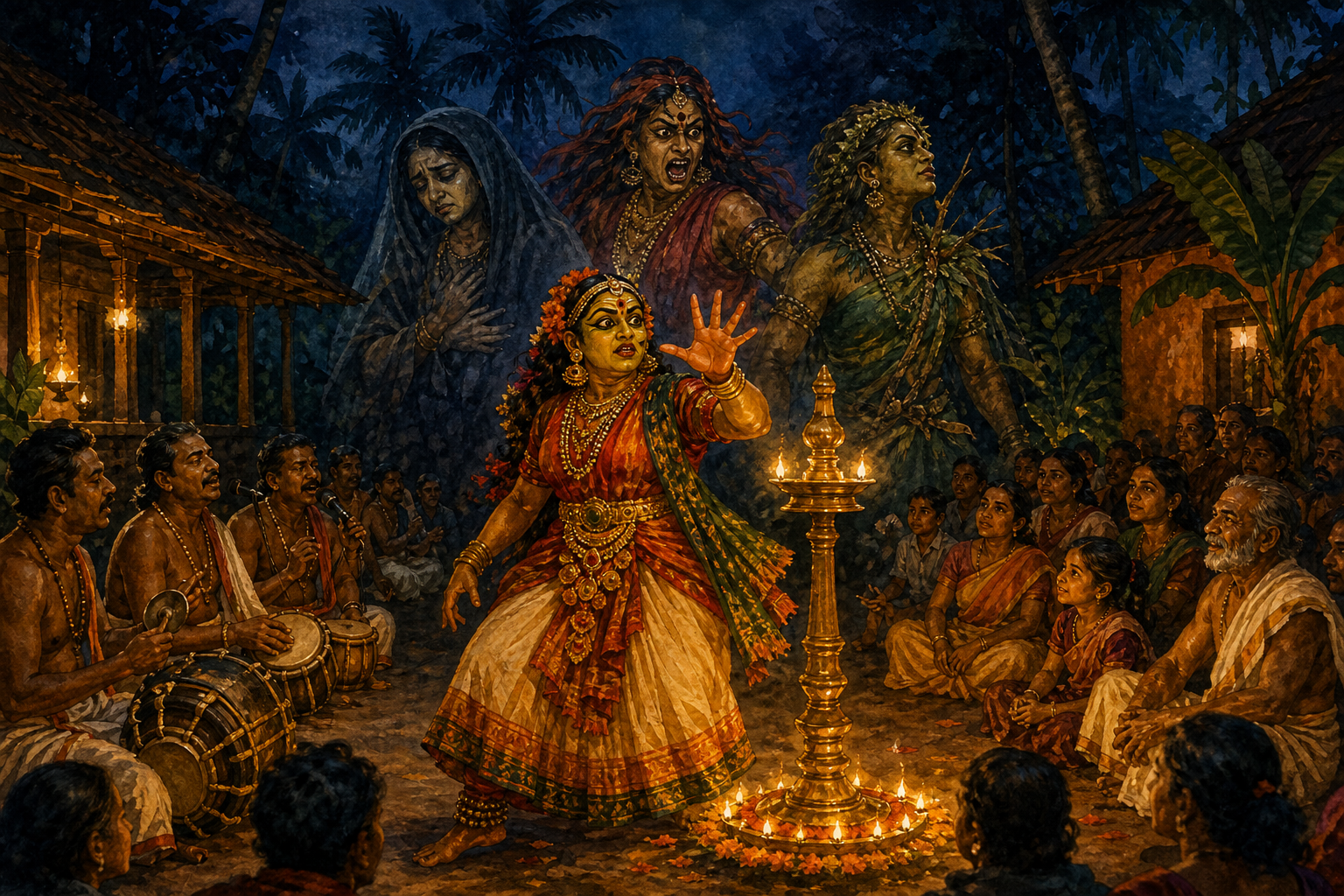
Kerala’s Ramayana culture is not confined to silent reading. Kathakali and Ottamthullal adapt epic episodes through gesture, music, rhythm and embodied character. Such performance gives storytellers room to intensify motives, make inner conflict visible and shape an episode for a local audience. A psychological suggestion can become a scene; a remembered subplot can acquire moral weight through repeated narration.
That context helps you understand how a distinctive account could live within Kerala. It does not establish that every Kathakali or Ottamthullal presentation contains the husband-killing episode. Nor does the label “Kerala folklore” mean that every community, performer or family in Kerala tells it in one form. Regional tradition is a location for variation, not a guarantee of uniformity.
If you are documenting a performance or oral narration, record four details before making a broad claim: the medium, the place or community, the teller or troupe, and the precise action attributed to Surpanakha. Also distinguish between killing, causing a death and orchestrating one. Those verbs assign responsibility differently. When the available account does not settle the mechanism, preserve that uncertainty instead of selecting the most dramatic version.
This discipline protects both the local tradition and the larger epic inheritance. Treating a regional variant as an error strips oral culture of authority. Treating it as the sole canonical account strips the Ramayana of its layered transmission. The better position is to let the variant add an ethical possibility while keeping its provenance visible.
How to retell the episode without flattening the tradition
A responsible retelling needs more than a disclaimer. Its wording should show the reader exactly what is stable, what varies and what you are interpreting.
- Begin with scope. Say that the episode appears in some Kerala oral tellings. Do not begin with the universal claim that “Surpanakha killed her husband in the Ramayana.”
- Separate identity from variable plot. Her relationship to Vishrava, Ravana and Pulastya belongs to her broader genealogy. Her direct responsibility for her husband’s death is the regional variation under discussion.
- Qualify the uncertain details where they occur. Use “Vidyutjihva in certain traditions” and present jealousy, humiliation and political rivalry as possible frames, not as one definitively established motive.
- Describe agency and accountability together. Greater narrative agency makes Surpanakha more complex, but it also makes her answerable for the choice attributed to her.
- Distinguish plot from interpretation. The alleged killing is a plot claim. Reading it through krodha, raudra rasa, self-mastery and the dharma-adharma tension is an ethical interpretation of that claim.
- Use Dharmic parallels with care. Jain anekantavada can discipline you to consider more than one perspective; Buddhist upaya can sharpen attention to context; Sikh commitments to compassion and seva can keep judgement connected to care; and Hindu narrative plurality can accommodate more than one telling. These are interpretive companions, not proof that every tradition teaches an identical doctrine or owns the same story.
The next time this Surpanakha story appears in a discussion, resist the demand for a quick verdict about which version is “the real one.” First ask which telling is being invoked, which details it actually preserves, and what moral work the change performs. That is how you honour both Kerala’s regional memory and the Ramayana’s larger, living field of meaning.
References
