
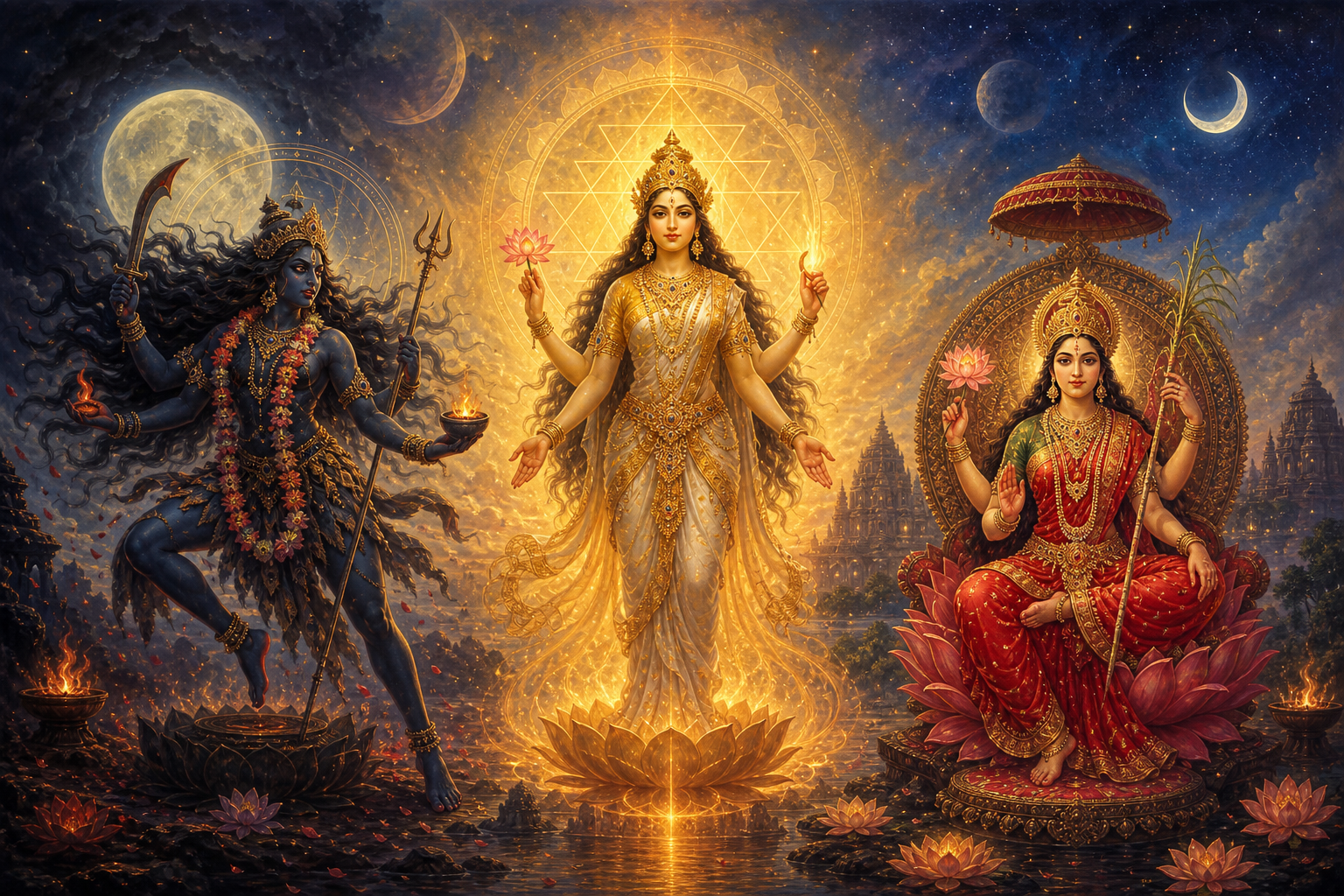
You may revere Devi and still wonder what that reverence requires of you. Does Shakti theology support gender equality, or can sacred images of the feminine coexist with unequal treatment of women? And what do unsettling forms such as Kali, alongside graceful forms such as Lalita Tripura Sundari, contribute to the answer?
The useful answer begins with a distinction. Shakti theology provides a powerful basis for dignity, agency, and shared authority, but an image of a goddess is not itself evidence that a family or institution treats women justly. You have to carry the theology from metaphysics into conduct. The Mahavidyas help because they refuse to reduce sacred femininity to beauty, obedience, motherhood, ferocity, or any other single role.
Start with the theological claim: power is not secondary
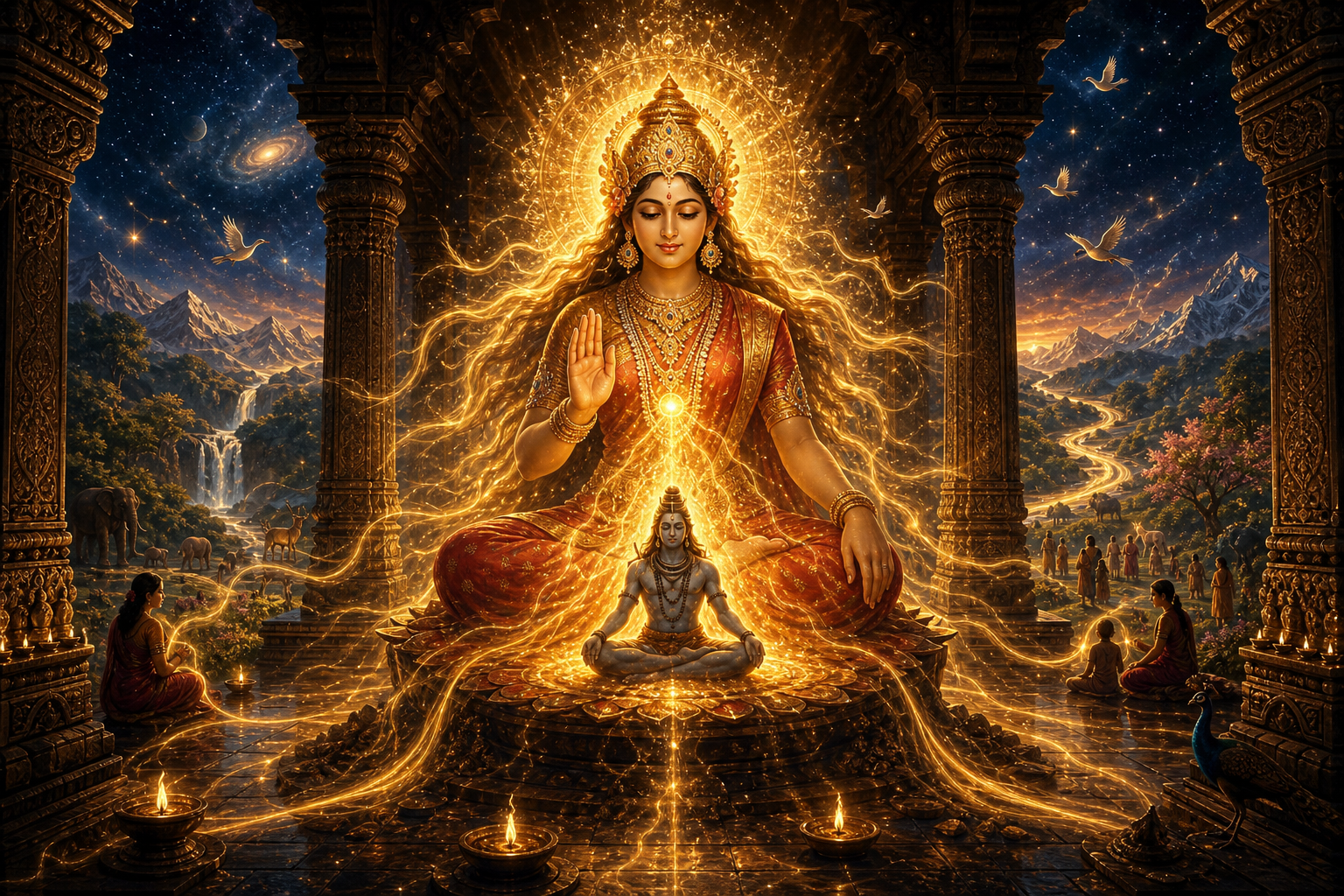
Shakti is not an ornament added to an otherwise complete divine order. She is the power by which existence moves, manifests, sustains itself, and changes. Rig Veda 10.125, commonly called the Devi Sukta, gives voice to the feminine as a cosmic presence rather than a merely domestic deity. Ardhanarishvara makes the same principle visible through the indivisibility of Shiva and Shakti. The theological point is not that two independent halves negotiate a partnership; it is that consciousness and power cannot be separated without distorting reality.
This is why a Shakta account of sacred balance can ground equality more deeply than a reluctant concession does. Creative power, knowledge, protection, abundance, and transformation are not secondary attributes loaned to the feminine. Forms such as Durga, Saraswati, Lakshmi, and the Mahavidyas disclose them as fundamental dimensions of divine reality.
Yet Shakti is not simply another word for a human woman, just as Shiva is not simply another word for a human man. Divine masculine and feminine imagery can describe relationships among awareness, energy, manifestation, stillness, wisdom, desire, and action. Biological sex does not assign one set of these capacities to men and the other to women. Every person must learn attention and action, firmness and receptivity, discernment and compassion.
This distinction protects you from two opposite mistakes. The first is to treat Shakti as poetic decoration with no ethical consequence. The second is to turn cosmic symbolism into a rigid social chart in which women must represent energy and care while men retain interpretation and authority. Both readings make the feminine serve a structure that was decided in advance.
When you encounter gendered sacred imagery, read it at three levels. Ask what it says about ultimate reality, what inner capacity it asks a practitioner to cultivate, and what obligation it creates in social life. Keep those levels connected, but do not collapse them. A goddess can reveal a universal spiritual power without prescribing a single personality, occupation, or family role for every woman.
The Mahavidyas refuse a narrow script for femininity
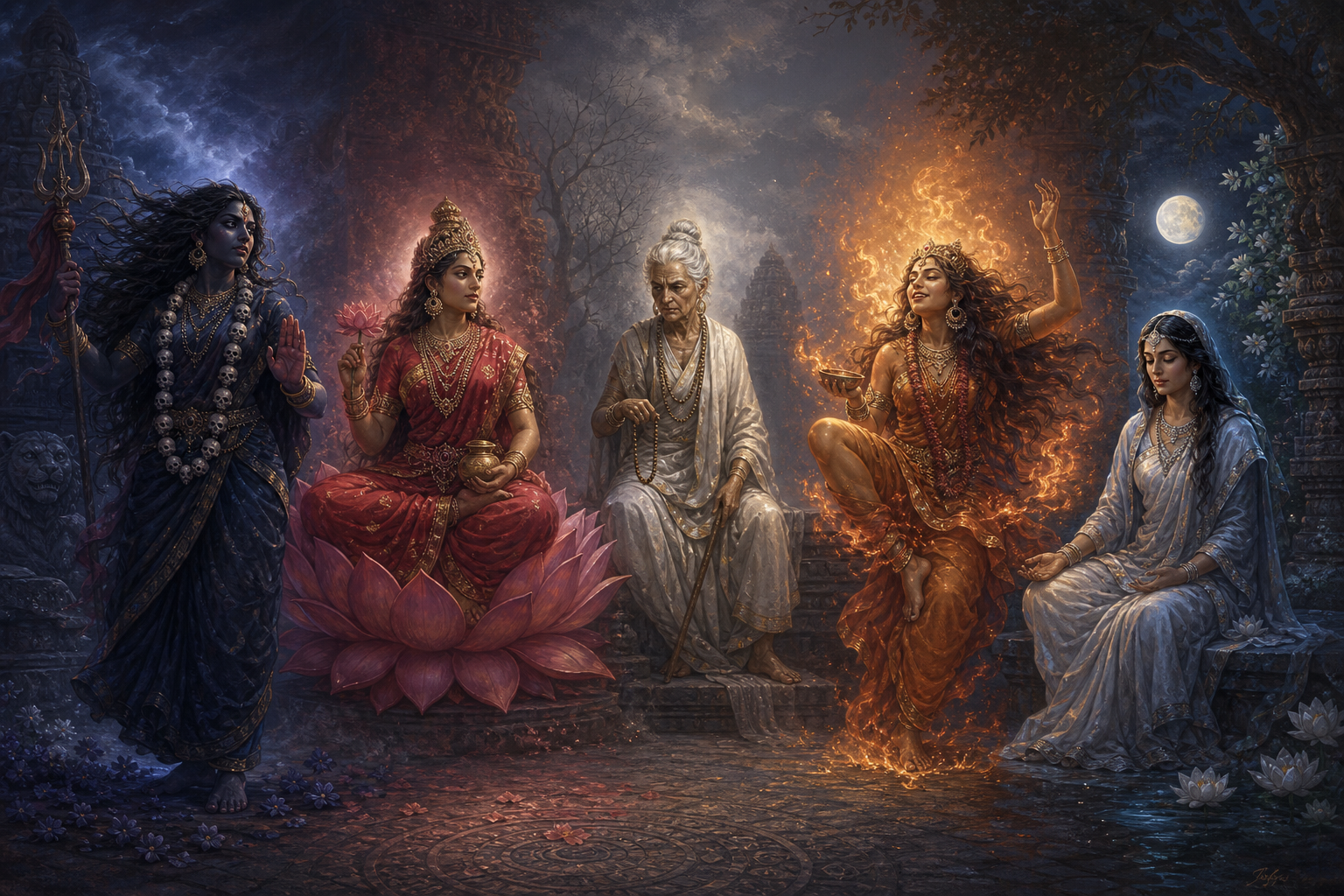
The Mahavidyas are especially important to a discussion of gender because they do not offer one approved version of the feminine divine. They confront the seeker with different modes of truth, including forms that appear beautiful, fierce, protective, unsettling, disciplined, or radically free. Instead of asking which form represents a respectable woman, ask which limitation in your understanding each form exposes.
Kali exposes the fear beneath control
Kali is associated with time, dissolution, and the ending of adharma. Her fierceness is not destruction for entertainment. It is the force that cuts through ego, attachment, ignorance, and whatever can no longer be preserved without serving falsehood. The transformative meaning of Kali therefore lies in liberation as much as protection.
Applied to gender, Kali challenges the expectation that feminine goodness must always appear quiet, agreeable, reassuring, or easily controlled. Anger is not automatically wisdom, and aggression does not become dharmic merely because it adopts Kali’s name. But neither should necessary truth, boundary-setting, or resistance to adharma be condemned simply because a woman expresses it forcefully.
Use a dharmic test instead of a temperament test. Is the force directed toward truth and protection, or toward humiliation and revenge? Does it remove an injustice, or merely transfer domination to another person? Does it leave greater clarity and responsibility behind? Kali’s symbolism asks you to examine the moral direction of power rather than judging power by whether it looks socially comfortable.
Lalita shows that beauty need not mean passivity
Lalita Tripura Sundari represents beauty, harmony, refined intelligence, and compassionate sovereignty. Her name evokes the three worlds, while her theology also encompasses waking, dream, and deep sleep. The sugarcane bow, flower-arrows, noose, and goad in her iconography point toward mastery of mind, desire, attraction, and the subtle forces that direct action.
Within Sri Vidya, her relationship with the Sri Chakra places beauty inside a disciplined contemplative order. Grace is not helplessness. Refinement is not submission. Desire is not simply indulged or despised; it must be understood and governed by wisdom. The spiritual vision of Lalita Tripura Sundari joins an open heart to a lucid mind rather than asking you to choose between them.
Applied to gender, Lalita corrects another stereotype: the assumption that a feminine presentation of beauty or tenderness signals weak judgment. A person can be gentle without surrendering authority and decisive without imitating harshness. Beauty becomes dharmic when it expresses order, awareness, and care; it becomes a trap when it is demanded as the price of being heard.
Kali and Lalita should not be arranged as opposites called anger and sweetness, much less assigned to different kinds of women. They disclose powers that a mature person may need at different moments. Kali asks what must end. Lalita asks what must be brought into harmony. The first question without the second can become indiscriminate destruction; the second without the first can preserve a pleasing but unjust surface.
Gender equality must be tested in authority, not symbolism alone
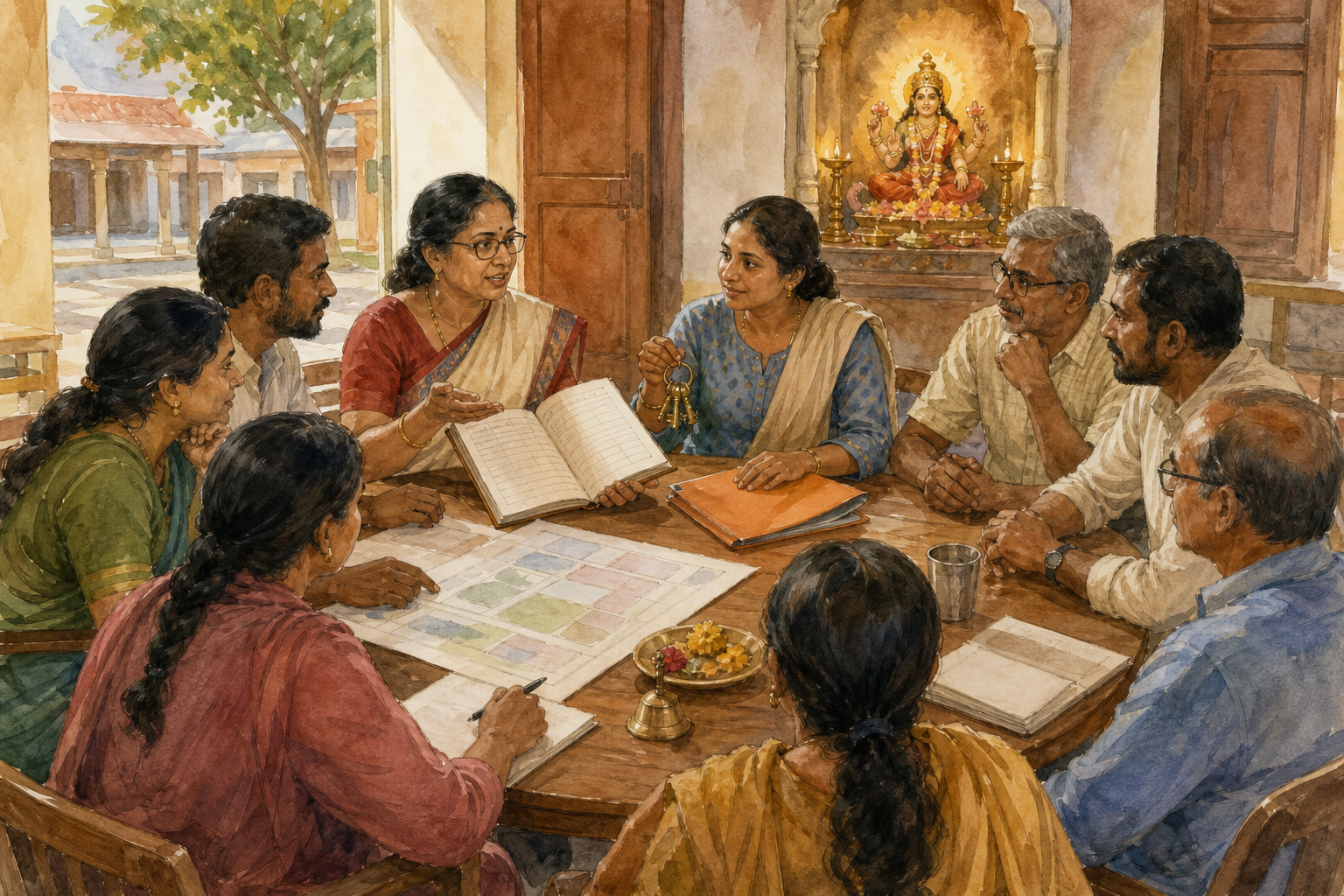
Shakti theology establishes a strong metaphysical argument against treating the feminine as inferior. It does not automatically prove that every custom, household, temple committee, or historical arrangement has embodied that truth. Reverence for Devi and injustice toward women can coexist when worship remains symbolic while authority remains closed.
This is where the language of complementarity needs care. Complementarity is dharmic when different people bring distinct strengths to a shared responsibility and retain equal dignity, voice, and moral agency. It becomes hierarchy in disguise when one party defines both roles, reserves final authority, and calls the other’s lack of choice sacred balance. The question is not whether two roles are identical. It is whether the people carrying them can learn, decide, dissent, change, and be held to comparable ethical standards.
Use four questions to examine a family or institution
- Who may interpret? Notice whether women are welcomed as teachers, scholars, ritual participants, and serious students, or praised mainly as keepers of devotion designed by others.
- Who may decide? Look beyond ceremonial visibility. Who controls schedules, resources, appointments, education, and the resolution of disputes?
- Who receives opportunity? Compare access to study, spiritual guidance, leadership, time for practice, and public platforms. Praise without access is not empowerment.
- Who carries the cost? Ask whether sacrifice, patience, family honor, or seva is demanded disproportionately from women while comparable duties are optional for men.
These questions convert reverence into something observable. A household honoring Saraswati can protect every daughter’s education and every woman’s time for intellectual life. A community invoking Durga can take women’s judgment seriously when protection, discipline, or institutional accountability is at stake. A temple celebrating Devi can examine whether women participate in decision-making as well as festival labor. The precise arrangement may respond to desa, kala, and patra – place, time, and circumstance – but adaptability cannot mean that equality is postponed whenever it becomes inconvenient.
This reasoning also clarifies how Shakti theology can meet the wider Dharmic family without erasing differences. Buddhist reverence for Tara and Prajnaparamita, Jain devotion involving Ambika and Padmavati alongside the learning and discipline of sadhvis, and Sikh affirmation of women’s dignity each arise from their own doctrinal settings. They should not be relabeled as versions of Shaktism. They can still stand in meaningful conversation around wisdom, compassion, courage, spiritual capacity, and the refusal to treat women as lesser beings.
Approach Mahavidya practice with devotion and discernment
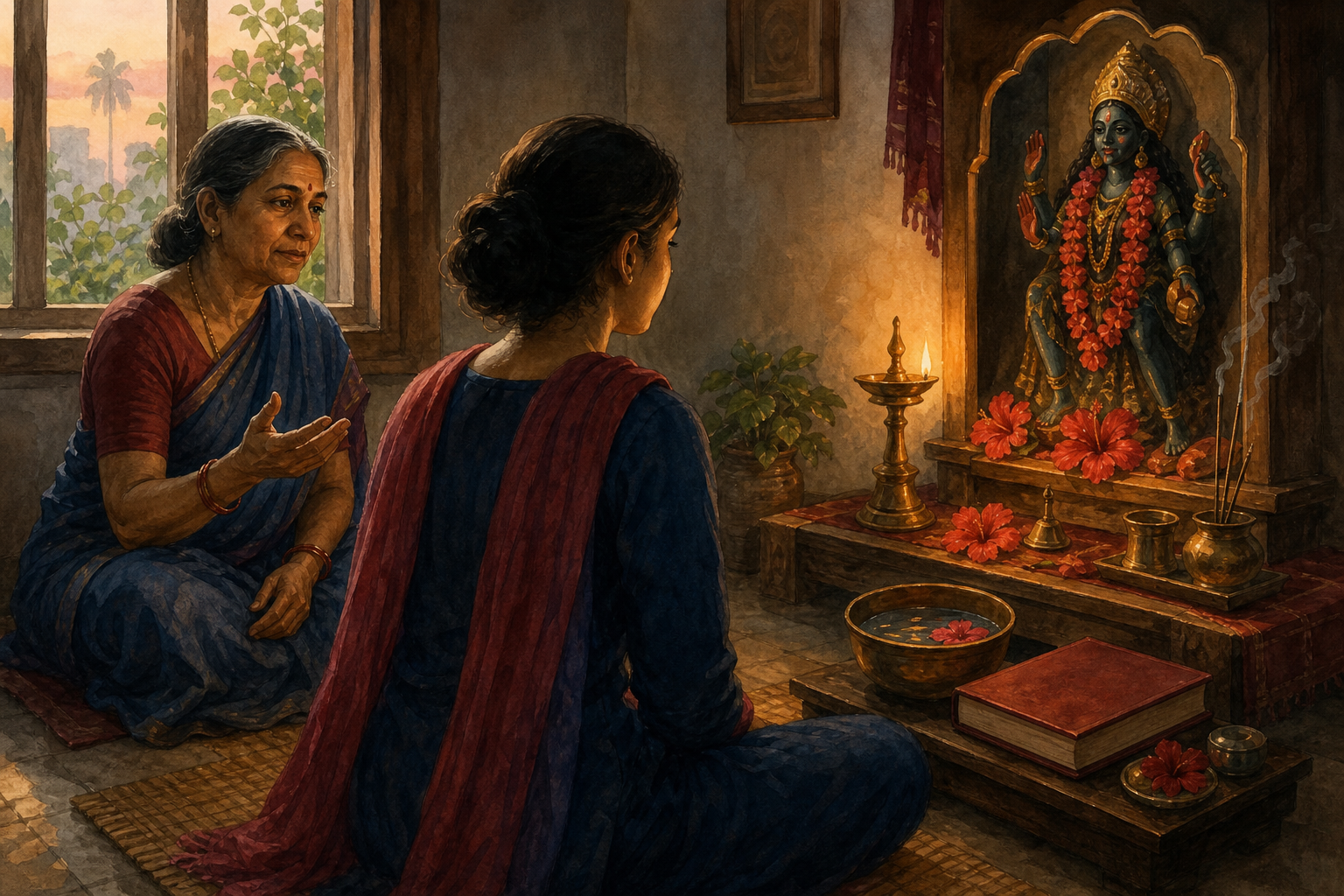
You do not need an elaborate ritual to begin learning from a Mahavidya. You do need a clear intention, an ethically sound practice, and honesty about the difference between devotional testimony and a guaranteed result. Begin with the form toward whom you already feel a sincere connection, not the form that appears most dramatic online.
- Name the inner work. If fear is making you avoid a necessary truth, Kali’s symbolism may help you contemplate courage and release. If desire, distraction, or disorder is scattering your attention, Lalita may help you contemplate harmony and disciplined beauty. Do not use either form to justify a conclusion you have already chosen.
- Stay within an accessible devotional form. Remembrance, a familiar household prayer, ethical reflection, and recitation already established in your family or sampradaya are sound starting points. Lalita Sahasranama, Friday worship, and Navaratri observance are associated with Lalita devotion. Kali worship is observed on occasions including Amavasya, Navaratri, and Kali Chaudas. You need not adopt every observance to be sincere.
- Seek qualified guidance before specialized practice. Advanced mantra, yantra, Sri Chakra upasana, and homa belong within disciplined traditions. A credible guru-parampara should increase humility, truthfulness, self-command, and responsibility. Secrecy, fear, financial pressure, claims of guaranteed supernatural control, or encouragement to harm another person are reasons to step away.
- Attach worship to one visible ethical duty. Pair prayer with satya, seva, protection of another person’s dignity, support for education, a fairer division of labor, or space for a silenced voice. This keeps sadhana from becoming a private mood disconnected from dharma.
- Examine the fruit without exaggerating it. Look for clearer judgment, reduced fear, steadier conduct, compassion, and willingness to correct yourself. Experiences of intensity or emotional relief are not by themselves proof of spiritual attainment.
Devotees associate Kali practice with protection, courage, and resilience, and Lalita devotion with serenity, clarity, and renewed purpose. Treat such accounts as devotional testimony, not as medical evidence. If you are dealing with prolonged illness, psychological distress, threats, or suspected poisoning or abuse, seek qualified professional help. Prayer can accompany responsible care; it should not replace diagnosis, treatment, safeguarding, or legal protection.
Key takeaways
- Shakti is foundational divine power, not a decorative feminine addition to an otherwise complete reality.
- Masculine and feminine sacred symbols describe powers and relationships; they do not assign fixed abilities or social roles by sex.
- Kali reveals the necessity of ending fear, falsehood, and adharma, while Lalita reveals the disciplined intelligence within beauty and harmony.
- Goddess worship supports gender equality only when dignity becomes access to learning, ritual participation, decision-making, and accountable leadership.
- Simple devotion is accessible, but specialized mantra, yantra, Sri Chakra, or homa practice calls for trustworthy guidance and ethical discipline.
At your next worship gathering, family discussion, or community meeting, choose one test: who interprets, who decides, who receives opportunity, or who carries the cost. Then make one correction you can actually observe. That is how Shakti moves from an honored name to a lived principle of dharma.
References
- DharmaRenaissance Blog – Shakti and Sacred Balance: What Hindu Scriptures Teach About True Gender Equality
- DharmaRenaissance Blog – Lalita Tripura Sundari Mahatmyam: Unveiling the Mahavidya’s Transformative Grace and Wisdom
- DharmaRenaissance Blog – Kali Devi Mahatmyam: Transformative Power of Kali Mahavidya for Courage and Healing
