
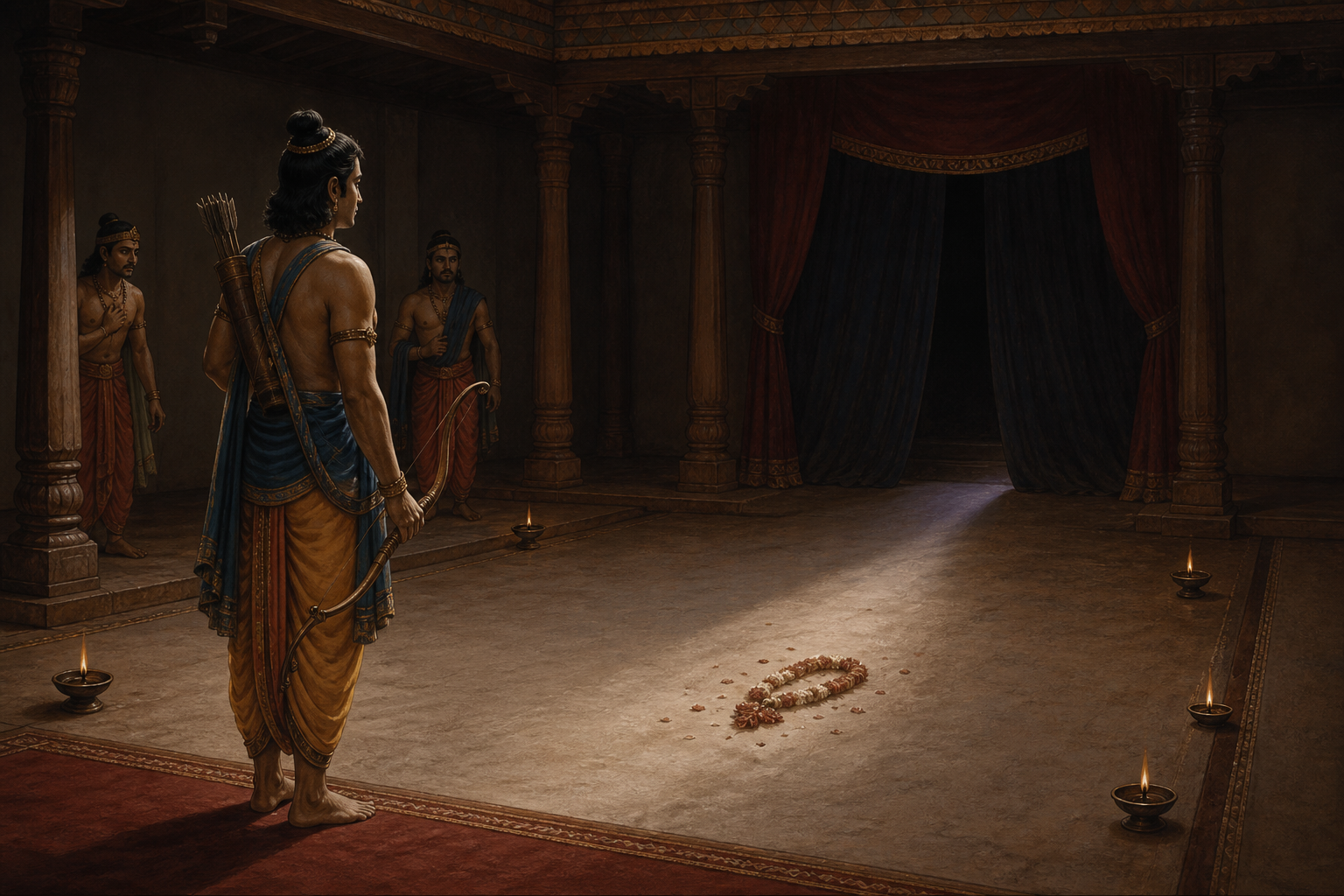
If you come to Pratima Natakam expecting the Ramayana’s decisive events to unfold visibly, Sita’s abduction may seem strangely absent. Bhasa places the violation outside the audience’s sight and brings its moral consequences to the centre of the stage.
That choice gives you the key to the play. Read not only for what happens, but for what the drama refuses to turn into spectacle. Dharma becomes visible through speech, memory, restraint, and the costly decisions characters make after the event.
Key takeaways
- Bhasa preserves the ethical direction of the Ramayana while changing how its crisis reaches the audience.
- Keeping Sita’s abduction off-stage does not make it unimportant; it shifts attention from the aggressor’s act to the responses that reveal character.
- Rama, Sita, Lakshmana, and Bharata embody dharma differently because their duties, temptations, and sacrifices differ.
- The pratima, or statue, turns absence into a dramatic presence and asks how memory can guide conduct.
- Karuṇa and vīra work together: sorrow reveals what adharma has damaged, while heroic resolve shows how that damage should be answered.
Read the action Bhasa does not show

In the familiar Ramayana arc, Sita’s abduction sets the search, the formation of alliances, and the eventual restoration of dharma in motion. Pratima Natakam does not discard that moral trajectory. It changes the audience’s access to it.
The abduction is mediated through messenger scenes, recollection, reflective dialogue, and symbolic representation. You encounter an event through the minds and words of people who must comprehend it. The stage therefore presents more than information about what occurred. It presents the ethical labour of receiving terrible information.
This distinction matters. A directly staged abduction would naturally concentrate attention on physical movement, danger, resistance, and Ravana’s domination of the scene. Indirect representation changes the spectator’s task. You must reconstruct the event while watching its meaning spread through relationships, duties, and political order.
Off-stage action is therefore not missing action. It is action whose dramatic force has been transferred from sight to consequence. The abduction happens once in the story, but it continues to happen morally whenever a character must decide how to respond.
Nor does restraint diminish Sita’s suffering. Refusing to reproduce a violation as visual entertainment can preserve its gravity. The audience is not invited to consume the crisis as an exciting set piece. It must remain with the injury, the absence, and the obligations that follow.
This gives you a practical way to read any major episode in the play. Separate the story event from the stage event. The story event is what occurs in the Ramayana narrative. The stage event is the report, memory, symbol, silence, or decision through which Bhasa makes you confront it. The distance between those two events is where much of the play’s ethical intelligence resides.
The historical transmission of the drama also counsels precision. The plays attributed to Bhasa came to light in the early twentieth century through T. Ganapati Sastri, while Ramayana narratives had long circulated through multiple recensions and performances. When you call Pratima Natakam a departure, do not use that word as an automatic criticism. Ask whether a formal variation abandons the epic’s ethical structure or illuminates it from another angle.
Dharma becomes visible when a choice carries a cost

Dharma in this drama is not a slogan applied identically to everyone. It is disclosed through role, relationship, pressure, and sacrifice. A ruler, an abducted queen, a vigilant protector, and a renouncing brother do not face the same decision. Their conduct can still participate in a coherent moral order.
- Rama’s steadfastness shows dharma as constancy under crisis. His ethical significance does not depend only on eventual victory; it lies in refusing to let suffering dissolve obligation.
- Sita’s resolve and dignified speech show dharma as moral sovereignty. Although another person has acted upon her circumstances, the drama does not reduce her to the passive object of that act. Her clarity determines how her presence is understood.
- Lakshmana’s vigilance shows dharma as disciplined responsibility. Alertness matters because loyalty must become attentive conduct, not remain a private feeling.
- Bharata’s principled renunciation shows dharma as the capacity to refuse possession when principle does not permit acceptance. His example separates the ability to hold power from the moral legitimacy to exercise it.
Use three questions whenever one of these figures speaks or decides: What obligation is active? What easier temptation competes with it? What cost does the character accept by remaining faithful? This prevents dharma from collapsing into vague goodness. It also reveals why two righteous characters may perform different actions without representing contradictory values.
Ravana provides the counter-test. His position as a sovereign does not sanctify his conduct. It makes the abuse of power more consequential. His adharma lies not in a lack of ability or status, but in using power against the law that ought to discipline it.
Dramatic complexity does not require moral ambiguity about the abduction. A character can possess the scale appropriate to a powerful ruler and remain culpable. Indeed, reducing Ravana to a thin monster would make it easier to imagine that adharma belongs only to obviously monstrous beings. Bhasa’s ethical contrast is sharper when authority, intelligence, and wrongdoing can occupy the same person.
This is why character should not be treated as decoration around the plot. The plot establishes the crisis; the characters disclose its dharmic meaning. If you remember only that Sita was abducted, you remember the narrative trigger. If you notice what each person protects, refuses, or endures afterward, you begin to read the drama.
The statue and the rasas turn absence into moral presence
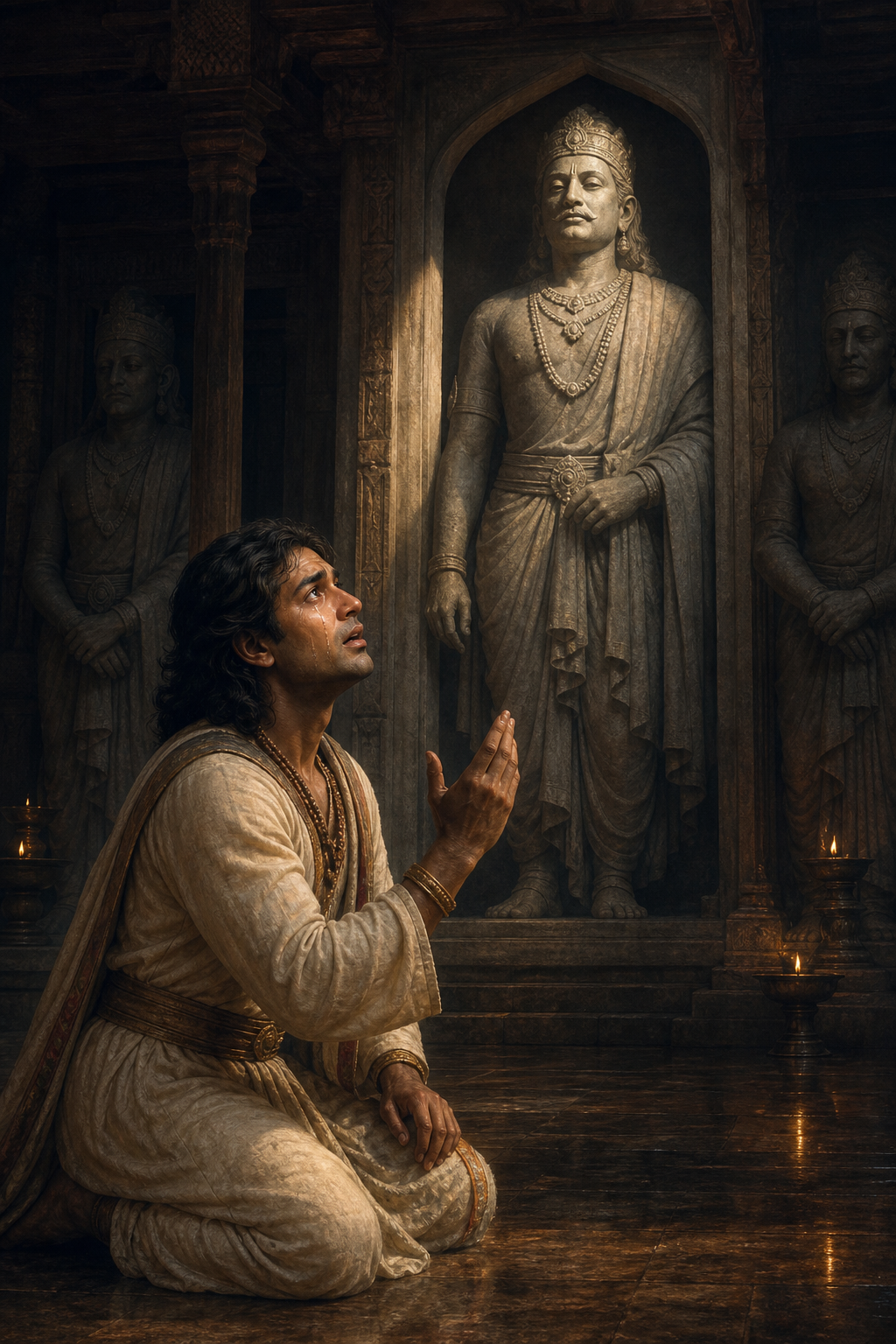
The word pratima directs attention to an image or statue: something visible that represents someone or something not fully present. That gap between presence and absence suits a drama in which decisive actions often reach the stage through their traces.
A statue cannot act, answer, or replace the person it represents. It can nevertheless organize memory and confront the living with a standard. When a symbol becomes prominent, pause before treating it as scenic ornament. Ask who or what is absent, what the representation preserves, and what duty that remembered presence places upon the people who remain.
The emotional design reinforces this symbolic work. Karuṇa, the rasa of sorrow and compassion, gives moral injury its felt weight. Vīra, the heroic rasa, gathers energy around courage, endurance, and righteous action. Bhasa needs both because neither is sufficient alone.
Karuṇa without vīra could leave the audience in passive lament. Vīra without karuṇa could turn the answer to injustice into emotionally empty triumph. Their conjunction teaches a more exact response: feel what adharma has violated, then act without abandoning the compassion that made the violation intelligible.
For a reader, this means tracking changes in emotional demand rather than assigning one mood to the entire play. Mark the moment when grief calls for reflection, when reflection hardens into resolve, and when heroic purpose remains answerable to suffering. Rasa then becomes an interpretive map rather than a label memorized after reading.
For performers, the indirect scenes require precision in abhinaya. A report cannot be delivered as neutral exposition merely because its physical cause occurred elsewhere. Tone, pause, gesture, and the listener’s reaction must carry the absent event’s pressure. Adding a spectacular reenactment or flashback would risk reversing the dramaturgical choice that gives the scene its ethical focus.
Contemporary Hindu, Buddhist, Jain, and Sikh readers may recognize a shared Dharmic vocabulary here: power restrained by law, courage governed by righteousness, truth maintained under pressure, and compassion joined to wisdom. That resonance does not make the traditions interchangeable. It identifies questions they can ask together without erasing their distinct teachings.
Use a five-pass method to read the play closely
You do not need to begin with an elaborate theory of Sanskrit drama. Use five passes through the relevant episode, keeping each pass limited to one question.
- State the underlying event in one sentence. For Sita-harana, identify the narrative change caused by the abduction without yet interpreting the staging. This gives you a stable point against which to notice Bhasa’s choices.
- List what the audience actually receives. Mark direct action, messenger report, recollection, reflective dialogue, silence, and symbol separately. Do not write that a scene contains no action merely because the decisive physical incident is absent.
- Build a dharma ledger for each principal character. Use four headings: obligation, temptation, accepted cost, and consequence. If you cannot fill one heading, return to the character’s speech before making a moral judgment.
- Track karuṇa and vīra. Note where the play asks you to dwell on loss and where it asks you to recognize resolve. Then examine whether the heroic response remains connected to the suffering that called it forth.
- Judge fidelity on two levels. First ask what changed in form: sequence, visibility, point of view, or mode of report. Then ask what happened to the moral axis. A retelling can be formally bold while remaining faithful to the conflict between dharma and adharma.
Three common misreadings to avoid
The first misreading is that an off-stage event must be secondary. In Pratima Natakam, invisibility increases the interpretive burden. The audience must follow consequences instead of relying on the immediate intensity of spectacle.
The second is that Sita lacks agency because the abduction is not enacted before the audience. Agency in this dramatic structure is not limited to physical control over circumstances. Sita’s resolve, speech, and moral clarity govern how she is represented and how the violation is judged.
The third is that dharma means passive obedience. Bharata’s renunciation, Sita’s steadfastness, Lakshmana’s vigilance, and Rama’s constancy all demand judgment and self-command. Dharma may require a person to refuse, endure, protect, or act. The shared element is alignment with righteous obligation, not mechanical submission to whatever power happens to command.
If you are teaching the play, give readers two sheets: one headed “What happens” and the other “How we are made to encounter it.” If you are reading alone, divide a page the same way. If you are preparing a performance, add a third column for the reaction that must make an absent event present.
Before deciding whether Bhasa is faithful to the Ramayana, answer one final question: What has this dramatic form made morally visible that spectacle might have concealed? That question turns Pratima Natakam from a shortened epic narrative into what it is best equipped to be: an exacting encounter with dharma under pressure.
References
