
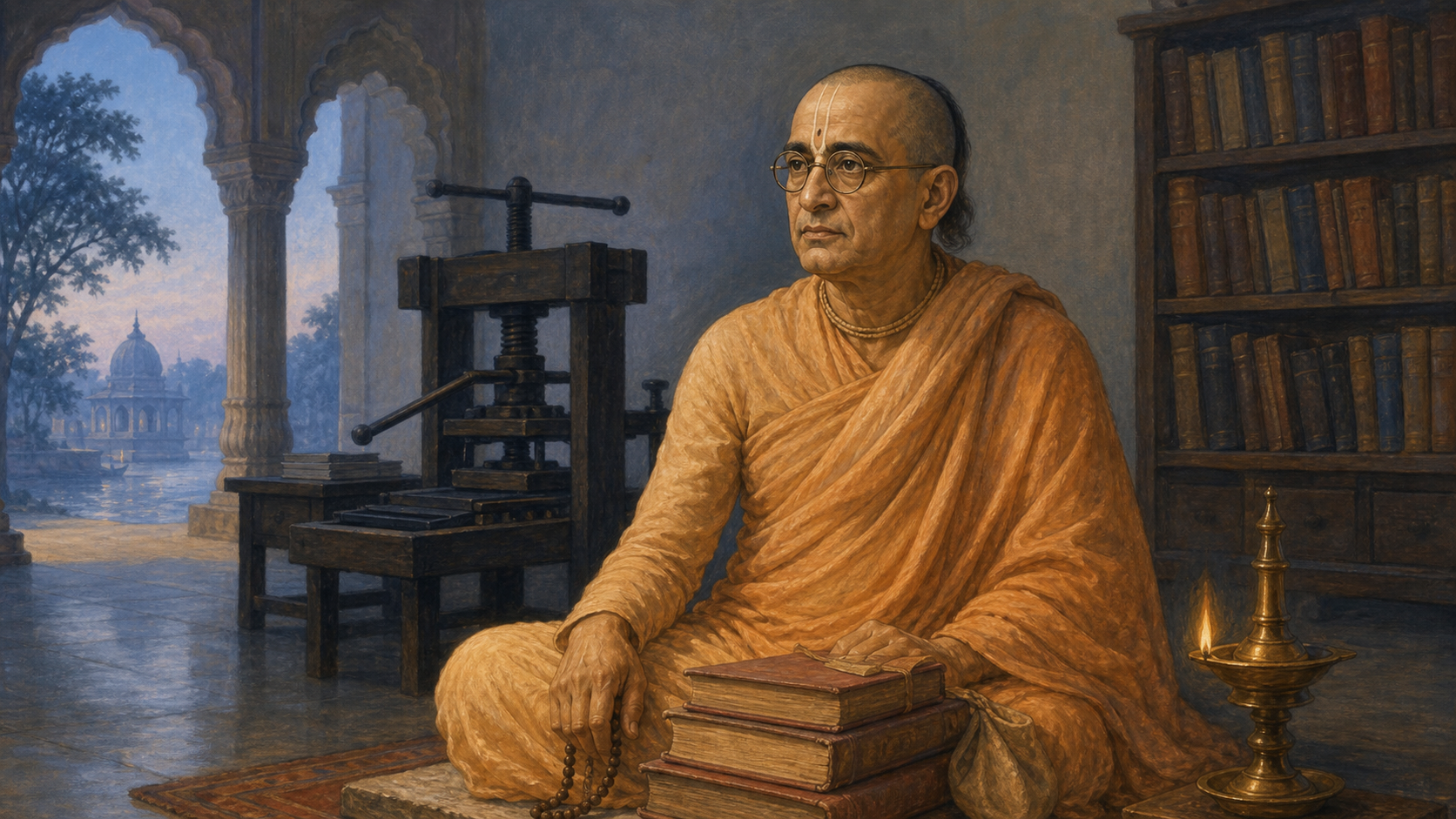
If you want to honor Srila Bhaktisiddhanta Sarasvati Thakur on his Disappearance Day, the hardest decision is not which ceremony to attend. It is deciding how remembrance will change your conduct after the observance is over.
His legacy gives you a demanding but practical test: sincere homage should produce steadier sadhana, clearer understanding, more responsible seva, and greater fidelity to the guru-shishya tradition. The day becomes meaningful when gratitude takes the form of practice.
The day asks for continuity, not nostalgia
In Gaudiya Vaishnava language, a disappearance day marks an acharya’s departure from visible presence. It is therefore solemn, but it is not simply an anniversary of loss. The relationship with the acharya continues through vani: teachings heard, understood, practiced, and transmitted without distortion.
This distinction changes how you approach the observance. Emotion may arise naturally, but emotion is not the only measure of devotion. Ask whether the acharya’s instructions have acquired more authority in your life. If your appreciation remains intense while your habits remain untouched, the remembrance has not yet reached its practical purpose.
Srila Prabhupada described Bhaktisiddhanta Sarasvati Thakur as a liberated soul sent by Krishna and a ray of Visnu. That is a theological assessment from within the disciplic succession, not merely praise for an accomplished organizer. It tells the devotee how to hear him: with reverence, attention, and a willingness to be corrected.
The remembered account of his infancy carries the same devotional meaning. Soon after his birth, Lord Jagannatha’s Ratha-yatra chariot stopped before the residence of Srila Bhaktivinoda Thakur. His mother carried the infant onto the chariot, where a garland from Lord Jagannatha fell upon him. Within the tradition, the event is received as an auspicious sign.
The useful lesson is not to become preoccupied with extraordinary signs. The stronger question is what a person does with divine favor. Bhaktisiddhanta Sarasvati Thakur answered through scholarship, discipline, preaching, publishing, and sustained service to Srila Bhaktivinoda Thakur’s mission. On his Disappearance Day, ask yourself two questions: Which instruction do you already accept but repeatedly postpone, and what regular action would prove that you have stopped postponing it?
His modernizing work was fidelity expressed through new means
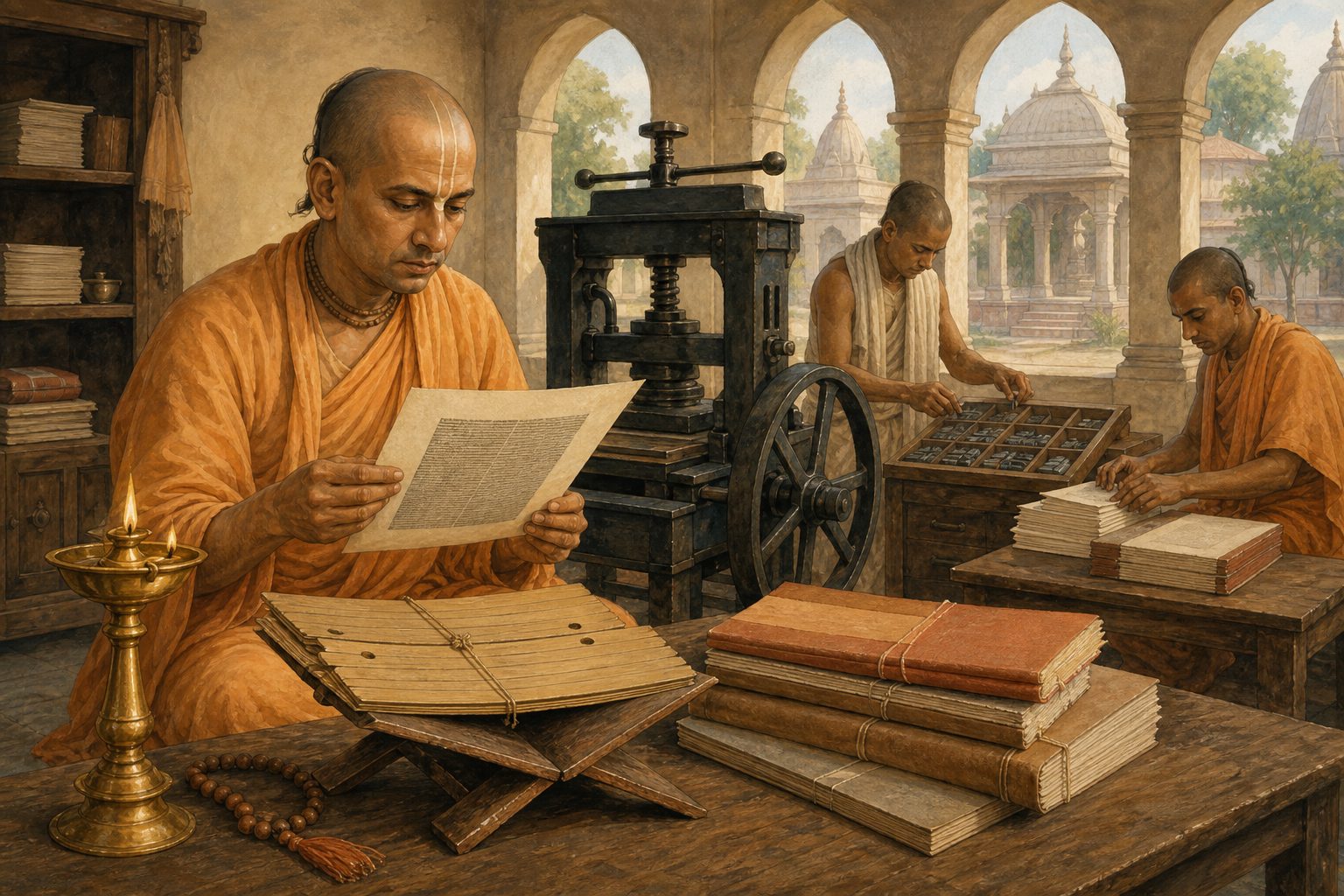
Bhaktisiddhanta Sarasvati Thakur did not preserve Gaudiya Vaishnavism by making it inaccessible. As founder of the Gaudiya Math, a prolific teacher, and a publisher, he brought disciplined study, public preaching, and institutional organization into a coordinated mission. He used the printed word to carry Krishna-bhakti across India, creating intellectual and organizational foundations that later influenced ISKCON and the wider modern bhakti movement.
That history corrects a common misunderstanding. Fidelity to parampara does not require freezing every method at an earlier point in history. It requires protecting siddhanta while selecting forms of communication that can reach the people in front of you. Method may respond to place and circumstance; the teaching must not be bent merely to win approval.
If you publish, teach, manage a temple project, lead a study group, or speak about Dharma online, apply that principle in this order:
- Establish what cannot be altered. Identify the teaching, scriptural basis, and lineage guidance that govern the work before choosing a format.
- Choose the medium for the people being served. Print, video, a messaging group, a website, or a public gathering is a vehicle, not the message itself.
- Build correction into the work. Give qualified people a way to review doctrinal claims, factual errors, and public conduct.
- Measure the result by practice. Attention alone is not success. Ask whether people are being directed toward hearing, chanting, study, service, and principled living.
A modern platform does not become seva merely because it carries devotional vocabulary. It becomes seva when its content is accurate, its conduct is accountable, and its audience is guided toward Krishna rather than toward the personality of the presenter.
Institutions deserve the same scrutiny. Bhaktisiddhanta Sarasvati Thakur’s legacy joins spiritual integrity with responsible organization. A healthy institution helps the teaching outlive individual charisma. Its leaders can explain the doctrinal basis of decisions, correct errors without treating correction as disloyalty, distinguish visibility from spiritual authority, and keep service moving when a prominent personality is absent. If those conditions are missing, commemorative praise cannot substitute for repair.
Keep bhagavata-marga and pancaratriki-vidhi together
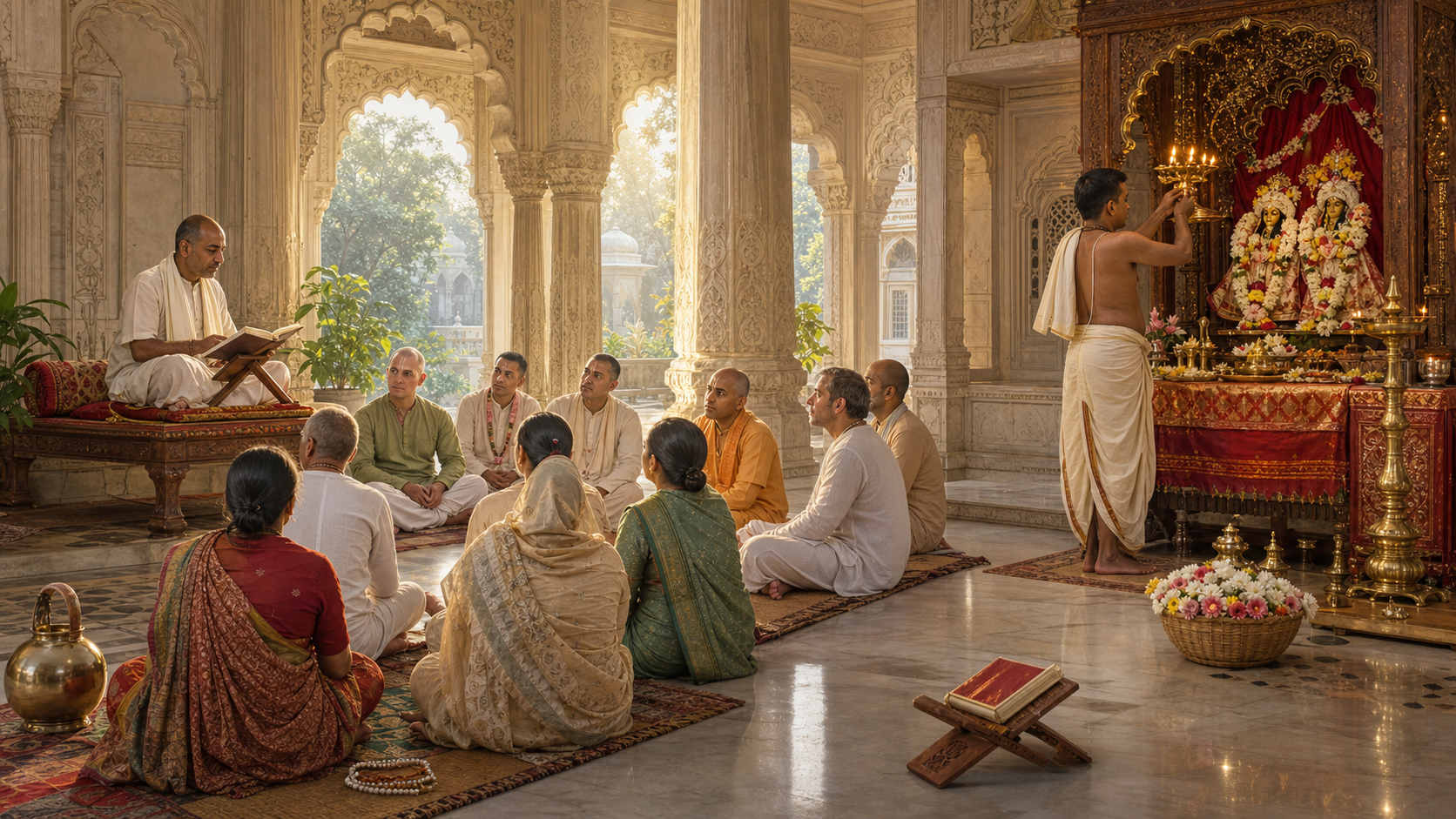
One of Bhaktisiddhanta Sarasvati Thakur’s most useful instructions is the need to practice bhagavata-marga and pancaratriki-vidhi together. In practical terms, bhagavata-marga cultivates heartfelt devotion and realization through hearing, study, remembrance, and absorption in divine teaching. Pancaratriki-vidhi gives devotion disciplined expression through regulated worship, service, and ritual.
These are not rival approaches. Inner cultivation protects ritual from becoming mechanical. Regulated practice protects good intention from remaining vague and occasional. Each reveals weaknesses in the other.
- If you read and discuss extensively but practice irregularly, attach your learning to a fixed act of worship or service. Insight that never enters your schedule is still only an intention.
- If you perform ritual carefully but seldom reflect on its purpose, add deliberate hearing and study. Ask what the practice is meant to purify, awaken, or redirect in you.
- If your private practice is steady but your dealings are harsh, examine whether discipline has produced humility. Ritual precision does not excuse contempt, dishonesty, or careless treatment of other devotees.
- If outreach is active but your own sadhana is thinning, reduce avoidable activity until the foundation is stable. Public service cannot indefinitely borrow strength from a neglected inner life.
- If inspiration is high only on festival days, design the observance around a commitment that survives an ordinary day. The inheritance of an acharya is carried through repetition, not occasional intensity.
This balance also prevents two unhelpful extremes. One turns personal feeling into the sole authority and treats discipline as unnecessary. The other treats correct form as proof of inner realization. Bhaktisiddhanta Sarasvati Thakur’s synthesis asks for both truthful interior work and faithful exterior practice.
Do not improvise lineage-specific rites merely to create an elaborate home program. If you are unsure about the proper form, follow the guidance of responsible Vaishnavas in your temple or lineage. Simplicity performed with understanding is better than complexity assembled without context.
Build an observance that changes the following week

A disappearance-day program does not have to be large to be serious. Whether you attend a temple gathering or observe at home, give each part a clear function. Follow your local temple or lineage calendar for the timing and any prescribed rites; the framework below concerns the purpose and follow-through of the observance.
- Prepare before the program. Read a reliable account of Bhaktisiddhanta Sarasvati Thakur’s life and select a teaching connected to a weakness you genuinely need to address. Do not choose only what confirms your present habits.
- Begin with guru remembrance. State inwardly why you are present: to receive direction, express gratitude, and become more useful in service. This keeps the occasion from becoming cultural attendance without spiritual attention.
- Hear or study with a question. During a lecture or reading, listen for an instruction that can govern conduct. Write it down in your own words and distinguish the instruction itself from the admiration it inspires.
- Chant without turning the practice into a performance. Kirtana or japa belongs naturally in the observance. Give it undivided attention rather than treating it as a transition between speeches and meals.
- Perform concrete seva. Join the actual work required by the community: preparation, cleaning, hospitality, distribution of approved literature, or support for an established devotional project. Choose a need, not a role that merely looks prominent.
- Make a defined commitment. Link the chosen instruction to a cue already present in your routine. For example: after morning worship, read the selected lineage text before opening messages; before publishing devotional material, obtain doctrinal review; after a community program, complete the assigned cleanup before socializing.
- Arrange accountability. Tell a trusted devotee what you intend to change and when you will review it. A private resolution is easy to revise when inconvenient; a clear commitment is easier to examine honestly.
If you are observing alone, resist the temptation to reproduce every feature of a temple festival. A focused home observance can include study, japa or kirtana, respectful remembrance, practical service, and a written commitment. If you are coordinating a community event, protect time for hearing and reflection instead of allowing logistics, introductions, and public recognition to consume the entire program.
The traditional practices associated with this remembrance include study, kirtana or japa, community service, and sincere guru reverence. Their sequence may vary, but their direction should be consistent: from hearing to practice, and from gratitude to responsibility.
Key takeaways
- A disappearance day honors an acharya through continued obedience to his teachings, not through nostalgia alone.
- Bhaktisiddhanta Sarasvati Thakur modernized the means of outreach while protecting the authority of parampara and shastra.
- Bhagavata-marga supplies inward understanding and remembrance; pancaratriki-vidhi supplies regulated form and service. A durable practice needs both.
- The most useful observance ends with a specific commitment, a place in your routine, and a way to review whether you kept it.
The wider dharmic lesson is integration without erasure
Bhaktisiddhanta Sarasvati Thakur belongs specifically to Gaudiya Vaishnavism. Honoring him does not require blurring that identity into a generic spirituality. His life nevertheless offers a recognizable lesson to the wider dharmic family: inward cultivation and disciplined form strengthen one another.
There are structural parallels in the relationship between Buddhist bhavana and vinaya, Jain samayik and vrata, and Sikh simran held within maryada. These terms do not describe identical doctrines or interchangeable practices. They show how distinct dharmic traditions connect inner formation with an ethical or disciplined framework.
This is a better basis for dharmic dialogue than pretending differences do not matter. When learning from another tradition, ask what its discipline protects, what interior quality it seeks to cultivate, and who is authorized to interpret its practices. You can recognize a shared concern for self-cultivation, non-harm, truthfulness, and service without borrowing sacred forms out of context or claiming that every path teaches the same theology.
For Gaudiya Vaishnavas, the immediate responsibility remains clear: preserve Krishna-bhakti through sound teaching, disciplined practice, ethical public life, and compassionate outreach. For other dharmic readers, his example poses a useful question: has your tradition become only an identity you defend, or does it still train the way you speak, work, serve, and restrain yourself?
When the observance arrives, do not judge it by how impressive the program looked. Judge it by what enters your next ordinary day. Put the chosen instruction into your routine, give someone permission to ask whether you followed it, and begin at the next available opportunity. That is how homage becomes succession rather than sentiment.
References
- Dandavats – Srila Bhaktisiddhanta Sarasvati Thakura’s Disappearance Day: Visionary Ray of Visnu, A Legacy
- Dandavats – Honoring Srila Bhaktisiddhanta Sarasvati Thakur: Disappearance Day Reflections from Mayapur
