

You may be asking a precise question: if Vishnu’s incarnations disclose different forms of dharma, why is Parashurama portrayed without a divine consort? Treating his solitude as an omitted romance or an incomplete biography misses the design of the incarnation.
Parashurama stands alone because his narrative concentrates attention on an ascetic mission: discipline power, confront corrupted rule, surrender the fruits of victory, and withdraw. Once you follow that sequence, the consortless portrayal stops looking like an anomaly. It becomes a theological signal about the kind of work this avatar came to perform.
Not every avatar teaches dharma through household life
The mistake usually begins with a rigid comparison. Rama is remembered with Sita and embodies the responsibilities of household life. Krishna’s life reveals dharma through a dense field of family, friendship, devotion, kingship, and social relationship. It can therefore seem that every incarnation of Vishnu should have a corresponding consort occupying the same narrative position.
But the avataras are not repetitions of one template. Each brings a particular dimension of dharma into focus. Rama’s household commitments belong to his teaching. Krishna’s relational complexity belongs to his. Parashurama’s austere and corrective vocation belongs to his.
This difference is not a ranking. Parashurama’s celibate orientation does not make renunciation inherently superior to marriage, just as Rama’s marriage does not make household life compulsory for every spiritual vocation. Grihastha-dharma and renunciate discipline answer different demands. An avatar’s relationships disclose the mission; they are not ornaments added to complete a standard divine portrait.
The better question, then, is not simply, Where is Parashurama’s consort? Ask what his consortless form allows you to notice. It directs your attention away from household continuity and toward vows, mobility, correction, relinquishment, teaching, and penance. He is not an opponent of grihastha-dharma. He simply is not its principal exemplar.
His mission follows a disciplined sequence, not a warrior fantasy
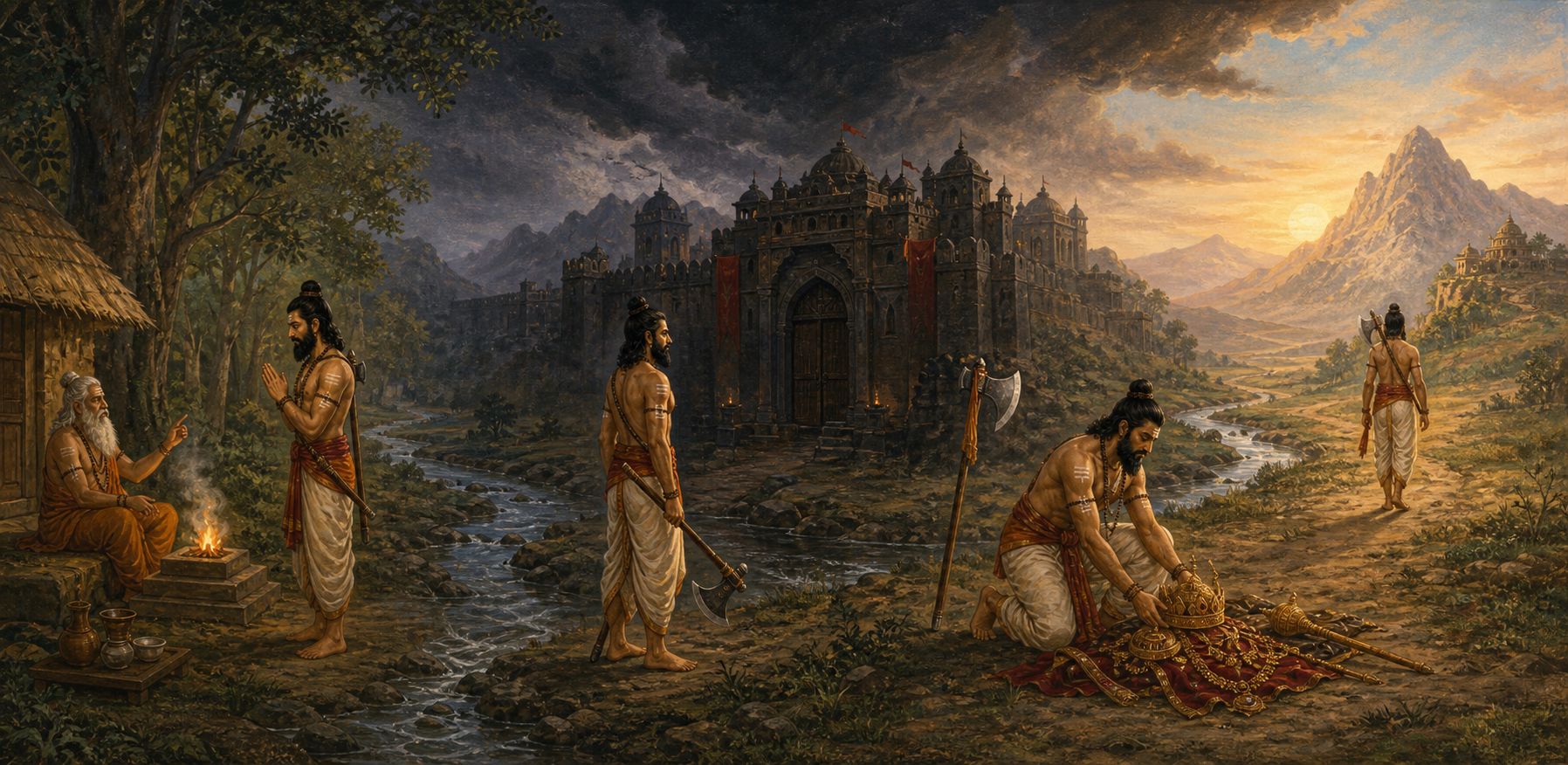
Parashurama is often reduced to the axe and the anger. That reduction removes the restraints that make his power intelligible within dharma. His life is better read as a four-part movement:
- Tapas before and around action: severe vows and austerity frame his strength. Power is governed before it is directed outward.
- Correction rather than conquest: his campaigns answer the abuse of royal power and the disordering of kshatra-dharma. The purpose is restored equilibrium, not permanent personal rule.
- Relinquishment after victory: he gives the reclaimed land to Kashyapa. He does not convert corrective power into a private kingdom.
- Withdrawal when the work is done: he retires to places of penance associated with Mahendra rather than establishing a dynasty at the centre of the restored order.
The order matters. If the story ended with Parashurama enthroned over everything he had subdued, its moral architecture would be different. Instead, action gives way to donation and retreat. The warrior does not claim ownership of the world he has corrected.
This also clarifies his unusual brahmana-kshatriya character. Martial capacity does not stand alone. It remains answerable to learning, vow, austerity, and a purpose beyond personal advancement. The axe cannot be separated from tapas without turning a demanding account of righteous correction into a convenient image of rage.
A vow-centred, mobile life fits that mission. Household dharma ordinarily establishes enduring reciprocal duties, a stable sphere of care, and obligations that cannot be suspended whenever another task appears. Parashurama’s narrative is organised around a different responsibility. His consortlessness keeps the incarnation’s attention on total availability to corrective duty and on the refusal to turn success into lineage, territory, or possession.
That does not mean a family is an obstacle to serious service. It means this particular avatar teaches through another mode. If you cite Parashurama to celebrate force but ignore his restraints, his surrender of land, and his withdrawal, you have retained the weapon while discarding the dharma that governs it.
Shakti is present without appearing as a spouse

A consortless incarnation does not imply an absence of shakti. Within Vaishnava theology, Vishnu’s work is not conceived as independent of divine power, often personified as Sri or Lakshmi. What changes from one incarnation to another is the mode in which that power becomes visible.
In Parashurama’s mission, shakti is expressed through tapas, resolve, disciplined detachment, and moral clarity. These are not decorative virtues. They are the capacities that prevent corrective strength from collapsing into appetite, revenge, or self-glorification.
This role-based interpretation avoids two opposite errors. The first is to conclude that the feminine divine is dispensable whenever no goddess is named beside an avatar. The second is to assume that shakti must always be represented through the same marital arrangement. Neither conclusion follows. Divine power can be disclosed through relationship in one avatara and through concentrated ascetic capacity in another.
We should also keep the type of claim clear. The identification of tapas and moral resolve as Parashurama’s mode of shakti is a theological interpretation of the whole narrative pattern, not a biographical detail announced in one isolated episode. Its strength lies in how well it explains the incarnation’s complete arc: vow, action, relinquishment, withdrawal, and continued guardianship.
When you encounter a divine figure without the relationship pattern you expected, first look for the power that the narrative is emphasising. In Parashurama’s case, the absence of a spouse moves ascetic discipline into the foreground. Shakti has not disappeared; it is operating through the form required by the mission.
Read the tradition carefully, then apply it carefully

A responsible explanation distinguishes three levels instead of blending them into an unsupported certainty:
- The narrative datum: the early accounts associated with the Mahabharata and the Puranic world do not supply Parashurama with a spouse.
- The received portrayal: later retellings, regional lore, and temple traditions regularly understand him as celibate and ascetic.
- The theological meaning: that celibate portrayal coheres with a life organised around tapas, mobility, corrective action, donation, retreat, and instruction.
The absence of a spouse’s name, considered by itself, is not the same thing as a modern historical record proving every detail of a person’s private life. The stronger and more accurate claim is that Hindu tradition has received and interpreted Parashurama as a consortless, vow-centred avatar. The interpretation rests on the direction of his entire life, not merely on silence in one passage.
His identity as a chiranjivi strengthens that reading. Parashurama’s continuing function is associated with penance, instruction, and the guardianship of martial discipline. Epic tradition remembers him as a teacher of figures such as Bhishma, Drona, and Karna. His lasting contribution is not a royal household or a hereditary realm. It is the transmission and regulation of kshatra.
Use his pattern as a discipline, not an excuse
Parashurama’s imagery is easy to misuse because anger is easier to imitate than austerity, and confrontation is easier to admire than relinquishment. Before invoking him to justify a hard decision, test your position with five questions:
- What exactly is the adharma? Name the violated duty or boundary. Disliking a person, group, or authority is not enough.
- What disciplines your response? Identify the vow, ethical limit, teacher, rule, or accountable person capable of stopping you when your action exceeds its purpose.
- What personal gain will you refuse? If intervention brings status, control, territory, attention, or resentment-driven satisfaction, decide what must be surrendered.
- What is the exit condition? Define what restored order would look like and when your intervention must end. Corrective action without an endpoint readily becomes domination.
- Which existing duties still bind you? A solitary self-image does not cancel obligations to a spouse, child, parent, community, or institution. Parashurama’s vocation cannot be borrowed as an alibi for neglect.
These questions translate the narrative’s sequence into moral scrutiny. Anger becomes measured only when it is preceded by discipline, limited by purpose, emptied of personal appropriation, and followed by withdrawal. Remove those conditions and Parashurama becomes a mascot for the ego he is supposed to teach you to overcome.
His solitude should be handled with the same care. It does not authorise contempt for marriage, women, family, or ordinary social responsibility. Nor does it teach that isolation is automatically spiritual. Across the dharmic paths, non-attachment has value because it frees action from possessiveness; it is not a licence to abandon the duties that genuinely belong to you.
Key takeaways
- Parashurama’s lack of a divine consort is best understood as a positive feature of his ascetic mission, not as a missing part of his story.
- Avataras embody different forms of dharma. Rama’s household example and Parashurama’s renunciate example are complementary, not competitors in spiritual rank.
- Shakti remains integral to Parashurama’s work, appearing through tapas, resolve, detachment, and moral clarity rather than through a named earthly spouse.
- His corrective power is bounded by a clear sequence: discipline, action, relinquishment, and withdrawal.
- His example can guide difficult action only when you also accept restraint, accountability, freedom from personal gain, and a definite endpoint.
The next time you meet the image of Parashurama standing alone, follow the verbs rather than stopping at the weapon: restrain, correct, relinquish, withdraw, and teach. If an interpretation skips those movements, it has probably mistaken wrath for dharma. Keep them together, and his solitude becomes neither a deficiency nor a claim of superiority, but the exact form of non-attachment his mission demands.
References
