
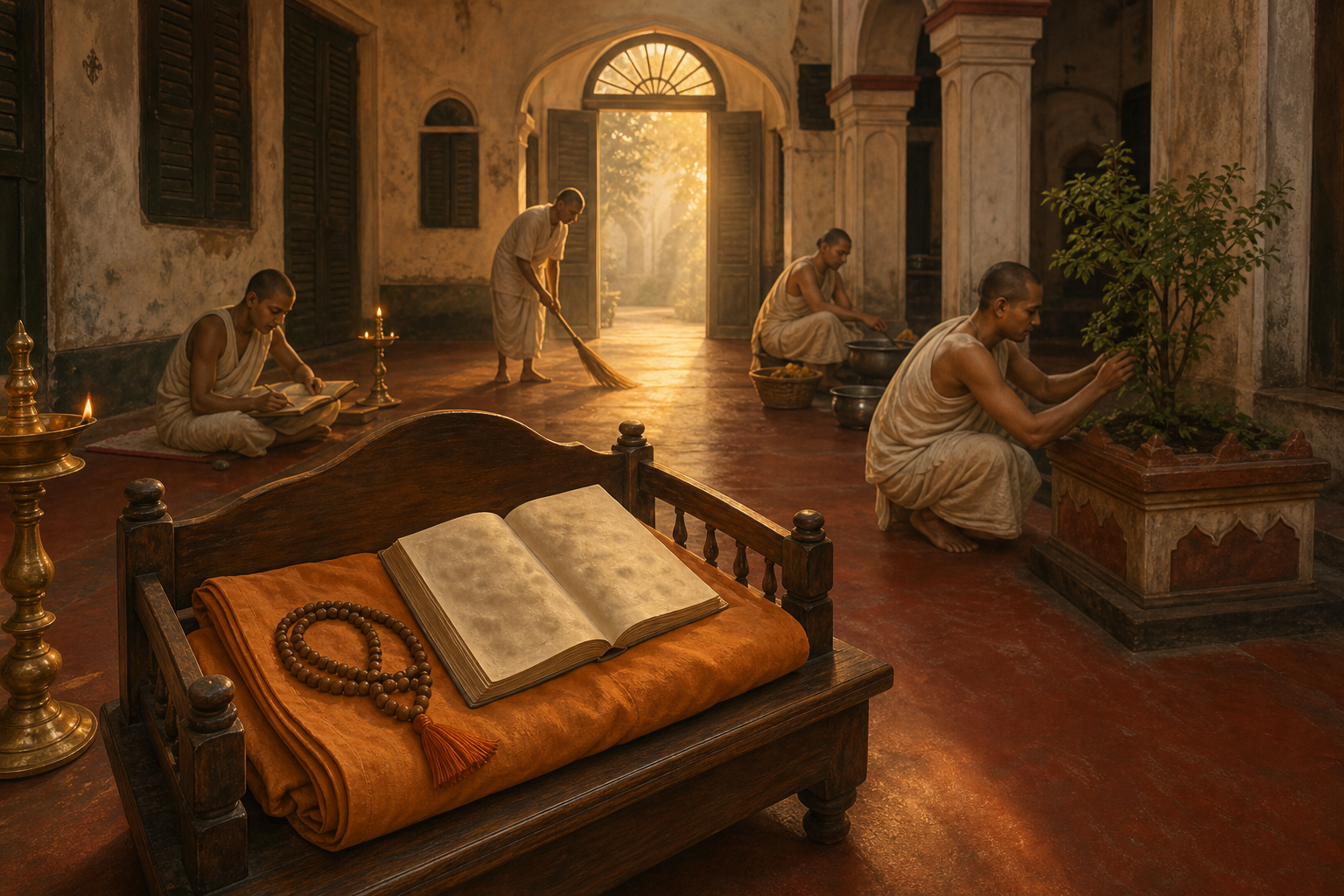
If you want to observe Srila Bhaktisiddhanta Sarasvati Goswami Prabhupada’s disappearance day but are unsure what meaningful remembrance looks like, begin with a demanding question: will anything in your study, conduct, service, or care for the tradition be different because you remembered him?
The day recalls his passing in 1937 at Sri Gaudiya Math in Baghbazar, Kolkata. Yet an observance need not end with a biography, garland, photograph, or ceremonial offering. Its deeper work is to connect reverence with responsibility through disciplined study, sincere sadhana, useful seva, and careful preservation of the lineage entrusted to us.
First locate the remembrance within the living lineage
Many devotees first encounter Bhaktisiddhanta Sarasvati through Srila A.C. Bhaktivedanta Swami Prabhupada and the worldwide growth of Krishna consciousness. That connection is essential: Bhaktisiddhanta Sarasvati was the spiritual master of A.C. Bhaktivedanta Swami Prabhupada, and the guru-shishya relationship links his legacy to ISKCON. But precision matters. A lineage is not a row of interchangeable names, and an institution is not the whole identity of an acharya.
When you prepare a remembrance talk, family discussion, temple announcement, social-media caption, or educational display, establish the relationship clearly. Name Bhaktisiddhanta Sarasvati, identify A.C. Bhaktivedanta Swami Prabhupada as his disciple, and then explain why that transmission matters to the community listening. This prevents a common mistake: repeating honorifics without helping a younger or less familiar listener understand who taught whom, what was inherited, and what responsibility accompanies that inheritance.
Within Gaudiya Vaishnava devotional language, a disappearance day directs attention toward an acharya’s departure from visible presence and the continuing duty of disciples and later generations. That makes remembrance active rather than merely historical. You are not being asked only to admire a completed life. You are being asked to notice whether the qualities associated with that life – humility, learning, disciplined devotion, and service – have a visible place in your own conduct.
A useful test for any commemorative program is simple. A newcomer should leave knowing the lineage more accurately. A practitioner should leave with a question about personal discipline. A community worker should leave knowing what needs to be taught, served, recorded, or preserved next.
Let Baghbazar and Mayapur teach different parts of the legacy
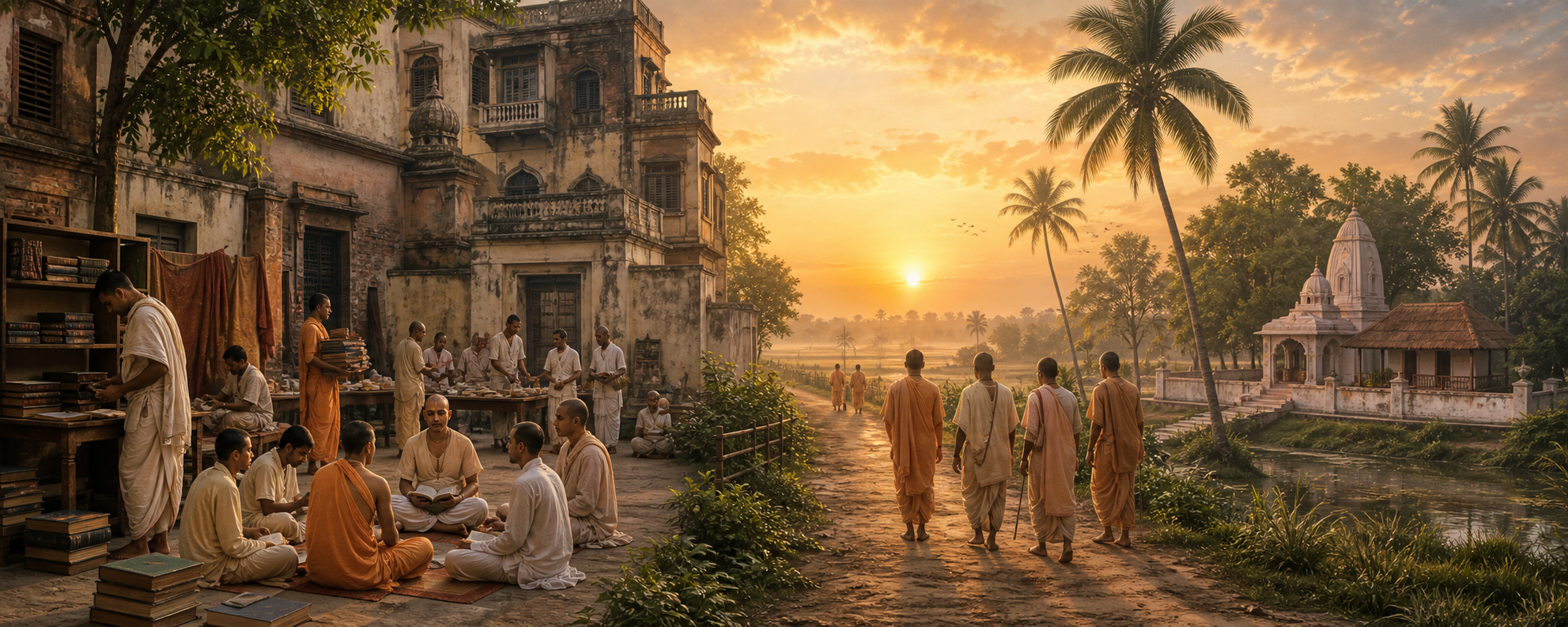
Baghbazar and Mayapur give the remembrance a concrete sacred geography. Sri Gaudiya Math at Baghbazar holds the memory of Bhaktisiddhanta Sarasvati’s final earthly setting. His private room, personal belongings, and the bed on which he departed have been photographically documented, although entry to the room is ordinarily restricted. Sri Chaitanya Math in Sri Mayapur Dham contains his samadhi mandir and is regarded within the tradition as the parent math of the Gaudiya Maths.
These places should not be treated as duplicate stops on a devotional itinerary. Baghbazar draws attention to disciplined daily life, personal austerity, and departure. Mayapur draws attention to samadhi, institutional continuity, sacred memory, and the transmission of learning and service. Holding both together helps you see an acharya not only as an exceptional individual but also as a teacher whose work continues through places, practices, disciples, institutions, and communities.
If you visit Baghbazar, do not presume that reverence entitles you to enter a restricted room. Confirm access with the custodians, follow their conditions, and ask what may be photographed or published. If access is granted, resist the urge to collect images quickly. Notice what the simplicity of the room and the objects of daily discipline reveal about a life organized around sadhana. If access is not granted, accept the boundary without turning it into a grievance; respect for custodianship is itself part of heritage preservation.
At Mayapur, do not let the visit end with a hurried pranam at the samadhi. Learn why Sri Chaitanya Math matters to the wider Gaudiya tradition. Ask how a memorial becomes a place of teaching rather than merely a marker of the past. Sit with the distinction between remembering a person and accepting the duties carried by that person’s lineage.
If you preserve photographs or notes from either place, record context while it is still available. A useful heritage record identifies the location, the object or feature shown, the person or custodian who supplied the identification, the permission attached to the image, and any detail that remains uncertain. Never infer a date, ownership history, or ritual use from appearance alone. When something is unknown, label it as unknown. An honest gap is more valuable than a confident error that later generations will repeat.
Build the observance around study, practice, and accountable seva
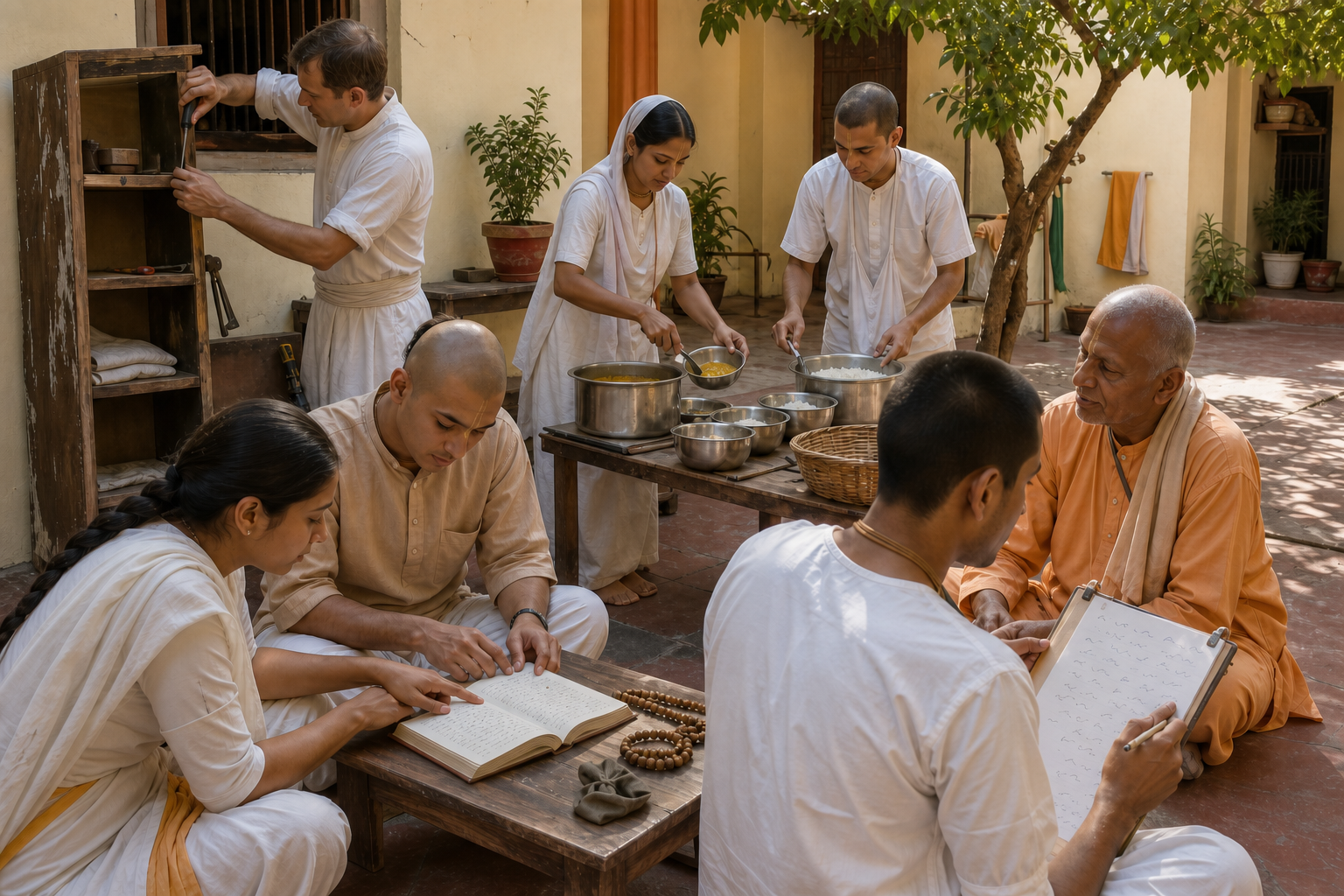
A strong disappearance-day observance moves in a deliberate sequence. It begins with context, passes through attentive study and self-examination, and ends with a service that can actually be completed. You can use the following pattern at home, in a study circle, or as the structure of a temple program.
- Establish the historical frame. State his full name, the 1937 departure at Baghbazar, the samadhi at Sri Chaitanya Math in Mayapur, and the guru-disciple relationship with A.C. Bhaktivedanta Swami Prabhupada. Keep this concise but exact.
- Read from material you can verify. Choose an authenticated teaching or a careful life account available to your community. Distinguish direct quotation from paraphrase and devotional reflection. If you cannot verify a quotation, do not circulate it under the acharya’s name.
- Ask what the reading exposes. Move beyond admiration. Ask where your sadhana has become irregular, where learning has remained unused, where pride obstructs cooperation, or where a duty has been repeatedly postponed.
- Turn the answer into bounded seva. Name the action, the person or community it serves, and the condition that will show it is complete. A vague promise to serve more is difficult to keep; a defined task creates accountability.
- Preserve what deserves to survive. Correct an inaccurate lineage caption, identify unlabeled temple photographs, prepare reliable notes for younger devotees, help catalog a local collection, or obtain permission to preserve an elder’s knowledge. Documentation is most valuable when it remains usable after the person who created it is gone.
- Review the commitment after the ceremony. Ask whether the task was completed, what obstacle appeared, and what should become a regular practice. This review is where annual remembrance begins to change ordinary conduct.
The best seva is not necessarily the most visible. It may be correcting names in an archive, preparing an accurate reading sheet, cleaning a space before others arrive, translating a teaching carefully, helping a child understand the guru-shishya relationship, or finishing an unglamorous task on which a community quietly depends. Visibility measures attention; it does not measure devotional value.
If you are organizing a public program, give participants a concrete next action before they leave. Provide the title of the verified material the group will study, identify the preservation task that needs volunteers, or state the community duty that requires follow-through. A program that generates emotion but no continuing practice may still be moving, but it has left the central opportunity unused.
Keep reverence from collapsing into display or faction
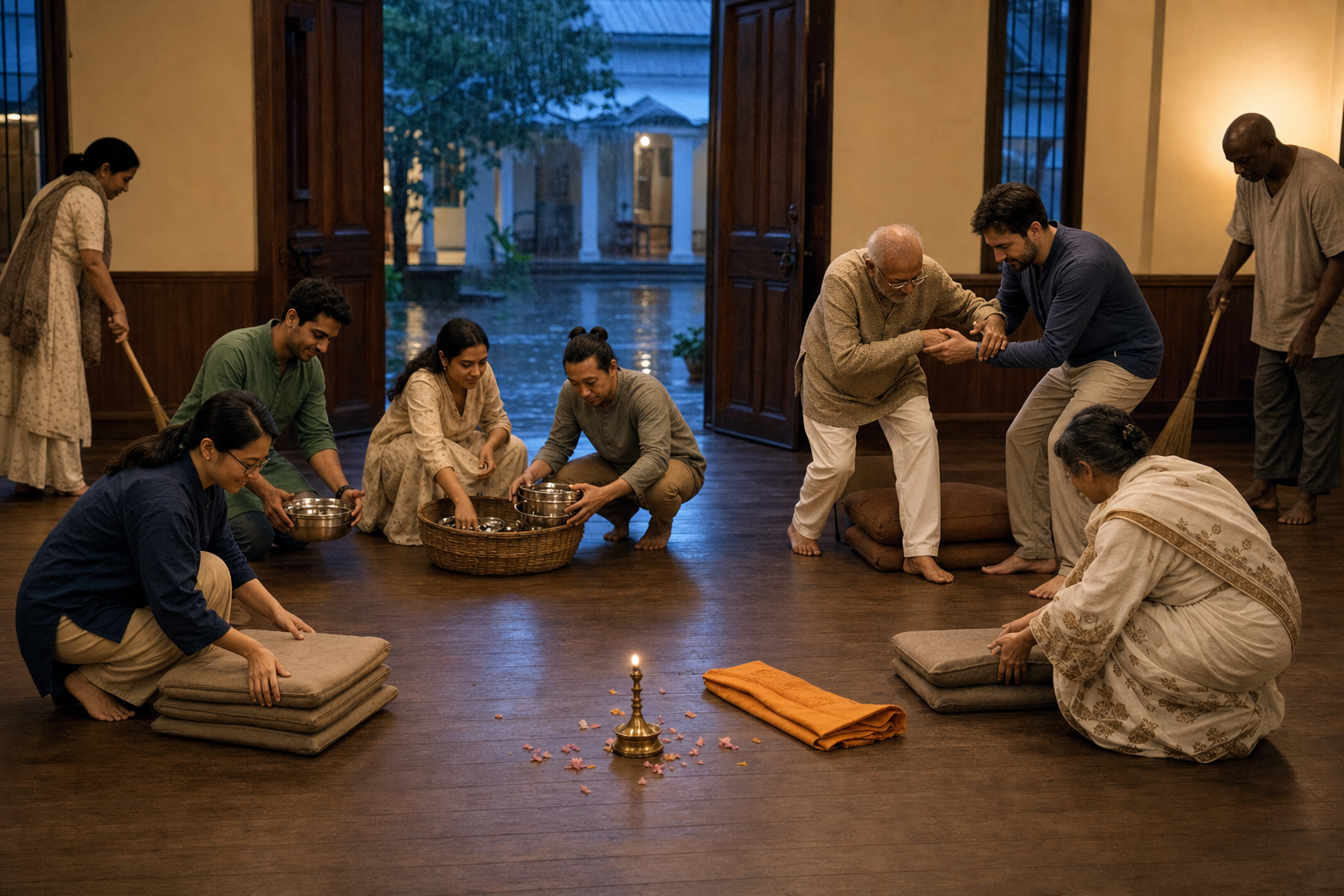
The main risks in remembrance are often not open irreverence. They are forms of reverence that stop at display. You can recognize and correct them before they shape the observance.
- Biography without application: A list of events may inform the listener while leaving conduct untouched. After each important biographical point, ask what quality, responsibility, or practice it places before the listener.
- Sacred tourism without attention: A visit to Baghbazar or Mayapur can become a race for photographs. Decide before arriving whether your purpose is darshan, study, preservation, or some combination, and behave accordingly.
- Personality without lineage: Praise becomes vague when relationships are blurred. Keep the identities of the acharya, disciple, math, samadhi, and later institutions distinct while showing how they are connected.
- Heritage without context: An image detached from a reliable caption soon becomes decorative evidence for whatever claim a later viewer wants to make. Record what is known, identify uncertainty, and retain permission information.
- Unity without specificity: Do not erase Gaudiya Vaishnava theology in the name of broad harmony. Begin with the specific lineage and then identify the shared Dharmic commitments to compassion, self-discipline, and truth-seeking that can support respectful fellowship among Hindu, Buddhist, Jain, and Sikh communities.
- Devotion used for factional advantage: An acharya’s remembrance should not become a contest over which group can claim him most loudly. Preserve institutional distinctions, speak accurately, and let the standards of humility, scholarship, and seva judge the observance.
This balance is especially important for a wider Dharmic audience. Specificity and fellowship are not opposites. You honor the tradition by explaining Bhaktisiddhanta Sarasvati within Gaudiya Vaishnavism, not by dissolving him into a generic spiritual figure. You serve Dharmic unity by showing how disciplined practice, learning, service, and responsible transmission can be recognized across traditions without pretending that all doctrines or institutions are the same.
Key takeaways for the day and the week that follows
- A disappearance-day observance should alter conduct, not only produce a devotional mood.
- Keep the lineage exact: Bhaktisiddhanta Sarasvati was the spiritual master of A.C. Bhaktivedanta Swami Prabhupada, whose work carried the connection into ISKCON.
- Read Baghbazar as a setting of disciplined life and departure, and Mayapur as a setting of samadhi, institutional continuity, and sacred memory.
- Respect restrictions around private sacred spaces. Permission, accurate captions, and acknowledged uncertainty are parts of seva.
- Use verified teachings and quotations. Do not repair a gap in knowledge by inventing certainty.
- Define remembrance through a task with an action, a beneficiary, and a clear completion condition.
- Draw connections with other Dharmic traditions through shared ethical commitments while preserving Gaudiya Vaishnava specificity.
Before the observance ends, write your commitment in this form: because I remember Bhaktisiddhanta Sarasvati, I will complete this action for this person or community under this completion condition. Make the action small enough to finish and meaningful enough to matter. Then complete it before adding another public tribute.
A remembrance day succeeds when devotion leaves a trace: a practice becomes steadier, a teaching becomes clearer, a neglected duty is finished, a younger person understands the lineage, or a piece of sacred heritage is preserved accurately. That is how you keep an acharya from being confined to an anniversary.
References
